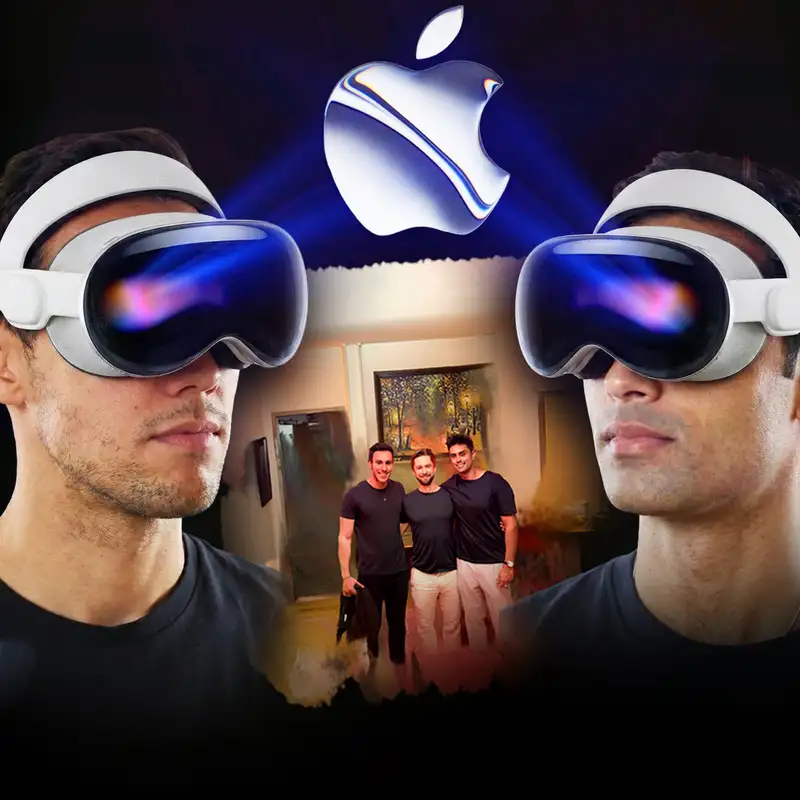
We Stepped Inside a Memory from 2005 (Apple SHARP Gaussian Splats)
Josh:
Ejaz, I've been obsessed with these things called splats for like six months.
Josh:
And just last week, we had a new breakthrough in this revolutionary weird world of 3D imagery.
Josh:
So I want to start with this image that we're looking at on screen right now,
Josh:
because this is, it's pretty unbelievable.
Josh:
And for the people who are just listening, what it is, is there's a dude with
Josh:
the normal backyard and he has a Vision Pro and he has a photo that he took
Josh:
in the past of the same backyard in a different season.
Josh:
And with this new Splat technology, he's able to overlay a previous picture
Josh:
onto a current place and then actually walk through it as if he's able to relive
Josh:
the memory for the first time using these Apple Vision Pro headsets.
Josh:
So it's this unbelievable technology that Apple released just last week that
Josh:
allows you to relive the past in the present in a way that is totally immersive,
Josh:
totally submersive using these things like the Vision Pro or any sort of virtual reality headset.
Josh:
The new technology has some pretty unbelievable examples. So that's what we're
Josh:
going to cover in this episode is the weird world of 3D splats and how you're
Josh:
actually able to turn any photo you've ever taken, any video you've ever taken
Josh:
into something you could actually step into and relive again like it's the first time.
Ejaaz:
Yeah, it's pretty crazy. It looks like he's taken a picture of his garden from
Ejaaz:
December 10th, 2017, when it
Ejaaz:
was snowing and he's kind of transposed it onto his garden in real time.
Ejaaz:
I think the thing that shocked me the most from this, Josh, I did a double
Ejaaz:
take was they have a doctor who prop in
Ejaaz:
here it's like a telephone box who has
Ejaaz:
this in their gun that this is pretty insane um but i
Ejaaz:
saw a more recent example actually of this technology
Ejaaz:
this week um in a slightly uh
Ejaaz:
uh crazy application so uh
Ejaaz:
you might have heard that uh some some epstein files got released uh and some
Ejaaz:
documented footage pictures videography got released and someone decided to
Ejaaz:
splat the entire thing so what you're looking at here isn't a real uh video
Ejaaz:
but rather a series of images which have been splattered to form this kind of
Ejaaz:
like 3D immersive experience.
Ejaaz:
And he was able to generate this in a couple of minutes, which is insane.
Ejaaz:
And to kind of prove to you that this is like a real thing, what you're seeing
Ejaaz:
on my screen right now is a Google Drive of basically all the leaked images from these files.
Ejaaz:
And you can literally click on any of these.
Ejaaz:
Let's go with blue guest room two. and if you press w to zoom in you can now
Ejaaz:
literally zoom in and peek around the entire thing like let's see how close i can go first can
Josh:
You look at what's on the mic oh.
Ejaaz:
My god wait what's under the bed okay we don't know we don't know but like i
Ejaaz:
can't read the title you can really get into it oh i'm under the bed now
Josh:
Oh you're under.
Ejaaz:
Officially under the bed anyway this stuff is is just insane josh and uh this
Ejaaz:
is due to apple shop's model right
Josh:
Yes, this is the coolest thing. So Apple Sharp just released this model last
Josh:
week, which coincided with the release of these files, which created this funny
Josh:
convergence of two technology, or I guess a technology and breaking news at once.
Josh:
But I do want to talk about what splatting actually is because we're saying
Josh:
this funny word a lot. No one actually has a clue what it means.
Josh:
It's basically a way to make a 3D scene by storing it as a cloud of tiny.
Josh:
Soft little blobs instead of building traditional 3D models.
Josh:
So in the past, each as we've all played video games before,
Josh:
it requires a large machine to run them because it's a lot of textures and polygons.
Josh:
And there's just a lot of detail required to render fidelity with what these
Josh:
blobs do, what these splats do is each blob.
Josh:
It's kind of like a puff of spray paint and it's floating in 3D space.
Josh:
And then every puff has a position, size, shape, color and transparency.
Josh:
So to render an image from any viewpoint the computer
Josh:
projects all those puffs onto your screen and then blends them together
Josh:
like layering this transparent paint so it's much more efficient
Josh:
than the previous way of doing this which is
Josh:
lots of crazy rendering lots of compute required
Josh:
and if you were to create something like we're showing on screen now which
Josh:
is an example of 3d skulls that are sitting with dynamic
Josh:
lighting and it looks really real it's something you'd see in a video game you
Josh:
would normally have to render that overnight it would take forever to
Josh:
do but what this new splatting technology does and what apple's ai
Josh:
model does is it allows you to take this high fidelity
Josh:
rendering and turn it into a splat by using
Josh:
these blobs and that way you could render it as a single asset
Josh:
on something as light as your smartphone so it turns these really detailed complicated
Josh:
compute 3d images into something very simple so simple in fact that you can
Josh:
actually do it yourself you can make images yourself you can do this for your
Josh:
own content and you can do it for free almost instantly. It's really cool.
Josh:
And this is thanks to Apple's new Sharp model that they released last week,
Josh:
which is open source, which allows people to go around and play with it themselves,
Josh:
which I think is a really cool new paradigm for this technology.
Ejaaz:
So the way I'm thinking about this, Josh, and correct me if I'm wrong,
Ejaaz:
is if I take a 2D image, right, it's 2D and it's composed of a bunch of pixels, right?
Ejaaz:
If I use this splat technology on that image, it turns every one of those pixels
Ejaaz:
into a kind of like 3D object, which is why like these skulls,
Ejaaz:
for example, isn't a video of like the skulls from all different orientations.
Ejaaz:
It's like a couple of pictures of these pile of skulls or even maybe an AI generated
Ejaaz:
image or whatever and it's
Ejaaz:
splattered into these like 3d blobs and i can now kind of like maneuver around
Ejaaz:
it and look around is that kind of roughly on the right track
Josh:
Yeah and it's funny you'll notice with like the epstein examples
Josh:
there actually is a lot of fidelity in the way that it's rendered so if you
Josh:
look at a video game in the past that you've played normally you'll look at
Josh:
the details and it's very fuzzy it doesn't look very real because the computer's
Josh:
trying to save rendering of compute for the things that you're actually looking
Josh:
at that matter but these scenes that use this new technology They look so photorealistic
Josh:
because you're essentially repainting the world from these millions of soft dots.
Josh:
And it's fast because rendering is mostly throw blobs onto a screen efficiency
Josh:
rather than heavy 3D geometry or this like slow ray tracing that you're seeing on a computer.
Ejaaz:
Got it. And so the number one question that pops into my head then would be,
Ejaaz:
well, what's the cost difference for like doing this in the traditional way
Ejaaz:
versus like in the current splatting way?
Ejaaz:
And how long does this take? We got this tweet by Brad Lynch who tried out this this Apple software.
Ejaaz:
And he said he generated what we're looking at on the screen right now,
Ejaaz:
which is, I think it's an image of him sitting by like an open ocean and like,
Ejaaz:
you know, he's got his Apple Vision Pro on and he's like kind of peering around
Ejaaz:
and he's in his living room. He's moving the images side by side.
Ejaaz:
And it made it, it took him 10 seconds to generate this on his MacBook Pro.
Ejaaz:
And I'm assuming because he used Apple Sharp, which you just said was open source,
Ejaaz:
it's the cost of downloading the software and just running that on your computer.
Ejaaz:
Is that, Do I have that roughly correct?
Josh:
It's totally free. It's totally open source. And it is totally available for users of any computer.
Josh:
I mean, you could render it on a laptop. You could render it on a phone.
Josh:
You could do this instantly, anytime.
Ejaaz:
Hold your horses, Josh. If you're saying that, that means we should do this ourself, right?
Josh:
Perhaps we should do a demo for the audience.
Ejaaz:
Let's not take his word for it. Let's do this ourselves.
Josh:
Let's do it ourselves. We're going to do it live here.
Ejaaz:
Yes, we have the Apple Shop kind of software here. We're going to upload an image.
Ejaaz:
Let me see if I can find a convenient image of Josh oh what do you know
Ejaaz:
what do you know i have it here i'm curious how long this is gonna take look
Ejaaz:
at us good looking gentlemen on the screen we look good in 2d i would love to
Ejaaz:
know how good we look in 3d and
Josh:
That's the fun thing too is if you have like loved ones or your children or
Josh:
people who are younger you could really freeze these moments in time special memories special trips.
Ejaaz:
You've gone we're done josh by the way sorry oh my god before i even finish
Ejaaz:
my explanation we're done okay here
Josh:
We are let's see this walk me through.
Ejaaz:
The picture here oh it's like a watercolor effect you can see it materializing
Ejaaz:
oh it's rendering oh this is weird this is weird i'm zooming in oh wait i need
Ejaaz:
to oh my god wait can we oh my god i can see you from like above yeah
Josh:
Wait try to go closer and get.
Ejaaz:
In deeper wait hang on let me get in deeper let me get into this face get
Josh:
Up in our faces.
Ejaaz:
Wait how do i how do i like zoom oh my god oh oh so we can like see us from
Ejaaz:
the side too that's wait that's pretty crazy david's face is a little warped
Ejaaz:
david's the guy the less handsome guy uh in the center um our arms are looking
Ejaaz:
pretty good we're going to the gym oh we could look at us from above as well that's pretty get in
Josh:
There scroll into the image i'm.
Ejaaz:
Trying i'm trying to sorry i don't i don't mean to zoom into
Ejaaz:
our crotches here but uh this is the this is the furthest i can go in which
Ejaaz:
i'm kind of upset about hang on maybe if i maximize oh wow okay that that does
Ejaaz:
look better oh my god well what i'm impressed with here josh is number one how
Ejaaz:
quick that took to take it's funny on the screen it said uh it gave us a countdown from 60 seconds.
Ejaaz:
And it ended up producing the entire rendering that we're looking at right now
Ejaaz:
with 47 seconds to go. So it took 15 seconds to make.
Ejaaz:
And I'm touching my laptop right now. It is not warm at all.
Ejaaz:
So I'm assuming it didn't cost anything energy-wise as well.
Ejaaz:
Also, the fidelity of this, Josh, is actually really, really good.
Ejaaz:
It's way better quality.
Ejaaz:
I mean, I think I look a bit kind of out of it. I look like I've had a few drinks.
Ejaaz:
Maybe I did on the night, actually. But it looks really good.
Josh:
Yeah, it's impressive how quickly it's able to render this and how low cost
Josh:
it is and how lightweight it is. I mean, you could just run this in a browser very simply.
Josh:
It's not a very compute intensive thing. And it's really cool.
Josh:
So this is an example of a photo.
Josh:
There are three kind of tiers to the splatting. There's the photo first.
Josh:
And then second is this in between before we get to videos, which is this example
Josh:
that you're seeing with Casey Neistat's studio.
Josh:
Now, a lot of people who watch YouTube, they know Casey Neistat.
Josh:
They love Casey Neistat.
Josh:
And this is the most iconic place in the world of Casey.
Josh:
What the meta team has done is actually go
Josh:
through and create a giant splat of the studio so that
Josh:
anybody with a vr headset can actually put the headset on and walk
Josh:
around it now what we're looking at on screen it looks like it's an
Josh:
actual video of the studio but the reality is is that it's one
Josh:
large splat and it is a full fidelity
Josh:
splat so if you put on goggles and you walk through
Josh:
the space you can actually go and read the bindings
Josh:
on the books you can like walk up to all
Josh:
the shelves and peer at all the little things all the little trinkets that
Josh:
are on them it is a full and total high fidelity
Josh:
scan of the studio but in a very lightweight way if you used to try to do this
Josh:
you would need a supercomputer to render this and you need a supercomputer to
Josh:
run it you couldn't even do this on goggles that would be like disconnected
Josh:
from a computer now thanks to this new technology you can scan real places into
Josh:
the cyberspace and it's kind of acting as that,
Josh:
almost like a preservation technique, where if there's a place that you love,
Josh:
if there's a place you want to remember, you can actually scan it and then relive in that forever.
Josh:
You can capture this place in its full fidelity, exactly how it is today.
Josh:
And I thought this was a really cool example.
Ejaaz:
I mean, what I find super cool about this is like in the traditional way,
Ejaaz:
you would have to take a million pictures and stitch them all together,
Ejaaz:
which would have taken you hours and hours and efforts and probably a bunch
Ejaaz:
of people to get involved to help you produce.
Ejaaz:
Also, I like that it's to scale as well, Josh.
Ejaaz:
Like a lot of these simulation kind of videos or games that I've tried with
Ejaaz:
Apple Vision Pro and stuff like that just seems kind of unrealistic.
Ejaaz:
Obviously, like maybe you're playing a fantasy game or something.
Ejaaz:
This is like to scale. It's like you're walking through, you're not going to bump into anything.
Ejaaz:
I just think it's awesome. But then the natural question that pops into my mind
Ejaaz:
is, well, can you do this with video?
Ejaaz:
And I think, you know, we had our answer a few months ago earlier this year
Ejaaz:
when this viral tweet went about of this guy who's kind of like directly speaking to a camera.
Ejaaz:
But you can see in this video that someone's navigating around him.
Ejaaz:
And this is just like, you know, a 2D video taken head on of this man sitting down in his chair.
Ejaaz:
And he is able to navigate around him in every single different type of direction.
Ejaaz:
You can peer at him at a kind of like angle perpendicular to him.
Ejaaz:
You can see kind of like the way that his jaw looks like. And this is all generated
Ejaaz:
through splats. None of that is real.
Ejaaz:
None of that was actually filmed with a camera to the side of him.
Ejaaz:
This is all generated via splats. Super cool.
Josh:
It's fun to think of...
Josh:
When you capture things to think of your camera as a paintbrush or
Josh:
maybe even a can of spray paint like we were talking about earlier
Josh:
where if you can just capture the smallest amount
Josh:
of detail of a specific part of an image you can then
Josh:
render it all fully in a 3d way like
Josh:
we're seeing another image here where you can zoom in on the video you can pan
Josh:
left and right and that's because it was kind of scanned like it was this can
Josh:
of spray paint you you want to kind of spray paint things and then you could
Josh:
relive them and capture them and i think it's such a cool new paradigm where
Josh:
they're driving through the city streets or they're watching someone dancing
Josh:
or whatever these examples are.
Josh:
If there's something in your life that you want to capture, you can just do it and then relive it.
Josh:
And this is particularly interesting if you're a user of iPhone,
Josh:
because Apple's really the company who has been leading the charge of this.
Josh:
And if you use an iPhone, you're aware of the camera sensor,
Josh:
right? How they're kind of lined up.
Josh:
And when you shoot a video using these top two, you actually give real 3D spatial depth to it.
Josh:
And that's also because there's a lidar scanner on the bottom of the camera as
Josh:
well so apple has all the tools here built in to
Josh:
create the highest fidelity splats possible and now they're rolling out the
Josh:
software to enable that to happen even more so on these handheld devices that
Josh:
we all use it's like i guess the last example is it's kind of like if you take
Josh:
a black and white photo you could add color to it this is taking a two-dimensional
Josh:
photo and adding a third dimension to it and that's a really cool unlock my.
Ejaaz:
Mind naturally goes on to um like applications like what can i use this technology for.
Ejaaz:
And I think through a bunch of the examples that we've shown so far,
Ejaaz:
it's kind of cinematic and maybe even veered towards gaming as well.
Ejaaz:
Hollywood is the instant industry that I think of that I'm like is going to
Ejaaz:
get completely run over by this, right?
Ejaaz:
I know for a fact that they spend months, in some cases years,
Ejaaz:
to render a single visual splat that we've been looking at throughout this entire episode.
Ejaaz:
And so I think that this is going to cut costs down by like tens of millions of dollars.
Ejaaz:
And it is going to cut time down and even jobs as well. I know they have teams
Ejaaz:
of different people with different skill sets to stitch all the images together,
Ejaaz:
to get the right grading, lighting, to like post-processing of a bunch of these
Ejaaz:
images and then kind of make these visuals.
Ejaaz:
There's no way that this doesn't get disrupted by it. It also got me thinking
Ejaaz:
of one of my favorite shows on Apple.
Ejaaz:
Finally, we're talking about Apple and now they have this. Like one of their
Ejaaz:
hit shows is Severance, right?
Ejaaz:
And I remember season two, they have this like crazy scene where like we've
Ejaaz:
got the camera panning around him in all different kinds of ways.
Ejaaz:
And Ben Stiller had an interview on this where he said each episode costs roughly $20 million to make.
Ejaaz:
And this particular scene alone costs $10 million.
Ejaaz:
Now, if he had something like a splat technology, right, he could generate this
Ejaaz:
in a couple of minutes or even under a minute, like we showed ourselves earlier on. And for a fraction.
Ejaaz:
Of the cost it just it just it's a no-brainer for me josh
Josh:
Yeah i don't want to say that hollywood is
Josh:
under attack but they are definitely in need
Josh:
of rapid innovation quick because this is
Josh:
a second front that there is being disruption on we
Josh:
had we talked about google's vo3 and all the video generation
Josh:
models how well they understand the world how good
Josh:
they're able to generate video now this merges that
Josh:
gap where you can actually take the real world
Josh:
but you could capture it much more efficiently than you ever have before and
Josh:
much more fully which creates a lot more dynamic optionality
Josh:
for these shots so if you can't create it
Josh:
in the real world using a splat well then you can create it in the digital world
Josh:
using ai and what i understand is that people
Josh:
in hollywood they're already starting to use stuff like this where they are
Josh:
capturing things once instead of 10 times and they're using ai they're using
Josh:
splats to just kind of massage the scene to get exactly what they want if it
Josh:
wasn't perfect on that first try and it just saves a huge amount of money But
Josh:
there are more use cases for this.
Ejaaz:
Yeah, so you put this one in the dock, Josh, of a Swiss glacier collapse in 4D.
Ejaaz:
Is this, like, can Splats be used as, like, a prevention model for these kinds of things?
Josh:
Yeah, so earlier this year, there was a big landslide in the Swiss Alps,
Josh:
and it took out an entire village, and it was very dangerous.
Josh:
It created a very uncertain situation.
Josh:
Times because it's hard to access that area and people didn't know what was affected.
Josh:
So a helicopter came through with a big camera array and it just swept the whole
Josh:
valley. And you could see on the video the before and after.
Josh:
And they captured this incredibly high fidelity splat up the valley.
Josh:
They could then diagnose immediately what areas were most in danger,
Josh:
what areas needed the most help, how much danger there actually was.
Josh:
And they were able to observe all of the things at any time without needing
Josh:
a specific video feed of a specific area. So let's say you were looking at a
Josh:
specific location on the mountain.
Josh:
Well, you could just pause the splat and you could zoom in on that one area,
Josh:
even if you didn't capture it with a video camera.
Josh:
So there's a lot of utility for these outside of just entertainment.
Josh:
There's also safety and other things like this.
Josh:
I just thought it was a fun example of a real world use case that actually happened earlier this year.
Ejaaz:
Love it. It's been a longtime dream
Ejaaz:
of mine to go to Japan, and I've been fortunate enough to go a few times.
Ejaaz:
And I'm going again next year. And I kind of thought about like,
Ejaaz:
how do I share this experience with different people?
Ejaaz:
And I spotted this one, Josh, where it's a tweet that goes, we've made it possible
Ejaaz:
to walk through the hot spring town of Yamagata, Ginzan's Onsen with an avatar.
Ejaaz:
And this is like a real life rendering. And it looks like a game because,
Ejaaz:
you know, it's been generated one of using a splat machine or splat model.
Ejaaz:
It is to scale. These are real life shop fronts and stores and homes and streams.
Ejaaz:
But obviously, it's like a simulated game environment. And it got me thinking
Ejaaz:
like, this looks like something out of GTA, Josh, right?
Ejaaz:
And I'm thinking like, this would change the way that you create simulated realities.
Ejaaz:
Like imagine the Sims game, but using real life worlds, and it can be generated
Ejaaz:
in real time to reflect different kinds of people, personalities and shops.
Ejaaz:
Like imagine if New york city was updated every
Ejaaz:
single second or day or every hour uh to
Ejaaz:
reflect accurate goings-ons in that city i just think this changes gaming forever
Ejaaz:
right because one of the things that i loved about gaming is that uh it had
Ejaaz:
kind of like a preset story but then when you got to the end of the story i
Ejaaz:
was like damn i can't i now have to wait like a year or two years until the
Ejaaz:
second one comes out gta what is it five or six which one have we been waiting on for
Josh:
Oh we're waiting on six.
Ejaaz:
Six right so we've been waiting
Josh:
For like 12.
Ejaaz:
Years 12 years over a decade for this game
Ejaaz:
now you can get the second game or the third game or the fourth
Ejaaz:
game or the fifth game immediately if we had these kind of
Ejaaz:
generated simulated realities but
Ejaaz:
it kind of like i played this out in my head josh um
Ejaaz:
the end game for these splats surely has
Ejaaz:
to be world models right world models um is supposedly going to be a big trend
Ejaaz:
next year in ai models where you create these simulated realities or environments
Ejaaz:
of the real world that we live in today and you stick in an AI agent or an AI
Ejaaz:
model to kind of generate synthetic data.
Ejaaz:
So it lives out its life and it kind of figures out how humans perceive things.
Ejaaz:
Aren't splats just world models?
Josh:
They're not actually. I think splats, you can think of a splat kind of like
Josh:
what a neural link is to the human brain and AI.
Josh:
A splat is kind of like to the physical world and the virtual world.
Josh:
It's the bridge that combines the two together.
Josh:
So what we just saw in that last example is,
Josh:
you're able to walk through Japan and capture it with the camera and then merge
Josh:
that real world data into cyberspace.
Josh:
And if it was a world builder, it would just kind of create these virtual worlds.
Josh:
So what I see is kind of the way this goes would ideally be a combination of
Josh:
the two where splats are unbelievably efficient and are easy to capture the real world with.
Josh:
And then you could take an AI model, a world model, and you
Josh:
could apply extra fidelity on top of it depending on how much compute
Josh:
you have so you could think of the splat as
Josh:
a way of scanning the real world into the digital world and then
Josh:
the ai world models are a way to increase the fidelity
Josh:
using neural nets to predict what should be there
Josh:
to fill in all the blank spaces and to make it feel
Josh:
like more of a a real world plus experience
Josh:
so if you were walking through your childhood house and you were scanning it you
Josh:
can take a low or a high res but not totally high res version with a splat and
Josh:
then use ai to enhance it so then you can actually capture this place that's
Josh:
special to you and relive it forever using this cool new technology so this
Josh:
very much feels like a bridge into this future hybrid between the real world
Josh:
and the digital space okay.
Ejaaz:
That makes sense so if the mission is to help ai understand humans in all forms
Ejaaz:
of the way that they sense things the way that they perceive things sight um
Ejaaz:
audio visual stuff um instead of like relying on them to kind of generate it
Ejaaz:
from a bunch of data that we feed them,
Ejaaz:
we can kind of take our reality and surroundings, compress it into this splat
Ejaaz:
model, and then feed that into an AI model, a world model,
Ejaaz:
a simulated reality that they're kind of operating in.
Ejaaz:
And they'll have a more accurate depiction of how humans perceive the world,
Ejaaz:
which will then accelerate us to whatever the hell AGI is going to end up being.
Josh:
Yeah, it's like if you played with like Nano Banana Pro, for example,
Josh:
and you added an image that was old, and maybe it was a black and white image
Josh:
that was very low quality it can add color and it can make it feel more high
Josh:
quality that's kind of what this does before for more virtual spaces.
Ejaaz:
Well, what I like about that is we're just going to end up with an abundance
Ejaaz:
of data and data has been lacking.
Ejaaz:
I think at this point, every single model has been trained on the same corpus
Ejaaz:
of data and we need to start tapping into private buckets of data to add kind
Ejaaz:
of value or intelligence to an AI model.
Ejaaz:
This kind of bypasses that entirely
Ejaaz:
and creates this kind of synthetic but really accurate environment.
Ejaaz:
That's super cool. And then like in terms of like the end game here,
Ejaaz:
Josh, like do you think Apple is going to forge the path here?
Ejaaz:
Has Apple somehow dug themselves out of the grave or rather dug up themselves
Ejaaz:
out of the grave that they've kind of left themselves? They haven't been involved in AI or anything.
Josh:
No, they haven't been. And this is not by any means a real attempt at AI.
Josh:
This is kind of a separate thing.
Josh:
This is in regards to their vision platform. This is kind of like what the future of compute is.
Josh:
Everyone's building a pair of glasses. We have Meadow. We have Google now.
Josh:
We have, I'm sure Microsoft is working on HoloLens.
Josh:
Apple is the Vision Pro. everyone is working on this new spatial compute platform.
Josh:
Apple is definitely furthest along this path and granted the Vision Pro gets
Josh:
a lot of hate because it's very expensive it doesn't have a lot of use cases
Josh:
but what you're seeing here is an early prototype for what the future of this
Josh:
compute will look like when applied to actual consumer products.
Josh:
So if you scroll down to one more beneath this there's a really fun example
Josh:
where we take the splats that were mentioned that we mentioned in the video
Josh:
and you can actually put them and pin them on your wall in your apartment.
Josh:
So as you walk through the real world, you're able to pin these photo frames
Josh:
and it has the splat built in so you could walk and actually look into the photo
Josh:
and relive that experience.
Josh:
There's some other examples that they have where they've pinned widgets on the
Josh:
wall and as you walk into your apartment, these widgets that are like a calendar
Josh:
will just be present on your wall.
Josh:
And again, it's this merging of the digital and physical worlds and it looks
Josh:
real. It looks like it's embedded inside the wall. It's kind of embossed in.
Josh:
But what this leads to is this merging. It's this...
Josh:
Combination of digital and physical through these augmented glasses
Josh:
that we're going to get and splats are a really important part
Josh:
of that so when apple open sourced their model earlier this week that
Josh:
was a really big deal because it allows other developers to also lean into
Josh:
this and you could see even in this example you could scan in people's faces and you
Josh:
could speak to them in real time as if they were sitting right in front of you so it's
Josh:
this this fun entry into the metaverse and this is almost what i wish i saw
Josh:
meta was doing because meta being their new name meta they should be leaning
Josh:
into building some sort of a metaverse which is the combination of these two
Josh:
worlds and it seems like apple's actually the furthest ahead and this is kind
Josh:
of what it'll look like when it's implemented across consumer products as we go it.
Ejaaz:
Looks like something out of star trek or star wars um like you know you got
Ejaaz:
this holographic simulations of people speaking to you i think um
Ejaaz:
A major trend that's helped us get to what we're looking at today in front of
Ejaaz:
us and make all of this feasible is just massively reduced costs of things.
Ejaaz:
Like we've just spoken about like the cost of producing a splat or like a Hollywood
Ejaaz:
traditional version of this would have cost tens of millions of dollars.
Ejaaz:
And now it takes a couple of seconds and download an open source software.
Ejaaz:
That is just massive. I think the next biggest trend
Ejaaz:
is going to be the form factor specifically like i
Ejaaz:
can't help but sorry hate on how
Ejaaz:
big and uh bulky these uh where's
Ejaaz:
the where is it um big and bulky the uh apple vision pros look on on people's
Ejaaz:
heads i'm like that just looks so dorky it also kind of reminds me of um google
Ejaaz:
glass which is obviously a completely different product but looked also really
Ejaaz:
dorky and crazy for people to wear uh it seems like the form factor is going to be glasses, Josh.
Ejaaz:
Meta's making them. It was leaked this week that Apple is also potentially working
Ejaaz:
on a glasses version. That's not going to be Apple Vision Pro.
Ejaaz:
It's going to be much more slimmer, sleeker, thinner.
Ejaaz:
And then you have Google that's releasing Google Glass 2 2.0 next year.
Ejaaz:
And then Amazon apparently is even releasing one as well. So it seems like glasses
Ejaaz:
are going to be the form factor.
Ejaaz:
I think it's now cheap enough to produce at a much larger scale so that anyone
Ejaaz:
and everyone can use them.
Ejaaz:
But also I think like the components of making these glasses,
Ejaaz:
like the transistor and stuff are also cheap enough to run this technology.
Ejaaz:
So we're kind of at a culmination of all these trends coming together where
Ejaaz:
it's going to make the spatial reality that you've just described happen in
Ejaaz:
real life, which is super cool.
Josh:
We're getting close. It's like apples are big, bulky, and expensive.
Josh:
They're $3,500. They weigh a couple of pounds. They work unbelievably well. That's what you want.
Josh:
Meta's glasses google's glasses they
Josh:
suck they're cheap they fit on your head but
Josh:
they're a terrible experience so as we converge to the
Josh:
middle of whatever that is as we reach apple's quality
Josh:
with meta's form factor that's when you're going
Josh:
to start to see this stuff everywhere because it will be cheaply accessible
Josh:
and a really phenomenal experience and like you
Josh:
said these costs are coming down quickly it is only a matter of
Josh:
time until we get that perfect middle ground and this
Josh:
hybrid product exists where we do start to get these experiences
Josh:
available to us in our day-to-day lives in a package that is reasonable to walk
Josh:
around in on a day-to-day basis so that's one of the things i'm most excited
Josh:
about is this new frontier of hardware that is paired and supercharged by ai
Josh:
and all these other cool pieces of software like splats that we're seeing um
Josh:
unveiled pretty much every week now so.
Ejaaz:
The metaverse is basically becoming a reality
Ejaaz:
and i i'm so glad that we've moved on
Ejaaz:
from it being a fad to it being a reality
Ejaaz:
maybe we were just kind of like five years
Ejaaz:
too early with all the nft stuff from the crypto sector that
Ejaaz:
we saw uh way back when um but this is this is
Ejaaz:
awesome and i'm excited to kind of see this scale to real life applications
Ejaaz:
josh like it's all and well seeing like these demos of things but i can't wait
Ejaaz:
to see the first uh splat movie so that i can kind of like see things from different
Ejaaz:
orientations get people's different perspectives i can't wait for it to hit
Ejaaz:
gaming and fast forward gta 6 7 and 8 so we don't going to have to wait another
Ejaaz:
decade for these releases.
Ejaaz:
And I'm excited about the costs and the form factors that are going to come
Ejaaz:
with this, like being able to wear glasses.
Ejaaz:
I'm curious, right? Because I was super skeptical when AirPods became a thing.
Ejaaz:
And then I'm like, oh, I wear them all the time now. And it's just kind of like embedded in culture.
Ejaaz:
It's going to change the way humans kind of interact with each other,
Ejaaz:
which is going to be super, super cool.
Ejaaz:
But that is it for the rest of this episode.
Ejaaz:
It has been quite a week and quite the year.
Ejaaz:
This is our Christmas day episode we hope you feel cheerful you know Josh and
Ejaaz:
I came in our best Christmas attire I came with uh
Ejaaz:
Let's call it the coal for being bad, I guess, the coal color.
Ejaaz:
And Josh, you're repping red.
Ejaaz:
That's awesome. If you are somehow so passionate about Limitless and you're
Ejaaz:
listening to this, I just want to say thank you. That's frigging awesome.
Ejaaz:
There have been thousands and thousands of you that have joined our community,
Ejaaz:
that have subscribed to us, that listened to us week in, week out.
Ejaaz:
And it means the world to us. It means the world to me, especially.
Ejaaz:
And it's just awesome to have you guys here. We know about like 80% of you aren't subscribed.
Ejaaz:
In the spirit of Christmas, we would love if you tap that subscription button,
Ejaaz:
if you tap the notification button, or if you're listening to this on Spotify
Ejaaz:
and you don't even want to see our faces, give us a rating. It would mean the world to us.
Josh:
Also, this is one fun fact is we just crossed 100 episodes for Christmas.
Josh:
So in terms of Christmas gifts, one, we have 100.
Josh:
Two, thank you. You guys listening is the Christmas gift. And three,
Josh:
we will continue to post all throughout the holiday season as a gift to you
Josh:
for supporting us. All year round.
Josh:
So thank you for the support. As always, you know, this is like the best part
Josh:
of it is just being able to just like see the success of it,
Josh:
see people listening, sharing it with your friends who would also enjoy it.
Josh:
Ejaz ran into someone the other day who randomly was talking about the show
Josh:
but didn't recognize Ejaz's face because he had never watched the videos,
Josh:
only recognized the voice, which I thought was so funny.
Josh:
So it's a really nice thing to see the message spreading.
Josh:
So thank you for that. I guess happy holidays to all who are listening.
Josh:
We are going to keep the episodes.