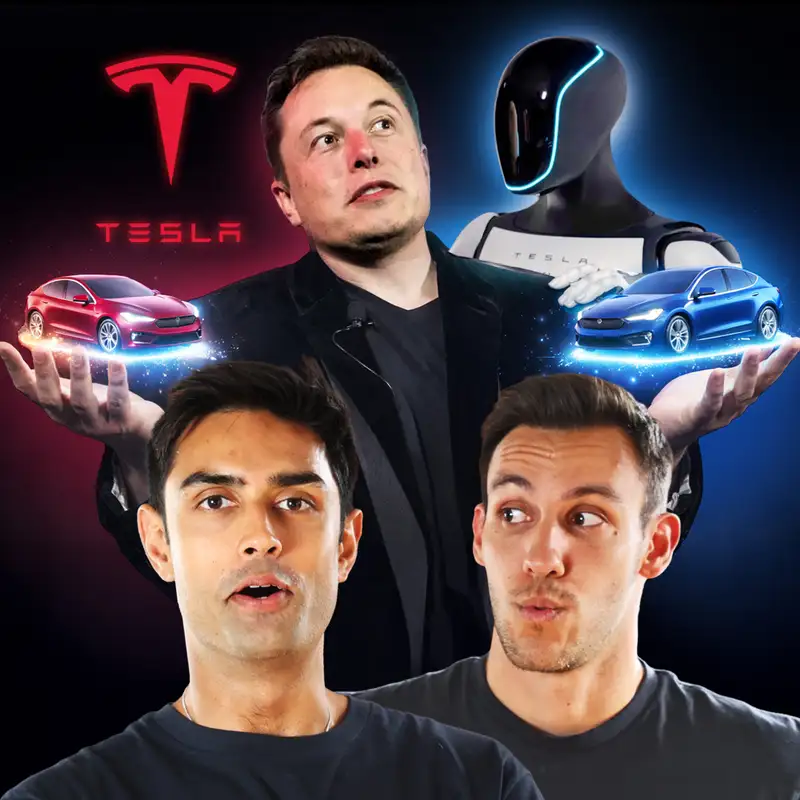
This Week in AI: Tesla Ending Model S, Gemini in Google Chrome, Grok Imagine
Ejaaz:
Welcome back to This Week in AI. It's been a pretty big week for the robots taking over.
Ejaaz:
Tesla are retiring two of their most iconic cars, the Model S and the Model
Ejaaz:
X, to make room to scale out their new Optimus Gen 3 robot, which is targeting
Ejaaz:
1 million units this year. Very ambitious, let's see if they make it.
Ejaaz:
Figure, another robotic startup, also launched a new humanoid robot,
Ejaaz:
which did something that no other robot has done before.
Ejaaz:
Clean the dishes, which sounds like a really simple task, but actually requires
Ejaaz:
61 very precise locomotive operations.
Ejaaz:
But the best part is that it did it completely autonomously.
Ejaaz:
And in final news, the Chinese and Google both released two AI models.
Ejaaz:
One can convert video recordings into production-ready apps,
Ejaaz:
and the other might just make the first major scientific discovery since we discovered DNA.
Ejaaz:
Google also introduced their leading Gemini model to 3.8 billion people in the
Ejaaz:
form of a personal AI agent in their browser. an exciting week. Let's get into it.
Josh:
Let's start with the Tesla earnings report because that was the highlight of
Josh:
the day for me, at least. I've been following these reports forever.
Josh:
In fact, it's funny, six years ago, I was watching a video that popped up six
Josh:
years ago this day talking about Tesla earnings.
Josh:
They were a blowout quarter in terms of forward-looking guidance,
Josh:
a little bit less so on the actual numbers. The stock's down for today,
Josh:
but that's not the story.
Josh:
The story is the forward-looking future of what this company looks like,
Josh:
which is very much centered around autonomy and robots and manufacturing.
Josh:
In fact, there's a world in which five years from now, you can't even really buy a Tesla.
Josh:
And that's signified slightly and early from the Model S and X depreciation. But I think
Josh:
You'll continue to see more of that as we go because Tesla is fully leaning into autonomy.
Josh:
So much so, in fact, that they're doubling their capital expenditure this year.
Josh:
I believe last year it was $8 billion.
Josh:
This year they're going up to $20 billion in CapEx spend just to scale these
Josh:
production lines for things like the CyberCav and for things like the Optimus humanoid robot.
Josh:
Which is really exciting because I think this year, paired with the Helix News,
Josh:
we're seeing a lot of humanoid robots, a lot of automation actually coming to the physical worlds.
Josh:
Like entering meat space, we're going to be able to walk down a street and not
Josh:
only have a self-driving car roll right by you, but also see a humanoid robot
Josh:
maybe walking down the street or doing something actually useful this year.
Josh:
And Tesla has a plan to scale these at a rate that no one else really is,
Josh:
starting with a million units this year and then going to 10 million, 100 million.
Josh:
And then they project up to a billion of these. The idea is that these will
Josh:
be able to offload enough of the human capital workforce that it'll unlock significant
Josh:
amounts of GDP for the actual country.
Josh:
So this is a gigantic project that's getting underway.
Josh:
And what we're seeing now is the early seeds being planted through these huge
Josh:
capital expenditures happening across the globe at all of the gigafactories.
Ejaaz:
This feels like a very prescient moment because Elon's clearly saying that Tesla
Ejaaz:
in five years or 10 years is not going to be known to be a car company.
Ejaaz:
It's going to be an autonomous robot company.
Ejaaz:
And we've kind of seen the signs of that over the last year where Elon's kind
Ejaaz:
of just spent all his time on full self-driving and improving that neural network
Ejaaz:
and focusing on his kind of Cybertruck's autonomously working in SpaceX and
Ejaaz:
then this new Optimus Gen 3 robot. that to me is like
Ejaaz:
kind of like crazy switch, I guess, to still kind of like materialize in my head.
Ejaaz:
And I don't think it's coincidental because this year was also,
Ejaaz:
or rather 2025 was the first year that Tesla's annual revenue went down.
Ejaaz:
They only put out 1.64 million cars.
Ejaaz:
I think that's down like around 9% from the previous year.
Ejaaz:
And the fact that he's shutting down two of his most early models,
Ejaaz:
I think it was like back in 2012 and 2015 that he released both the S and the X.
Ejaaz:
He's now going all in on humanoid robots. I feel like, Josh,
Ejaaz:
that this is the same moment where Elon was like, no, FSD is going to be the
Ejaaz:
biggest thing for Tesla cars.
Ejaaz:
He's doing the same thing for robots now.
Ejaaz:
So people might kind of take it as this is kind of crazy right now.
Ejaaz:
This humanoid robot isn't really useful for me or can't automate a bunch of manual labor.
Ejaaz:
But I think Elon sees something that we don't. Do you agree with this?
Ejaaz:
Do you feel kind of like solemn that we're going from cars to robots now?
Ejaaz:
Or has this always made sense to you?
Josh:
Yeah, well, this has always made sense because they've telegraphed this years in advance.
Josh:
Tesla famously has released these master plans, or Elon has released the master
Josh:
plan, once every three to five years for the last 15 years.
Josh:
And it just very clearly states exactly their plan and what they're going to do.
Josh:
And going back and looking at the old content from me, the old content from
Josh:
the master plans, it's very clear that this has always been the plan.
Josh:
They're just accelerating the advent of sustainable transport.
Josh:
And now they're kind of moving to a sustainable abundance through the Optimus
Josh:
humanoid robot. But the idea is always just to move the world towards an autonomous future.
Josh:
And cars were the gateway drug to doing that. It started with the Roadster.
Josh:
The Roadster was the very high-priced model that wealthy people were able to
Josh:
buy to fund the production and development of the Model S and the X,
Josh:
which funded the production of the scale vehicles, which is the three and the Y,
Josh:
which is funding the production of full self-driving, as well as serving as
Josh:
the actual network in which they could distribute the software on.
Josh:
So it makes sense to depreciate the S and X. I'd like to take a moment of silence
Josh:
for these unbelievable cars that changed the world.
Josh:
I mean, I would argue the Model S is one of the most.
Josh:
One of the most important cars that was ever built and ever shipped because
Josh:
it came out in 2012, just five years after the iPhone.
Josh:
And it proved that electric cars were not only possible, but they can be great
Josh:
and they can be better than gas vehicles across the board.
Josh:
And not only that, but they could be capable of autonomous transport in a world
Josh:
where all of those things were complete contradictions and believed to be impossible.
Josh:
And the Model S did that. And it went on an amazing 15-year,
Josh:
13-year run where they sold almost a million of these vehicles.
Josh:
It proved that it was possible. It funded the development of where we are today.
Josh:
And they're just unbelievable vehicles.
Josh:
A lot of people don't understand that the Model S and the X actually only account
Josh:
for about 3% of Tesla's vehicle sales now. It's a very niche audience.
Josh:
They're fairly expensive.
Josh:
They're over-engineered to hell. They have the craziest features,
Josh:
particularly the Model X. So it is very sad to see them go, but it is very much
Josh:
expected and very much exciting in the sense that that production line starts
Josh:
turning out humanoid robots this year.
Ejaaz:
Well, it's also important to remember that robots, as it were,
Ejaaz:
isn't just going to materialize as humanoid robots.
Ejaaz:
It's also going to look like the cars themselves, right? You mentioned like
Ejaaz:
they only account for 3%.
Ejaaz:
The rest of the vehicles that he's going to be producing are mainly going to
Ejaaz:
be targeted for just completely autonomous vehicles.
Josh:
So they won't even have a steering wheel.
Ejaaz:
They won't have a steering wheel. Like, it's a good point, right? Which is
Ejaaz:
these vehicles are going to become thought of
Ejaaz:
as less of a car where you sit in the front and
Ejaaz:
steer something to kind of like a third space to kind
Ejaaz:
of like a living room where you can be productive or enjoy
Ejaaz:
and consume entertainment when you get from
Ejaaz:
as you go from point a to point b and we're seeing this with his plans to roll
Ejaaz:
out the robotaxi service so um you know at the end of last year he was all kind
Ejaaz:
of like there were numerous sightings of him trying robotaxi um he's going to
Ejaaz:
be rolling out or planning to roll out the robotaxi service to nine more cities this year,
Ejaaz:
which is super exciting to see, nine cities in total.
Ejaaz:
And I know that there are several reports at this point where it is good enough
Ejaaz:
to drive much better with lower incidental damage than humans.
Ejaaz:
I don't know if you saw this, Josh, but Lemonade Insurance, which is a very
Ejaaz:
popular insurance startup here in the US, are offering drivers 50% off their
Ejaaz:
driver's insurance if they enable FSD on their Tesla cars.
Ejaaz:
And I kind of thought of this like fun idea where like it would be funny if
Ejaaz:
Elon just kind of like packages his new FSD subscription that we spoke about
Ejaaz:
in a previous episode last week with this kind of like insurance discount
Ejaaz:
to kind of like increase FSD subscribers and stuff like that.
Ejaaz:
I know those are ways that you can mix and match this. I'm excited to see more
Ejaaz:
robots roll out this year.
Josh:
Yeah, for the people who are listening, the new cities that you will be able
Josh:
to get a robotaxi are going to be Austin, Dallas, Houston, Phoenix,
Josh:
Miami, Orlando, Tampa, Las Vegas.
Josh:
If you live in any of those places by the end of this quarter,
Josh:
you will be able to try this for yourself, which I think is so cool.
Josh:
And as it rolls out, I would encourage everyone to try.
Josh:
Like I mentioned last week, I was in LA and using Waymos.
Josh:
And it's unbelievable if you've never experienced it before to see and feel
Josh:
what it's like to have a computer driving you around.
Josh:
So far, they have 600,000 autonomous miles driven on the robo taxi network that
Josh:
number is going to increase it is safer than a human driver as reflected with
Josh:
the insurance tesla actually also offers their own insurance which incentivizes
Josh:
people to drive safely so really cool updates from tesla across the board very
Josh:
excited about that and this isn't the only news from the elon,
Josh:
atmosphere i guess this week uh there's also some more
Josh:
spacex news particularly as it relates to the ipo which
Josh:
seems as if they're going to be raising even more money
Josh:
than previously thought 50 billion dollars which is going to be i think the
Josh:
largest amount of capital ever raised for an ipo and the largest market cap
Josh:
of a company to ever go public all in one this is going to be huge they're targeting
Josh:
june as the announcement and release date for this ipo to go public for people
Josh:
to actually invest in SpaceX.
Josh:
And SpaceX, to me, I mean, this is a huge opportunity. This is a huge company.
Josh:
I'm so excited for this to get into the open market and see how the public reacts.
Ejaaz:
It's also one of the few IPOs that are raising at such a large valuation that
Ejaaz:
I think justifies the amount that they're raising.
Ejaaz:
We're going to talk about OpenAI raising $100 billion later on this episode.
Ejaaz:
But I would say $50 billion is probably too low in an IPO.
Ejaaz:
And I know he's raising other rounds, but like he probably needs more money
Ejaaz:
to achieve his mission of getting to Mars, the moon and setting up,
Ejaaz:
you know, these interplanetary energy factories and stuff like that that he's spoken about on X.
Ejaaz:
So this is really cool and exciting. I think 2026 is gonna be the year of big IPOs, Josh.
Ejaaz:
We were talking about this before we started recording. We've got what, the Anthropic IPO.
Ejaaz:
You've got OpenAI raising an $850 billion round now and they're gonna be presumably
Ejaaz:
IPO-ing more than that. like 1.4 is what some more before trillion dollars is
Ejaaz:
what some of the rumors are saying um yeah this is just crazy to see
Josh:
Yeah we might get striped this year too a lot of ipos and part of the value
Josh:
in which enabled starlink and spacex to go public is the starlink network is
Josh:
the internet network and as they improve this network through starship launches
Josh:
which allows them to put their new version 3 satellites into space,
Josh:
And for reference, those version three satellite launches are 20 to 40 times
Josh:
more effective than the current versions that they're pushing out right now with the version two.
Josh:
So it's a huge increase in bandwidth. And that bandwidth is going to make its
Josh:
way into cell phones in our pockets because the direct to cell network is growing very quickly.
Josh:
If you're a user of T-Mobile, you can try this now. But Apple is now reportedly
Josh:
planning to integrate Starlink directly into the iPhone 18 Pro,
Josh:
which is coming later this year in September.
Josh:
So this is really exciting news coming from Apple. Again, outsourcing the software
Josh:
stack to someone else who is more capable and competent in doing this.
Josh:
In this case, it's Starlink.
Josh:
And it solves one of the huge pain points for the perfect mobile device,
Josh:
where my hypothetical perfect mobile device has unlimited battery,
Josh:
unlimited connectivity, no matter where you are.
Josh:
And now this solves the connectivity problem, where there's nowhere you can
Josh:
go where Starlink will not be. And that's a really exciting partnership that I'm looking forward to.
Ejaaz:
In other robotics news, I saw one of the coolest, but maybe unsexy to some,
Ejaaz:
demo of a humanoid robot.
Ejaaz:
What you're watching on the screen right now, and if you're listening to this,
Ejaaz:
I'll describe it to you, is a humanoid robot, which looks very much like a human,
Ejaaz:
I have to say, he's just missing some clothes, unloading a dishwasher,
Ejaaz:
walking across a full-sized kitchen,
Ejaaz:
placing all these dishes and crockery into the cabinet.
Ejaaz:
Very delicate, precise movements are needed for this, by the way,
Ejaaz:
walking back and refilling the dishwasher with all the dirty dishes.
Ejaaz:
These include wine glasses, by the way. Okay. So for all of you haters out there
Ejaaz:
that are saying they're using plastic stuff, no, he's using delicate glasses as well.
Ejaaz:
Now, what you're looking at is the new robot from FIGURE, a very hot robotic
Ejaaz:
startup here in the US called Helix O2.
Ejaaz:
And this humanoid robot is different from the other humanoid robots in a few different ways.
Ejaaz:
Number one, it is the first robot to perform a four-minute fully autonomous task of this level.
Ejaaz:
Just get that into your head. That may not sound very impressive right now,
Ejaaz:
but I remember a time where AI model LLMs could only work autonomously for 10
Ejaaz:
minutes at a time. And now they're doing weeks at a time.
Ejaaz:
This is the same kind of moment that we see for robotics.
Ejaaz:
And I think that Helix is kind of like nailing that.
Ejaaz:
To emphasize, it is completely autonomous. There are no humans.
Ejaaz:
There's no teleoperation. You know who dares leverage teleoperation? 1KX.
Ejaaz:
Also Tesla Optimus, dare I say, although the new generation should be fully
Ejaaz:
autonomous in some way, shape, or form.
Ejaaz:
This is a really impressive feat because the technicalities and the mechanisms
Ejaaz:
that you need to achieve this is nothing short of just insane.
Ejaaz:
So 61 locomotive manipulations are required for this robot to do this,
Ejaaz:
but that's not even the most impressive part.
Ejaaz:
Typically, these robots are pre-programmed to execute on a set number of different moves.
Ejaaz:
So those 61 moves I just mentioned, you need to hard code it.
Ejaaz:
And when it faces a scenario, it'll then activate that movement.
Ejaaz:
This is completely different.
Ejaaz:
So what Felix did was they launched something called System Zero,
Ejaaz:
I believe, which is their new neural net, which is only 10 million parameters.
Ejaaz:
But it basically ingests what it sees around it through its palm senses,
Ejaaz:
through its eyes, and reacts in real time.
Ejaaz:
This is different from how the model previously used to work, which is
Ejaaz:
Take in some kind of input, process it through its hard code,
Ejaaz:
and then output an action.
Ejaaz:
And hey, presto, the kind of like trophy win here is that it's fully autonomous,
Ejaaz:
and it's the first humanoid to be able to do this.
Ejaaz:
Now, to remove all that code and transform it into neural net is cool enough.
Ejaaz:
But what I also like about it is that they have this new form of tactile sensors.
Ejaaz:
And I think we spoke about something about this on our previous run,
Ejaaz:
or maybe it was even last week's.
Ejaaz:
But because of its palm sensors and its new tactile sensors,
Ejaaz:
it's able to know when to apply pressure and when to be delicate.
Ejaaz:
For example, lifting a wine glass and placing it into a cabinet.
Ejaaz:
So I personally like took this kind of boring task and thought,
Ejaaz:
huh, this is actually something that I would actually have in my home because
Ejaaz:
I can trust it. Also, look at the speed that it's moving.
Ejaaz:
It's definitely quicker than my sister that I've seen her loading the dishwasher at home at least.
Josh:
Do you think this is ready to be in your home? Is this something you'd be interested in buying?
Ejaaz:
Well, I would need it to do something more than just dishwasher stuff.
Ejaaz:
But presumably, if it can do this, it can also fold my laundry,
Ejaaz:
Josh, and load the laundry basket as well.
Ejaaz:
So depending on what they're charging, if it's a subscription or if I have to
Ejaaz:
buy it outright, would influence my decision, right? If I could have a live-in housekeeper,
Ejaaz:
sounds pretty good i'm a pretty messy guy
Josh:
Yeah when evaluating robots i think the things
Josh:
that are most important to look at are first the hands the dexterity the
Josh:
the sensors within the hands how capable the hands
Josh:
are because that's by far the most complicated thing the second thing is
Josh:
the intelligence how general purpose is it we we've seen this example over and
Josh:
over again of loading a dishwasher or doing simple tasks like sorting clothes
Josh:
how complex are those tasks able to get and how quickly are they able to roll
Josh:
that out is the second thing and then the third is how quickly and how effectively
Josh:
are they able to actually manufacture this at scale?
Josh:
Are they going to be able to create enough of these at a price point that makes
Josh:
enough sense with a feature set that makes enough sense to encourage people
Josh:
like me and you to want to buy one?
Josh:
It seems like there is a very long and challenging path for figure to get there.
Josh:
I'm really looking forward to Tesla's Optimus 3, which is coming this quarter
Josh:
and will be rolling out at scale this year. And I...
Josh:
I'm hopeful that figure can keep up because competition is good.
Josh:
And I hope they don't turn into like the Rivian of electric cars.
Josh:
I want them to stay on the forefront.
Josh:
And I hope Brett and the whole figure team continue to keep their foot on the gas.
Ejaaz:
Yeah, I mean, I think this demo is cool, right? But it's pitched towards... It's like, it's cute.
Ejaaz:
It's cute. But I think the real application, the reality is these robots aren't
Ejaaz:
going to be in your homes first. They're going to be in factories.
Ejaaz:
In fact, their Helix O1 robot has been working at BMW controlling their operating
Ejaaz:
system or one of their manufacturing plants for, what is it now? Four months now?
Ejaaz:
24-7? There's like a live stream of this. Well, hopefully, maybe we can link
Ejaaz:
to this and people can go watch it.
Ejaaz:
But Brett keeps talking about it every single week.
Ejaaz:
So I don't know. I'm bullish on it. I think Optimus is also going to be in factories
Ejaaz:
first before people's homes.
Ejaaz:
But we shall see.
Ejaaz:
We have some big news from Google. Josh, you were showing me some pretty cool
Ejaaz:
demos. What's going on here?
Josh:
Yeah, big news. If you remember from a little while ago, we had the CEO of Perplexity
Josh:
on the show, and he was talking about the new pivot to the AI browser.
Josh:
Since then, OpenAI has released their own AI browser.
Josh:
Claude has released a plugin for Chrome, but now Chrome, where everyone actually
Josh:
uses their browsing, has rolled out their own...
Josh:
Gemini agentic controller inside of the browser. And it's pretty incredible.
Josh:
I mean, like you mentioned at the intro, 3.8 billion people on earth use the Chrome browser.
Josh:
And now all those people have just been given a magical update overnight that
Josh:
allows this agent in and allows it to actually control and do things on behalf
Josh:
of the user within this browser.
Josh:
So we're watching on screen a introduction demo video that shows some examples.
Josh:
And I thought they were really amazing.
Josh:
The first one that they did was with NanoBanana Pro, which is the image generating model.
Josh:
And they were just looking at a home and they wanted to add furniture to it,
Josh:
like looking at an empty apartment. And you could just ask NanoBanana to stage the apartment.
Josh:
Yeah, here's the demo. Where it's empty, you could ask it to stage the apartment
Josh:
and it shows you what it looks like with furniture on the fly as you're browsing.
Josh:
The follow-up feature to this is they were looking for an apartment that accepted
Josh:
dogs, that was in X proximity to this place, that had a whole list to parameters
Josh:
that were pretty complicated that would have taken the average person a long time to do.
Josh:
And they typed in that prompt and it actually clicked through the browser and
Josh:
navigated through this for them.
Josh:
Putting in all the filters and figuring out which results were best for them.
Josh:
And I think this is such a great use case because it's just so prevalent in
Josh:
what you do every day as a user of Chrome and as someone who uses a Chrome browser.
Josh:
And I'm excited to see it integrated where people are, where you don't actually
Josh:
need to download a separate piece of software, move everything over.
Josh:
It's just meeting people where they are and building on top of this existing
Josh:
knowledge base that Google has about you through your Gmail account.
Ejaaz:
What I like about this is they're not over-promising, or they didn't over-promise
Ejaaz:
Gemini 3 being pretty much wherever you are on the internet.
Ejaaz:
Like, I've used Chrome browser for years now. I've used Gmail for longer.
Ejaaz:
And the fact that, you know, these demos show kind of places that I visit every
Ejaaz:
day, because like, let's face it, like most of my online life,
Ejaaz:
or rather, most of my computer life doesn't live on my desktop, right?
Ejaaz:
Which is my, which was separately my point around cloudbot i'm like it's not
Ejaaz:
useful for me because i'm always on the internet but google is bringing gemini
Ejaaz:
and ai cutting edge ai to me on the internet on the browser where i am every day
Ejaaz:
I might not be someone that edits images all the time and says,
Ejaaz:
hey, show me in this outfit, but I am someone that writes a lot of emails.
Ejaaz:
I am someone that spends a lot of time in documents.
Ejaaz:
And in some of these demos, Josh, it doesn't just get me to prompt it.
Ejaaz:
It prompts me and says, hey, I see that you have updated some of these goals for the next month.
Ejaaz:
Do you want me to email so-and-so on your behalf?
Ejaaz:
I've generated you a prescript if you want me to do that for you.
Ejaaz:
All I need to do is look over to it on my task panel on the right, and click send.
Ejaaz:
And that's just like such a beautiful experience.
Ejaaz:
It sounds, again, unsexy, but I think this is going to make people way,
Ejaaz:
way more productive and most importantly, loyal to Google.
Ejaaz:
We mentioned their major release of personal intelligence, which is basically
Ejaaz:
a personal AI assistant that is prevalent across every single Google product
Ejaaz:
that you use, not just on your browser, but on Google Maps, Android, wherever you are.
Ejaaz:
This is it coming into reality just for Chrome. It's frigging awesome.
Josh:
Yeah, really nice feature. It's just, it's, it's again, it's another muscle
Josh:
that people are going to need to train as they get used to these new tools in
Josh:
reaching for the agent in your browser versus trying to do it all yourself,
Josh:
where I would encourage anyone as you're browsing and you're doing something,
Josh:
you're trying to achieve a goal.
Josh:
Try to click that Gemini button and see if it can achieve that goal for you.
Josh:
And the process of doing that over and over kind of trains your brain to rely more on this.
Josh:
And it just leads to a far better quality of life because it's better at doing
Josh:
a lot of these tasks than we are.
Josh:
The other thing that I thought was interesting to note is that they updated
Josh:
their Gemini AI Pro plans, the Pro plan and the Ultra plan, which are either
Josh:
$20 a month and $250 a month.
Josh:
If you have those now, the big thing on this long list of things that they include
Josh:
is Google Cloud Credits.
Josh:
So now you can actually use, you could build your own environments for these AIs.
Josh:
You could start querying more of their API to get more, I guess,
Josh:
more just requests done, more intelligence.
Josh:
They're including a lot more tools in this package for people who are interested
Josh:
in just toying around with these products.
Josh:
And for me, this is really exciting because I'm not running large scale,
Josh:
products. I don't need a server that costs more than $10 a month.
Josh:
And essentially for one membership of $20, I get all of these really cool perks.
Josh:
You get access to the entire Google AI ecosystem.
Josh:
And I just, I liked this pivot that they're moving towards kind of giving people
Josh:
the tools to tinker at a very low price point at $20 a month.
Ejaaz:
So in other Google news, they released what is probably the most impressive
Ejaaz:
scientific AI breakthrough ever.
Ejaaz:
And no one kind of noticed it because it got published in Nature,
Ejaaz:
which is a scientific journal, but it was 100% open source and super cool.
Ejaaz:
So this is, the best way to think about this is this is kind of like a DNA sequencer AI.
Ejaaz:
Now, the reason why this is cool is 98% of our DNA is actually not that important.
Ejaaz:
It doesn't actually lead to protein production.
Ejaaz:
The reason why protein production is important is because it influences pretty
Ejaaz:
much how your entire body, mind, and world works, how your perception is, right?
Ejaaz:
The issue is we don't understand the 98% of that dark matter because it controls
Ejaaz:
some types of genetic expressions.
Ejaaz:
So for decades, like humans have basically just kind of like mapped out the
Ejaaz:
genome themselves and then like just tried a bunch of different tests to figure
Ejaaz:
out what proteins or what genes are expressed in A, B or C type of condition.
Ejaaz:
Now there's an AI model that can not just sequence a couple hundred thousand
Ejaaz:
of these base pairs for your DNA, but up to 1 million base pairs.
Ejaaz:
Now there are four main base pairs in your DNA strand. We're taking it back
Ejaaz:
to like, you know, fifth grade biology here.
Ejaaz:
And if you connect them together in different types of combinations,
Ejaaz:
you can result in different types of proteins, which kind of make up your genetic makeup.
Ejaaz:
Now you have an AI model that can just sequence this entirely and predict what
Ejaaz:
the expression is going to be. Now, the reason why this is super cool is you
Ejaaz:
can apply this to so many different things.
Ejaaz:
You could apply it to preventative medicine. You could apply it to personalized
Ejaaz:
medicine to create personalized pharmaceuticals for yourself.
Ejaaz:
Or you could recognize genetic disorders before it manifests,
Ejaaz:
before it becomes an issue and kind of snip that baby out. So it is such a cool thing to see.
Ejaaz:
It kind of harkens back to my biology degree where I'm just like,
Ejaaz:
oh my God, I can't believe that they've produced a tool that could have saved
Ejaaz:
me like months of work when I was doing that degree.
Ejaaz:
But I just think it is super awesome. Josh, are you impressed by something like this?
Josh:
Yeah, this to me is the coolest news of the week, actually, which is funny enough.
Josh:
The biology stuff is so unbelievably impressive. And I think it's easy to overlook
Josh:
it because it's kind of complicated and difficult to understand for those.
Josh:
I mean, like myself, who just haven't spent much time in the world of biology.
Josh:
But in the research and learning about this segment, I discovered that the DNA
Josh:
sequence is 3 billion letters long.
Josh:
It's this ginormous sequence of letters.
Josh:
It essentially acts as an instruction manual for the
Josh:
human body for the makeup it tells you everything that's right with you but
Josh:
also everything that's wrong with you and previous ai models before this they
Josh:
were like it was like reading a manual with either a magnifying glass where
Josh:
you can see tiny details but only a few segments at a time versus binoculars
Josh:
where you could see like a lot but it's kind of blurry this is able to do both
Josh:
simultaneously and like you mentioned it can read one million letters at once
Josh:
with perfect clarity so while it's not the three billion.
Josh:
It is 1 million, which is a significant improvement because when doctors find
Josh:
a weird genetic variant and they ask, is this variant causing a problem?
Josh:
Alpha genome has beat the previous models on 25 out of 26 of these tests,
Josh:
which means there's a lot of fewer, we don't know the answer,
Josh:
answers for patients with rare diseases.
Josh:
And it's able to kind of diagnose things that previously were not possible.
Josh:
And as we see progress through this, there's going to be a lot of unbelievable
Josh:
examples as it relates to like cancer and splicing these DNA sequences and improving things.
Josh:
It's just, it's a huge quality of life improvement for the people who understand
Josh:
it and for the people who stand to benefit from this, which is,
Josh:
I mean, in a way, everyone we mentioned on a previous episode,
Josh:
you can upload your DNA sequence to something like Claude and you could ask it questions.
Josh:
This is that on steroids. This is going down to the letter and diagnosing what's
Josh:
wrong and what's right based on a single variance in a 3 billion letter data
Josh:
set. It's really amazing.
Ejaaz:
For those of you who haven't spent time in many of the scientific journal world,
Ejaaz:
there are tens of thousands to hundreds of thousands of scientific papers published every single year.
Ejaaz:
But the common pattern across all of these is that some of these conclusions
Ejaaz:
are simply inconclusive.
Ejaaz:
They don't have enough data or they just don't know. They haven't got enough
Ejaaz:
tools or technology to figure it out.
Ejaaz:
Now, a tool like this, to your point, Josh, I don't think it's going to suddenly
Ejaaz:
have a crazy discovery this year, but you're going to see the discovery in some
Ejaaz:
of these papers that come out from the researchers that are using it.
Ejaaz:
In fact, we're probably going to see Alpha Genome be quoted as a main author
Ejaaz:
on some of the papers produced in 2026.
Ejaaz:
There are already 3,000 researchers using this. I think 1 million API calls every single day.
Ejaaz:
So it's really been crushing a bunch of research across 160 countries.
Ejaaz:
So I am curious to see what this gets involved in and what discoveries it makes.
Ejaaz:
To your point, maybe it's cancer or maybe it's something smaller,
Ejaaz:
but one thing's for sure, there's going to be something major this year, would be my prediction.
Josh:
Yeah, the velocity in progress of this has just been, it's unbelievable.
Josh:
It's really exciting to see.
Josh:
I'm looking forward to all the continued breakthroughs that scientists are now
Josh:
able to use because this is just open weights, open source, freely available
Josh:
for anyone who's involved in research to actually go and use for themselves.
Josh:
There's another interesting breakthrough, or at least released this
Josh:
week that's slightly less eccentric this
Josh:
one's more practical and something you can use today which is Claude
Josh:
releasing interactive tools within Claude
Josh:
itself so if you are a user of Slack or
Josh:
Figma or Asana or any of these programs you
Josh:
actually never need to go to those websites ever again they will be integrated
Josh:
into your Claude interface on your desktop for you to actually engage with through
Josh:
the chat interface to do whatever you want them to do so the example we're seeing
Josh:
on screen now is figma if you're a designer this is how you design things this
Josh:
is how you create websites create renderings of things.
Josh:
And built into Claude now is tooling control that allows you to type in a prompt
Josh:
or even manually adjust things yourselves from within the interface in a way
Josh:
that's smart, it understands the context, and it writes back to the main server.
Josh:
So if you, like for example, we use Asana for production workflows,
Josh:
for scheduling episodes.
Josh:
I don't need to go to asana.com anymore. I just ask Claude, when do we need to publish this by?
Josh:
Who is responsible for publishing this? And it has all the answers built in,
Josh:
and it can write the changes to that. And this is on the back of the integrations
Josh:
that they've recently added.
Josh:
Things like iMessage, which I think is really cool.
Josh:
Previously, or early in this week, we released an episode on CloudBot,
Josh:
which is this whole desktop controller that allows you access to your whole
Josh:
desktop, but it is a bit technical. It does cost a bit of money.
Josh:
This is so easy. If you are a Mac user and you have Cloud downloaded on your laptop.
Josh:
You can connect Claude to iMessage and then have it send messages on your behalf
Josh:
or read messages on your behalf or integrate it into any of these other services.
Josh:
And what they're doing is they're just creating, I think what OpenAI was trying
Josh:
to do, which is this full stack place in which you can go for any of your needs.
Josh:
It's just slowly embedding itself into more and more of your day-to-day workflow.
Ejaaz:
To me, what this announcement says is it's confirmation that we are heading
Ejaaz:
towards an AI operating system that is ephemeral.
Ejaaz:
Now, we've mentioned this many times on the show before, but I believe in the
Ejaaz:
future, you're not going to navigate to an app or a website or scroll.
Ejaaz:
It's just going to appear ephemerally in front of you, auto-generated by tokens
Ejaaz:
generated by an LLM or any kind of AI model that is multimodal, right?
Ejaaz:
And the reason that description that you just gave just now,
Ejaaz:
actually, Josh, is, you know, it all kind of converges into one synonymous experience
Ejaaz:
where you could be on different devices or you could be on your browser or you could be on a chat bot.
Ejaaz:
And somehow the same LLM or AI model follows you around and is there to be helpful
Ejaaz:
and expressive in many different ways. This is Anthropic confirming it.
Ejaaz:
OpenAI actually released this feature themselves in ChatGPT last year.
Ejaaz:
Actually, I think it was mid last year. So that was super early with the exact same partners.
Ejaaz:
That uptake didn't really take off. I'm curious whether like six months later,
Ejaaz:
we now see a similar pattern with Anthropic or whether people enjoy it and find it more useful here.
Ejaaz:
Another kind of subtle point that this is using underneath is something called
Ejaaz:
MCP, Model Context Protocol, which is something that Um...
Ejaaz:
Anthropic, I believe, found it. It's an open protocol that allows you to connect
Ejaaz:
to a bunch of different apps.
Ejaaz:
Now, the change here is that it's allowing the generative experiences to happen
Ejaaz:
within the chatbot, which is a UX decision, which I think is really cool.
Ejaaz:
Now, I think this is a very strategic move for Anthropic because they created
Ejaaz:
the protocol themselves.
Ejaaz:
So Google famously produced Android and open source the entire thing,
Ejaaz:
or rather was like, hey, this is for everyone.
Ejaaz:
But they ended up becoming the dominant company that controlled that.
Ejaaz:
And now they manage like, you know, millions and millions and millions of devices.
Ejaaz:
I think this is Anthropic's attempt to do the same thing. Now they're not planning
Ejaaz:
to release a new device, but it is yet another step for them to own the entire
Ejaaz:
operating stack for whatever AI becomes.
Josh:
Yeah. You said, you said this good word. I actually looked it up because I don't
Josh:
know what it means. Ephemeral.
Josh:
You said ephemeral operating system, which is something that lasts for a very
Josh:
short time is fleeting or transient, often describes things that are beautiful,
Josh:
but temporary, like a moment of feeling.
Josh:
So I guess the idea is that this is, it's dynamically generated,
Josh:
right? Like it's kind of built on the fly.
Josh:
It doesn't actually exist as a permanent fixture in our workspace,
Josh:
which is super interesting. This is cool.
Josh:
There is one use case that I particularly loved, which was the iMessage wrapped.
Josh:
I think one of my favorite parts of the year is Spotify wrapped when we can
Josh:
see all of the most played music.
Josh:
Everyone talks about how they're listening age. It's very fun because it has
Josh:
access to these more intimate personal data sets.
Josh:
It can actually use that data to generate these fun things like iMessage Wrapped,
Josh:
which is a code project that this woman did, which I thought was really fun.
Josh:
It showed how many messages were sent throughout the year, who the top messages were with.
Josh:
It showed heat graphs and charts of when you are most likely to send messages.
Ejaaz:
Relationships over time.
Josh:
Yeah, you could see relationships over time. When a relationship got hot,
Josh:
you were texting a lot. When it faded away, it's this really fun, exciting thing.
Josh:
Experiment. It shows grammar, who gets your best English, most formal versus
Josh:
most casual, your writing style over time.
Josh:
And you can really break it down because it has this deep understanding and
Josh:
intelligence, but also because it has this connection to your personal intimate data set.
Josh:
And I thought this was so much fun because it shows you even the heat chart
Josh:
of when you are most likely to be sending messages. Oh, I like this.
Josh:
Your dream dinner party.
Ejaaz:
The dream dinner parties is good.
Josh:
Very cool. Who's sitting at your ideas table? Who are your ride dies.
Josh:
Who's the industry dinner?
Josh:
It's a really fun example of a use case that I hope we see a lot more of.
Josh:
And again, the hardest problem with these is just figuring out how to extract value from it
Josh:
And whenever we get a cool example like this, it's awesome. It's like,
Josh:
okay, here, it's open source of my GitHub.
Josh:
You can go and copy it for yourself and go have fun. And this is a really awesome
Josh:
use case that I see for Cloud in particular.
Ejaaz:
As we're filming this episode, Josh, and we've given a bunch of tool demos and
Ejaaz:
examples right now, I'm realizing that we have made so much progress over the
Ejaaz:
last year when it was incredibly manual.
Ejaaz:
And now it's much, much, much less manual. But in my opinion,
Ejaaz:
it's still manual enough.
Ejaaz:
Do you know what I mean? and i think there's going to be a dissection
Ejaaz:
of audiences where you have the more kind of
Ejaaz:
i guess you can call them semi-technical folk that will spin up
Ejaaz:
a clawed bot or try out a new ai native thing
Ejaaz:
and to your earlier point like you should be proactively trying to
Ejaaz:
use these tools so you can kind of evolve your brain and thinking
Ejaaz:
into using these tools that you're not caught off guard but i
Ejaaz:
think eventually uh majority of people are just going
Ejaaz:
to use some kind of package system like google is like the perfect placement
Ejaaz:
for this right where it's like hey don't worry gemini is just going
Ejaaz:
to come to wherever you are and we've got you we're just going to give you
Ejaaz:
the features instead of you trying to figure out the features this is an example
Ejaaz:
of someone figuring out the feature and i'm actually more of an advocate for
Ejaaz:
people to go out and do that but yeah it just occurred to me that i think a
Ejaaz:
lot of people are just going to kind of take the lazy option and just wait for
Ejaaz:
that pre-packaging which isn't a bad thing because there's less security risk
Ejaaz:
it's probably going to be cheaper at that point it's probably going to be a
Ejaaz:
better user experience well
Josh:
It's also like what is the actual delta between the time that
Josh:
early adopters use it versus the time that the general public uses it
Josh:
and it's becoming increasingly small it used to be months to years now it's
Josh:
a matter of days i mean claude bot was exciting because it had access to your
Josh:
iMessage and you could talk with it and now we have a connection and a really
Josh:
cool use case that's built right into your claude desktop app without any of
Josh:
the technical know-how or installation and that was a matter of days the compression
Josh:
is happening very quickly.
Ejaaz:
Yeah i i agree with you on the software front i
Ejaaz:
maybe don't agree if I look at it from an investment angle.
Ejaaz:
Because to your earlier point, you knew Tesla was going to be a robot company,
Ejaaz:
a humanoid specific company six years ago with that video that you recorded, right?
Ejaaz:
So it's crazy to see how like a lot of these timelines are like collapsing for
Ejaaz:
some things, but in other things, they're not. Or maybe it's just lagging. I don't know.
Josh:
I think people mostly understand the trajectory. The question is whether they
Josh:
can deliver on that or not. And in the case of Tesla, they have actually delivered on it.
Josh:
In don't have set timelines they don't have set delivery dates
Josh:
it's kind of a fuzzy thing but everyone is generally working towards the same
Josh:
goals so what we're seeing is just incremental progress some faster than others
Josh:
um and xai right here is another example of incremental progress that perhaps
Josh:
leaves a little bit to be desired here the uh the new grok imagine model ijaz
Josh:
let's talk about this for a sec okay.
Ejaaz:
I'm gonna be honest because i'm a massive elon bull that that is no secret on this show but
Ejaaz:
And the video and image models from Grok, Grok Imagine specifically,
Ejaaz:
have kind of been subpar.
Ejaaz:
Like when I look at like what Mid Journey is putting out, when I look at like
Ejaaz:
what VO3 is putting out, when I look at like what Runway is putting out,
Ejaaz:
there's just a higher quality and definition that Grok just isn't giving me.
Ejaaz:
And that wouldn't even matter because they are, again, like only a two and a half year old startup.
Ejaaz:
But it's the fact that Elon keeps on shilling it like it's the next best
Ejaaz:
thing and i'm like bro it's not right anyway the
Ejaaz:
the news here is we have a new grok imagine
Ejaaz:
api uh which is basically their latest um
Ejaaz:
image or video model and as you can see it is
Ejaaz:
actually quite impressive and i might be being a bit of a brat here because
Ejaaz:
this is uh next level compared to like what we had last year and the cool part
Ejaaz:
is it's cheaper it's quicker to generate um and it's just simply a better model
Ejaaz:
that is available everywhere um whether this inspires me to use it isn't really the point.
Ejaaz:
I'm sure there are people that are involved in video production that will find this way more useful.
Ejaaz:
Well, actually, let me ask you, Josh, as someone that plays around with a lot
Ejaaz:
of this stuff, is this a tool that you would use? Are you impressed by it?
Josh:
No, they didn't need to release this. This didn't need to happen.
Josh:
They could have just shelved this and kept going with Grok 4.2 and then working on Grok 5.
Josh:
Had this been released a year ago, it would have been amazing. It's a great image
Josh:
video generation model uh given today's standards
Josh:
it's not and while it's an improvement for the xai team it is not an actual
Josh:
improvement pushing the frontier of video or photos forward so while i look
Josh:
forward to the next iteration of this as they work towards their game development
Josh:
engine and building these graphics in real time this is kind of an incremental
Josh:
progress update that really didn't need to come out i don't think many people
Josh:
are going to be super excited about this.
Ejaaz:
Well what if i framed it in a different way josh what if i told you that this
Ejaaz:
was actually never meant for video production
Ejaaz:
but rather game development. So one of our predictions at the end of last year
Ejaaz:
was that XAI is going to release one of the best gaming AI models,
Ejaaz:
which will allow for real-time game immersion and gameplay, which is kind of
Ejaaz:
like some of the demos that we're seeing on this video right here.
Ejaaz:
And I'm wondering whether that might be their angle. Maybe they're just not
Ejaaz:
going for video production at all.
Josh:
Yeah, and I suspect that's probably why Elon is abnormally excited about this,
Josh:
because he understands the vision for this and he understands where
Josh:
on the trajectory this incremental like data point falls
Josh:
whereas we're seeing it at face value and being like
Josh:
this isn't that impressive we've seen this before but gaming
Josh:
is certainly where they want to go gaming and animation and graphics and
Josh:
building real-time three-dimensional spaces which are going to compete with
Josh:
google's genie the world building model so i'm looking forward to that war as
Josh:
it comes along because logan kilpatrick from google is actually teasing genie
Josh:
3 this week which hopefully we'll be getting very very soon and we'll have a
Josh:
real comparison of a true frontier your world-building model very soon.
Ejaaz:
Mm-hmm. In other news, we put out an episode earlier this week.
Ejaaz:
I actually think it's our last episode on this new Chinese model, Kimi K 2.5.
Ejaaz:
Now, we're not going to get into it on this episode, but the TLDR is it is a very impressive model.
Ejaaz:
It's 100% free, open source. You can download it, amend the model weights, and run it locally.
Ejaaz:
But it might cost you a few very expensive bits of hardware to be able to do that.
Ejaaz:
But you can access it for free on their website. and the coolest part about
Ejaaz:
it is you can kind of like convert video recordings into live production ready
Ejaaz:
apps but there was an update that we wanted to make based off of this.
Josh:
Yeah so we actually said that it would be immensely difficult to run this locally
Josh:
on a machine because it would have required a tremendous amount of compute and
Josh:
the reality is is that someone actually got this running with far less than we thought.
Josh:
You don't need a couple GB200s or H100s or any cutting-edge NVIDIA technology.
Josh:
This person actually did it with two Macs on his desktop.
Josh:
So he bought two M3 Ultra Mac Studios and strung them together,
Josh:
which costs about $20,000 USD.
Josh:
And he was able to generate 24 tokens per second using these two computers and
Josh:
the new Kimi K 2.5 Pro model.
Josh:
So I think that is a testament to how accessible a model this good is and essentially making it free.
Josh:
So now, it's funny, tying it back to the Tesla autopilot example,
Josh:
where you can buy a license currently for $8,000 and that gives you lifetime
Josh:
free miles, or you can do a subscription for $20,000.
Josh:
Now you can basically get a lifetime membership to pseudo AGI to one of the
Josh:
highest level frontier AI models. And you could run that for free through infinity
Josh:
at the cost of these two localized models.
Josh:
And I think that's a really impressive and fun breakthrough where, I mean,
Josh:
assumedly the server costs to run this would be significantly lower and you
Josh:
could just run these open source models now that are very much at the frontier
Josh:
for a very reasonable cost relative to what some people are paying to use like
Josh:
an API like Opus 4.5 which is charging you $25 per million tokens.
Ejaaz:
Yeah, I mean, the funniest part about this model release has got nothing to
Ejaaz:
do with the model, but the fact that you can never rest easy because your competition
Ejaaz:
is always cooking up something better.
Ejaaz:
And literally within hours after recording that episode of Kimi K2,
Ejaaz:
Google pretty much announced an identical copy or functionality where they can
Ejaaz:
turn, they call it agentic vision,
Ejaaz:
but they can turn any screen recording into a production ready application.
Ejaaz:
Now, they don't state that specifically on here, but that's technically what it should be able to do.
Ejaaz:
And it just is a testament to how quickly and almost synchronously these AI
Ejaaz:
labs are working together.
Ejaaz:
Now, in my opinion, it's more impressive for the Kimi K2.5 team,
Ejaaz:
the Moonshot Labs team, because they have less infrastructure.
Ejaaz:
Although someone made the point in our episode in the comments,
Ejaaz:
Josh, I don't know if you saw this, that they have a much, much cheaper energy.
Ejaaz:
So I don't know how that translates necessarily. Maybe they just run these servers
Ejaaz:
for way, way longer and it just costs them less. So it kind of like matches out.
Ejaaz:
But it's interesting that the open source teams and the centralized teams are
Ejaaz:
kind of like moving at parity right now.
Ejaaz:
It's cool that the open source teams have even caught up. But yeah,
Ejaaz:
Google's come up with the same thing if you want to try it and use a Western AI lab product.
Josh:
It's amazing how quick they were to respond. And also that comment is very correct.
Josh:
Chinese electricity costs significantly less than the US electricity does because
Josh:
they have so much more of it. So the cost per token, the cost to train these
Josh:
models is significantly lower because of that cost per kilowatt as it relates
Josh:
to just generating all of this energy.
Josh:
Yeah, yeah. But really nice reply from the commenter, but also Google in a matter of seemingly days.
Josh:
It feels like they had this ready to go and they were like, oh,
Josh:
all right. Well, I guess we should probably just release this now because Kimmy did something similar.
Josh:
And now here we are. Agentic vision for all.
Ejaaz:
Well, if Moonshot AI, KimiK 2.5, is the model example of spending your resources widely,
Ejaaz:
OpenAI probably needs to be on the opposite end of that spectrum with the breaking
Ejaaz:
news that they are raising a $100 billion round,
Ejaaz:
which is just gargantuan, to value them at around $730 billion.
Ejaaz:
I've seen $850 as well.
Ejaaz:
I can only imagine that they are raising this amount of money to blow it all
Ejaaz:
on training various different models, not just one model, or to kind of build
Ejaaz:
out a new social network that we saw on the timeline.
Ejaaz:
Apparently, they're building that and their hardware device.
Ejaaz:
And what else am I missing, Josh? We've got the Sora TikTok app competitor.
Ejaaz:
It just seems like at this point, and I know this might be a negative take,
Ejaaz:
they've been raising so much money and endlessly blowing it on myriad different
Ejaaz:
things. so they're spreading themselves very thin.
Ejaaz:
This doesn't signal confidence to me, actually. It actually signals that they
Ejaaz:
are kind of being reckless at this point.
Josh:
Yeah, it's probably helpful to look at past fundraising history to get a better
Josh:
perspective of how much money this actually is in a way that feels almost existential.
Josh:
There's so many vested interests in OpenAI succeeding.
Josh:
If they don't, what does that look like for the rest of the industry?
Josh:
That's an important question to just kind of sit on for a little bit.
Josh:
But if you go back to the funding rounds, even April 2023, they were raising still in the millions.
Josh:
They raised $300 million at a $27 billion valuation. Then in October 2024,
Josh:
they raised 20 times that, $6.6 billion at $157 billion valuation.
Josh:
And now they're raising eight times that at $40 billion at a $300 billion post-money valuation.
Josh:
Now, this is interesting because Ejaz, earlier in the episode,
Josh:
we mentioned SpaceX was looking to raise $50 billion at about a $1.5 trillion
Josh:
valuation. So they're raising 20% more.
Josh:
At 500% the market cap.
Josh:
And we're starting to see like OpenAI is giving up a lot of equity here.
Josh:
They're really giving a lot of vested and controlled interest to a lot of companies
Josh:
that may not want that liability.
Josh:
And I wonder if this is a strategy in where he's trying to, Sam and the OpenAI
Josh:
team are just trying to get as many vested interests as possible in their success
Josh:
in a way that they become too big to fail.
Josh:
Where so many people have so much money tied up in this thing that they own
Josh:
a lot of, that they are forced to give whatever it takes to make this work because
Josh:
the downside effect impacts the entire industry in such a large way.
Josh:
And I can't help but read these headlines and not think that.
Josh:
I mean, this is just outrageous. They have a tremendous amount of debt.
Josh:
They haven't made a single profit. They're trying all these things like ads.
Josh:
They're trying to take revenue cuts.
Josh:
They're trying social media things, seeing what sticks.
Josh:
And it's giving it's giving desperate vibes.
Ejaaz:
Yeah i mean i have a simple take
Ejaaz:
which is uh they are on track to make and
Ejaaz:
also burn 20 billion dollars of capex
Ejaaz:
this year i think they need someone to foot the bill uh
Ejaaz:
to also spin up a bunch of the compute data centers 1.4 trillion dollars worth
Ejaaz:
um over the next three years and i think they're panicking that they didn't
Ejaaz:
spend enough time and resources on building out a better coding model to compete
Ejaaz:
with anthropic which is kind of taking over all of enterprise and eating out
Ejaaz:
their market share right now.
Ejaaz:
And Neil's is spending it on other stuff like social media apps and stuff like that.
Ejaaz:
Uh, my take is, listen, I hope they raise the round. Good for them.
Ejaaz:
Uh, but I don't trust Sam and the team to spend it wisely for now.
Ejaaz:
And that might be super bearish take.
Ejaaz:
I'm willing to be proven wrong, but that's just where my head's at.
Josh:
Well, I feel like we have to root for them because we have no choice.
Josh:
If OpenAI goes down, so does everything with it. So we're rooting for you, Sam and the OpenAI team.
Josh:
I hope everything works. I hope this money goes to good use.
Josh:
And I think that probably wraps up our roundup for this week. of all the top news in AI.
Josh:
As you enter the weekend, you can now feel properly satiated that you are fully
Josh:
up to date and aware of all the hottest news that you needed to this week.
Josh:
We released a few pretty great episodes. They're doing really well on Kimmy
Josh:
K2 and Claudebot. So if you haven't had a chance to go listen to those,
Josh:
please go and check them out.
Josh:
The ask for you perhaps this week is to try out the Gemini Chrome extension
Josh:
situation and use it to subscribe to our podcast.
Josh:
That's like a fun little demo. You can say, hey, subscribe to my favorite new
Josh:
AI in Frontier Technology podcast, and it will actually go and click the button for you.
Josh:
And then if you go on Claude and you connect your iMessage, you could ask it,
Josh:
send the Limitless podcast to 10 of my best friends and figure out which are
Josh:
my 10 best friends who would be most interested and share the link with them.
Josh:
And I think these are really great use cases that you can try. And then get it to spin.
Ejaaz:
Up a number of other Google accounts and do the exact same thing,
Ejaaz:
right, Josh? Let's just create an entire platform.
Josh:
Exactly. But I mean, this is a bit of a longer episode. So if you made it this
Josh:
long, thank you so much. These are the real ones that are still here at the end.
Josh:
Thank you for listening. We will be back again next week with plenty of new
Josh:
episodes, lots of new news to cover, and a lot of exciting topics that we will
Josh:
keep on keeping you up to date with. So thank you for watching,
Josh:
and we'll see you guys next week.
Ejaaz:
See you guys.