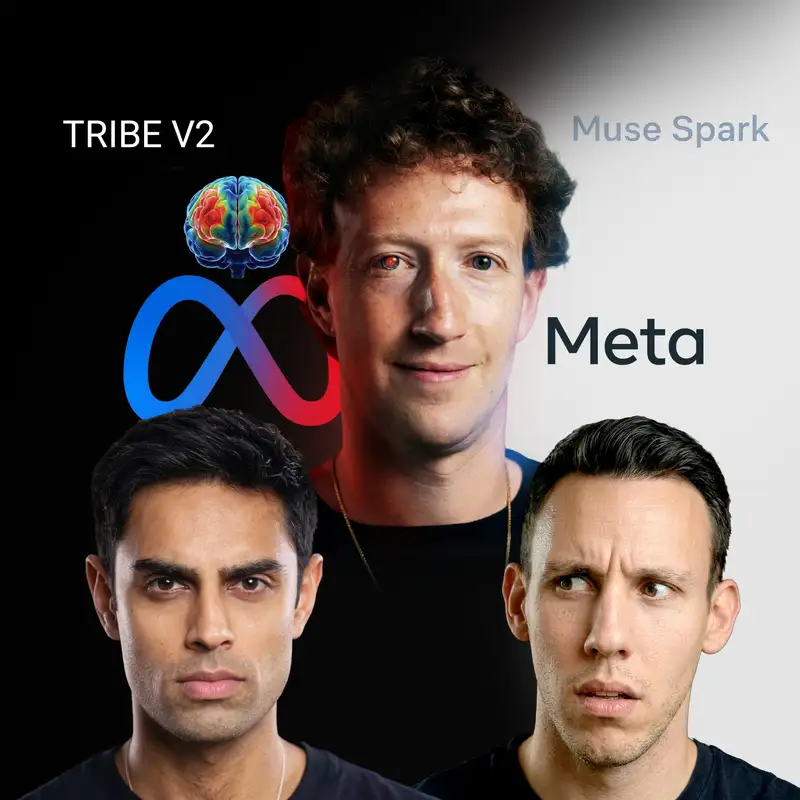
THIS WEEK IN AI: Real Anthropic Revenue, Meta Muse Spark, OpenAI's Next Model
Josh:
This week, Meta released MuseSpark, its new flagship AI model built from scratch
Josh:
by Alexander Wang's Super Intelligence Lab.
Josh:
And noteworthy for the very first time, it's not open source.
Josh:
They closed source the entire model, but the model isn't what caught our attention, it's distribution.
Josh:
MuseSpark is rolling out across Facebook, Instagram, WhatsApp,
Josh:
and the Rayvan Metaglasses to over 3 billion users.
Josh:
That's more than every other AI company on Earth has. This is a really big deal.
Josh:
Meta's been calling us personal superintelligence. You log in with your Facebook
Josh:
or your Instagram account, and then the model pulls from your social graph that
Josh:
it has based on the past, what, decade that you've been using these applications.
Josh:
So no other model in the world has the type of information that this new meta
Josh:
AI model is going to have. Now, here's where it gets interesting.
Josh:
Meta is also developing another research project in parallel called Tribe V2,
Josh:
something that almost nobody's talking about, but it's trained on brain scans from human beings.
Josh:
And it understands how you react to certain imagery in certain videos so that
Josh:
it knows when a video or a piece of content is going to light up part of your
Josh:
brain that makes you interested and engaged.
Josh:
Now, they're claiming to do both of these separately and in parallel,
Josh:
but you have to ask the question, what happens when these things merge together?
Josh:
What happens when Meta knows everything about you, they know everything that's
Josh:
going on in your brain, and they're able to serve the absolute best content possible.
Josh:
They become the 21st century drug dealers through this artificial intelligence.
Josh:
And maybe that's a doomer take.
Josh:
I know, Ejaz, you have a very different take on this, perhaps.
Josh:
We're going to talk about that and a lot of other things on today's episode,
Josh:
including Anthropik's not-so-real annual recurring revenue. We have some news
Josh:
around OpenAI and then some cool robotic arms that we actually had the guest on a few months ago.
Josh:
He is back with the final products. There's a lot going on this week,
Josh:
but first, Meta, Ejaz. Meta's a pretty big story this week.
Ejaaz:
They released MuseSpark, which is the first Frontier AI model that they've released
Ejaaz:
in over a year now, which is a crazy amount of time in the AI world. Now, I'm going to
Ejaaz:
I'm thinking about the story arc of Meta, and it's hard to be over-enthusiastic about this model.
Ejaaz:
Last year, Zuck burned around $75 billion on AI CapEx.
Ejaaz:
He then fired 600 of his AI staff, and then hired 150 more staff,
Ejaaz:
spending $25 billion to do so.
Ejaaz:
$15 billion, of which he used to hire one guy, Alex Wang, who leads Meta Super
Ejaaz:
Intelligence Labs, who helped build this model. So I'm expecting big things at this point.
Ejaaz:
Unfortunately, the model underperforms Claude Opus 4.6 and GPT 5.4 across the
Ejaaz:
most important benchmarks, which is coding and reasoning.
Ejaaz:
So it's easy to be bearish about this model, but I dug into it more.
Ejaaz:
And what I realized is that's not what Zuck or Meta is going after at all.
Ejaaz:
They're going after what I'm dubbing personal AGI.
Ejaaz:
Personal AGI is basically super intelligent AI that's trained on your own personal
Ejaaz:
data. It'll become an AI assistant that basically lives and breathes you.
Ejaaz:
So how is Meta going to be able to pull this off versus all the other competitors
Ejaaz:
who are leagues ahead of them?
Ejaaz:
Well, they have something that none of them have, which is the personal data
Ejaaz:
and very incriminating data of 3.4 billion daily active users.
Ejaaz:
So not only do they have a crap ton of data, they also have the data being refreshed every single day.
Ejaaz:
Now, I'm personally not a user of Facebook, but I use WhatsApp.
Ejaaz:
I use Instagram every single day.
Ejaaz:
So they have already collected a bunch of data around what type of conversations
Ejaaz:
I'm having, what type of media that I'm liking, what kind of memes that I enjoy.
Ejaaz:
And they can use this to engineer the perfectly crafted AI assistant that no
Ejaaz:
other lab can do. And this is what they're doing.
Ejaaz:
So the benchmarks that do matter, if you look at this table over here,
Ejaaz:
they excel or this model excels in visual reasoning and multimodality.
Ejaaz:
So it can look at a picture and understand it and perceive it better than Opus 4.6 and ChatGPT 5.4.
Ejaaz:
And so if they're going to end up building a model that ultimately can feed
Ejaaz:
you a better algorithm or feed you the best content, this is going to be the
Ejaaz:
model that enables that. And that's what they're doing.
Josh:
Yeah, the personal AGI, it's a good way to put it. I don't think this needs
Josh:
to be everything for everyone. This just needs to be better than nothing.
Josh:
Because the reality is that a lot of people still aren't using these AI tools
Josh:
in their day-to-day life.
Josh:
What I found interesting is the examples that they showcase.
Josh:
Now, we don't actually know what it looks like applied to these social media
Josh:
networks. We're not sure what that integration is going to look like.
Josh:
But they showed a few examples in the blog post that they shared,
Josh:
which is it has the visual intelligence.
Josh:
When you point your camera at something like a refrigerator,
Josh:
say, it knows what's in there. it can calculate the amount of protein in that
Josh:
block of cheese or the amount of calories in that hamburger that's sitting there.
Josh:
And I think that's really interesting.
Josh:
They had another example of someone who was doing yoga and you could actually
Josh:
analyze the positions of the arms and the legs and the body and you could see
Josh:
if they were doing it properly.
Josh:
So the visual element of it, I think the native multimodality is something that's
Josh:
pretty noteworthy and interesting.
Josh:
Yeah, here's the example of the food. Here's the yoga pose.
Josh:
I'm not sure what that looks like fully integrated into...
Josh:
Our social media experiences today, outside of what could be just like a much stronger algorithm.
Josh:
But they did release meta.ai, which is a website that you can go to to actually
Josh:
try this out yourself and run some tests.
Josh:
So I would encourage anyone who's curious, who wants early access to the model
Josh:
before it hits your Instagram feeds or WhatsApp to go actually on the website
Josh:
and check it out for yourself. It's available for anyone with an account.
Ejaaz:
Yeah. And it's been a labor of love for Zuck. I think he famously said on an
Ejaaz:
interview about a month ago that he is willing to spend the entire wallet on
Ejaaz:
AI CapEx and training the best AI model versus risking losing out on this race entirely.
Ejaaz:
He would rather make an incredibly expensive mistake than produce a subtale model.
Ejaaz:
They spent the last nine months pre-training this model. Fun fact,
Ejaaz:
typically pre-training takes
Ejaaz:
around a couple of months and then you kind of go into post-training.
Ejaaz:
So they've invested a lot of time, money and heart into this.
Ejaaz:
So that's why I'm kind of like, I'm kind of split as to why this model isn't
Ejaaz:
as good enough. They delayed it.
Ejaaz:
They delayed its own launch about a month as well. But the CapEx spend keeps on going.
Ejaaz:
They today announced a partnership with CoreWeave to the tune of $21 billion.
Ejaaz:
So they're just pushing ahead with all the data center type stuff.
Ejaaz:
But you mentioned a model earlier on, Josh, which kind of went viral a couple of weeks ago.
Ejaaz:
And this is the scary part of this entire story. I would love to think that
Ejaaz:
Meta is in my best interests and wants me to become a better productive human.
Ejaaz:
But stuff like this, this new model, Tribe V2, which basically reads your brain
Ejaaz:
signals and predicts what type of content is going to stimulate different parts
Ejaaz:
of your brain and make you more engaged in certain types of content, doesn't give me hope.
Ejaaz:
Because presumably, they're going to use this model to understand what types
Ejaaz:
of content stimulate different people's appetites for videos,
Ejaaz:
reels, memes, or whatever that might be.
Ejaaz:
And then AI generate this exact amount of content that they can feed you in
Ejaaz:
the timeline, because they already have the distribution, right?
Ejaaz:
They already have the social media platforms, they can create and perfect the
Ejaaz:
content and own that without relying on creators.
Ejaaz:
They now have a recursive dopamine loop that they can just trap you in.
Ejaaz:
Doesn't give me hope. Maybe that's a do my take.
Josh:
Well, I'm curious what the stated intention of this model is, right?
Josh:
It's like, why are you trying to understand how the brain reacts to certain
Josh:
type of content? And sure, it's interesting.
Josh:
I know they're working on their metaglasses and they have that like wrist strap
Josh:
that's kind of like a neural interface that detects your hand movements and
Josh:
understand this information is probably more helpful to their future hardware products.
Josh:
But also, I mean, the clear and obvious use case
Josh:
for this is understanding what types of impulses trigger
Josh:
when you watch a specific type of content and then funneling that
Josh:
into your feed on a daily basis and luke who
Josh:
is behind the scenes he was mentioning earlier that in a way
Josh:
they become like the this high-end drug dealer that can feed
Josh:
you like some dopamine here or some cortisol here and they know exactly
Josh:
how a video is going to hit your brain and in fact they can optimize those
Josh:
videos through a very tight feedback loop to improve them to a point in which
Josh:
it can guarantee that the part of your brain that they want to fire will fire
Josh:
and that level of deep understanding not only from the data and preferences
Josh:
they've collected over the last decade but also now understanding the biological
Josh:
brain and truly at a deep level how it works.
Josh:
I can see the good use cases for it, but man, it gets scary quick because they
Josh:
have their Vibes app. I don't know if anyone remembers it.
Josh:
I'm not sure anyone's even used it, but it's the short form scroller that is
Josh:
AI generated content only. And this is like injecting that with steroids.
Josh:
And I could see a world in which this content gets very good very quick.
Josh:
And is it a good or bad thing?
Josh:
That is TBD. You can argue that I would prefer to get good ads that are personalized
Josh:
for me that actually sell me things that I'm interested in versus nonsense.
Josh:
But at the same time, it's not my decision because they will have more understanding
Josh:
of how my brain works than even I will. And that's a little unnerving.
Ejaaz:
I'm going to argue on the side of Skynet. It's a bad thing.
Ejaaz:
Prove me wrong, Suck, if you're watching this or anyone from Meta. I would love to know.
Ejaaz:
Tell me the counter argument. But the good news is, even if they are going after
Ejaaz:
your brain and hijacking your dopamine circuits, you might be able to get paid for it.
Ejaaz:
This was a story that broke a few weeks ago where this kid, or I think she's
Ejaaz:
like a young adult now, basically won a court case against Meta and YouTube
Ejaaz:
where she got paid $3 million.
Ejaaz:
For the effects of social media, specifically Meta's platforms and YouTube,
Ejaaz:
had on her depression and personality, her core years that formed her adolescence.
Ejaaz:
She got a three million paycheck.
Ejaaz:
I'm wondering if I could do this because I definitely suffered from a lot of this growing up.
Josh:
Yeah, what a come up. I mean, it sets a somewhat dangerous precedent,
Josh:
right? It's like I spend a lot of time on my computer and my mental health,
Josh:
sure, it could be improved.
Josh:
Am I eligible for a $3 million raise? And if not me,
Josh:
I certainly know some other people nearby that definitely qualify
Josh:
for this if that's the parameter that counts so three
Josh:
million dollar paycheck i don't know not a bad deal dangerous precedent
Josh:
if people are going to be able to start claiming that um as they go because
Josh:
i mean again this company has it's done a lot of great things but social media
Josh:
as a whole has generated a lot of damage specifically around um the meta-owned
Josh:
companies and we'll see what happens meta has been disappointing they continue to be disappointing
Josh:
But I am hopeful that a founder-run company led by someone like Zuck can figure
Josh:
out a way to really turn this into something special and meaningful and positively impactful.
Josh:
So we'll see. I think that is the meta story.
Josh:
Now we have another story that has left me a little unnerved,
Josh:
which is the annual run rate revenue story between Anthropic and OpenAI and
Josh:
how they're actually counting their revenue.
Josh:
Because the headline is that what? Anthropic just went from $19 billion to $30
Josh:
billion in annual revenue in like a month.
Ejaaz:
Yeah. So the breaking news here was that Anthropic had signed a multi-billion
Ejaaz:
dollar deal with Google to basically use their GPUs to train Claude.
Ejaaz:
But there was a hidden nugget in this article, which revealed that Anthropic's
Ejaaz:
revenue run rate, their ARR, has officially hit $30 billion.
Ejaaz:
Now, for context here, at the end of last year, it was $9 billion.
Ejaaz:
At the start of the year, it had just about hit around $12 billion.
Ejaaz:
Last month, it hit $19 billion. In a single month, it has gained $11 billion.
Ejaaz:
Now, that's the result of Claude Opus being amazing and the rumored Mythos model,
Ejaaz:
which is now confirmed, we did a whole episode about this, being as good as people claimed.
Ejaaz:
So people are obviously buying Claude subscriptions and running their revenue rate up to $30 billion.
Ejaaz:
I thought this was amazing until we had a conversation this morning,
Ejaaz:
Josh, where you said that this is fake news?
Josh:
This is nonsense. The accounting is technically GAAP compliant,
Josh:
but the way that they get there is so vastly different that you really can't
Josh:
compare the two companies together.
Josh:
I mean, this example is showing Anthropic is at $30 billion of annual revenue
Josh:
and OpenAI is at $24 billion.
Josh:
But then explain to me why OpenAI is valued at twice the current valuation of
Josh:
Anthropic. It's an accounting problem.
Josh:
Now, open ai has a deal with microsoft where open ai shares 20 of its revenue
Josh:
with microsoft in the financial statements it counts those sales before that
Josh:
deduction but for like azure cloud customers buying open ai models open ai only
Josh:
books 20 of that cut as the revenue
Josh:
And Anthropic, they have a deal with AWS, Google, and Microsoft,
Josh:
and all three of those cloud providers resell cloud to their customers.
Josh:
Anthropic books the entire thing as revenue, and then marks off the 80% cut
Josh:
as a line item in marketing expenses.
Josh:
And that is such a huge difference. I mean, both of those are technically GAAP
Josh:
compliant, but they produce very different top line numbers.
Josh:
And I think this is really important. And a lot of people are missing this,
Josh:
That when they see Anthropic projecting a $30 billion annual recurring revenue,
Josh:
that's only projecting out what they've currently done for the last four weeks.
Josh:
And it's counting all revenue, including the amount that they're going to have
Josh:
to give back to AWS, Google Cloud, and Microsoft Azure.
Josh:
And that's like a huge accounting difference. That is a big problem that I don't
Josh:
think a lot of people are taking note of.
Ejaaz:
I have so many thoughts on this. Number one, how is this compliant and legal?
Ejaaz:
Why are they allowed to do that?
Ejaaz:
Number two, this is financial accounting crime. They shouldn't be able to do that.
Ejaaz:
But something isn't adding up for me, which is one thing that I see a lot of
Ejaaz:
these articles comparing is how much revenue they're making,
Ejaaz:
but also how much they're burning.
Ejaaz:
So for example, with OpenAI, they're making, let's say, $25 billion this year,
Ejaaz:
but they're also burning $25 billion dollars.
Ejaaz:
And so if Anthropic is moving the line item for their cost center to just say
Ejaaz:
marketing, shouldn't their burn rate still be higher than what is being reported on?
Ejaaz:
Like something doesn't make sense. Like, is the Financial Times just wrong and
Ejaaz:
they're missing this line item completely? Or is Anthropic genuinely just not
Ejaaz:
burning as much still and they're still on track to making a profit by 2028?
Ejaaz:
Because that's what all the projections have it at, right?
Ejaaz:
They're going to be making a profit or turning a profit much sooner than OpenAI
Ejaaz:
is who are spending way too much on capex so there's something i'm missing though.
Josh:
Yeah i wonder if they're not counting it as burn because it's it's technically
Josh:
not like they they are earning money on it just 20 of what they are actually
Josh:
putting on the accounting book so like they're not actually burning cash they're
Josh:
just accounting for more cash than they're going to right but the
Ejaaz:
80 is being put on the marketing expenses book right well i'm not misunderstanding that.
Josh:
Uh, that one we're going to have to talk to an accountant about. I'm not sure.
Josh:
I do know that we are comparing apples to oranges though. And we look at open
Josh:
AI and Anthropics run rate. And I think this is something that,
Josh:
um, an IPO is going to fix.
Josh:
Once we have all of these documents publicly stated again, a lot of this is insider reporting.
Josh:
You need a subscription just to access this document that we're showing on the screen.
Josh:
It is this like really messy, uh, article also in the article or really messy accounting.
Josh:
And also in the article, they mentioned how they count their revenue,
Josh:
which is just projecting their prior four weeks out for a multiple of 13 to
Josh:
account for all 52 weeks.
Josh:
So there's a lot of handwaving going on in order to make these numbers go up into the right.
Josh:
I just think it's important when you look at these headlines to really take
Josh:
it with a grain of salt and understand that Anthropic actually didn't gain $11
Josh:
billion in revenue in like a week. That's not happening.
Josh:
They're just doing these funny accounting methods to make things look like they are going great.
Josh:
And they are going great, just perhaps not as great as people perceive.
Ejaaz:
And it might be getting a lot greater for OpenAI.
Ejaaz:
I mean, talking of like the IPO rumor mill and like boosting valuations,
Ejaaz:
it's all marketing, right? It's all storytelling.
Ejaaz:
And there was a story that Axios broke this morning before we started recording
Ejaaz:
that OpenAI plans to release their next model. Now they're dubbing it SPUD.
Ejaaz:
Some people are calling it GPT 5.5. Some people are calling it GPT 6.
Ejaaz:
But apparently it's going to be so good that they have to do a limited release
Ejaaz:
that they can't release it publicly because it's too good or too dangerous.
Ejaaz:
Now, if that sounds similar, it's because that's exactly what Anthropic did
Ejaaz:
this week, announcing Claude Mythos, their next AGI-like model,
Ejaaz:
which they're not releasing publicly because it's a cybersecurity risk.
Ejaaz:
It discovered 1,000-plus security vulnerabilities.
Ejaaz:
And what was interesting about that entire news cycle earlier this week is someone
Ejaaz:
commented and said, well, if it's that good and if it's that expensive,
Ejaaz:
we're probably not gonna get to use this model for our next another couple of months, basically.
Ejaaz:
And OpenAI's head of model training, Thibault, basically said,
Ejaaz:
Uh, I wouldn't count on that. He said, um, dot, dot, dot, which implies that
Ejaaz:
OpenAI is going to release a very similarly capable model very soon.
Ejaaz:
So that's what, uh, that's the news that basically Axios broke.
Ejaaz:
But I just want to point out, I want to check myself here that it might also be fake news.
Ejaaz:
Um, this post from Dan Shipper apparently spoke to someone within OpenAI and
Ejaaz:
he basically said his, his contact basically said that we're talking about a
Ejaaz:
different model here that is, uh, hyper-focused on cybersecurity specifically.
Ejaaz:
Typically, and it'll be a separate release to GPT-6.
Ejaaz:
So at this point, I have no idea what's going on, but I know that OpenAI's valuation
Ejaaz:
for their IPO has probably gone up in the space of time that this has happened.
Josh:
Yeah, I can't imagine they don't already have a model that is close to Mythos, if not already there.
Josh:
And if they don't, then they're, I'm sure, just weeks behind actually having something like that.
Josh:
What I found interesting about this story is it says that they're working explicitly
Josh:
on a cyber product, which implies that it's for cybersecurity.
Josh:
And with Claude Mythos, they weren't actually training it on cyber at all.
Josh:
It was just a downstream effect of really powerful code.
Josh:
And when I think about the pivot that OpenAI has had recently from retail to
Josh:
enterprise, a lot of that focus has been around code.
Josh:
So I wonder if they're just building a really strong coding model and this is
Josh:
a downstream effect, or if they're genuinely training something explicitly on
Josh:
cybersecurity. And I have to imagine, if it's trained explicitly on cybersecurity...
Josh:
It probably will become better than mythos and then
Josh:
you have to ask the question what happens three months from now
Josh:
when these tools actually do become available and also who's going
Josh:
to decide when to release them if open ai is taking the clod route or
Josh:
the anthropic route and they're keeping it private well now suddenly
Josh:
we have everyone's worst nightmare where the labs are kind of all working together
Josh:
they all have the most powerful stuff and there is no counterbalance to whatever
Josh:
they decide to do with it and they in a way become those king makers and when
Josh:
you think about like the Department of War contract that we had this whole episode about is a big mess.
Josh:
Anthropic kind of has all the leverage. And if OpenAI moves with them,
Josh:
they have the ability to crack nation state software at will.
Josh:
And that seems really powerful. And they are now the gatekeepers.
Josh:
And I don't know, Chris, a lot of interesting questions as we move into this
Josh:
next paradigm of Blackwell models that are unbelievably powerful.
Ejaaz:
But as we mentioned earlier, Project Glasswing, Anthropic mentioned their breaking
Ejaaz:
tier model, Claude Mythos, which is coming out. We did an entire episode about
Ejaaz:
this earlier this week. Definitely go and check this out.
Ejaaz:
Now, I want to end this segment on a bit of chart crime, Josh,
Ejaaz:
because now that you've told me about the fake revenue numbers,
Ejaaz:
I can't look at this Wall Street Journal analysis and think,
Ejaaz:
is Anthropik's numbers fake? On the left here, we see yearly AI model training costs.
Ejaaz:
And it basically shows that OpenAI is spending way too much money.
Ejaaz:
And Anthropik is spending a fraction of that.
Ejaaz:
But now I'm realizing that that's probably in projection with their revenue.
Ejaaz:
And if you look at the bottom left over here, it shows that they're kind of the same.
Ejaaz:
So I think there is some chart crime or county crime happening with Anthropic,
Ejaaz:
and I want that to be talked about more.
Ejaaz:
But it's not all rosy with OpenAI.
Ejaaz:
They did have the UK Stargate project go down, right?
Josh:
The whole Project Stargate thing is really just a huge disappointment.
Josh:
It was supposed to be this giant grand buildout domestically, internationally.
Josh:
I think they also did this in Saudi Arabia, somewhere in the Middle East.
Josh:
They were planning to build one. They didn't do it in the UK.
Josh:
They're not doing it in the U S they're not doing it. Project Stargate was really
Josh:
just as big, like raw, raw project that was initiated with the government.
Josh:
Elon famously said the post the day that it was announced, you don't have the
Josh:
money to do this. Turns out he was right. No one actually wants to foot the bill for this.
Josh:
Logistically, it's very technical and challenging. And it turns out it's just
Josh:
really hard to build things at scale,
Josh:
particularly internationally in places like Europe and the UK,
Josh:
where there's a lot of regulatory issues, both environmental and energy related,
Josh:
that just make doing these things incredibly difficult.
Josh:
And we're seeing it here domestically. We have a story a little bit later about
Josh:
AI data centers and how they're just having a really tough time getting them
Josh:
online. And this is probably one of the future trends that we're going to look
Josh:
out for is just the idea that building these data centers is hard.
Josh:
And not always just because of the technicalities, but also because of the regulation
Josh:
and legislation associated with this and the public sentiment. It's not looking good.
Josh:
There is certainly a rift in the world right now between people who want to
Josh:
build these things and people who do not.
Ejaaz:
Shifting gears slightly, I wish Anthropix Claude Mythos was the main headline,
Ejaaz:
but they're still shipping other products somehow.
Ejaaz:
Maybe they're using an AGI-like model to do so, right? They announced a new
Ejaaz:
product called Claude Manage Agents, which is basically, think of AWS,
Ejaaz:
but for spinning up AI agents.
Ejaaz:
It's a platform that allows you to design and architect an agent through a single
Ejaaz:
prompt or a couple of prompts.
Ejaaz:
You can amend the memory, a bit of its own custom design, and then launch it,
Ejaaz:
which may not sound novel, right?
Ejaaz:
You could create AI agents before, but there's a distinct difference here.
Ejaaz:
Typically, when you create an AI agent, you can't scale it to your millions of users.
Ejaaz:
Let's say if you're a Fortune 500 company, because you need to set up a bunch
Ejaaz:
of other production and dev tooling environments in order to support that.
Ejaaz:
That typically takes anywhere between three to six months.
Ejaaz:
Now, I ran a bit of the math on this. Typically, an app development at scale
Ejaaz:
for, say, a million users costs around $50,000, depending on the specific type
Ejaaz:
of feature or product you want to launch.
Ejaaz:
This reduces it down to $100. That's like a 500x reduction, and you can do it in under an hour.
Ejaaz:
But there is a new cool thing that this product unlocks. Josh, can you guess it?
Josh:
I'm going to guess the end of white call it work or am I being dramatic?
Ejaaz:
Well, that's also that, but they figured out a new revenue run rate for them.
Josh:
Of course they did. Of course they did.
Ejaaz:
Right now. Now listen to this genius plan, right?
Ejaaz:
Typically, every single AI model provider charges you based on the amount of tokens you use.
Ejaaz:
Tokens in, tokens out, you pay a subscription, or you pay an API cost.
Ejaaz:
Anthropic, for this product, is charging you for the amount of time that your
Ejaaz:
agent takes to think of a solution.
Ejaaz:
So the tokens it's using to think is now being charged to the tune of $0.08
Ejaaz:
per call. Now, if you assume that, and I actually don't need to assume,
Ejaaz:
they used a live example of Sentry processing 1 million bug reports.
Ejaaz:
If each agent session is 10 minutes, that's 166,000 session hours,
Ejaaz:
which turns out to be around $13,000 per run in fees.
Ejaaz:
That all adds up massively. If you're a massive corporate enterprise where you
Ejaaz:
distribute this platform to whatever, 50 plus teams, you end up making millions of dollars.
Ejaaz:
Genius unlock anthropic well done i'm clapping for you also you're going after
Ejaaz:
all the other startups out there you probably killed out a bunch of different
Ejaaz:
agent harness startups that will value their billions of dollars well done.
Josh:
If you use a computer you just have to assume that
Josh:
you're months away from no longer needing to use a computer for anything you
Josh:
don't want to do yeah um it will just be automated you
Josh:
can have the computer watch your screen emulate your decision making processes
Josh:
do all the clicking and thinking that you would need to do in order
Josh:
to accomplish whatever you're trying to do and that's been
Josh:
it's been a recent realization particularly with mythos about how close we are
Josh:
to this reality and i have to imagine that all these features are being built
Josh:
with that model and are therefore resulting in this incredibly fast iteration
Josh:
loop that anthropic's having where every day we get some like groundbreaking
Josh:
technological impact if you just push this out three months six months even 12 months
Josh:
there's no way that you're going to need to use your computer for anything you
Josh:
don't want to it It will just automate the entire process for you.
Josh:
So Anthropic with another big win. Quad is just on fire. The rate of acceleration
Josh:
is truly through the roof.
Ejaaz:
Josh, are you a Black Mirror fan?
Josh:
Oh, huge fan. Watched every episode.
Ejaaz:
Huge fan. So what if I told you there is now a robotic lamp that you can buy
Ejaaz:
that turns into pincers that can fold your clothes, make your bed,
Ejaaz:
and maybe make you a cup of coffee?
Josh:
You buy that? I say 100% chance it stares me through the heart when I'm sleeping.
Josh:
But I'm going to hope that's not the case because we actually did have this
Josh:
founder on the show a while back to talk about this product, which is now out?
Josh:
Yes. Kind of. On a second, Cali, explain what's going on here.
Ejaaz:
Okay. So what you're seeing on your screen is a lamp which basically extends
Ejaaz:
into a robotic arm and it can do a bunch of chores for you.
Ejaaz:
So what you're seeing on the screen is this lady is apparently putting her clean
Ejaaz:
laundry on the front of her bed and her lamps are now activating.
Ejaaz:
And now you can see their claws coming out and they can start folding your clothes
Ejaaz:
and making your bed or starting your record player.
Ejaaz:
And the point is robots are going to be pretty pervasive in human society.
Ejaaz:
They may not necessarily look like humanoids. And that's the point that Sincere
Ejaaz:
and Aaron Tan, the founder, is aiming at.
Ejaaz:
Now, the last time that we spoke about this founder, he only had a mock-up.
Ejaaz:
And to be honest, the lamp looked pretty scary. The pincers were much larger.
Ejaaz:
It's nice to see that they've now got like a kind of curved metal piece over
Ejaaz:
the pincers. So maybe they can't necessarily stab you. It's more colorful, it's more amenable.
Ejaaz:
It looks kind of slow, but the good news is you can start ordering this right now.
Ejaaz:
I signed up on the wait list and I got an email the other day saying,
Ejaaz:
hey, you can now order this thing. I don't know when they're gonna start delivering
Ejaaz:
it, but it might be something that I try out. Are you trying it out?
Josh:
No, I will not be trying this out. Okay.
Josh:
I love founders who are trying cool things. And I think building a narrow use
Josh:
robot like this is so cool.
Josh:
The design is awesome. It's a lamp that does robot things. And that's very cool.
Josh:
When I look at the trailer here, and this isn't really showing many use cases,
Josh:
one of which is the folding of laundry.
Josh:
You kind of see the actuators there. They're a little like fidgety.
Josh:
They're not quite smooth.
Josh:
They're like, it doesn't seem that it's moving very quick. I can't imagine this many use cases.
Josh:
Like we're looking at a robotic lamp that is being manually adjusted and turned.
Josh:
Like why is that happening there's a lot of questions i have about what the
Josh:
actual use cases of something like this are and how effective it is at those
Josh:
use cases but again i love the idea that people are trying new things and trying
Josh:
to build something unique with beautiful design that's actually effective inside
Josh:
of a home and as soon as you get yours delivered i'm coming over and i'm trying
Josh:
it out because i want to see i
Ejaaz:
Might be dead so i don't know maybe you're recovering my corpse at that point
Ejaaz:
josh but in other news space x ai is back and they've signed a massive partnership
Ejaaz:
with Intel, American made fabricator of AI chips.
Ejaaz:
And the question becomes, why on earth are they doing this? Well,
Ejaaz:
there's a few different reasons.
Ejaaz:
Number one, Elon Musk announced something called the TerraFab,
Ejaaz:
which is pretty much the most ambitious AI chip manufacturing project that is
Ejaaz:
ever going to be achieved if it does get achieved over the next, say, five to 10 years.
Ejaaz:
The idea is to achieve one terawatts worth of compute, 80% of those AI chips
Ejaaz:
are actually getting sent out to space to harvest the sun's energy to train
Ejaaz:
AI models, presumably Grok.
Ejaaz:
Now, if all of that sounds insane, we have a bunch of episodes that you can
Ejaaz:
go and check out and we explain everything.
Ejaaz:
But the point is, why Intel specifically?
Ejaaz:
I think there's two main reasons. Number one, you need these AI chips to be
Ejaaz:
American-made and American-manufactured.
Ejaaz:
AI has become a huge geopolitical weapon and taiwan the threat of taiwan being
Ejaaz:
taken over by china and tsmc being.
Ejaaz:
Within Taiwan is a massive threat to the US AI production of AI models,
Ejaaz:
GPUs, etc. NVIDIA realized heavily on TSMC.
Ejaaz:
Intel is the closest American-made lab or manufacturing plant that we can get
Ejaaz:
to building A-grade AI chips.
Ejaaz:
But why is Elon signing up with Intel specifically?
Ejaaz:
There was this little nugget that I saw Robert Scoble post about,
Ejaaz:
which is there's this compound called gallium nitride, which basically makes
Ejaaz:
these AI chips radiation-hardened, which, there you go,
Ejaaz:
is going to make it perfectly suitable to launch these AI chips into space.
Ejaaz:
So Elon's already thinking way in advance.
Ejaaz:
Robert got into a bit of trouble because he published that Elon had liked this
Ejaaz:
tweet, aka confirming that this was partially the reason why they did that.
Ejaaz:
But yeah, this might be the next unlock for achieving the TerraFap. It's pretty cool.
Josh:
It's one of the most ambitious projects I think any company is undertaking on earth.
Josh:
There's no one who's really trying to offset this monopoly that exists on chip
Josh:
fabrication and production.
Josh:
And I think one of the most important things that's underrated about the TerraFab
Josh:
is the fact that they have a separate staging facility separate from the TerraFab
Josh:
that has all of the required pieces needed to make these chips.
Josh:
It has the lithography, it has the masking, it has the packaging.
Josh:
And what that allows you to do is iterate very quickly on the actual design
Josh:
of these chips. A lot of times a chip gets submitted and then a year goes by
Josh:
or even longer until you actually have the full thing completed.
Josh:
This compresses that iteration cycle because it's all into one roof and allows
Josh:
them to make chips that are far better very quick because they can do all the testing in one place.
Josh:
And they can even do that prior to the TerraFab going fully online because it's
Josh:
a small sample set of that.
Josh:
The TerraFab is going to be hard. I'm sure there's going to be a lot of negative
Josh:
press as they make mistakes and as things get delayed.
Josh:
But the outcome of the terafab is so
Josh:
profound that it's hard to imagine a world in which tesla
Josh:
does accomplish this at scale or spacex ai does accomplish
Josh:
this at scale and they are collectively not the most valuable company in the
Josh:
world because that implies not only do they have the chips but they have the
Josh:
robots they have the satellites they have the spaceships they have all the infrastructure
Josh:
required for this next generation of embodied ai of space trained intelligence
Josh:
and super super intelligence and I'm really bullish on it.
Josh:
Intel's badass. I'm glad they're helping them, and I'm just so stoked for the
Josh:
tariff app in general. This is going to be a fun one to follow over the next few years.
Ejaaz:
Yeah. I have a huge Intel bag, so please, please, please keep signing all these partnerships. Please.
Ejaaz:
Now, the reason why Josh and I started this show, the reason why we do Limitless
Ejaaz:
is we're very optimistic about the tech.
Ejaaz:
Now, we know that there's a lot of doomerous takes, but the fact is we believe
Ejaaz:
AI is going to change the world for good, and there are many different ways
Ejaaz:
that we think that's going to happen, and we're going to track every single news story.
Ejaaz:
Supports that. But there are obviously people in the world that don't believe that's the case.
Ejaaz:
And unfortunately, this week, we had a pretty serious story where someone fired
Ejaaz:
13 shots into the home of an Indianapolis counselor with a note reading,
Ejaaz:
no data centers left at the scene.
Ejaaz:
Now, we don't know the exact motivations of this person, because I don't believe
Ejaaz:
they've been caught just yet.
Ejaaz:
But you can hypothesize what the takes are, which is stuff that we've covered
Ejaaz:
on the show before, which is people are worried that data centers are going
Ejaaz:
to empower AI models that are going to eventually replace them or take their job.
Ejaaz:
They're worried about the energy costs. They're worried about the water consumption.
Ejaaz:
Now, the issue with this is, number one, AI data centers take up less water
Ejaaz:
than your average golf course.
Ejaaz:
That's like in your neighborhood itself. We did a whole episode covering this.
Ejaaz:
Number two, for the electricity charges that kind of increase for people's bills,
Ejaaz:
a lot of governments and states have mandated that the AI labs responsible for
Ejaaz:
this pay for that extra surplus so that it doesn't actually hit you.
Ejaaz:
Also, we're working on different ways to deal with this electricity consumption,
Ejaaz:
like launching GPUs into space. So it's just a sad and very concerning story to see.
Ejaaz:
There's a growing contingency of people that are against data centers,
Ejaaz:
and I understand the concerns, but this shouldn't be the way to deal with it.
Josh:
This is dark. You know what's way worse than not having data centers?
Josh:
Trying to getting mythos first and then using it to attack all of our infrastructure
Josh:
and then using it to iterate and build even more powerful models that are even
Josh:
more dangerous, more harmful, and then applying that back to us.
Josh:
And I think the impact of that is far greater than the impact of some patch
Josh:
of grass that is so detached from most towns getting turned into a data center.
Josh:
And I think the moral dilemma here is that people are saying they want one thing
Josh:
and then doing something else.
Josh:
And it's disturbing to see the sheer size of the population that doesn't want
Josh:
to move forward as it relates to AI and progress,
Josh:
totally unaware of the fact that this moves on whether we're a participant or not. And...
Josh:
As these things become more powerful, there's a lot more profound downstream
Josh:
effects of not having these models in our core, having them like having the power on our side.
Josh:
And I hope that this becomes more of a realization for a lot more people.
Josh:
There's this clear divide happening now where it's like people who are using
Josh:
these AI tools to further empower themselves and to do better work in their
Josh:
lives or to handle more things in their personal lives. and then those who don't.
Josh:
And that K-curve that's going to come out of this in the economy,
Josh:
in society, just throughout our general day-to-day lives is going to become pretty wide.
Josh:
And I hope a lot of people really reflect on
Josh:
What it looks like to like actively be on the wrong side, be on the slowdown
Josh:
side of history, be on the, what is it?
Josh:
The deceleration side of history and like what the actual implications of that
Josh:
are as we continue progress forward.
Josh:
I don't know. It makes me sad, but hopefully it's something that will change over time.
Josh:
And perhaps it's just a messaging thing. It's funny. A lot of people that hate
Josh:
SpaceX were very excited about Artemis.
Josh:
So perhaps like the goals are the same. We just need to package them differently.
Josh:
In a way that's more digestible that these mobs can get behind.
Josh:
And I don't know, maybe it's a messaging thing. Maybe it's a moral thing.
Josh:
But that's where we'll leave you at the end of this week on the conclusion of the AI Roundup.
Josh:
That's four episodes in a single week about all of the hottest topics.
Josh:
If you missed anything, you can go back and watch them.
Josh:
I think it's been a big week. I mean, we had a few huge models released.
Josh:
We had Mythos. We had OpenAI versus Anthropic.
Josh:
We had Gemma 4, which was very cool and a very powerful model.
Josh:
But that wraps up everything for this week. Gijos, any final thoughts before
Josh:
we let these lovely listeners go?
Ejaaz:
Nope. Thank you guys for watching and listening. I'm curious if you guys have
Ejaaz:
any thoughts on any of the topics that we've discussed today,
Ejaaz:
or if there are any topics that you think we have missed or that you want to hear more of.
Ejaaz:
We are trying to cover any and every breaking topic, as well as some novel analysis
Ejaaz:
into the actual tools. It's one thing announcing the tools.
Ejaaz:
It's another thing using them. We're going to be doing more demos in the future.
Ejaaz:
But yeah, that's the end of the agenda for this week. And we will see you next
Ejaaz:
week. Thank you guys so much for listening.
Josh:
See you guys in the next one.
Creators and Guests