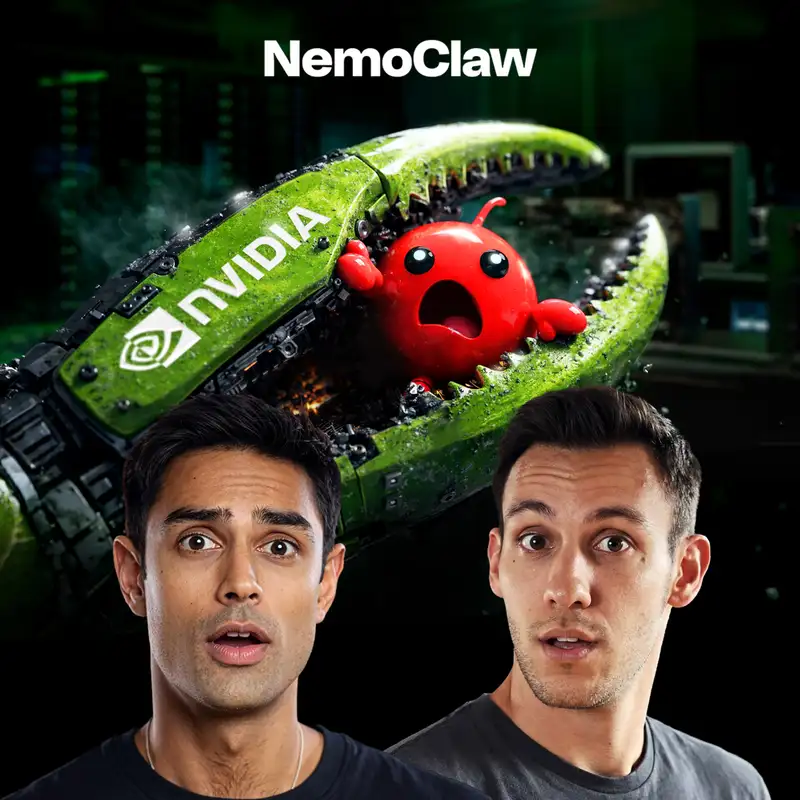
THIS WEEK IN AI: NVIDIA's OpenClaw Killer, Meta Buys Moltbook, Perplexity Computer
Josh:
So over the last month, basically everyone in the world of AI has either experimented
Josh:
with OpenClaw or is actively running an OpenClaw instance.
Josh:
It's this AI agentic framework that allows an agent to go off and do all the things that you want.
Josh:
It could do the work for you, it can buy your groceries for you,
Josh:
it can book you tickets and flights to go on vacations, it can do seemingly everything.
Josh:
But on the backside of that is a lot of complexity and a lot of risk in terms
Josh:
of security that I'm not sure a lot of people are really taking into account.
Josh:
What's happened since then is that a lot of other companies have gotten involved.
Josh:
They've wanted to take the market share away from OpenClaw, which is this open
Josh:
source Wild West version.
Josh:
And just this week, NVIDIA and Jensen Chuang seem to have the alternative figured out.
Josh:
This is coming from an unlikely suspect. We have Clawed, we have OpenAI.
Josh:
Both of those are clearly working on OpenClaw competitors. We're seeing features shipped every week.
Josh:
But to see Jensen get in the ring and announce something called NemoClaw,
Josh:
which is the new open source alternative, it seems like there's going to be
Josh:
a new player in town, and maybe even more with perplexity too.
Josh:
Like a lot is going on in this open-claw world. So if you are an open-claw user,
Josh:
you're gonna wanna tune in for this one.
Ejaaz:
This is a really underrated moment for Nvidia, in my opinion.
Ejaaz:
It is their Apple moment. Now Apple is our geniuses in two things,
Ejaaz:
both the hardware and the software for all cellular phones.
Ejaaz:
They own the app layer and they nail the hardware layer, right,
Ejaaz:
best phones in the industry.
Ejaaz:
NVIDIA is now making its foray into consumer hardware or consumer software, rather, right?
Ejaaz:
So they announced this week that they're going to invest $26 billion over the
Ejaaz:
next five years into open source agents.
Ejaaz:
And NemoClaw, which is their OpenClaw competitor, is going to be one of their major steps in this.
Ejaaz:
So what NemoClaw is, is, as the name suggests, a direct competitor to OpenClaw.
Ejaaz:
It's going to be an agentic platform where you are able to design,
Ejaaz:
create, and spin up AI agents and have them interact with each other.
Ejaaz:
Now, this hasn't been officially announced yet. We're breaking the news right now.
Ejaaz:
But rumors state that these agents will be able to do very similar things to OpenClaw.
Ejaaz:
So you'll be able to get them to do your nine to five job potentially,
Ejaaz:
or you're going to get them to be able to do the shopping for you,
Ejaaz:
like you mentioned earlier.
Ejaaz:
But with one or two different twists, number one, it's going to be way more secure.
Ejaaz:
Now, the number one bit of feedback around OpenClaw is that there's huge amounts
Ejaaz:
of security exposures. people have lost money, personal data,
Ejaaz:
credit card information has been exposed.
Ejaaz:
You won't get any of that with Nemo Call. Number two, the user experience is going to be way better.
Ejaaz:
And Jensen Huang has reportedly stated that he's designing this first and foremost
Ejaaz:
for enterprises, so businesses that want to take their kind of work seriously,
Ejaaz:
but also to the consumer layer as well.
Ejaaz:
And the number one signal that he's demonstrated doing that is making the entire thing open source.
Ejaaz:
The instant thing that I thought of, Josh, is NVIDIA produces the GPUs to power
Ejaaz:
the AI models who power AI agents.
Ejaaz:
And now Jensen is creating the AI agents, which is going to lead to more demand
Ejaaz:
for GPUs. So NVIDIA just keeps on winning.
Ejaaz:
$5 trillion, probably $10 trillion, $15 trillion if this actually hits.
Josh:
Everyone's making their way up and down this AI layer cake, which starts in
Josh:
chips and goes all the way up to the application layer.
Josh:
A lot of people have started the application layer or the model layer.
Josh:
NVIDIA is one of the rare ones that started at the bottom and is working its
Josh:
way up. I mean, we have the
Josh:
what is it the gtx spark nvidia is like small household
Josh:
thing desktop computer sits on your desk and i assume
Josh:
we'll be getting a lot of updates at their gtc conference on monday
Josh:
so this hasn't been confirmed this will be confirmed on monday i strongly suspect
Josh:
it will be called nemo claw they will have their own version of an open source
Josh:
open claw instance and this is a seemingly pretty opportune time because a lot
Josh:
of people have been having issues that we have reported with open claw when
Josh:
you run open claw it's the wild west you're building these systems,
Josh:
you're putting things in place, you're building your own checks,
Josh:
but you're ultimately responsible for managing and orchestrating this huge
Josh:
AI network that begins to grow over time. And Matthew Berman here,
Josh:
he has another great podcast in the AI space.
Josh:
He was talking about how his OpenClaw had a similar issue.
Josh:
And I've seen this a lot around the internet where the OpenClaws get into a
Josh:
bad state and you start to use it and it starts to get worse in terms of output.
Josh:
And then it just totally breaks.
Josh:
And then he followed this up with anyone else having their tokens, keys, secrets,
Josh:
reappearing in plain text after moving them to keychain open claw
Josh:
really wants keys in plain text so he's been having these
Josh:
issues there's another one where the open claw outputs were
Josh:
causing these like duplicate mentions so open claw
Josh:
has been good for some great for others and incredibly challenging for most
Josh:
because a lot of this requires upkeep i'm hoping that what we're going to see
Josh:
is this trend of more rails around this open claw we had it with um nvidia hopefully
Josh:
this week we're going to see claude's been working on this and also perplexity
Josh:
had something fairly interesting right yeah
Ejaaz:
Yeah they announced personal computer, which is basically their version of OpenClaw.
Ejaaz:
Now, Perplexity doesn't actually have their own AI model.
Ejaaz:
They use a bunch of the leading frontier models from the likes of Claude and
Ejaaz:
ChatGPT, but they package it into what they're calling the personal computer,
Ejaaz:
which can toggle your desktop for you, move your mouse around and perform a bunch of actions.
Ejaaz:
You can spin up a bunch of agents in parallel and they can go off and do different
Ejaaz:
things. They can code for you, do your shopping, whatever that might be.
Ejaaz:
Again, an OpenClaw direct competitor. Now, the silver lining across all of this
Ejaaz:
news is that there's a huge amount of demand for these AI agents.
Ejaaz:
In fact, people are paying $6,000 to have someone come to their place or office
Ejaaz:
or work in person and set up OpenClaw from scratch.
Ejaaz:
Now, bear in mind, this is something that you can ask Claw to literally guide you through.
Ejaaz:
And instead, people are paying $6,000. Now, the perks that you get for this
Ejaaz:
is that you are getting an unofficial but official guarantee that there's not
Ejaaz:
going to be any kind of security exploits.
Ejaaz:
And you can have someone just manage the entire thing whilst you can focus on
Ejaaz:
the core business. But to go back to my earlier point.
Ejaaz:
The silver lining is there is insatiable amounts of demand for AI agents.
Ejaaz:
And two, they're actually becoming quite useful. And the likes of OpenAI saw
Ejaaz:
that when they decided to acquire the official OpenClaw open source project.
Ejaaz:
And NVIDIA is now seeing it as well, Perplexity is seeing it as well.
Ejaaz:
So it's kind of like this whole surge.
Ejaaz:
I think even China this week was trending because they were hosting community
Ejaaz:
meetups with 50 to 75-year-olds that were all spinning up OpenClaws.
Ejaaz:
God knows what they are using OpenClaws for, but there's an insatiable amount
Ejaaz:
of appetite for this right now. And it's exciting to see where this goes.
Josh:
Feels like a cult-like following. It's unbelievable how many people use it, love it, adore it.
Josh:
The community events that are spawning up around it. It's become this cultural
Josh:
movement that's global now.
Josh:
It's totally around the world. So 2026 is undeniably the year of agents,
Josh:
which I think is really exciting.
Josh:
And on the topic of agents, we have some news on...
Josh:
Elon musk's xai's tesla collab
Josh:
project around agents and this
Josh:
is an update on macro hard now macro hard for those not familiar is
Josh:
the inverse of microsoft and it is xai's
Josh:
plan to replace software companies through the use of these large language models
Josh:
basically the idea is that microsoft office it's a series of software that creates
Josh:
an output that you interact with and if you clearly define your outputs that
Josh:
you want if you clearly define the outcomes that you're looking for in the software,
Josh:
then Grok and the XAI team can go off and they can build your own custom software
Josh:
for yourself, for your enterprise, for your company.
Josh:
This update is pretty cool. This describes a two-step approach, right?
Ejaaz:
Yeah, so he's launching something incredibly ambitious called Digital Optimus.
Ejaaz:
Now, Optimus is known well globally as the physical manifestation of Tesla's robots.
Ejaaz:
It's a humanoid robot that's hopefully going to be releasing later this year.
Ejaaz:
We don't know, it's an Elon guesstimate there.
Ejaaz:
Digital Optimus is going to be the digital version of that robot.
Ejaaz:
So what the hell does that mean?
Ejaaz:
Well, if you imagine the current market for humans doing computer-based tasks
Ejaaz:
is estimated to be around $30 to $40 trillion worth of the global economy. It's a huge amount.
Ejaaz:
Think about people that use Slack or send messages or need to use a computer
Ejaaz:
for their day-to-day job. That's computer-based tasks.
Ejaaz:
Now, Digital Optimus is aiming to replace or automate a bunch of those tasks.
Ejaaz:
So if you imagine when you're talking to someone on the other end of Slack, right?
Ejaaz:
How do you know that that's actually a human being? You assume it,
Ejaaz:
right? But it doesn't necessarily have to be.
Ejaaz:
Digital optimist is basically going to be the arms and limbs to Grok,
Ejaaz:
the AI brain. It's going to be able to move your mouse around.
Ejaaz:
It's going to be able to intuitively know which file to select.
Ejaaz:
It's going to be able to read things, browse the internet just like you can.
Ejaaz:
But it's going to be a digital human that lives on a computer.
Ejaaz:
Now, this is a pretty ambitious but also vague kind of goal that needs to be
Ejaaz:
done now. It's basically similar to a human emulation or emulator.
Ejaaz:
I don't really know how this is going to manifest.
Ejaaz:
Some of the products that we just spoke about just now, Perplexity Computer,
Ejaaz:
kind of sound like the foundations of this.
Ejaaz:
But again, we haven't seen a release from XAI for a while now.
Ejaaz:
So I'm curious to see how Grok upgrades first before we see a product like this come out.
Josh:
Yeah, well, the idea is that it's going to read, understand your inputs,
Josh:
outputs, and then be able to emulate your job better than you can.
Josh:
And it uses this interesting architecture, which has been around for a while
Josh:
as it relates to how humans think.
Josh:
If anyone's read the book Thinking Fast or Slow, there's like the two components,
Josh:
the two brain architecture.
Josh:
One is your fast system, which is system one. One is the slow, which is system two.
Josh:
So in this collaboration between tesla and xai this is
Josh:
the first time they're actually working together on a formal instance tesla becomes
Josh:
that system one which is the reflexes it's constantly watching
Josh:
the screen for five seconds at a time and it's executing those
Josh:
actions in real time and then grok is that system too it's the
Josh:
big brain that understands has a real clear concept
Josh:
of the world around it and it applies this like high level
Josh:
knowledge and reasoning to the task at hand
Josh:
and what's interesting that i don't think we mentioned yet
Josh:
is the cost of what this takes to run um tesla
Josh:
claims that they're able to run this on their ai4 chip
Josh:
which is 650 so that
Josh:
is a very cheap chip for inference relative to what other data
Josh:
centers are using with blackwell and 30 000 gpus so the cost to actually run
Josh:
this software is going to be very low and these ai4 chips are chips that currently
Josh:
exist they're out there in vehicles in the millions so they have the scale to
Josh:
produce these they have seemingly the software and now they have the collaboration
Josh:
between Tesla and XAI, I have to wonder,
Josh:
is this going to translate to another...
Josh:
Between Tesla and XAI and SpaceX. It's like, is this the thing that's going
Josh:
to bring them together or will they continue to exist separately?
Josh:
I don't know, but really cool updates coming out of the Elon corner.
Josh:
I hope we see more from Grok and XAI soon. They have been moving slow in terms
Josh:
of what they've been releasing, but it seems like they're moving pretty quick behind the scenes.
Ejaaz:
I think they're going to merge. And also the running through line between this
Ejaaz:
story and the NVIDIA story is like both companies are trying to be Apple at
Ejaaz:
this point. They're having their Apple moments, right?
Ejaaz:
Software and hardware stack being combined, vertical integration. in general.
Josh:
That's it. That's the name of the game.
Ejaaz:
It's really being pushed. But listen, let's move away from the software digital
Ejaaz:
robots. Those aren't as cool as the real ones.
Ejaaz:
Brett Adcock, CEO and founder of Figure, which is a leading US robotics startup,
Ejaaz:
released this cool demo, a useful demo rather, of their Helix 2 robot cleaning
Ejaaz:
a living room fully autonomously.
Ejaaz:
Now, listen, I'm not going to be the biggest advocate of having creepy looking
Ejaaz:
robots moving around. Maybe if we slapped a few clothes on this thing,
Ejaaz:
I'd be more amenable to it.
Ejaaz:
But we saw a demo of this robot, I think about a month ago, unloading and reloading
Ejaaz:
a dishwasher, handling glassware.
Ejaaz:
So the point is, these robots are becoming very precise.
Ejaaz:
They're not just these kind of clunky metallic objects that are just doing a bunch of random stuff.
Ejaaz:
It's going to be actually useful to you. Now, whether consumers are actually
Ejaaz:
going to be kind of positive towards spending $30,000 to $40,000 or whatever
Ejaaz:
the price tag of these things are, it's definitely going to be quite expensive
Ejaaz:
and putting them in their home.
Ejaaz:
I don't think we're quite there yet as this demo kind of insinuates,
Ejaaz:
but I'm curious to see what these things are going to be like in actual manual factories.
Ejaaz:
I think that's where they're going to be more proliferant.
Josh:
Yeah the novel breakthrough here is that this was fully autonomous
Josh:
a lot of these tasks that they have they've kind of pre-trained it
Josh:
for a specific task so it's doing the dishes and it's
Josh:
trained on doing the dishes uh this is a fully autonomous system
Josh:
the robot is going around without any commands without any specific training
Josh:
and it's just doing the maintenance on the room which
Josh:
i think is pretty cool it's a fun use case it seems
Josh:
useful elon has been dunking on everyone recently saying
Josh:
optimus 3 is going to be far superior even than this um
Josh:
so i'm looking forward to seeing that and i was actually looking
Josh:
before recording when we can expect to
Josh:
get our hands on optimus because helix has been doing a lot
Josh:
of these demos they haven't started shipping them quite yet and it seems
Josh:
like tesla is not really going to be front running
Josh:
them by any means perhaps in terms of technicality but in
Josh:
terms of when they're going to release according to the polymarket it looks
Josh:
like there's a very slim chance they're going to release this year at all
Josh:
um so 18 chance it releases
Josh:
by december 31st five percent chance it
Josh:
releases by june 30th so we're probably
Josh:
not going to be getting these available anywhere anytime soon
Josh:
but that's not to say we're not going to see the new version of optimus fairly
Josh:
soon it seems like they're teasing it for a mid-year announcement so at least
Josh:
have an idea of what it's going to look like we'll get a demo that's figure-esque
Josh:
um but yeah it seems according to polymarket we will not be getting this and
Josh:
thank you very much polymarket for sponsoring the segment of the episode now
Ejaaz:
Moving on to probably what is the craziest story of the week um our friends
Ejaaz:
at meta who uh are definitely not leading the AI race right now,
Ejaaz:
they haven't released a model in almost a year at this point,
Ejaaz:
made one of the wilder acquisitions.
Ejaaz:
And that's saying something because they spent $15 billion to acquire one guy last year.
Ejaaz:
They acquired Maltbook, which is the viral AI agent social media platform,
Ejaaz:
which is rumored to have around 1.6 million AI agents all autonomously posting, talking to each other.
Ejaaz:
And the stick behind this entire platform is
Ejaaz:
you need to be an AI agent to basically post and interact on there. No humans allowed.
Ejaaz:
And it went viral around the time that OpenClaw did, because if you're spinning
Ejaaz:
up these agents, how do you get them to really benefit society?
Ejaaz:
Well, get them to talk to each other, get them to share skills,
Ejaaz:
get them to interact with each other, get them to transact with each other.
Ejaaz:
And all of that was happening on Maltbook. So this acquisition, in theory, makes sense.
Ejaaz:
You've got the biggest social media company acquiring the biggest AI agent media
Ejaaz:
company, social media company, except I don't think this makes sense in my head
Ejaaz:
because a lot of these agents I think are spoofed.
Ejaaz:
Humans found a way to spin up multiple agents and get them to do certain things,
Ejaaz:
which meant that they weren't really autonomous.
Ejaaz:
Also, I heard that this platform was vibe coded in about a week.
Ejaaz:
So this kind of adds to my perception of meta, which is they are just wildly
Ejaaz:
out of touch and they don't really know what they're doing.
Ejaaz:
Now, if I were to put my smart glasses on and try and envision what they're thinking about here.
Ejaaz:
I think that Zuck is making a really big bet on the future of social media,
Ejaaz:
not having many or if any humans involved.
Ejaaz:
I think he thinks it's all going to be AI personalities, AI content.
Ejaaz:
That's why he's delivering MetaVibes, their video reels app,
Ejaaz:
their TikTok competitor.
Ejaaz:
He thinks that people are only going to consume AI content. And so he wants
Ejaaz:
the producers of that to also be AIs, AI agents.
Ejaaz:
It sounds pretty dystopian to me. I don't really like that future,
Ejaaz:
but it seems to be the direction that we're heading.
Josh:
It doesn't make sense that they would spend money on like an old thing.
Josh:
We recorded the Moplook episode like a month ago.
Josh:
No one's talked about it since. No one used it. There's been a lot of instances
Josh:
where people have clearly created tens of thousands of fake agents on the site
Josh:
that aren't even real. I mean, yeah, this guy...
Josh:
Registered a million fake agents um that's crazy um it's just not really based
Josh:
on anything real it's not a hot topic it's not anything noteworthy or interesting
Josh:
the network effects are probably not real so i would love to ask zuck what he
Josh:
thinks the value proposition in that acquisition is yeah
Ejaaz:
Yeah and it's not like his investments have been doing very well um the guy
Ejaaz:
that i mentioned he spent 15 or 14 billion dollars to acquire alexander wang
Ejaaz:
is rumored to be you know in kind of treacherous territory with Meta right now.
Ejaaz:
They might be parting ways. They may not be agreeing on things.
Ejaaz:
I've seen kind of both sides of this story.
Ejaaz:
Some saying that it's all just kind of like fear-mongering, but it might be true.
Ejaaz:
So I don't know how well things are going for Meta right now.
Josh:
I have some context on this story in particular. Please. This is fake news.
Josh:
The post that we're showing, not true.
Josh:
And the reason I know that is because Zuck posted a picture with Alexander Wang,
Josh:
proving the fact that they're still on good terms and there's not an issue.
Josh:
The problem is that he only posted that photo on
Josh:
threads so i'm sure you never saw it because nobody
Josh:
actually uses threads so this was disproved but
Josh:
it was disproved on the meta platform well i
Josh:
was on instagram and i saw it via like the suggestion thing
Josh:
um because i don't use threads either but yeah this
Josh:
is totally fake news but it's just a testament again to how poor meta's
Josh:
been performing where zuck disproved this rumor
Josh:
but it hasn't quite made it out of the escape velocity because no one is using
Josh:
their products no one's on thread so i don't know i wish met all the best speaking
Josh:
of meta though one of the old really deeply entrenched people at meta jan lacun
Josh:
he departed from meta and now it seems like we finally know what he's working on next
Ejaaz:
Yeah, a former and also disgruntled Meta employee.
Ejaaz:
So he left. He was formerly the head of Meta Superintelligence or whatever the
Ejaaz:
AI intelligence lab was at the time.
Ejaaz:
Then Zuck acquired Alexander Wang and he was kind of ousted out.
Ejaaz:
Yan Le Koon was gone. And he's like one of the godfathers of AI,
Ejaaz:
although I hate to say it.
Ejaaz:
He's been a hater of LLMs and he's been calling the demise of LLMs for a while
Ejaaz:
now, even as LLMs have gotten much, much better and way more intelligent.
Ejaaz:
Empower all of our favorite AI products today.
Ejaaz:
And he's put his money where his mouth is. He launched Advanced Machine Intelligence,
Ejaaz:
or AMI Labs, which is focused on building a world model.
Ejaaz:
Now, world models are different from LLMs in the sense that they're more sensory.
Ejaaz:
They take in video inputs, image inputs, audio inputs.
Ejaaz:
And the idea is it's meant to understand the physical reality that humans engage with.
Ejaaz:
Now, LLMs, they only work on text and character.
Ejaaz:
So they kind of understand what the outside world looks like through descriptive
Ejaaz:
context, but they don't actually know. They can't actually see.
Ejaaz:
World models actually help AIC, and that's what he's going to be building at AMI Labs.
Ejaaz:
Now, in order to do this, he raised Europe's largest seed round, $1 billion.
Ejaaz:
It's not euros, $1 billion. It was less than euros.
Ejaaz:
But it's a strong signal that world models are going to be a huge thing.
Ejaaz:
He's not the only one that's saying that.
Ejaaz:
Demis Hassabis, the CEO of Google AI, has also said the same thing.
Ejaaz:
It's going to be a core focus of Google.
Ejaaz:
They released a banger of a model which we made an episode about called Genie 3.
Ejaaz:
What you're looking at on the screen here is completely AI generated.
Ejaaz:
You can walk around this cat that's on a vacuum right now. You can interact with the world.
Ejaaz:
It's super cool. feels like a game but it's actually simulated reality I wish
Ejaaz:
him the best of luck I don't know what his angle is going to be I don't know
Ejaaz:
how he can catch up to the labs that are spending tens of billions of dollars
Ejaaz:
hundreds of billions of dollars but it's a good start I guess.
Josh:
Yeah. And I mean, it's another testament to the fact that a lot of people are
Josh:
really interested in world models and understanding the physics and understanding multimodality.
Josh:
And the basis of these world models is that natively multimodal world where
Josh:
you're able to understand text, audio, imagery, videos, and then therefore represent
Josh:
physics and understand why certain things do the things that they do.
Josh:
And Google actually made some serious progress in this front this week with
Josh:
their new embedding to model, which is the first natively multimodal embedding
Josh:
model, which means maps, text, images, video, audio, and documents all into
Josh:
a single unified space in its native form.
Josh:
So this is different because previously you had to
Josh:
translate each one of these modalities into the other this
Josh:
one they all exist in the same plane which unlocks a lot of really interesting
Josh:
use cases i mean one of the ones that i like in particular
Josh:
i saw is that if you're training for sports or if you're training for anything
Josh:
physical if you're in the gym working out you point the camera at you and it
Josh:
understands the video so it can actually ingest the video understand what you're
Josh:
doing and then give you productive output or give you help to improve either
Josh:
your form or to improve your your weight lifting or whatever it is that you're doing.
Josh:
And there's a lot of other unique use cases, right, Ijaz, you were just telling
Josh:
me about a couple earlier.
Ejaaz:
Yeah, kind of sticking on the sports theme. Do you know when you're having a
Ejaaz:
conversation with a friend and you remember a moment in a video or like in a
Ejaaz:
movie and you're like, oh, yeah, what movie was that?
Ejaaz:
Or like, what scene was that? And maybe you need to scroll through a video to find the same thing.
Ejaaz:
You can now ask Google embedding, you know, hey, can you find me that sports
Ejaaz:
moment where Kobe shot this particular shot?
Ejaaz:
And it trolls through the entire YouTube blog or whatever, the MBA log,
Ejaaz:
and it finds that excerpt and can drag that clip to you.
Ejaaz:
And this is what technology like this or the new embedding model unlocks.
Ejaaz:
You now not only can query different types of media like images,
Ejaaz:
photos, whatever that might be, but it also understands what you're asking it for.
Ejaaz:
Previously, it would just be like, okay, he's kind of referencing a photo or
Ejaaz:
a video. I'm going to try and figure out which one that is.
Ejaaz:
Now it intuitively understands what you mean when you say, oh yeah,
Ejaaz:
it's during this time during the autumn.
Ejaaz:
Could you find this picture of my mom and I? And it'll be able to do that for you.
Ejaaz:
Secondly, it's also kind of cool. You can connect this model to say your photos.
Ejaaz:
And this is in theory, by the way, developers actually have to build this app
Ejaaz:
that I'm about to describe.
Ejaaz:
You can connect it to your photos or videos and you could say,
Ejaaz:
can you find the last time that I was like super motivated?
Ejaaz:
Show me a clip, show me a photo of when that was, and it'll be able to troll
Ejaaz:
through your entire library and understand and know when that is and pick it
Ejaaz:
out for you so i'm excited for the new apps that are going to be enabled by this model.
Josh:
Yeah, the context is great. It's like if you think of a universal library,
Josh:
traditionally it's just books.
Josh:
Well, now it's like books, photos, podcasts, videos, music, and it all is processed in the same way.
Josh:
So if you want to explain to me quantum computing, it will not only surface
Josh:
the books, but it'll also surface the videos and the custom essays and whatever
Josh:
it may be. It's an amazing model.
Josh:
I'm looking forward to the people who are building those apps.
Josh:
But we also have more news out of the Google front, right? The Google Maps biggest
Josh:
upgrade ever. And Google Maps is noteworthy because
Josh:
How many billions of people use Google Maps every day?
Ejaaz:
Two billion. Every month. Two billion every month.
Josh:
So now two billion people just got a pretty serious upgrade. Yeah.
Ejaaz:
Yeah. So it's called Ask Maps. It basically integrates Gemini,
Ejaaz:
so Google's AI model, into Google Maps, but in a really unique way.
Ejaaz:
So you can now ask it, hey, I want to play tennis tonight, but I need the court
Ejaaz:
to have lights and I want it to be kind of like on my way home.
Ejaaz:
Can you find me a few places? and it's able to query search using this multi-modality
Ejaaz:
that we just described with embedding two and kind of intuitively figure out where you want to go.
Ejaaz:
Now, it instantly reminded me of the experience that you've described,
Ejaaz:
Josh, when you use Grok in your autonomous car in your Tesla.
Ejaaz:
This is now Google's version for that. What I love about this is it's not just
Ejaaz:
based on kind of AI knowledge, it's based on 500 million reviews from 300 million real people.
Ejaaz:
And it takes you from like having to scroll through a bunch of reviews,
Ejaaz:
reading comments to this experience where you're having an LLM whilst you figure
Ejaaz:
out where you want to go or what you want to do with your day.
Ejaaz:
And it changes the way that people plan their itineraries or choose where they want to go.
Ejaaz:
Now, what's most exciting for this, for Google in particular,
Ejaaz:
is can you imagine if they switch on ads for this type of thing?
Ejaaz:
Like they will now own the entire funnel from deciding what people want to do
Ejaaz:
because they're going to suggest what you want to do and then monetizing that on the back end.
Ejaaz:
So it's just a crazy world that we're headed into. I thought this was cool.
Josh:
Yeah, Google Maps is great. They're crushing it. Okay, this final story of the
Josh:
week, I had to confirm with you that this was real.
Josh:
And I had to watch the videos a couple times. And even after watching it the
Josh:
first time, it took me a moment to understand
Josh:
What was actually happening here? There are... This is a combination.
Josh:
The convergence of cockroach and computer has finally happened.
Josh:
We've reached the cockroach singularity in which they've converged into one super roach.
Josh:
And for some people, this is an absolute nightmare. And for others,
Josh:
this is this cool kind of futuristic sci-fi world that we're living in. But there are now...
Josh:
Robotic cockroaches walking around the planet. Ejaz, I know you were all over
Josh:
this news. What is going on here? This video is outrageous.
Ejaaz:
So these aren't robotic cockroaches, Josh. These are real cockroaches,
Ejaaz:
live cockroaches that have been fitted with a few things.
Ejaaz:
Cameras, microphones, and a locally run AI model.
Ejaaz:
It's slapped on the back of these cockroaches. This is like the big helmet thing
Ejaaz:
that you can see them wearing in this video.
Ejaaz:
You might be asking why? Well, the idea was birthed from NATO.
Ejaaz:
And by the way, these things have been alive for like almost a year at this
Ejaaz:
point, but the news broke yesterday.
Ejaaz:
NATO issues these things to military. So right now, the German military has
Ejaaz:
deployed a bunch of these cockroaches to scout out certain military locations
Ejaaz:
or places that they're targeting, their enemies, sleuthing, things like that.
Ejaaz:
These cockroaches can maneuver through rubble, creep into certain cracks to
Ejaaz:
check out certain areas, pick up audio feeds, spying on different people, basically.
Ejaaz:
Now, the reason why this is wild is the tech alone.
Ejaaz:
So the tech, to be able to compile a microscopic AI chip onto a cockroach is a feat in itself.
Ejaaz:
But they also steer these cockroaches, Josh, using electrical pulses.
Ejaaz:
So if they want the cockroach to go left or go in a certain direction,
Ejaaz:
they're constantly sending these electrical pulses to maneuver them,
Ejaaz:
just like you would like an RV car or remote control college just a insane uh
Ejaaz:
bit of technology for you to round.
Josh:
Up the theme for this week seems to be sci-fi and all
Josh:
of these terms are kind of all these themes are kind of disturbing right so
Josh:
earlier this week we did the doom episode where
Josh:
we kind of sliced human or we took human brain cells
Josh:
we trained them to play doom and then we sliced us uh
Josh:
the brain of a fly a fruit fly and then you
Josh:
can like put that fruit fly into a computer and clone them and now we've we've
Josh:
augmented cockroaches to have these physical augmentations that allow them to
Josh:
be controlled and merged with ai and it feels like this is all early versions
Josh:
of where it's headed towards in terms of like human augmentation like okay we could cut a fly brain
Josh:
to copy and put it in digital world how long until it
Josh:
becomes a human brain like oh now we're augmenting cockroaches how long
Josh:
before we start augmenting humans and you start to map
Josh:
this out and it's like okay we're we're making progress far
Josh:
quicker than we ever have before the world is seemingly very sci-fi and ai is
Josh:
accelerating the rate at all this scientific progress happens so it's it's a
Josh:
weird future like imagine you're in the war zone and there's a million of these
Josh:
cockroaches coming towards you cockroaches never die they're invincible too
Josh:
so this is like clearly a very dominant form.
Josh:
I hope they keep these out of Manhattan and New York City because I think the
Josh:
cockroach problem is already enough without like these AI machines controlling them.
Josh:
But yeah, this is like weird dystopian sci-fi craziness that we're seemingly getting an
Josh:
Cool story to end the week on. This is pretty fascinating, pretty weird,
Josh:
pretty wild. Don't know if I like it. Like, I respect the innovation.
Ejaaz:
I've never been more disgusted by such a cool piece of tech.
Josh:
Dude. Yeah, yeah. So shout out to whoever's working on that.
Josh:
Good for you. I'm happy for you. I hope you keep that in a lab.
Josh:
Don't let it out, please.
Ejaaz:
Don't let it get out, please, please. So that rounds up our weekly roundup.
Ejaaz:
We had three banger episodes put out this week. we
Ejaaz:
talked about uploading a fruit fly's brain and
Ejaaz:
human brain cells playing doom on episode one episode
Ejaaz:
two we talk about uh starlink mobile and the
Ejaaz:
upcoming starlink v3 satellite launch you definitely want to catch that um and
Ejaaz:
then the third episode we released yesterday was is ai coding reaching its peak
Ejaaz:
or has it hit a massive wall the dark side of ai coding we released that this
Ejaaz:
morning or yesterday morning if you're listening to this right now definitely
Ejaaz:
go check that out I actually had a question for the audience, Josh.
Ejaaz:
For those of you who are still listening, I keep seeing this fossil of an AI
Ejaaz:
model keep popping up on my screen. It's called Copilot.
Ejaaz:
It's from this little known company called Microsoft.
Ejaaz:
And I'm curious whether any of you listening to this actually use it.
Ejaaz:
Now, the reason why I'm saying this is I've kind of been skeptical of it because
Ejaaz:
I have never known anyone in my circle, at least, that uses it.
Ejaaz:
But apparently, a bunch of Fortune 500 companies pay Microsoft tens of billions
Ejaaz:
of dollars a year to access it. So if you are one of those people,
Ejaaz:
can you let us know in the comments? Like, I really want to hear from you.
Josh:
Hey, if you've made it this far and you've listened to all of our episodes,
Josh:
congratulations, you are totally caught up.
Josh:
Go enjoy your weekend. Go touch some grass. The weather's been pretty great,
Josh:
at least on the East Coast. So I hope you have some time to enjoy that.
Josh:
Thank you so much again for sharing with your friends, rating five stars on
Josh:
the podcast apps if you haven't.
Josh:
And just being generally supportive. We try to read all the comments.
Josh:
We've been getting through just about all of them.
Josh:
That's a lot. I really appreciate all the support as always.
Josh:
So thank you for another amazing week of four episodes.
Josh:
And we will see you guys next week with all the new AI news.
Creators and Guests