This Week in AI: NVIDIA Wins CES With Rubin and Alpamayo, ChatGPT Health, Anthropic Raise
Josh:
Welcome back to the AI Roundup, the first of the year in 2026.
Josh:
And the first year of every year always comes with a lot of excitement,
Josh:
for me at least, because it is the biggest consumer electronic show in the world.
Josh:
In fact, that's what it's called.
Josh:
CES 2026 has come, it is on the way out. And there have been some pretty amazing
Josh:
announcements that have come out of it.
Josh:
But through all of these amazing announcements, it has become increasingly clear
Josh:
that almost every CES now should just be rebranded to the NVIDIA show.
Josh:
NVIDIA is releasing the coolest, most badass
Josh:
technology every year jensen shows up with this like really
Josh:
fancy shiny alligator leather jacket and he just drops the
Josh:
most honestly the most groundbreaking new technology that
Josh:
we've ever seen and this year is no different there are two major announcements
Josh:
he made one around full self driving the other around their new chip architecture
Josh:
and then also this week on the roundup we have a few other updates one of them
Josh:
being open ai's new health application are you going to give them all of your
Josh:
health data do you want them to know everything about you we'll get into that but Ijaz,
Josh:
I want to start with the autonomous car situation because as a Tesla diehard,
Josh:
as someone who has been driven around autonomously for the last X amount of years,
Josh:
what's going on with nvidia and their attempt at doing this because it feels
Josh:
like if nvidia puts their mind to something normally they can do it and this
Josh:
is the first real attempt i've seen at someone else who doesn't actually manufacture
Josh:
the car trying to build some sort of full self-driving technology i
Ejaaz:
Don't think you need to start selling your tesla shares just yet but it's something
Ejaaz:
to be uh aware of um okay what is it just an yeah so they announced this uh
Ejaaz:
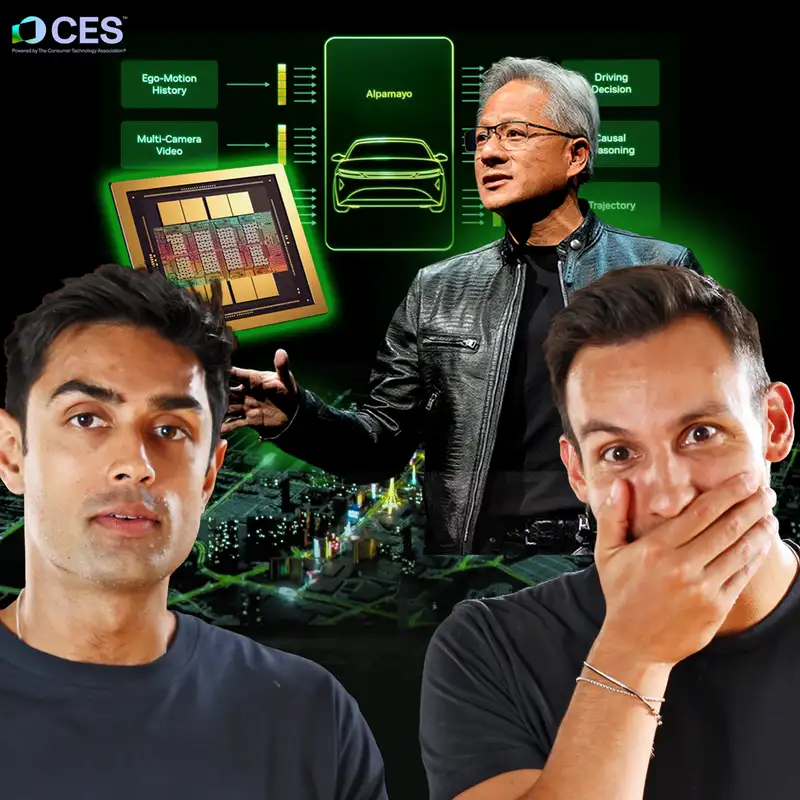
new self-driving ai model called Alper Mayo.
Ejaaz:
And in Jensen's words himself, it's the world's first thinking,
Ejaaz:
reasoning, autonomous vehicle AI.
Ejaaz:
And he's launching it on US roads as soon as Q1 of this year with Mercedes CLA
Ejaaz:
cars, which is going to be like an insane turnaround time.
Ejaaz:
He says it's trained end to end, literally from camera in to actuation out.
Ejaaz:
It reasons what action it's about to take, the reason by which it came about
Ejaaz:
that action and the trajectory.
Ejaaz:
If this sounds similar to end-to-end neural net, which is exactly what Tesla
Ejaaz:
FSD is, you would be correct. That's basically what he's built with Alpameo.
Ejaaz:
It's a vision language action model, which takes in a lot of data via different
Ejaaz:
types of sensors, such as cameras, kind of barometers, stuff like that.
Ejaaz:
And it feeds it into the neural net and judges what to do in a particular scenario.
Ejaaz:
But it's not just one model, Josh. There's a few other aspects to it,
Ejaaz:
such as simulation testing,
Ejaaz:
which is also what Tesla FSD does to kind of generate different types of hypothetical
Ejaaz:
ways to deal with a particular scenario on a car so that it can judge and reason
Ejaaz:
to kind of do the right type of action, whether to decelerate,
Ejaaz:
accelerate, change steering, etc.
Ejaaz:
Now, the main core difference between what NVIDIA has built here versus Tesla
Ejaaz:
FSD is that he's not building the actual car.
Ejaaz:
In fact, he doesn't want to go anywhere near it. He's not going to be building
Ejaaz:
any of the sensors either.
Ejaaz:
What he's proposing here is the end-to-end model itself that you can retrofit into a car.
Ejaaz:
And the first brand that he's working with is Mercedes to achieve this.
Josh:
What I like about this is that NVIDIA, in a way, they're kind of acting like
Josh:
Apple, where Apple normally kind of sits on their hands, lets the fields play
Josh:
out, decides what the winning strategy is, and then goes all in on that.
Josh:
We had really Waymo and Google and Tesla kind of competing on these different
Josh:
types of way that you could train it. One was hard-coded, one was neural nets.
Josh:
It became clear that the convergence was on neural nets. And that's what NVIDIA
Josh:
did is they built this architecture just for that.
Josh:
What I find interesting is that this is kind of like Apple CarPlay,
Josh:
but for full self-driving, where Apple doesn't make any cars and yet their software
Josh:
is prevalent in every single car that's basically made in the US today because everyone has an iPhone.
Josh:
Well, NVIDIA is doing the same thing, but for full self-driving where they're
Josh:
not going to actually try to manufacture these cars.
Josh:
Like you said, they're just going to license them to other dealers like Mercedes
Josh:
using this thing called Drive Hyperion, which is this reference architecture.
Josh:
And it's built on the standardized sensor set. And one thing that I found interesting
Josh:
with the sensor set is how
Josh:
Detailed it was, how much there was going on in this, included but not limited
Josh:
to 14 cameras, nine radars, one LiDAR, 12 ultrasonic sensors, and a microphone array.
Josh:
So this is a full stack suite of tools that they're giving to car companies
Josh:
like Mercedes to do whatever they want with it.
Josh:
And notably, it's funny that the ratio of LiDARs to cameras is like 0.75.
Josh:
There's still a lot of LiDAR built into this. So it's interesting to see someone
Josh:
who feels like they actually have a chance at competing with Tesla in the world of autonomy.
Josh:
This is the first real threat that I think exists.
Josh:
Not to say that it's a real threat just yet, because they have a long way to
Josh:
go before they reach the 84 billion miles or whatever it is that Tesla has of training data.
Josh:
But they're on their way, and this is the correct approach to do it.
Ejaaz:
Yeah, it's interesting. We were watching the CES Q&A after this announcement,
Ejaaz:
and someone actually asked him, like, is this a direct competitor to Tesla FSD?
Ejaaz:
And Jensen starts of the response with saying like, hey, listen,
Ejaaz:
Tesla is an amazing company, blah, blah, blah.
Ejaaz:
And then he says Alpameo was designed around a different kind of idea.
Ejaaz:
The first difference being that NVIDIA doesn't want to actually build the self-driving
Ejaaz:
cars, which is the point that we just mentioned, but he wants to build the full
Ejaaz:
stack of technology for everyone else that is trying to build self-driving cars.
Ejaaz:
So reinforcing the point that he just wants to be around the software and maybe
Ejaaz:
some of the sensor stack, but otherwise it's on the car producers themselves
Ejaaz:
to kind of manufacture the actual vehicle itself.
Ejaaz:
And this is an interesting strategy because you could argue that like Tesla
Ejaaz:
has easy scalability because they've built their product end to end,
Ejaaz:
right? And they're churning it out of their factories.
Ejaaz:
Kind of refactored the dye architecture so that they can kind of pump these
Ejaaz:
cars out once an hour or whatever.
Ejaaz:
And NVIDIA is kind of taking a different approach where they're like,
Ejaaz:
okay, we'll just let every single other car manufacturer do this and we'll retrofit
Ejaaz:
with our own kind of model. So I like the approach that they're taking.
Ejaaz:
And I don't know if you saw this as well, Josh, but kind of within all the CES
Ejaaz:
announcements, Uber and Lucid announced that they were also going to launch
Ejaaz:
an autonomous vehicle fleet or network system.
Ejaaz:
So every single car company is kind of veering towards doing this.
Ejaaz:
And I think NVIDIA kind of pitching the software play, like the Apple CarPlay
Ejaaz:
analogy that you just used, it's actually a really, really smart one.
Ejaaz:
Because if this ends up kind of like, if they end up signing like all the right
Ejaaz:
partnerships with the right kinds of car makers, they could end up with the
Ejaaz:
same amount of data and therefore as good a model as Tesla does in fewer years
Ejaaz:
that Tesla's taken to get to the standard that they are at right now.
Josh:
And it's funny, it's not like companies haven't tried to do this.
Josh:
I mean, Rivian's tried full self-driving Ford, Chevy, a whole bunch of companies have tried.
Josh:
They just can't figure it out. So NVIDIA is like, okay, well,
Josh:
clearly there's a huge market demand. We're going to step in to fill this.
Josh:
And to me, it feels like, I mean, they are the NVIDIA, but of the full self-driving industry.
Josh:
Whereas you could kind of compare Tesla to Google, where they own the entire
Josh:
stack. They own the chip architecture. They own the training. They own everything.
Josh:
NVIDIA is just the pick and shovel salesman. They're like, hey,
Josh:
if you want to sell a car, you're going to need to have it fully autonomously. Yeah.
Josh:
You're going to want our software. And this is actually, I mean,
Josh:
people will view this as a threat to Tesla, but a lot of people don't know that
Josh:
Tesla open sourced all of their patents for any other car manufacturer to use from day one.
Josh:
The problem is just, it's incredibly difficult to do these things.
Josh:
So it's not like Tesla has not wanted the industry to keep up because the mission
Josh:
is to move the whole world forward.
Josh:
It's just that no one actually took them up on this and use the patents to actually
Josh:
build something meaningful.
Josh:
So Nvidia came along, they're building the picks and shovels and they're doing
Josh:
it at scale, right? Like a significant percentage of the company has now shifted to
Ejaaz:
Work 20 yeah 7 000 people so
Ejaaz:
20 of nvidia employees are now going to be working um
Ejaaz:
you know monday to friday and probably on the weekends uh for
Ejaaz:
the foreseeable future and that is just like a huge signal that
Ejaaz:
jensen thinks that this is one of the most important industries to win he said
Ejaaz:
multiple times during ces that he thinks robotics is undeniably going to be
Ejaaz:
the future and the next industry to face a chat gpt like moment um and so he
Ejaaz:
thinks that with this bet it's going to be autonomous cars that kind of like flag the play first,
Ejaaz:
it's interesting I saw yeah I saw a response from Elon here because someone
Ejaaz:
asked him like hey Elon do you see this as kind of like a threat the way that
Ejaaz:
I kind of think about this is that it's not really a threat because,
Ejaaz:
whilst NVIDIA is kind of like creating a software that is 95% as good,
Ejaaz:
the extra 5% takes years and years to actually improve.
Ejaaz:
And Elon replies, you know what, you're right, the actual time from when FSD
Ejaaz:
sort of works to where it is much safer than a human is several years.
Ejaaz:
So maybe this is a competitive pressure on Tesla in five or six years, but probably longer.
Ejaaz:
So Elon's probably, you know, saying this for public opinion,
Ejaaz:
but he doesn't see it generally as a threat.
Ejaaz:
And to your point around like the Google full stack architecture,
Ejaaz:
I think Tesla still very much has the moat right now.
Josh:
Yeah, and they'll win on the margins. I mean, no one's going to be able to create
Josh:
a lower cost per kilometer for traveling if you don't own the whole stack than Tesla will.
Josh:
So it is good that, I think it's a net positive for the world.
Josh:
It is slightly negative for Tesla, but not in a meaningful way.
Josh:
Both of these companies are going to do excellent. And we probably should get
Josh:
into the other excellent thing that was announced from NVIDIA this week,
Josh:
which is probably even bigger than the full stuff. of drawing architecture,
Josh:
that is their new Vera Rubin chip, which Ejaz, I know you were looking at this.
Josh:
I was taking a peek. This chip is incredible.
Josh:
It's like outrageous how meaningfully an impact this will have on the world
Josh:
of AI training. Some fun facts just to get started.
Josh:
Hopper was the first major chip that was being trained that was from NVIDIA.
Josh:
They went from Hopper to Blackwell. That was a 10% or sorry,
Josh:
a 10x energy efficiency improvement.
Josh:
And then from Blackwell to what we have today, Vera Rubin, is another 10x improvement.
Josh:
So we have two orders of magnitude energy efficiency in addition to other crazy
Josh:
stats like Rubin, the GPU is now five times faster than just the previous generation
Josh:
of Blackwell, but it only has 1.6 times the amount of transistors.
Josh:
So they've managed to squeeze a tremendous amount of compute,
Josh:
energy efficiency, and also ease of integration. If you remember,
Josh:
the Hopper chips from Hopper to Blackwell was a really nasty transition period
Josh:
because the whole architecture was different.
Josh:
So you had to rip out the guts of the
Josh:
entire data center, rewire all the electricity, rewire all the cooling.
Josh:
What's nice about this is it's a hot swap. It's easy. You just pull one out,
Josh:
you pop one in, and you're on your way.
Josh:
And what's also interesting about this new chip is this is one of the most amazing
Josh:
things to me is the cooling, how they cool this thing.
Josh:
So with Blackwell, they had a lot of these tubes and wires that would run through
Josh:
that would cool it with liquid.
Josh:
They still have liquid cooling, but there's no more tubes or wires hanging out of this thing.
Josh:
And the water required to cool it can be, I think, 115 degrees Fahrenheit.
Josh:
It's too hot. So they're cooling these GPUs with hot water now because they're so efficient.
Ejaaz:
Doesn't make sense.
Josh:
So now, this is huge for cost per token. If you want to generate more tokens
Josh:
at a lower cost. This is great for training. I mean, Ruben across the board seems incredible.
Ejaaz:
And Josh, it's four times cheaper when it comes to inference costs as well. That's what it is.
Josh:
Four times.
Ejaaz:
That's huge. It's insane. So to put this into context for listeners and viewers
Ejaaz:
here, this kind of a jump between one GPU model to the next is unprecedented. entered.
Ejaaz:
Usually you'll get like a 2x better performance output. To get a 5x,
Ejaaz:
you must have done something different here, right?
Ejaaz:
And the answer is they did.
Ejaaz:
So typically when you refactor a GPU for the next version, which is what they've
Ejaaz:
done from Blackwell to Vera Rubin, you kind of have six components in your AI
Ejaaz:
chip architecture, right?
Ejaaz:
It's not just the GPU that you want to refactor it's the
Ejaaz:
software components it's the cpu that helps orchestrate and
Ejaaz:
help these gpus kind of like talk to each other it's how
Ejaaz:
you stack these gpus together you'll notice in the tweet that we
Ejaaz:
just had up here i'll show it right here um jensen huang
Ejaaz:
talks about a rubin pod which consists of 1152 gpus 16 racks of these gpus stacked
Ejaaz:
together which if you stack this together in this pod gives you the best performance
Ejaaz:
output the performance output and metrics that josh and i just covered right
Ejaaz:
um what nvidia did was they rebuilt.
Ejaaz:
From scratch, all six of these components to build out this pod, Josh.
Ejaaz:
So it wasn't just the GPU architecture.
Ejaaz:
It wasn't just kind of like neatly fitting in a bunch of transistors in a much more impactful way.
Ejaaz:
They refactored the central processing unit, so the CPU, the graphics processing
Ejaaz:
unit, the MVLink 6 switch, which is what helps the software communicate between
Ejaaz:
the CPU and the GPUs, and a bunch of other Ethernet cables.
Ejaaz:
You'll notice the Spectrum 6 Ethernet switch as well.
Ejaaz:
So the point I'm saying here is they did something unprecedented and rebuilt
Ejaaz:
everything, all six components from scratch, which is what led to this massive, massive jump.
Ejaaz:
And it's just like crazy to kind of see some of the takeaways here.
Ejaaz:
So there's a summary here where Rohan over here goes, NVIDIA rolled out six
Ejaaz:
new chips under the Rubin platform.
Ejaaz:
And one highlight is the Vira Rubin Superchip, which pairs one Vira CPU with
Ejaaz:
two Rubin GPUs on a single processor. Now, if none of that is making sense,
Ejaaz:
the summary is here where it talks about the Rubin pod and I mentioned that.
Ejaaz:
Now, they haven't released pricing for this thing.
Ejaaz:
But let's conservatively take the cost of a Blackwell GPU, which was between $35,000 to $40,000.
Ejaaz:
I'm going to take the high-end estimate of that. If we factor in the number
Ejaaz:
of GPUs in this pod, which is 1,152, that comes out at $46 million for the cost of this entire pod.
Ejaaz:
So if you're an AI lab or a startup, God forbid, that's trying to enter this
Ejaaz:
market with the best of the best GPUs, you're going to need to fork out 46 to
Ejaaz:
get some of the best metrics ever.
Ejaaz:
So this will continue to be a game played by very big hyperscalers and big AI
Ejaaz:
labs like Google, OpenAI and XAI, which are securing majority of the capacity so far.
Josh:
But you know why that price doesn't matter at all is because the constraint isn't dollars.
Josh:
The constraint is energy. So they could probably charge double for that rack.
Josh:
And there will still be no shortage of demand because, again,
Josh:
that energy constraint means everything. And when you look at the performance
Josh:
per watt of a Vera Rubin rack versus a black hole rack, it is that multiple,
Josh:
would you say four times multiple?
Josh:
That is worth so much money because you are limited in energy.
Josh:
That you cannot make more of.
Josh:
But now you can get four times the amount of compute for the same energy.
Josh:
That is worth more than any amount of dollars you can possibly spend.
Josh:
Like they will spend infinite money to get that efficiency.
Josh:
And that's why this chip is going to do so good. Another really interesting
Josh:
fact for those who don't really spend their life in this world,
Josh:
think of the internet, how much global bandwidth the entire internet uses every single day.
Josh:
One of these racks moves 240 terabits per second, which is equivalent to twice
Josh:
the entire global internet bandwidth in one rack, double.
Josh:
So this is a tremendous amount of compute that we're talking about,
Josh:
and it is all powered by NVIDIA.
Josh:
Now, you just, if you scroll down to the first reply here on this post,
Josh:
it's from none other than our good pal Elon Musk, who says this will probably
Josh:
take about nine months or so before the hardware is operational at scale.
Josh:
And this is an important thing to note.
Josh:
Because to move from Hopper to Blackwell, it took like 16, 18 months.
Josh:
And we had this weird lull period where there wasn't a lot of progress on the hardware front.
Josh:
The progress came from software. So this is when we started to get these chain
Josh:
of thought and these reasoning breakthroughs that kind of held us through that
Josh:
lull period between Hopper to Blackwell.
Josh:
What we're getting now is we're just starting to feel the effects of Blackwell.
Josh:
And then we have this nine-month period until Vera Rubin. So there should be
Josh:
this weird lull period where we're starting to see what happens with Blackwell,
Josh:
but we're not actually gonna feel the effects of this new chip until probably the end of this year.
Josh:
So I would say if we're gonna get AGI, it's gonna come from these chips.
Josh:
It's going to happen in Q4 once these
Josh:
things are actually online and fully operational and training things.
Josh:
And there's also just one random fun fact that I thought, Ijez,
Josh:
you probably didn't know that you should know that I found out.
Josh:
Vera Rubin is actually the name of a person. It's an American astronomer whose
Josh:
work helped convince the world that dark matter was real.
Josh:
So I just thought that was like a fun fact. It's like, okay, cool.
Josh:
They got some cool meaning behind it. But yeah, this ship is remarkable.
Ejaaz:
Insane. I'm super pumped about it. It is an impressive feat of engineering.
Ejaaz:
I just wish it was here to play with already.
Ejaaz:
You know, like Blackwell announced, what is it, like five to six months ago?
Ejaaz:
And it's only now coming online. Probably the first data center is going to be XAI's Colossus 2.
Ejaaz:
So we're going to see the real effects of that generation of GPUs.
Ejaaz:
Kind of like relatively soon. So Vera Rubin is probably not going to be seen
Ejaaz:
until early next year if we factor in pre-training and post-training for AI
Ejaaz:
models once they've spun up these podcasters.
Ejaaz:
So I'm excited to see that, but I hate that we have to wait so long.
Ejaaz:
Another point to make, I guess, is NVIDIA is pumping out these new GPU versions
Ejaaz:
way more frequently than they used to be.
Ejaaz:
And that just is kind of a sign of the competitive times as the likes of AMD,
Ejaaz:
Intel, Google's TPU kind of breeds down their neck.
Ejaaz:
They kind of want to make sure that they're top dog.
Ejaaz:
And they've shown this with the 5x performance increase. I expect to see probably
Ejaaz:
a new NVIDIA GPU probably come out at a cadence of once every year eventually,
Ejaaz:
which gets me thinking, if there are constraints around memory,
Ejaaz:
we actually did an amazing episode on this earlier this week,
Ejaaz:
definitely go check that out.
Ejaaz:
And other types of things like energy, as you mentioned, Josh,
Ejaaz:
I wonder how many of these GPUs are just going to be collecting dust.
Ejaaz:
Do you remember we spoke about, there was that clip of Satya Nadella saying,
Ejaaz:
hey, I have like $300 million worth of H100s just collecting dust because I
Ejaaz:
don't have the energy to kind of like fit this out.
Ejaaz:
I wonder if we'll start running into those kinds of problems going forwards
Ejaaz:
but such a such a cool announcement.
Josh:
Yeah it's exciting and then in the meantime we're just going to get these
Josh:
software breakthroughs so the um like you
Josh:
were saying the breakthroughs from blackwell have not totally
Josh:
come we have this like nine month lull period in between where we're going to
Josh:
make some software innovations and it's it's just this like double parallel
Josh:
exponential progress they're both building on each other they're both compounding
Josh:
the line is going vertical progress as fast as you think it's moving it is moving
Josh:
so much faster but i want to round out the CES segment was something a little more fun,
Josh:
Ijaz, because it wasn't just the NVIDIA show, there was other stuff.
Josh:
I'm curious if you saw anything personally that got you excited,
Josh:
because for people who don't know, this is the consumer electronics show.
Josh:
This is where they announce all the cool new technology that,
Josh:
for the most part, you can actually buy sometime this year to put into your
Josh:
life. So is there anything that caught your eye in particular?
Ejaaz:
Yeah, this is peak AI. For any of you who are just listening,
Ejaaz:
I suggest you turn the screens on.
Ejaaz:
The world's first robot vacuum, Josh, that has legs. With legs.
Ejaaz:
So, hey, hey, hey, listen. The number one issue I had with Roomba,
Ejaaz:
which, by the way, went bankrupt last week,
Ejaaz:
was that, okay, it can move around my floor and vacuum and kind of get into
Ejaaz:
crevices, but it can't climb stairs.
Ejaaz:
So how can it, can I, I just want to leave it alone and let it clean my entire house.
Ejaaz:
This Roborock Saros rover has the ability to now climb stairs.
Ejaaz:
You have a video of this where it basically helps to put it up there.
Ejaaz:
It has a rectangular surface versus a circular surface.
Ejaaz:
It has AI-powered software and sensors, which allows it to map out your entire
Ejaaz:
house in 3D so that once it's mapped the entire house out, it can just kind
Ejaaz:
of run the same routine over and over again.
Ejaaz:
Here is a separate angle for those of you who are really keen to see like,
Ejaaz:
hey, I don't know if it's cleaning the entire step.
Ejaaz:
It is look at this look at this like flexibility and mobility on this i i just
Ejaaz:
freaking love love it um so it's going to be coming out uh relatively soon uh
Ejaaz:
they haven't kind of like gone into production yet but i like the fact that
Ejaaz:
it's a prototype that actually works josh versus something that is a kind of
Ejaaz:
like graphics video demo very cool that's pretty sick.
Josh:
Yeah i love i love the robots look it could even jump it was hopping a little bit earlier
Ejaaz:
Exactly all right what about what about you what you got what were you for me excited about.
Josh:
Yes this year this was the year of displays, man. This display technology in
Josh:
general was so exciting for me.
Josh:
First, I want to reference the Samsung folding display because what you're seeing
Josh:
here isn't just a Samsung folding display.
Josh:
This is the display in the new iPhone that's coming later this year.
Josh:
And it's cool that we get to see the core technology displayed before it gets
Josh:
placed into products that we'll all use later in the year.
Josh:
And the cool thing about this new Samsung folding display is for the first time
Josh:
ever, your display can fold in half and when it unfolds, will not leave a seam.
Josh:
So if you see on the left here, there's a display that has a seam right down
Josh:
the middle. It doesn't look that good. You could tell that it's folded,
Josh:
The display on the right looks no different than an iPad. And this is what we're
Josh:
going to be getting in the iPhone Fold later this year.
Josh:
So it's cool to see Samsung, who is a supplier of Apple, showcasing their new
Josh:
technology that will eventually be in their hands and pockets later this year.
Ejaaz:
Android users are punching the air right now, Josh. Because they've had this tech for so long.
Josh:
Yeah, but yours had a seam. Ours doesn't have a seam,
Ejaaz:
Bro. Hey, don't. Okay, yeah. Sorry, I thought you were personally attacking
Ejaaz:
me. I'm an Apple user. Come on.
Josh:
No, I'm attacking the Android people. but like, yeah, okay, you guys have been
Josh:
folding for years, but like, yeah, have fun with your seam.
Josh:
Anyways, the second cool technology is micro LED displays. And what's cool,
Josh:
what we're seeing on screen is they're transparent.
Josh:
You can actually create these beautiful transparent displays that use micro LEDs.
Josh:
And the difference between a standard LED and a micro LED is a micro LED actually
Josh:
has all three color diodes.
Josh:
It has RGB built into each one of the tiny little pixels.
Josh:
So it's really high fidelity, really cool, interesting displays.
Josh:
And then the third and final thing in the display world is for people who use Macs.
Josh:
There is no 5k 120 hertz
Josh:
display for mac and that has
Josh:
driven me absolutely crazy because 120 hertz is
Josh:
what is it feels very smooth it's what the new iphones use and 60 hertz just
Josh:
doesn't cut it but they haven't been able to do this because they've been throttled
Josh:
by thunderbolt and long story short if you are a macbook user and you want the
Josh:
native display resolution this is a big year for you you will be buying a new
Josh:
monitor it is very exciting but that wraps up our CES news this week.
Josh:
Ejaz, we had some other big news, not CES related, but instead from Big Dog
Josh:
OpenAI. This is their first big announcement of the year.
Ejaaz:
I am pumped about this.
Josh:
With, yeah, ChatGPT Health. You were very excited about this.
Josh:
So please explain to myself and the audience what caught your eye with ChatGPT Health.
Ejaaz:
So one of the biggest ways that I use ChatGPT is through all the research and
Ejaaz:
reading that we do, including prep for the episodes that we talk about.
Ejaaz:
But the other, probably second most used one is around personal health and fitness.
Ejaaz:
I would use it to kind of design gym routines for me, diet plans for myself.
Ejaaz:
And in some ways, Josh, I will give it my medical labs,
Ejaaz:
my reports, my records to kind of like gauge whether I'm going to be facing
Ejaaz:
some sort of issue in the future,
Ejaaz:
or whether the diagnosis or rather symptom that I'm feeling or getting today
Ejaaz:
is actually accurate. And I've run into a few obstacles.
Ejaaz:
Typically, ChatGPT would give me a weird sort of answer that isn't really accurate,
Ejaaz:
or it'll just politely decline and say, sorry, I'm not a doctor,
Ejaaz:
I can't do this. Until this week.
Ejaaz:
OpenAI released something called ChatGPT Health, which is a dedicated space
Ejaaz:
for health conversations in ChatGPT. Okay, so what does that mean?
Ejaaz:
Basically, it's a separate space that you can connect your medical records and health fitness apps.
Ejaaz:
So now Apple Health, the likes of MyFitnessPal, and also Peloton and an array of other apps.
Ejaaz:
I'm hoping Aidsleep, Aidsleep, if you're listening to this, please connect to this.
Ejaaz:
And you can feed this data into
Ejaaz:
your ChatGPT, and it can start to identify certain patterns of health,
Ejaaz:
whether you're feeling something, you can recognize whether you've consumed
Ejaaz:
too much alcohol the night before, and it can give you personalized information
Ejaaz:
about how you can start to improve your life.
Ejaaz:
Now, it's important to stress that it's not trying to replace the role of a
Ejaaz:
doctor, and they've been very explicit in actually saying that,
Ejaaz:
but it's meant to be an aid.
Ejaaz:
It's meant to be an assistant, and it's that jump into a personal AI assistant
Ejaaz:
that extends beyond just becoming your essay writer or kind of writing up a
Ejaaz:
product plan for you for your kind of nine-to-five knowledge worker job.
Ejaaz:
This is something that actually applies to
Ejaaz:
pretty much anyone that wants to live, which is every human on earth.
Ejaaz:
And so I'm excited to see something like this scale. This, this to me is something
Ejaaz:
useful that I would like pay an extra 10 to 20 tech, even 50 bucks to use.
Josh:
I'm finding it funny the roles that companies are finding themselves in where
Josh:
we have in one corner, Anthropic, they are the world's best at coding.
Josh:
They're sounding the alarm that we are building AGI very quickly. We need to be careful.
Josh:
We need to make sure this is aligned then we have grok which
Josh:
is dead set on building the truth-seeking ai they're building the biggest data
Josh:
center in the world as fast as possible and then chat gbt is like we partner
Josh:
with disney to give you cute little things that you could pair with your videos
Josh:
and now we have this like fun little health feature where we can improve your
Josh:
health by ingesting your records and it's it's nice it's important it's just
Josh:
the stark contrast between
Josh:
the other companies and open ai kind of made it clear this year that they're
Josh:
going to be leaning more into the commercial side of the business versus the
Josh:
consumer side of the business.
Josh:
So this is interesting to me. I think the personal take was that we're reaching
Josh:
a crossroads now where you kind of have to make the personal decision of how
Josh:
deep do you want to go with these LLMs, with these companies?
Josh:
Are you ready to go all in? Because if you do, then you open yourself up to
Josh:
all the benefits that will come from it. You give them your health data.
Josh:
Well, you'll get all the health advisory stuff. And then as the hardware comes,
Josh:
it'll track more of your health.
Josh:
It'll It'll gain this full stack profile on you and know you better than anything else in the world.
Josh:
And if you're okay with the people at OpenAI having that data to use at their
Josh:
will, then this is a great thing.
Josh:
But I think it's a personal decision whether or not you want to decide to go
Josh:
all in on a company like this and give them all your data versus kind of reserving
Josh:
it and maybe giving it to someone else who you trust more or just keeping it for yourself.
Josh:
It's this interesting world dilemma, but this is like really awesome and really impressive.
Josh:
And I frequently think about how
Josh:
Steve Jobs would think about AI and how someone like Kim would sell AI.
Josh:
And it's not the way that OpenAI is doing it, but I would imagine it would follow
Josh:
similar principles where, listen, now you have a doctor in your pocket that
Josh:
knows everything about you. It can help save your life.
Josh:
It can save your loved one's life. It's like this very powerful technology.
Josh:
And OpenAI is leaning into it with this whole thing. So I don't know.
Josh:
I'm feeling excited about it. I'm not there yet.
Josh:
I signed up for the wait list. I'm not sure I'm going to be user number one.
Josh:
But if they could prove that it really is valuable enough, it seems like it makes sense to do it.
Ejaaz:
Well, what I appreciate with OpenAI from the start is that they've hyper-focused
Ejaaz:
on the retail consumer, like the average Joe and how they can benefit from AI.
Ejaaz:
Yeah, they're focused on enterprise.
Ejaaz:
I'd say Anthropoc actually is focused more on enterprise, but OpenAI has always
Ejaaz:
tried to figure out, okay, what's the best consumer product loop that I can provide them?
Ejaaz:
And I think health is a really good one to focus on.
Ejaaz:
We've just obviously ended 2025. And one of the most painful tasks that I need
Ejaaz:
to do at the end of every year is figure out my health insurance for the next
Ejaaz:
year, living in America, right?
Ejaaz:
And being in New York on the East Coast, it is the most arduous.
Ejaaz:
I absolutely hate it. I have to like sign up to like 10 different accounts.
Ejaaz:
I need to evaluate a million different plans.
Ejaaz:
And then even when I'm on the plan, it is super hard to kind of verify whether
Ejaaz:
the information about a particular doctor and their address is even correct.
Ejaaz:
So it's very, very antiquated.
Ejaaz:
And I've been waiting for this industry to be disrupted.
Ejaaz:
And then came along an app like Oscar Health.
Ejaaz:
For those of you who haven't heard about this, this kind of like changed healthcare
Ejaaz:
in many different ways in America in particular, because you could just pick
Ejaaz:
up your phone and FaceTime your doctor and get that live healthcare, right?
Ejaaz:
ChatGPT Health, to me, is that next step evolution where eventually,
Ejaaz:
you mentioned, Josh, it's funny, that you'll have a doctor in your pocket
Ejaaz:
you'll have the best doctor in your pocket. In fact, you won't just have the
Ejaaz:
best specialist in your pocket, you'll have the equivalent of 10 specialists in one doctor.
Ejaaz:
How much would you be willing to pay to see that doctor every single day, 24-7?
Ejaaz:
These doctors don't sleep, right? And then I think about the next step evolution, which is,
Ejaaz:
if you have this doctor in your pocket, it can start feeding into pharmacies,
Ejaaz:
which can start delivering personalized pill packs, or maybe even personalized
Ejaaz:
treatments, peptides, stuff like that going on to the future.
Ejaaz:
So this is the first step of many.
Ejaaz:
And Sam Altman has said for a while now, I'd say like for the last five months,
Ejaaz:
that he intends for health to be a big component for OpenAI.
Ejaaz:
They have RetroSciences as well, which are kind of like their lab to kind of
Ejaaz:
build out future cures for diseases that ChatGPT helps discover.
Ejaaz:
So I think this is part of a much larger puzzle that will help kind of like
Ejaaz:
build this health AGI, which they're aiming for by the end of this year.
Josh:
Yeah. And the key piece to the health puzzle is data. And the problem is that
Josh:
a lot of, for a lot of people, it's just difficult to collect the data.
Josh:
You're not really going for MRIs and CT scans and scanning a lot of parts. It's very topical.
Josh:
It collects data from something like an Apple Watch or maybe some blood results you got from a doctor.
Josh:
One interesting thing I've seen people doing that I would advise you to possibly
Josh:
try if you've ever done a DNA test or you've ever done Ancestry or 23andMe or
Josh:
whatever companies give you your DNA profile.
Josh:
It's normally a couple hundred gigabytes of raw data, but you can actually upload
Josh:
this into an LLM and get customized feedback on what types of things could possibly
Josh:
affect you based on your genomic makeup.
Josh:
So you could see if you are resistant to insulin or if you are prone to these types of diseases.
Josh:
And these LLMs do a remarkably good job of analyzing this tremendous amount
Josh:
of data and kind of giving you the places that you need to focus on and be most
Josh:
cautious of as you move forward.
Josh:
So this type of health practice, as we collect more data and figure out how to parse through it.
Josh:
It's really exciting. And it's made me want to go get a DNA test and try to load it up into an LLMC.
Josh:
And I think it's super exciting stuff. Health is going to be a very large category
Josh:
this year and OpenAI is making sure of it.
Ejaaz:
Going to be huge. Okay, in the final story on the docket, we have some capital
Ejaaz:
raised news from two of our favorite AI labs that are out there.
Ejaaz:
We've got Anthropic of Claude Code.
Ejaaz:
They've confirmed that they're raising $10 billion at a $350 billion valuation.
Ejaaz:
Now, this nearly doubles its previous valuation of $183 billion.
Ejaaz:
Josh, you gave me the timeline of if you were an investor in August of last year what's the return.
Josh:
Yeah i was looking at like uh i think it was foundry is the name of the company
Josh:
there's like uh basically spvs you could buy into them employees will sell some
Josh:
of their shares in the public market or private market you could buy into them
Josh:
it showed the chart over time and i think august 1st of 2025 it was trading
Josh:
at 69 a share and now it's something like 260
Josh:
so 4x in a couple of months i mean if you own any of these things if you are
Josh:
an employee at any of these things, congratulations.
Josh:
You are getting generationally wealthy and the train is not stopping anytime soon.
Josh:
This is not the only big raise this week. We had a second one,
Josh:
XAI in the news, a $20 billion Series E.
Josh:
And they were targeting $15 billion. It was oversubscribed.
Ejaaz:
$5 billion over target. Oversupped.
Josh:
One of the interesting stats here is that top line there, these 600 million
Josh:
monthly active users, that is encroaching on OpenAI.
Josh:
And they're getting closer and closer to that mythical 800 million
Josh:
weekly active user number granted monthly to weekly so
Josh:
it's a little bit different but uh they're on a roll and i
Josh:
think this capital raise will be enough to this is a crazy take this could be
Josh:
enough to get them to the able could be could be 20 dollars applied to blackwell
Josh:
and vera rubin over the course of the next 24 months leads to some pretty unbelievable progress
Josh:
And $20 billion may be enough to get there.
Ejaaz:
You might have noticed for regular listeners on the show, we've been kind of quiet about Grok.
Ejaaz:
And the simple reason is since Grok 4, we haven't really got their unofficial
Ejaaz:
release of Grok 4.20 or any rumors around Grok 5.
Ejaaz:
And the reason behind this is because I think Elon has gone kind of full on
Ejaaz:
founder mode and he wants to assemble the largest armory of top-end GPUs in
Ejaaz:
Colossus 1 and Colossus 2 data centers.
Ejaaz:
Once he's acquired these, once he's scaled these data centers quicker than any
Ejaaz:
other competing AI lab, he'll be able to train the mother of all AIs.
Ejaaz:
And rumor has it that he's going to amass 900,000 GPUs in Colossus 2 data center
Ejaaz:
alone. And these aren't just any GPUs.
Ejaaz:
He's the largest acquirer of Blackwell GPUs, fun fact, the ones that are going
Ejaaz:
to go live very, very soon in this quarter.
Ejaaz:
And he's also one of the largest purchasers of Vera Rubin GPUs.
Ejaaz:
Jensen absolutely loves this guy and says he's the guy that can scale GPUs quicker than anyone.
Ejaaz:
So he's aiming for 900,000 GPUs by the end, sorry, by mid Q2.
Ejaaz:
That is like astoundingly quick and will beat OpenAI to the punch,
Ejaaz:
even though they started well before.
Ejaaz:
So if he pulls this off, Josh, i think that prediction is not too far-fetched
Ejaaz:
he will end up building the best ai model this year that's that's my bet.
Josh:
At least yeah no and i say this with very high levels of conviction do
Josh:
not mistake their silence for weakness xai is building faster than anybody else
Josh:
and i think they were my winner for the the like winner of 2026 in terms of
Josh:
who's going to create the best ai models they are building at a rate faster
Josh:
than anybody else in the world and in these races where the resources are the constraint.
Josh:
The person to deploy them the fastest and the most efficiently is the one that wins the race.
Josh:
And XAI right now is winning that race, if you're looking at it from a more
Josh:
long-term perspective.
Josh:
But with that, we conclude our weekly roundup. All the topics that we wanted to get into about
Josh:
I think the prompt for this week maybe is CES announcements.
Josh:
What's the coolest CES announcement? There's so many fun gadgets and gizmos
Josh:
that I saw come out this week.
Josh:
And a lot of them are available to purchase right now. Like even Anchor,
Josh:
the charger company that I use a lot, they put like these cute little LEDs in
Josh:
the charging bricks now. It's like a lot of cool stuff.
Josh:
So I think the prompt for today could maybe be, what's the coolest thing you
Josh:
saw from CES? What are you buying from CES?
Josh:
Or what are you most excited about from CES? Did you got anything for them?
Ejaaz:
I have a slightly different prompt. I know a lot of you listeners are Teslables
Ejaaz:
and even in some cases Tesla haters.
Ejaaz:
I want to hear from both of you guys whether you think NVIDIA's competing Alpameo
Ejaaz:
vehicle AI is actually a legitimate threat or not.
Ejaaz:
Kind of let us know in the comments. I want to hear all about this.
Ejaaz:
And yeah, that is all we have for the docket today.
Ejaaz:
We released two episodes earlier this week, one on the semiconductor memory
Ejaaz:
squeeze, as well as OpenAI's new secret device.
Ejaaz:
Definitely go check those videos out. we also dropped a sick kind of thesis
Ejaaz:
and essay on the memory squeeze as well for those of you who don't want to be
Ejaaz:
consuming video content all day
Ejaaz:
we've got a nice little article that we've written out for you um and all.
Josh:
This link in the description don't forget to click that down below
Ejaaz:
All linked in the description and also as you're watching this video we dropped
Ejaaz:
the five biggest highlights of this week um so definitely go check that out
Ejaaz:
um if you're wondering where the hell that is that's on our newsletter subscribe
Ejaaz:
um like and subscribe on our video channels,
Ejaaz:
wherever you do Spotify, Apple Music, RSS feeds, wherever you are.
Ejaaz:
And we will see you, hopefully, on the next one. Number two, 2026. Buckle up.
Josh:
We are in it now. This is going to be a huge year and we will be here to cover
Josh:
the entirety of it as we go through. So yeah, thanks for watching.
Josh:
We'll see you guys in the next one.
Ejaaz:
Cheers, guys.