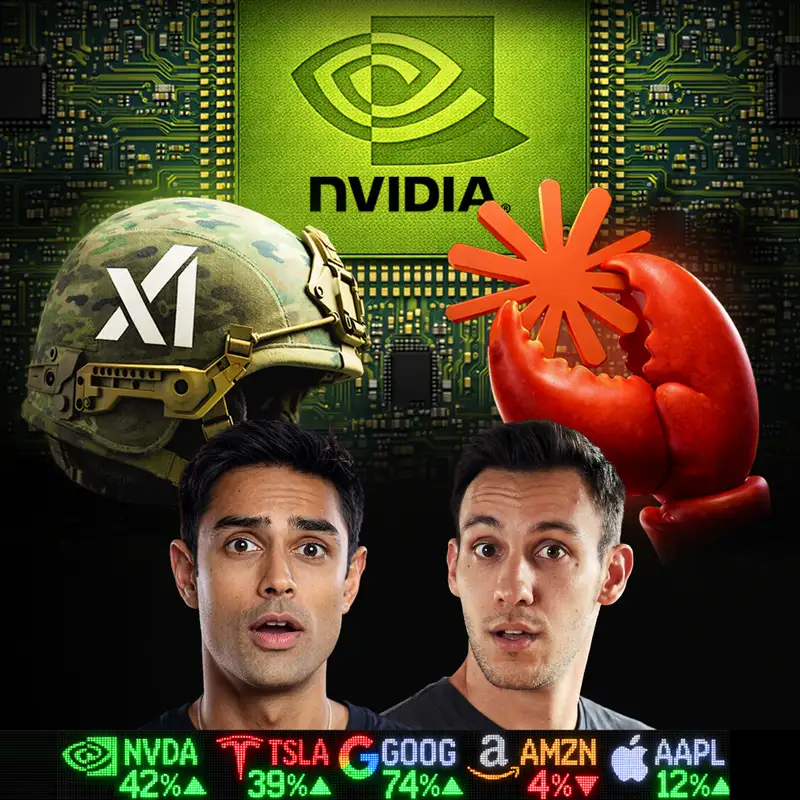
This Week in AI: NVIDIA Earnings, Anthropic vs Pentagon, Perplexity Computer
Josh:
NVIDIA earnings are in, the stock is moving, and pretty much everyone has an
Josh:
opinion on what this means.
Josh:
But most of the commentary, I think, is missing the real story,
Josh:
which isn't actually about this quarter at all.
Josh:
It's about whether AI is in a super cycle that has likes for years or whether
Josh:
we're about one overbuilds away from a dot com style wipeout.
Josh:
Today, we're getting into the thesis that has Wall Street buzzing,
Josh:
which is, I mean, kind of answering the question, are we in a bubble or not?
Josh:
And if we're not, how much longer do we have? We have a lot of new data points
Josh:
now with this NVIDIA earnings report that I think are worth getting excited about.
Josh:
This is also the AI Weekly Roundup where we talk about the top news of the week.
Josh:
So in addition to this, we have Perplexity. They launched a new personal computer from the ground up.
Josh:
Cloud Cowork has become OpenClaw now. There's many OpenClaw alternatives that
Josh:
come from everywhere. And Anthropic
Josh:
wiped out, what was it, 15% of IBM's market cap in one single post.
Josh:
So lots of things are happening quickly, but maybe we'll start with the NVIDIA earnings report.
Ejaaz:
Yeah, so NVIDIA earnings pretty much broke the entire stock market. And I'll tell you why.
Ejaaz:
For every single target, they beat it.
Ejaaz:
They beat earnings per share. They brought in $68.1 billion in Q4,
Ejaaz:
which is up about 70% from the year before and 20% from the previous quarter.
Ejaaz:
And they're also estimating $78 billion for Q1 of this year,
Ejaaz:
whereas the Wall Street estimates were about $72 billion.
Ejaaz:
So things are looking pretty positive, right? And actually, in post-closed market,
Ejaaz:
the stock pumped 4%. But this morning, it's down 4%. It completely retraced the move entirely.
Ejaaz:
So it added $150 billion to their market cap, and then it completely removed it.
Ejaaz:
And I think that there's just a clear misunderstanding of what NVIDIA is doing
Ejaaz:
here and why it's actually bullish.
Ejaaz:
I think a lot of people look at this and say, this seems like an AI CapEx bubble.
Ejaaz:
I don't know how much more sustainable it is.
Ejaaz:
And to be honest, I'm going to spend a bit of time arguing as to why it actually
Ejaaz:
is pretty amazing, because we're talking about a 75% year upon year growth.
Ejaaz:
And I think that what the market misunderstands is there is a lot of investment in GPUs.
Ejaaz:
Buying GPUs is very expensive. And at some point, the music has to stop, right?
Ejaaz:
Except that the companies buying the GPUs are, number one, fully utilizing all
Ejaaz:
their GPUs, so they're maxed out and they need to actually buy more.
Ejaaz:
But number two, there's a story about a little thing known as electricity or
Ejaaz:
energy, which needs to power these GPUs.
Ejaaz:
And we just don't have enough of it.
Josh:
Yeah, any way you look at this report, the numbers are pretty outrageous.
Josh:
I mean, revenue of this quarter coming in at $80 billion estimate versus 72.
Josh:
I mean, the amount of money they're going to be earning and the profit margin
Josh:
that they have on those earnings is just absolutely gigantic.
Josh:
And I think one of the best takes that answered the question,
Josh:
are we in a bubble or not? Where are we in the bubble?
Josh:
What does this bubble look like? Is from this guy named Gavin Baker.
Josh:
I think everyone here, we love Gavin Baker. He's great.
Josh:
He's an analyst at Atreides Capital, I think.
Josh:
And right before the earnings report, he published this
Josh:
post not knowing what the results were going to be not knowing
Josh:
kind of how impressive it was going to be and he
Josh:
kind of broke it down into a few sections with
Josh:
the core question is like nvidia's earnings durability is it actually going
Josh:
to be able to hold through not only this report but through future reports and
Josh:
he he outlines in this paper that every major tech revolution like railroads
Josh:
radio the internet it follows the same playbook generally where the market correctly
Josh:
identifies the potential of
Ejaaz:
That creates a bubble.
Josh:
And then the excitement creates that bubble and the demand temporary collapses.
Josh:
And then there's a crash.
Josh:
And he has this line that I love that says, believing this time is different
Josh:
is dangerous, but I think this time might be different.
Josh:
Maybe you have some insight as to why he really believes this time is different,
Josh:
because it seems like this is backed up by like real information that separates
Josh:
this bubble from those previous bubbles, like railroads, like the radio,
Josh:
like the internet, even this time actually is different for a few key reasons.
Ejaaz:
Yeah, so he makes the very valid point that in every previous bubble,
Ejaaz:
we have overstepped what is actually real.
Ejaaz:
So in this case, the people that are calling for the AI CapEx bubble,
Ejaaz:
their argument would be that all the GPUs that are being bought aren't actually
Ejaaz:
being utilized and they're just kind of sitting and collecting dust.
Ejaaz:
The truth is all these GPUs, all these new ones and five to 10 year old GPUs are maxed out.
Ejaaz:
In fact, if you wanted to go and rent a five-year-old GPU from NVIDIA or from
Ejaaz:
a secondary market right now, you'd be paying roughly one and a half times the
Ejaaz:
original cost of the GPU five years ago.
Ejaaz:
The demand is off the scale and it's not stopping anytime soon.
Ejaaz:
But the second more prescient point that he makes is the hyperscalers,
Ejaaz:
even if they wanted to blow up a bubble that would lead to an ultimate collapse
Ejaaz:
that all the doomers are talking about,
Ejaaz:
they can't because they're limited by the amount of electricity and power that
Ejaaz:
our grid can currently support.
Ejaaz:
So he's saying that we can buy all these GPUs and they could overbuy it,
Ejaaz:
but they will have not enough power to power them up in the first place.
Ejaaz:
So in a weird sort of way, the hyperscalers are restricted from creating the
Ejaaz:
bubble that everyone is fearing and, you know, worrying about.
Josh:
Yeah, in the dot-com bubble, there's this huge race to deploy fiber as fast
Josh:
as possible across the oceans, across the continents to get everyone connected online.
Josh:
And the reality is, is that they were able to deploy the fiber so much faster
Josh:
than, I mean, we could come up with use cases for it.
Josh:
And in this case, the inverse is true where everyone wants to move quickly.
Josh:
But he has this really elegant line that says, we're constrained by watts and
Josh:
wafers, meaning we don't have enough electricity, we don't have enough chips.
Josh:
And as a result, that becomes the limiting factor, enabling the growth.
Josh:
And it will stop us from actually accelerating as fast as we could and smoothing
Josh:
out what could eventually become a bubble, but still has a lot of narrative runway left.
Josh:
The summary of this is that so long as nvidia is printing cash and doing well
Josh:
there is basically infinite demand because they are just not able to create
Josh:
as much as the industry desires and as a result of watts and wafers being the limiting factor
Josh:
we are just not able to reach bubble levels required to make things,
Josh:
to put things into the danger zone.
Josh:
So kind of his sentiment, and it seems like the sentiment after this NVIDIA
Josh:
report is that there's a lot of time left before you have to worry about things collapsing.
Josh:
And there will be ruts along the way, but we are like still green lights full speed ahead.
Ejaaz:
A lot of people are worried about AI basically replacing human labor entirely.
Ejaaz:
And he makes the point that because we're restrained by energy and the electrical
Ejaaz:
grid, and we will be for the foreseeable future for the next at least five years
Ejaaz:
until we build this thing, this stuff takes a lot of time.
Ejaaz:
We'll reach a point where we buy enough GPUs, but the cost of paying an AI to
Ejaaz:
do a human job actually becomes more expensive than just employing a human.
Ejaaz:
As long as we have this limiting factor of electricity and power,
Ejaaz:
humans are good for the foreseeable future.
Ejaaz:
And of course, take that with a pinch of salt. It's interesting,
Ejaaz:
this article was a direct rebuttal to a really.
Ejaaz:
Tantalizingly written post from citrini which is a
Ejaaz:
research firm which basically outlined the doomer case where
Ejaaz:
ai takes over everything and you know humans basically need to kind of like
Ejaaz:
fight for themselves and like subsidize themselves through i don't know some
Ejaaz:
kind of just voluntary payment uh structure and so he's outlining the positive
Ejaaz:
side of this here josh i don't know if you saw but there was also a piece that
Ejaaz:
came out from citadel securities which by the way,
Ejaaz:
is the most funniest thing ever because Citadel is like known for making most
Ejaaz:
of their money from shorting stuff.
Ejaaz:
So the fact that they're now like super bullish, this new technology is just
Ejaaz:
kind of hilarious. They must have quite a few long positions open.
Ejaaz:
But yeah, I think overall, the point that's being made here is like NVIDIA is beating its earnings.
Ejaaz:
It's consistently done this for about eight quarters now. Let me repeat that.
Ejaaz:
Around eight quarters. They're up 75% in gross revenue from last year.
Ejaaz:
They've been repeating this for about two years now.
Ejaaz:
This train isn't stopping. And I don't know how much longer the doomers can
Ejaaz:
keep saying, hey, I think this is the top.
Ejaaz:
This is the top. This is the end. I just don't think we're there yet.
Josh:
What we see is the CapEx spend that we talked about a few weeks ago.
Josh:
Like clearly this is all going to places like NVIDIA. These companies have pledged
Josh:
$650 billion of CapEx spend, which is almost exclusively going to AI buildouts.
Josh:
NVIDIA is going to see a ton of that. These earners are not going to slow down.
Josh:
The build-outs are not going to stop.
Josh:
I mean, it's just a very clear path to moving forward and to continuing this
Josh:
growth. And it's really exciting to be a part of this ride.
Josh:
Another ride that I went on yesterday
Josh:
was with Perplexity saying that they rebuilt the personal computer.
Ejaaz:
Josh, how much did that trigger you, that single sentence?
Josh:
I'm just a little confused because, you know, Perplexity, they've been quiet.
Josh:
We had Arvin, the CEO, as a guest on the show. Feel free to go back and find that interview.
Josh:
It was really interesting because
Josh:
they pivoted the entire company around building an agentic browser.
Josh:
And now it appears like they have expanded from the browser to the entire computer.
Josh:
So, Ijaz, I haven't looked into this news entirely. I'm not exactly sure what it is they built.
Josh:
But based on the announcement video, it seems like computer use is actually
Josh:
getting pretty good on perplexity. Is that true?
Ejaaz:
Let's start with the good news. The vision with perplexity computer is number
Ejaaz:
one, they didn't rebuild an actual physical computer.
Ejaaz:
What they rebuilt was the operating system for a computer.
Ejaaz:
So right now, if you have Windows, you booted up Windows. If you have Mac OS, you have Mac OS.
Ejaaz:
What they've tried to do here is build a layer on top of that that unites all
Ejaaz:
the things that you might potentially do on a computer, whether that's coding.
Ejaaz:
Whether that's doing your nine-to-five job, whether it's opening up a browser,
Ejaaz:
whether it's like playing around with a few apps.
Ejaaz:
They've unified it on a single layer called perplexity computer.
Ejaaz:
Why did they do this? Well, their argument is very simple. They're saying,
Ejaaz:
hey, you're using a different model for your browser.
Ejaaz:
You're using a different model to
Ejaaz:
code, using a different model to spin up agents to do your work for you.
Ejaaz:
Let me just bring all of this under one roof and make a single unified experience.
Ejaaz:
So I actually love the vision. And I think that something like this is actually
Ejaaz:
desperately needed in a world where we have open claw.
Ejaaz:
And it's funny, we're just talking about like 10 different open claw variants.
Ejaaz:
We have clawed co-work. I have a million subscriptions.
Ejaaz:
My mind is going crazy. I just want one singular thing that I can like operate on.
Ejaaz:
And this is what that thing supposedly does. It can research,
Ejaaz:
design, code, deploy, and manage any project end to end.
Ejaaz:
So that sounds good. But the question is, can it actually do it?
Ejaaz:
So I want to go through like a few demos.
Ejaaz:
One, which is showing, I think this might be the actual video where it takes
Ejaaz:
a long form video and creates a short form type of content. Do I have that right, Josh?
Josh:
Oh yeah, this is, it's about halfway into this video. It's, it's pretty well
Josh:
done because I've been trying to get this to work with a service like Claude
Josh:
And it doesn't have the ability to edit videos within it.
Josh:
So I think that is a plus one to perplexity where the example that it uses,
Josh:
it's like go to an interview that Dario Mode, the CEO of Anthropocad,
Josh:
and then pull out a specific part and turn it into a clip.
Josh:
And then it actually went and it rendered the clip and it added subtitles and
Josh:
descriptions and it did everything that a producer on a show like ours would do.
Josh:
So that was really interesting. And I think it's exciting to see these companies
Josh:
leaning more into this new AI first operating system because as these ai models
Josh:
are getting better at computer use and anthropic just acquired another company
Josh:
that is exceptional at computer use they're going to continue to kind of rebuild
Josh:
what the computer does but through the ai first lens
Josh:
And this seems pretty interesting. Like as someone who hasn't used Perplexity
Josh:
in months, I'm reconsidering maybe I should sign up for a subscription and try this out.
Ejaaz:
Yeah, the way I would describe this is it is open core, but for normies,
Ejaaz:
for the everyday person, you don't have to worry about massive security issues.
Ejaaz:
It's a really simple and easy looking interface in terms of like connecting your apps.
Ejaaz:
I think a portion of this data is held privately.
Ejaaz:
The agents are very intuitive to use. You just kind of like prompt them.
Ejaaz:
If you look at one of these demos right here, he says, I'm thinking about buying
Ejaaz:
Walter White's house and turning it into a rental. Please build me a financial model.
Ejaaz:
And it just kind of goes off and does its own thing. You don't need to tell it what tool to use.
Ejaaz:
If it requires access to Slack or something, it'll say, hey,
Ejaaz:
can I get access to Slack? You just say, yes, approved.
Ejaaz:
And it just kind of like gets on with it. So I think that's pretty cool.
Ejaaz:
There are also other few demos that I quite enjoyed.
Ejaaz:
So if you're not in the finance world, or maybe you are, but you would have
Ejaaz:
heard of something called Bloomberg Terminal. It is like the mecca.
Ejaaz:
It costs $30,000 a year to access, and you get all the latest,
Ejaaz:
greatest financial news before the public gets it.
Ejaaz:
If important financial news breaks, it breaks on Bloomberg Terminal first. It is the mecca.
Ejaaz:
Someone rebuilt it from scratch using perplexity computer, and it took them
Ejaaz:
less than an hour to do so.
Ejaaz:
So you've already automated away $30,000 a
Ejaaz:
year worth of value for the cost of a single prompt and if i look at this interface
Ejaaz:
right here from this demo it actually looks super legit now i don't know what
Ejaaz:
ip infringements happen here and like in defense of the non-perplexity computer supporters.
Ejaaz:
We actually kind of did something similar, Josh. I think we,
Ejaaz:
what did we use to build this?
Ejaaz:
We used, oh yeah, we did a test between Cloud Code, Opus 4.6 and Codex 5.3.
Ejaaz:
And we said, hey, can you build up an investment tracker analysis app for us?
Ejaaz:
And I did it in a few minutes, but it wasn't to the extent that this thing is.
Ejaaz:
So I think it's just that added layer of an operating system helps you kind
Ejaaz:
of piece together a bunch of different tools and builds a better app or a better
Ejaaz:
tool or a better web experience for versus like prior.
Josh:
Models it'll get you close like what what
Josh:
is this missing well it's missing the real-time news it's missing the
Josh:
private chat room so it loses a lot of the value that comes from that thirty
Josh:
thousand dollars or however much it costs but it created an interface that without
Josh:
those added values it actually looks pretty much like a bloomberg terminal and
Josh:
it all the data works all the news tracks all the charts are accurate and it
Josh:
creates this fun dashboard with a single prompt.
Josh:
So perplexity seems like they're onto something.
Josh:
I hope that they are aware that the rest of the industry is also working very
Josh:
hard to doing this. In fact, they might even be there already.
Josh:
And when I'm saying that, I'm referencing Claude Cowork because essentially
Josh:
this week they have turned Claude Cowork into OpenClaw one step at a time.
Josh:
And I think this started with news that was discussing scheduled tasks.
Josh:
So a big thing about OpenClaw in particular is that it has a heartbeat and every
Josh:
30 minutes it kind of wakes up and it goes through its tasks and what Claude
Josh:
does now is you can schedule tasks to happen throughout the course of the day.
Josh:
You could ask it for a morning brief, you could ask for weekly updates,
Josh:
for Friday presentations, whatever it may be, it adds these things called
Josh:
cron jobs into the Claude co-work operating system and i think it's it's another step of
Josh:
Claude and Anthropic and a lot of these companies kind of working towards this
Josh:
first operating system in a way that is is very compelling like now i have it
Josh:
do a little morning roundup where in the morning it'll go through all the news
Josh:
that i missed over the night and just give me a couple bullet points to see
Josh:
if there's anything i find interesting it's pretty cool yeah i
Ejaaz:
Mean that's one very essential part of what makes open claw an amazing product
Ejaaz:
and the fact that now you have like this kind of sandbox version where you don't
Ejaaz:
need to kind of check for any security risks or anything like that is awesome.
Ejaaz:
That's not the only tool that they launched this week. Like Anthropik's been
Ejaaz:
on a generational run this week alone.
Josh:
It seems like every day they're announcing a new feature.
Ejaaz:
I need them to give me a break because it takes a while to process these things,
Ejaaz:
but they're just shipping every single day at this point. I'm tired, dude.
Ejaaz:
So this new feature is called Remote Control, which is exactly what it sounds
Ejaaz:
like. you can now code using Claude from your phone whilst you're going on a
Ejaaz:
walk, whilst you're walking on the dog.
Ejaaz:
So if you need to get away from a screen,
Ejaaz:
Now, I'm sorry, you're chained, you're ball and chained even when you leave
Ejaaz:
your house at this point.
Ejaaz:
It's really cool because one of the great parts about OpenClaw was the fact
Ejaaz:
that you could lay in bed or communicate with your coding agent or your claw
Ejaaz:
bot from anywhere in the world. And you didn't need to be at your desktop terminal at that specific time.
Ejaaz:
Clawed code and Anthropic prior to this announcement required you to do so.
Ejaaz:
Now you don't need to be able to do that. So now when you combine this with
Ejaaz:
the autonomous cron jobs that you just mentioned, Josh, you start to see what
Ejaaz:
the vision is going to be.
Ejaaz:
And it looks something very similar to OpenClaw.
Ejaaz:
But to go back to the original form of Anthropic announcements,
Ejaaz:
they typically announce, I don't know, what is it?
Ejaaz:
One to three new plugins for Clawed in general, Cowork specifically, maybe every week.
Ejaaz:
And it results in a, I saw a stat here, it results in a 10 to 35% stock decline
Ejaaz:
of any company that currently has the winning leading software,
Ejaaz:
because now Clawed has automated that entirely. and we have a new one this week. That's crazy.
Josh:
We need to pause there for a second to just to acknowledge how powerful Anthropic
Josh:
has become, where a single tweet and a single feature unlock has the ability
Josh:
to move markets billions, maybe tens of billions of dollars.
Josh:
And what I find funny and ironic before we get into what happened this week
Josh:
with the news is that it seems as if this is a power only Anthropic holds.
Josh:
If ChatGPT announced something similar to this, I'm not sure it has the impact of anthropic and quad.
Josh:
And I think that's worth acknowledging is because they haven't.
Josh:
They haven't. Yeah, we haven't seen this. And I think it's worth acknowledging
Josh:
because Anthropic very clearly is seen as not only a powerhouse,
Josh:
but a real threat to a lot of institutions, a lot of companies that have been
Josh:
kind of grounded in their ways.
Josh:
And this example this week, I love, it's so funny.
Josh:
So please share with us what the hell happened with this new post that knocked
Josh:
a certain company off the grid.
Ejaaz:
Okay. So there are many different types of programming languages and one very
Ejaaz:
important and I guess essential programming language for the business world
Ejaaz:
for data processing specifically is known as COBOL, C-O-B-O-L.
Ejaaz:
It stands for Common Business Oriented Language.
Ejaaz:
And one particular company called IBM has held the monopoly on this.
Ejaaz:
And the reason why they've held the monopoly on this is that it's quite a complex
Ejaaz:
programming language to understand.
Ejaaz:
You need to kind of like learn how the different tools work.
Ejaaz:
Then you need to adopt how the language actually fits to your business. it's a whole process.
Ejaaz:
IBM walks you through hand in hand and figures it out for you,
Ejaaz:
and they charge you a premium price to be able to do that.
Ejaaz:
Until two days ago, when Anthropic announced that they had launched a single
Ejaaz:
plugin that was coded from scratch using Claude Code, and it does all of that
Ejaaz:
for you, for the cost of a single prompt.
Ejaaz:
The news wasn't too great. IBM stock, it says here it dumped 10%.
Ejaaz:
It actually dumped 15% within an hour of that tweet going live.
Ejaaz:
Just insane to see. And this isn't the first time Anthropic has done this.
Ejaaz:
They announced a legal plugin about a week and a half ago, and all law stocks
Ejaaz:
dumped about 30 billion dollars just insane.
Josh:
That's a huge amount of money that's blown and i
Josh:
think it's it's a testament to kind of where things are going right it's
Josh:
ibm makes so much money because cobalt is such a old outdated
Josh:
protocol that no one really supports no
Josh:
one really understands how it works they're maintaining dinosaur code and now
Josh:
anthropic comes in and says we're not like humans we don't get tired we don't
Josh:
get bored we will actually just go and work with your cobalt code and fix things
Josh:
and that knocked 15 that's a huge amount of money and that's still not the extent
Josh:
of all the philanthropic news this week because there is another security implementation.
Josh:
So if I remember correctly, when they announced Opus, maybe it's 4.6,
Josh:
they announced it with the fact that
Josh:
it found 500 zero-day vulnerabilities in code.
Josh:
Correct. Meaning that there is existing code bases out there that have exploits.
Josh:
It uncovered 500 of them just via the AI model itself.
Josh:
And now what they're doing, it seems, is they're kind of reversing that and
Josh:
allowing you to have the tools to play defense against Claw's own hacking abilities. Is that right?
Ejaaz:
Yeah, I actually think that it might have been Codex 5.3 from OpenAI,
Ejaaz:
but the fact is like both models can do the same thing.
Ejaaz:
And these coding models are getting so good finding the vulnerabilities that
Ejaaz:
humans are very prone to implementing in their own code.
Ejaaz:
And these vulnerabilities, by the way, can be exploited for billions of dollars.
Ejaaz:
I'm not like underselling this. Like if you are a multi-billion dollar company,
Ejaaz:
a hundred billion dollars plus, right?
Ejaaz:
And you have security floor that gives people access to personal data or back
Ejaaz:
account information, that could be a really large financial and legal risk for
Ejaaz:
you. So it's very important that you patch these things up.
Ejaaz:
But the issue is humans, well, number one, need to be an expert in that specific
Ejaaz:
code base in order to find those specific flaws.
Ejaaz:
So there's only usually about three to five people in any of these big companies that can do that.
Ejaaz:
So there's a heavy risk point there, where if those people leave the company,
Ejaaz:
or they decide to like go focus on something else, you now have an open risk.
Ejaaz:
Claude announced this new tool called Claude Code Security, which now does this for you.
Ejaaz:
It scans your entire code repository in about 10 to 30 minutes.
Ejaaz:
It understands the nuance and the way that you wrote this code,
Ejaaz:
the context with your business, et cetera, et cetera.
Ejaaz:
And then it finds all the security flaws for you.
Ejaaz:
Typically, this would have taken a team of five to 10 people months,
Ejaaz:
or it's like a recurring thing.
Ejaaz:
And now you can just run a single prompt like every 30 minutes or every week,
Ejaaz:
and it'll discover all the flaws for you, but it gets even better.
Ejaaz:
It proposes the solution that you need to fix in order to resolve that security issue.
Ejaaz:
It doesn't go to the extent where it writes up the fix for you,
Ejaaz:
although you can definitely say like, hey, okay, that sounds good,
Ejaaz:
build the fix for me, because they wanted to maintain the human in the loop.
Ejaaz:
But if you can imagine, if the AI is already good enough to find the flaws and
Ejaaz:
create the fix for the flaws, you might just let this thing run autonomously for you.
Ejaaz:
Now, let me ask you this, how much is that product worth for your business?
Ejaaz:
It's probably like tens of billions of dollars, if not more.
Josh:
They're just continuing to snipe and cherry pick the value from every existing
Josh:
company until it's all in one. It's amazing the amount that they're absorbing in the market.
Josh:
We have a few things left to cover this week that I kind of want to go through quickly.
Josh:
The first one being the XAI Pentagon deal.
Josh:
XAI and Grok is now powering Pentagon's AI technology. And we had a crazy sentence.
Josh:
This is like a strange narrative timeline that we're running.
Josh:
And we had an episode earlier this week that I would recommend checking out
Josh:
about Anthropic and their kind of difficulties they've been having in dealing
Josh:
with the government because they seemingly don't want to give access to all
Josh:
of the ways in which the Pentagon wants to use it.
Josh:
But it appears as if Grok and XAI did not have this problem.
Josh:
And the plan is that they're going to fully integrate Grok starting later this
Josh:
month into military operations. What those are, I don't know.
Josh:
I'm not sure we'll ever find out. But I just find it interesting...
Josh:
That there is a new kind of role in government here for AI Labs and Grok is
Josh:
now going to be one of the front runners here.
Josh:
This comes on the back of, I mean, more drama with Anthropic, right?
Josh:
It was after we recorded the episode, there was still even more.
Josh:
I mean, apparently Anthropic has an ultimatum where by Friday they have to either
Josh:
decide if they're going to comply with the Pentagon's request or not.
Josh:
And if they don't, what's at stake here for Anthropic?
Ejaaz:
So there's this thing I'm highlighting here called the Defense Production Act.
Ejaaz:
The Pentagon basically has two options if Anthropik refuses.
Ejaaz:
On Friday, they can force their hand, initiating the Defense Production Act to basically say,
Ejaaz:
sorry, you legally now need to give me an uncensored version,
Ejaaz:
even though you declined, because it is now the official law and it's a case
Ejaaz:
of national state security, which, by the way, is an insane thing.
Ejaaz:
Or they can take option two, which is blacklist Anthropik and all of their models
Ejaaz:
as a security risk to the nation,
Ejaaz:
which means that Anthropic probably ceases to receive any kind of government
Ejaaz:
funding or regulatory support in the future.
Ejaaz:
And it also pushes up all the other models that have signed partnerships with
Ejaaz:
the Pentagon, such as Grok.
Ejaaz:
And I hear OpenAI and Google is doing the same as well.
Ejaaz:
The sentiment has been split on this, Josh. I've seen both sides.
Ejaaz:
One saying Anthropic just needs to wisen up. And I think that was a lot of the
Ejaaz:
argument that we gave on our episode earlier this week. Again,
Ejaaz:
please go check it out. Let us know if you think we're wrong.
Ejaaz:
But then the other side, like I saw Jeff Dean tweet this morning.
Ejaaz:
Jeff Dean is like the guy from Google. He built so many of Google's key products.
Ejaaz:
And he said, I like that Anthropics taking a stand and it's important that they don't violate,
Ejaaz:
I think is what the first amendment or whatever it is where you can't surveil
Ejaaz:
all Americans. And I respect the fourth, the fourth.
Josh:
Yeah. It's seems heavy handed, right? Like I can understand not working with
Josh:
them, but putting them on a blacklist seems a bit extortive,
Josh:
especially when there's other options. Yeah.
Ejaaz:
Well, here's the thing, like the government's favorite model.
Ejaaz:
And Pete said this himself,
Ejaaz:
the head of the Pentagon, he said that Claude is the best model and they've
Ejaaz:
been using it for over a year now so you can imagine if claude has been trained
Ejaaz:
with all your employees it's been entrenched on your data you kind of don't
Ejaaz:
want to rip that out and then like train a new model from scratch so,
Ejaaz:
Antarmic has everything to win and lose here.
Josh:
Yeah, it's interesting because I'm sure we're missing a lot of context too,
Josh:
due to just the general private nature of how these deals work.
Josh:
So it's going to be tough to really give an honest opinion because I'm sure
Josh:
we're missing a lot of data, but interesting nonetheless.
Josh:
And congrats to XAI and the team for getting a new contract.
Josh:
Last winner of the week, AMD. Oh my God, 15% jump in one day on a Meta deal.
Josh:
Meta is now working with AMD. I thought Meta was working with NVIDIA. That's what I thought.
Ejaaz:
But no, they signed a new $6 billion compute partnership.
Ejaaz:
And remember, it's not a deal now. It's just, we're specifically calling it partnerships.
Ejaaz:
These are crazy. Yeah, it's insane. The circular economy is back.
Ejaaz:
The nature of the deal is basically Meta doesn't want to rely solely on NVIDIA
Ejaaz:
chips, although NVIDIA is the big boy here.
Ejaaz:
So they want to diversify their compute arsenal so that if anything were to
Ejaaz:
happen to NVIDIA or any of the other chip makers, they can still stay alive
Ejaaz:
and feed their product to you.
Ejaaz:
Now, Meta has been out of the kind of news for a while because their models
Ejaaz:
weren't able to keep up and they spent about, what was it?
Ejaaz:
Like a hundred to maybe $200 billion to hire like something ridiculous,
Ejaaz:
like 50 people in their new AI team and they have had nothing to show for it.
Ejaaz:
Rumor says they're meant to be releasing a new model in a few weeks time.
Ejaaz:
Avocado is the code name. and so if that is all it's hyped up to be then they're
Ejaaz:
going to need all the data center compute that they can and they seem to be
Ejaaz:
sure that amd will be the ones to be one of the main providers for them so they've
Ejaaz:
locked in that deal they're building out data centers and yeah amd stock jumped
Ejaaz:
15 absolutely insane well.
Josh:
Happy for all parties involved i think one thing throughout the episode there's
Josh:
a central theme in which there is no amount that can satiate the demand And
Josh:
for AI compute and energy and electricity.
Josh:
And like, I'm sure Meta would prefer to work with NVIDIA.
Josh:
This is the option that they have because they need GPUs they
Josh:
need compute they need energy and they have no choice so
Josh:
we are going to continue this run this
Josh:
generational run that we've had really in the world of AI
Josh:
it doesn't seem like the top is in it doesn't seem like the top is anywhere near
Josh:
and that leaves me optimistic and wanting to continue to deploy
Josh:
capital into this ever-changing absolutely outrageous
Josh:
market but that is another week of the AI
Josh:
roundup I hope you guys enjoyed this one I hope you enjoyed all the
Josh:
episodes this week if you missed any they're pretty short normally 20 to
Josh:
25 minutes we talked about uh google had some pretty
Josh:
amazing tools where now we can create songs and jingles for
Josh:
the podcast we talked about anthropic at length and
Josh:
now we have this kind of roundup that is covering just about anything
Josh:
that you would need if you don't feel satiated we
Josh:
have a second form of content which is the newsletter every wednesday
Josh:
release the think piece this week was about a new company that i am
Josh:
very excited about a startup that i guarantee 95 plus maybe 99 of the people
Josh:
listening have not heard of so if you're interested in that or if you're interested
Josh:
in the second roundup which is released every friday uh ejes is tackling that
Josh:
one and i would highly advise subscribing the links are all in the description
Josh:
down below ejes any final notes before we we part for the weekend nope
Ejaaz:
Wherever you listen or watch us please like subscribe give us a rating it helps
Ejaaz:
us out so much and we will see you on the next one.
Creators and Guests