THIS WEEK IN AI: Google TurboQuant, OpenAI Ends Sora, SpaceX IPO
Ejaaz:
Google might have just popped the AI bubble. They released a new algorithm yesterday,
Ejaaz:
which shrinks the requirement of memory needed to run an AI model,
Ejaaz:
which isn't great news for the top memory stocks, which had billions of dollars
Ejaaz:
of their market cap wiped out over the last 24 hours.
Ejaaz:
We're looking at SanDisk is down almost 7% today.
Ejaaz:
Micron is down 18% over the past five days, the majority of that yesterday.
Ejaaz:
And SK Hynix, another major memory provider is down 6% today.
Ejaaz:
It's absolutely decimated the market. We're going to get into this story and
Ejaaz:
so much more on this episode.
Josh:
Yeah. And some important context to know before we get into this is the reason
Josh:
why these memory stocks are so high is because memory has been the single largest
Josh:
constraint in the world of AI.
Josh:
If you have ever tried to build a PC or buy a PC in the last 12 to 18 months,
Josh:
chances are it's almost doubly as expensive as it was the previous 18 months. That's because AI.
Josh:
It's what happened when crypto stole all the GPUs. AI is taking all of the memory
Josh:
and memory is the limiting factor memory is what serves inference whenever you
Josh:
ask chat gpt or anthropica question,
Josh:
When it serves you the answer, that uses inference, that uses memory.
Josh:
So memory has been the single crux. It's the reason why companies haven't been
Josh:
able to scale as fast as they want, because the costs have been out of control.
Josh:
This algorithm changes things a little bit. This changes the math here just
Josh:
a smidge, but enough to make it scare the market entirely, right?
Ejaaz:
Yeah, it changes it in a huge way. And the wildest part is the Google research
Ejaaz:
team made this public and available for everyone to read the blueprint of.
Ejaaz:
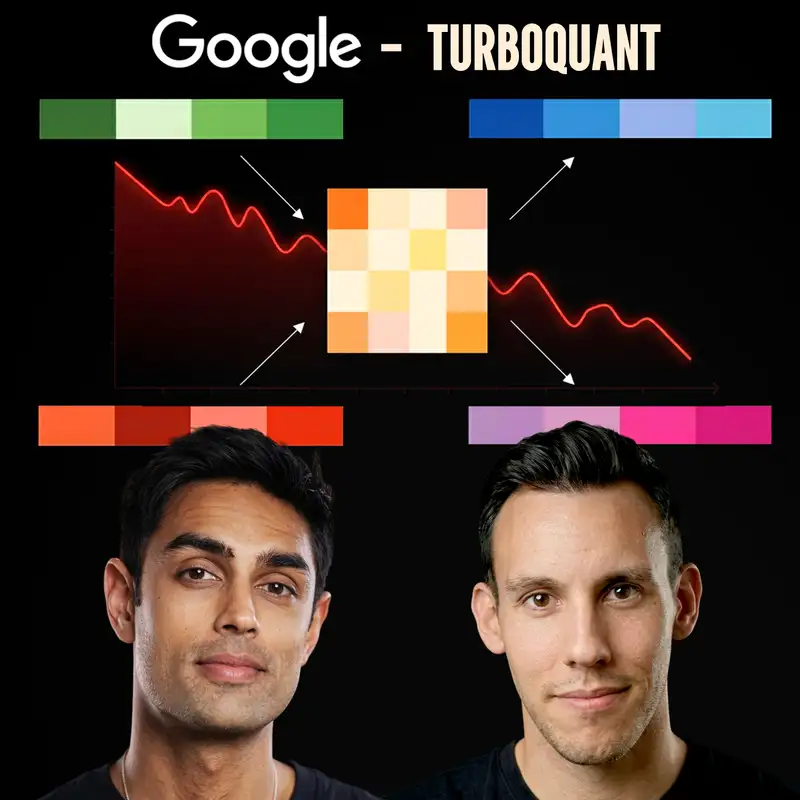
So it's called TurboQuant, and they're describing it as a new compression algorithm
Ejaaz:
that reduces LLM key value cache memory by six times and delivers up to 8x speedup.
Ejaaz:
So let me translate what that means.
Ejaaz:
When you type or speak to an AI model, it has a short-term memory.
Ejaaz:
Think about like humans, they kind of hold things in their head for a bit,
Ejaaz:
and then they go to bed, and then they commit some of those memories for long-term
Ejaaz:
memory, and some of those they kind of discard. But LLMs work in a similar way,
Ejaaz:
and it's called the cache memory.
Ejaaz:
Now, the issue with LLMs are that cache memory, as you talk to an AI more and
Ejaaz:
more, gets really quite big and bloated, which means that AIs are very expensive to run.
Ejaaz:
That's why we spend so much money on GPUs. That's why these data centers cost
Ejaaz:
billions of dollars to build out.
Ejaaz:
It is part of the reason when you inference a model.
Ejaaz:
Now, what Google did was they released an algorithm which said,
Ejaaz:
hey, yeah, you know that thing that bloated up your AI model?
Ejaaz:
We can cut that down pretty massively by six times, actually,
Ejaaz:
and save you a ton of money.
Ejaaz:
So the world is going crazy with this new research, because if you could scale
Ejaaz:
this up to Claude or ChatGPT, you may not need as many GPUs as we originally
Ejaaz:
thought to serve Frontier AI models to anyone.
Josh:
Yeah, it's a really big deal. Like you mentioned, every time you message a chatbot,
Josh:
the model stores your entire conversation in that KV cache.
Josh:
And on a large model, like the 70 billion parameter model, if you run a long
Josh:
conversation, that cache will eat up to like 40 gigabytes of space on your GPU,
Josh:
which is more than the actual model itself.
Josh:
So that's why this is such a huge issue. And the big breakthrough here is that
Josh:
Google can do so without any loss functions.
Josh:
If anyone's a Silicon Valley fan, the TV show, the crown jewel of the entire
Josh:
show was this middle out compression algorithm that didn't have any loss function.
Josh:
You can just compress the data without losing any of the quality.
Josh:
And Google's announcing that they've actually done this.
Josh:
They've actually solved this problem. And that's why the memory market is freaking out.
Josh:
It's like, oh my God, wait, if we can get six times the compression,
Josh:
eight times faster on the same GPUs, surely there will be less demand for memory.
Ejaaz:
Well, despite these stocks being down massively, I think the market is kind of overreacting.
Ejaaz:
This is a good thing for AI in general, and it will lead to more consumption of AI.
Ejaaz:
It's great that the AI models become cheaper to inference and that it frees
Ejaaz:
up space for us to compute other AI prompts and queries.
Ejaaz:
Jevon's paradox is going to occur here in the same way that people were kind
Ejaaz:
of crapping on GPUs and saying these things are too expensive and aren't going to get cheaper.
Ejaaz:
The same thing is going to happen with memory here. It's not going to result in less demand.
Ejaaz:
It's going to result in even more demand. The demand for AI products right now
Ejaaz:
is insatiable, and I don't think this changes anytime soon.
Ejaaz:
The other part is, I think that what Google has created here
Ejaaz:
is something that's going to take time to scale out. This is not going to happen tomorrow.
Ejaaz:
This is a research paper, which you and I were actually joking about before
Ejaaz:
we started recording, was released 11 months ago.
Ejaaz:
But because the paper was so complex and had so many algorithms and mathematical
Ejaaz:
formulas, it didn't actually surface to the public until yesterday.
Ejaaz:
And everyone was like, wow. So it takes time.
Ejaaz:
Since those 11 months, we haven't scaled it out to major models just yet.
Ejaaz:
This only applies to small to medium models.
Ejaaz:
But I can imagine the scaling to frontier models at some point,
Ejaaz:
which will be a win-win for both sides.
Josh:
I mean yeah there's there's no reason why you wouldn't be focused solely
Josh:
on this right it's like if you can serve six times the inference on the
Josh:
same amount of gpus or tpus or whatever gpu accelerator you're
Josh:
using that's a huge breakthrough for any company and it also
Josh:
extends past the cloud it moves to local inference as
Josh:
well it's like if you're running a mac mini or you're even
Josh:
on your iphone the amount of intelligence you
Josh:
can run on a model that is six times more efficient
Josh:
eight times faster and has zero
Josh:
loss function is a really big deal and i think google
Josh:
may be moving towards this what i see this trend happening with
Josh:
google is i mean they have the tpu they're building their own stack
Josh:
they have the partnership with apple to get into all of the iphones they have
Josh:
their like kind of android division they're they're publishing their research
Josh:
publicly to disrupt the market as they go it's a really noteworthy strategy
Josh:
from google and it seems like as always they're leading on the thought leader
Josh:
front right they've always been the top tier of research we'll see how they
Josh:
can implement this into actual products
Josh:
But it seems like the market's wrong. I can't imagine a world in which there
Josh:
is less memory demand as a result of this.
Josh:
Like, as you said, there will only be more. If we get six times more intelligence,
Josh:
we will gobble that up so quickly. So market seems like it's wrong.
Josh:
Maybe it's just an excuse to dump because the stocks have gone up so much over the last 12 months.
Josh:
But I wouldn't be too worried about this if you are a owner of any sort of memory.
Ejaaz:
It's actually very bullish Google stock, in my opinion. I actually bought a
Ejaaz:
bunch more when this came out because I was like, oh, this is going to result
Ejaaz:
in massive efficiencies for AI.
Ejaaz:
Another thing is like, lest we forget, Google has been like the pioneer of a
Ejaaz:
lot of these different AI trends.
Ejaaz:
Like one of the earliest LLM formations was from a bunch of Google or ex-Google researchers.
Ejaaz:
TPUs they've been working on for over a decade now. So they saw the GPU trend
Ejaaz:
like way, way, way in advance. And now they're doing the same here.
Ejaaz:
My question to you is, why do you think they publicize this for everyone to see?
Ejaaz:
Surely this, like i saw a few comments about this as well like surely they should
Ejaaz:
have patented this because this is a pretty sick algorithm that now like any company can use
Josh:
Yeah i don't think the patenting thing really works anywhere
Josh:
at all because a lot of this stuff is just a couple lines of
Josh:
code it's like andre wrote auto research and it's
Josh:
600 lines of code it's like someone will take it
Josh:
someone will use it the the race is far too powerful
Josh:
far too there's far too much of a monetary incentive to
Josh:
do this and you could think of it almost like google's deep
Josh:
seek moment where deep seek created this unbelievable
Josh:
research dropped the bomb they got all the publicity but
Josh:
then the rest of the market kind of rushed to tackle that this is google dropping
Josh:
their their deep seek moments and i think it's it's noteworthy it's really impressive
Josh:
for google google has been kind of at the forefront of all this stuff and they're
Josh:
proving that their research team really are super impressive and have the ability
Josh:
to continue to lead the frontier forward.
Ejaaz:
So speaking of companies that are at the frontier, one of those companies are
Ejaaz:
falling behind this week, Josh.
Josh:
We got to do a little victory lap, slam dunk. I'm not really sure how to frame this.
Ejaaz:
But this is about Sora. Yeah, let's start with the victory lap, I guess.
Ejaaz:
So Sora, for those of you who don't know, is one of OpenAI's winning consumer apps.
Ejaaz:
It is their AI video generation app that functions very similarly to TikTok.
Ejaaz:
You kind of scroll through Reels, but all the videos are air-generated.
Ejaaz:
But the coolest part is you can feature yourself in them.
Ejaaz:
You can feature your friends or any kind of IP or characters.
Ejaaz:
This week, they announced that they were sunsetting the entire project.
Ejaaz:
Sora, which six months ago wasn't a thing, is now dead.
Ejaaz:
Some fun stats from Sora's very short but mighty reign.
Ejaaz:
Within the first day, they achieved over 5 million downloads, which is just insane.
Ejaaz:
I don't think any other app has done that before. they also hit
Ejaaz:
number one and stayed at number one of the apple app store and i
Ejaaz:
think the android play app store as well for a number of different
Ejaaz:
weeks but it wasn't without any kind of
Ejaaz:
grimace the public was split hollywood is basically uh how do i say um dancing
Ejaaz:
on their graves uh open ai is shutting down its ai video slot making platform
Ejaaz:
sora and if you look at the comments from different people it's just like did
Ejaaz:
we just win uh people are like saying like this is such a big W.
Ejaaz:
So people are generally happy outside of their AI sphere. But I don't know,
Ejaaz:
Josh, how do you feel about this? Are you happy?
Josh:
Yeah, well, this was just a failed experiment in the way that Meta did.
Josh:
I forget. I don't even remember Meta's. What was it?
Ejaaz:
Vibes?
Josh:
Vibes perhaps vibes where they tried to do the same thing it
Josh:
was tiktok but for ai and open ai tried tiktok but
Josh:
for ai again but through the sora platform and i
Josh:
am i mean we said this was stupid i haven't opened the
Josh:
app since the week of i think there's there's a
Josh:
harsh reality that open ai is learning that they perhaps don't understand
Josh:
just due to the nature of them being a new company sam really
Josh:
this is his first large company that he's run but i mean
Josh:
it seems like a very predictable outcome when you just look
Josh:
at what standard consumer behavior is and you kind of compare to other platforms
Josh:
because when you think about a platform like
Josh:
meta right it has two billion users or something like that and particularly
Josh:
on instagram how many people of those 10 billion actually want to create content
Josh:
maybe 10 million maybe 0.5 percent of the people would actually be serious creators
Josh:
and the reality is is that almost every single human just wants to scroll and
Josh:
zone out instead of spending energy like conceptualizing and editing these complicated things,
Josh:
The novelty factor of it was very fun, but people don't want this and it's not that good.
Josh:
And I think that novelty wears off. It's like we created those videos that show
Josh:
us and you in them, and it was really cool for like two hours,
Josh:
but creating a dedicated application where you have to go and download it and
Josh:
you have to use it outside of the ChatGPT OpenAI universe is very annoying.
Josh:
Had they rolled this up into the same app that everyone's using every day with
Josh:
ChatGPT, maybe that's a different story, but it's, I don't know,
Josh:
it's tough to kind of reason why they would have gone through with this in the
Josh:
first place the way they did.
Ejaaz:
Let me try and argue the other side. I think what Sora did really well was they
Ejaaz:
made it really easy if you were super lazy, but you kind of had an idea for
Ejaaz:
a piece of content to make that content.
Ejaaz:
Just write it in words, takes a couple seconds, maybe max a minute.
Ejaaz:
And then a couple of minutes later, you have a fully fledged video.
Ejaaz:
Now, obviously, Sora v1 wasn't that great.
Ejaaz:
Sora v2 started to improve and become much better. Sora v3 was way better,
Ejaaz:
but there was still some AI cringiness around this. I do think this improves
Ejaaz:
with a bunch of now other AI models that still exist to do this.
Ejaaz:
CapCut actually yesterday released their own version just as Sora was sunsetted
Ejaaz:
that uses Seed Dance 2, which is a Chinese AI model.
Ejaaz:
And my God, the content that creators can now create just through words looks insane there.
Ejaaz:
And then you have Grok Imagine on the ex-AI side under Elon Musk,
Ejaaz:
and they're piling so many millions and millions of dollars to try and improve that model.
Ejaaz:
So there is something there. I just think that a lot of this reason behind OpenAI doing this is
Ejaaz:
One, they're constrained on cash. They've spent a lot of money on GPUs,
Ejaaz:
Stargate. They had to sunset that.
Ejaaz:
And now they're figuring out that they need to focus all their cash and resources
Ejaaz:
on building the best LLM to beat Anthropic and the best coding AI to beat Anthropic,
Ejaaz:
who is, quite frankly, eating their lunch right now.
Ejaaz:
But there is another bit of news, which I didn't realize immediately.
Ejaaz:
But then I noticed Disney.
Ejaaz:
OpenAI had signed a $1 billion deal with Disney through Sora.
Ejaaz:
And the idea here was Disney would invest $1 billion in OpenAI,
Ejaaz:
and OpenAI would also get access to Disney's IP and characters and make them
Ejaaz:
super famous on Sora via the AI-generated type of video medium.
Ejaaz:
It sounds like Disney didn't even know.
Ejaaz:
I've seen multiple tweets like this, where on Friday, they were signing a deal
Ejaaz:
with OpenAI, and then on Wednesday of this week, when they decided to announce
Ejaaz:
the news that they were shutting down Sora, the Disney team had no idea.
Josh:
It's tough. I think this is a good lesson. there is this quote from Johnny Ive
Josh:
that I love that I think would be nice for Sam Altman to hear when he was asked
Josh:
about what Steve Jobs taught him about focus.
Josh:
And he says, this sounds really simplistic, but it shocks me how few people
Josh:
actually practice this.
Josh:
One of the things that Steve would say to me was because he was worried that
Josh:
I wouldn't focus. He would say, how many things have you said no to?
Josh:
And I would tell him, I said no to this and I said no to that.
Josh:
And he would create these sacrificial things that he was saying no to.
Josh:
But focus means saying no to something with every bone in your body you think is a phenomenal idea.
Josh:
And you wake up thinking about it, But because you are focusing on something
Josh:
else, you can't work on that one thing.
Josh:
And OpenAI does not have that focus.
Josh:
OpenAI is creating these sacrificial things. They are not deeply focused on
Josh:
one thing. And that's why there's
Josh:
four different apps you have to download to use all of their tools.
Josh:
There's just all of these spread attempts at creating virality,
Josh:
at manufacturing virality through TikTokification of it, through this like image
Josh:
generation of the Studio Ghibli stuff.
Josh:
None of it is just building their core thing. And I think when you look at Anthropica,
Josh:
when you look at OpenAI, and the difference between the two is that one has
Josh:
focus and one does not. When you look at OpenAI...
Josh:
You see five different product SKUs. They're all kind of all over the place
Josh:
with different intentions.
Josh:
When you look at Anthropic, they're the best coding model in the world. And that's it.
Josh:
Everyone can converge on that one point. And therefore their velocity is so
Josh:
fast. That's why we just filmed an episode yesterday.
Josh:
Everyone should go watch about the eight updates they published in eight weeks
Josh:
that basically entirely replaced OpenClaw.
Josh:
They have the focus. And I'm hoping that OpenAI can now kind of shift this focus
Josh:
into this singular place and start to move towards this new organization that
Josh:
they are calling AGI Deployment.
Josh:
This is crazy. They're preparing for AGI already.
Ejaaz:
Yeah, so the team is basically getting reshuffled under a product organization
Ejaaz:
within OpenAI called AGI Deployment.
Ejaaz:
And this kind of harkens to a wider strategy that OpenAI has assumed for the
Ejaaz:
last couple of months now, which is to build the best LLM, build the best coding
Ejaaz:
AI model, and also the best world model, which is actually where the Sora team
Ejaaz:
researchers are moving to.
Ejaaz:
They're going to focus on building a world model, which basically helps AI models
Ejaaz:
see the world and understand the physics of the world. the advantage of this
Ejaaz:
is you get to better understand how humans perceive and interact with the world,
Ejaaz:
which is something that LLMs can't do.
Ejaaz:
Think of LLMs as an AI model that sits in the library and reads all the books,
Ejaaz:
but doesn't actually experience the world for himself.
Ejaaz:
World models actually help you understand the world. That's what the Sora team
Ejaaz:
is going to focus on right now. And that's super exciting for one major reason, which is robotics.
Ejaaz:
Robotics is going to be a huge thing.
Ejaaz:
OpenAI teased robotics in one of their major announcements a couple of weeks
Ejaaz:
ago. So we know that they're going to focus heavily on that.
Ejaaz:
And I do think that's a smart move.
Ejaaz:
I'm bullish OpenAI after all of this. But just to recount, this isn't the only
Ejaaz:
major pivot they've made over the last week.
Ejaaz:
Over the last couple of weeks, they've done quite a few things.
Ejaaz:
So they've sunsetted Sora.
Ejaaz:
They've announced that their Stargate project, which was like their major project
Ejaaz:
to scale GPUs across the globe, is now canceled one year later due to funding issues.
Ejaaz:
And Altman said that like, you know,
Ejaaz:
I'm never going to release ads on the platform. He ended up doing that.
Ejaaz:
In-app shopping completely failed and flopped. And now they've got to redesign
Ejaaz:
that entire thing but it's been put on pause for now until they focus on all
Ejaaz:
this other stuff all of this to say
Ejaaz:
I think OpenAI is going to IPO soon, Josh. And I don't know what you think the
Ejaaz:
odds are for this, but we should probably like bet on that.
Josh:
Well, if only we had a marketplace for it. And thanks to our friends at Polymarket, when will OpenAI IPO by?
Josh:
And the answer is kind of surprising where there's only a 36% chance that they'll even IPO this year.
Josh:
And I think earlier in the year, this would have been a little bit different,
Josh:
but it appears as if there's been some trouble in paradise for Anthropic.
Josh:
Maybe that is moving over to OpenAI.
Josh:
The reality that we're starting to see now is SpaceX might be the big one, and that might be it.
Josh:
Um which is a little disappointing because i was hoping this would be
Josh:
the year of all of the ipos but according to polymarket 36 chance
Josh:
and if you think it's happening this june there's four percent chance so that's
Josh:
absolutely not happening spacex is going to be the one that will be taking that
Josh:
crown uh polymarket thank you very much for sponsoring this part of the episode
Josh:
and maybe we should just go right
Josh:
into spacex and their ipo which now is rumored to be filing next week,
Josh:
confidentially this will not be public but they will do their confidential s1
Josh:
filing later this week, early next week, which would point them to a public listing,
Josh:
around the first couple of weeks of June. This is a really big deal for the
Josh:
world because, I mean, this is likely to be now over a $2 trillion IPO.
Josh:
That's the biggest IPO by far. This is going to be the largest thing to enter the market.
Josh:
It's going to be larger than the GDP of some countries, and it will just go
Josh:
live on the New York Stock Exchange or the NASDAQ sometime in a few months from
Josh:
now. We're getting close.
Ejaaz:
What a sequence of events to get us to this point. we had the rumors of SpaceX
Ejaaz:
and XAI emerging and then it happened.
Ejaaz:
Now we have rumors of SpaceX and Tesla merging. But first, I think we're going to get the SpaceX IPO.
Ejaaz:
Rumors also say that they're going to be raising $75 billion in this listing,
Ejaaz:
which is just absolutely insane and probably the largest raise that's ever been
Ejaaz:
done on an American public stock market.
Ejaaz:
The other thing is this comes off the back of Elon announcing some pretty ambitious
Ejaaz:
projects for SpaceX itself.
Ejaaz:
They're going to be launching a TerraFab. We made an episode about this.
Ejaaz:
Definitely go check that out, which is a gigantic AI chip factory.
Ejaaz:
They're going to be launching 80% of those chips into space via SpaceX.
Ejaaz:
So it's going to become this whole monopoly of like AI in space,
Ejaaz:
which I can't wait to see. Mass drivers on the moon.
Ejaaz:
Definitely go check out that episode earlier this week. But yeah,
Ejaaz:
it's going to be one of the biggest IPOs, Josh. Are you buying it? Absolutely.
Josh:
I cannot miss it. I currently own SpaceX. It's the only private company I own. I'm ready to buy more.
Josh:
I think it's going to be the most valuable company in the world. rolled in with tesla and
Josh:
i could not be more bullish more optimistic more excited for the future with
Josh:
these companies if elon's predictions are right we'll be seeing nvidia at 10
Josh:
trillion and spacex and tesla will be right there with them um the companies
Josh:
are going to grow quick i think the spacex ipo is very much the starting gun
Josh:
now there is another gun that's been fired and it's been a not not a good one
Josh:
from apple not a good because they have been,
Josh:
banging out all the applications of everyone who
Josh:
wants to get in the app store now there's been a recent issue with the app store
Josh:
is now the fact that anybody can make apps means that a lot more people are
Josh:
submitting apps so for the larger companies and the smaller companies like if
Josh:
you have an app in the app store it's taken a lot longer to get your app approved
Josh:
whether it be for just a normal update or to release an actual app and now it
Josh:
appears that apple has stopped,
Josh:
allowing updates for popular Vibe-coded applications?
Ejaaz:
Yeah, they've basically put a
Ejaaz:
not official, but unofficial halt on anyone launching AI Vibe-coded apps.
Ejaaz:
And I'm confused about this for a few different reasons.
Ejaaz:
Number one, if you look at a chart of app launches on the App Store over the
Ejaaz:
last year, before Vibe-coding became a thing, it had completely plateaued.
Ejaaz:
No one was making apps anymore. And that was becoming an issue for the Apple
Ejaaz:
app developer ecosystem. They're
Ejaaz:
actually kind of trying to encourage developers to build more things.
Ejaaz:
Then AI vibe coding came along and suddenly they had a flourish of different
Ejaaz:
vibe coded apps. Now granted, 90% of them were crap,
Ejaaz:
10% of them were pretty good. We got the replets of the world,
Ejaaz:
which helped other people kind of build apps just by typing words or talking to an AI on your phone.
Ejaaz:
And replet as a company is worth, I think, $9 billion. As of last week,
Ejaaz:
they did another massive raise.
Ejaaz:
So we aren't talking about small fish here. These are pretty big fish.
Ejaaz:
Apple just cut them at the head this week or last week over the last seven days
Ejaaz:
by saying that they are not going to encourage AI vibe coding anymore.
Ejaaz:
And it just signals that monopolies like Apple, which have a chokehold on the
Ejaaz:
app ecosystem like this, that take a massive 30% cut off of fees.
Ejaaz:
We saw this happen in the crypto world as well, where people wanted to allow
Ejaaz:
transactions. Apple said, we'll allow it for a bit and then we don't want this.
Ejaaz:
They're now doing it with Vibe coding. I don't get the issue for them unless
Ejaaz:
there's like major security exploits. I just don't think this is a good move in general.
Josh:
This topic actually makes me pretty sad as an Apple fanboy, not because of what
Josh:
they're doing to the developers, which is messed up.
Josh:
And i don't like but the idea that apple is going
Josh:
to exist as the king as it stands now
Josh:
is just an impossibility in this new world when you
Josh:
think about how easy it is to generate one of these apps and how easy it is
Josh:
just to sideload them onto your phone like anyone with a
Josh:
test flight account can vibe code an app of whatever you've ever wanted an iphone
Josh:
app to look like you can send it direct to your iphone you can't put on the
Josh:
app store but you can send it directly to your iphone and you could have your
Josh:
own version of your dream app and it can do whatever functionality you want
Josh:
and you're one prompt away from updating it and editing it and changing it to do whatever you want.
Josh:
And the fact that it's so accessible now, and Apple is...
Josh:
Clearly not leaning into adopting this new paradigm shift, there's this clash
Josh:
that's happening. And we're seeing it here with this vibe coded apps.
Josh:
They're not the good guy anymore.
Josh:
They're not the person who is helping developers do what they want,
Josh:
empowering them for this new paradigm of engineering.
Josh:
They are the bottleneck. They are the like hammer who is stopping people from innovating.
Josh:
And that to me makes me really sad. And that has always throughout history been
Josh:
a losing formula. So I hope they turn it around.
Josh:
We just got a WWDC announcement, which is happening in the next month,
Josh:
I think. I forgot the dates.
Josh:
But that's going to be their time where they're going to showcase all of the new AI stuff.
Josh:
That's when they initially announced Apple Intelligence. It was the biggest
Josh:
flop of all time. They're going to try to do it again.
Josh:
Hopefully, they'll come out with some new policies to address this.
Josh:
And hopefully, they'll have a chance to turn the ship around.
Josh:
But that is their last chance.
Ejaaz:
So something tells me, Josh, correct me if you think I'm wrong,
Ejaaz:
that this may not be an outlandish move by Apple.
Ejaaz:
It might be a strategic one because we also got some other news that broke this
Ejaaz:
week, that their deal with Google,
Ejaaz:
the deal with Google, where they pay Google $1 billion and get access to Google's
Ejaaz:
Gemini AI models, what we originally thought was going to be some kind of licensing, right,
Ejaaz:
actually is Apple getting full access to Google's Gemini model weights,
Ejaaz:
which means that they can fine tune and build the model in any way that they
Ejaaz:
want, they get full access to a model that Google spent hundreds of millions
Ejaaz:
of dollars training years training just for a billion dollars a year.
Ejaaz:
I don't know what's going on here. And it just means that Apple's got an absolute
Ejaaz:
steal of a model, a Frontier LLM from Google, and they can now run with it and
Ejaaz:
build their own AI apps, which is presumably what I think they're going to do.
Josh:
This is a huge win for Apple. And we have to ask the question,
Josh:
why is Google doing this? And I
Josh:
I think it kind of pairs to that first topic that we spoke about,
Josh:
which was that research paper where they're kind of democratizing intelligence
Josh:
as best they can with TurboQuant, right?
Josh:
It's like they're increasing the efficiency, they have their own custom TPUs
Josh:
to make the price per token down.
Josh:
And when we consider what the most existential threat in the world of AI is,
Josh:
it's that edge inference and local inference gets really good so that you don't
Josh:
need to generate tokens from these megacloud providers.
Josh:
And I think the reality is that it's becoming more and more true because we
Josh:
have now these turbo quant models that are going to be six times more efficient.
Josh:
We have Apple who is taking Gemini models which are leading edge and distilling
Josh:
them down into something that runs on your iPhone and the majority of the people
Josh:
don't need world-class intelligence.
Josh:
They don't need the bleeding edge stuff that is solving new physics and math.
Josh:
They just want it to solve the day-to-day stuff and this
Josh:
is possibly a hedge against that for Google is they're
Josh:
creating the problem by throwing out papers like turbo quant
Josh:
but then they also have access to the solution which is apple i
Josh:
mean when we think about where the most local inference is held it's just
Josh:
on the entire apple network on your laptops on your iphones you can run these
Josh:
unbelievable models and now apple has the ability to do that with gemini and
Josh:
i think it's strategic it makes sense they're collecting a paycheck they have
Josh:
a great relationship with apple they've been doing it with the browser forever
Josh:
and this is just a natural extension of that apple.
Ejaaz:
Has all the distribution.
Ejaaz:
They have 2.5 to 3 billion live Apple devices active in the world right now.
Josh:
The Mag 7 stocks too. When you look at the Mag 7 stocks who've been like suffering
Josh:
the most, Apple suffered the least.
Josh:
It's just out of the race. It's right there unaffected by all of it.
Ejaaz:
Yeah, they stayed number two market cap in the entire world for a company without
Ejaaz:
touching a single GPU expenditure, without a single AI CapEx expenditure.
Ejaaz:
Just insane strategy from them.
Ejaaz:
They hold a very rich and important moat. But looking at Google as well,
Ejaaz:
they're smart because they know that Apple won't win any of this AI stuff unless
Ejaaz:
they get access to a major frontier LLM.
Ejaaz:
Google's bet here is compute plus data equals the best model in the world.
Ejaaz:
Apple does not have the compute. They do not have the model.
Ejaaz:
Google can supply that for them. And something tells me that whereas Google
Ejaaz:
might not be getting paid as much by Apple, they're going to exchange or broker
Ejaaz:
a deal where they you get access to some of Apple's user data,
Ejaaz:
which they can then use to train a better model, and it becomes this synonymous thing.
Ejaaz:
But now, if the future is actually locally run edge compute models that run
Ejaaz:
on your laptop that are frontier, then Google's shot themselves in the foot,
Ejaaz:
maybe shot themselves in both feet at this point. But it's a bet they're making.
Ejaaz:
And I think, I don't know, I think Google might have this one, if I'm being honest.
Josh:
Yeah, I'm rooting for them. I'm also rooting for Meta now, who has this like
Josh:
unbelievable pay package that I just saw.
Josh:
$9 trillion is the valuation they need to exercise all these pay packages.
Josh:
Like, okay, Elon, okay, Tesla board. I've seen this before.
Josh:
What's the deal with this milestone package here?
Josh:
Because a $9 trillion valuation for Meta, that seems like a lot of money.
Ejaaz:
Okay. So two things have happened over the last week, which are at extreme odds at each other in Meta.
Ejaaz:
Number one, they are closing down their metaverse division and rumored to be
Ejaaz:
laying off up to 20% of the company. Now, these employees range from low-level
Ejaaz:
product employees, engineering employees, all the way up to senior director roles.
Ejaaz:
But this week, news also broke that they are going to be rewarding or they've
Ejaaz:
offered very attractive comp packages to their top executives to the tune of
Ejaaz:
$800 million for one person, their CFO.
Ejaaz:
But it's under one premise and condition, which is over the next five years,
Ejaaz:
Meta needs to hit a $9 trillion.
Ejaaz:
That's with a T, dollar market cap. Just for context, no company in the history
Ejaaz:
of the world has ever hit that market cap.
Ejaaz:
In fact, the biggest and largest and most important company in the world right
Ejaaz:
now, NVIDIA, is currently sitting at $4.5 trillion.
Ejaaz:
So we're talking about a 2x for that. And for Meta, who is currently sitting
Ejaaz:
in, I don't know where, are they still in the Mag 7 at this point?
Ejaaz:
If so, I think they're like six or seven. They've got a long way to go,
Ejaaz:
but it's interesting seeing the incentive design that Zuck is setting up. He spent
Ejaaz:
I think upwards of $30 billion hiring 200 people this year and hasn't released a single AI model.
Ejaaz:
Llama, their open source model is dead in the water. All the apps that they've
Ejaaz:
released have been crap.
Ejaaz:
So Meta is kind of making a big bet here. And I don't know if they're incentivizing
Ejaaz:
the right people, if I'm being honest.
Josh:
I'm rooting for them. I hope it works. I mean, in five years,
Josh:
there will be a $9 trillion company, possibly multiple of them.
Josh:
So there is a world in which Meta can achieve this. The problem is that they
Josh:
haven't actually done anything to make progress towards that recently.
Josh:
Like they've spent all this money, they've hired all this talent,
Josh:
they haven't released anything compelling.
Josh:
They haven't actually proven that the money that they're spending is working.
Josh:
In fact, the counter argument to that is true, where Meta, the company,
Josh:
just crushed the division that was responsible for renaming the company Meta.
Josh:
So clearly there has been a series of big swings that haven't worked,
Josh:
and we've yet to actually see a big swing that has worked, everything's failed.
Josh:
Like you said, the open source models have failed. The pivot to the metaverse has failed.
Josh:
Everything besides the core product of Facebook, which is their,
Josh:
algorithm and their home feed and their social media platforms hasn't worked
Josh:
out. Even the hardware sucks.
Josh:
So they have a lot to figure out if they want to make this work.
Josh:
But I'm rooting for them.
Josh:
Zuck's an amazing CEO. I am like very hopeful that he can figure this out.
Josh:
And this incentive structure is the right way to do it. You want to incentivize
Josh:
people to bring the value. I hope they can bring the value.
Ejaaz:
Now, for the last story of this episode, I want to introduce the listeners and
Ejaaz:
watchers of this show to a secret, a secret within Limitless that none of you
Ejaaz:
have ever known or has been publicized before.
Ejaaz:
And this secret is about our co-host, Josh. Josh is a part-time music producer,
Ejaaz:
and he releases absolutely banging tunes for the world to hear.
Josh:
Yes. And this part-time skill actually originated about two weeks ago with the
Josh:
advent of Google Lear A3.
Josh:
And the fact that now I can make music with a single prompt,
Josh:
maybe a sentence or two. So that's what I did today.
Josh:
I said, generate me a three minute song about the Limitless podcast and how
Josh:
it's the absolute best number one podcast in the world. There's nobody better.
Josh:
The AI is scared of our show because it's so good. This just sounded like an
Josh:
R&B hip hop type vibe. And we've spoken about Lyria 3 before of the show.
Josh:
Lyria 3 is the music generation software from Google where you can prompt it,
Josh:
you say what you want the song to be about, you say if you want lyrics or not,
Josh:
what type of lyrics you want to sound, or you just let it run wild and choose everything for you.
Josh:
So that was all the instruction i gave and it generated me
Josh:
a song named no logic for the soul
Josh:
which is very elegant i love i love the artwork it has like this cloud and these
Josh:
roots and it's it's very good but the song is good so i want to play you a little
Josh:
clip here of this song i'm not sure if you've had a chance to really enjoy the
Josh:
full thing neither of us have so we're going to experience it for the first
Josh:
time together but this is our new original no logic for the soul enjoy okay.
Ejaaz:
That has to be a new outro song,
Josh:
Josh. That is a banger. It's unbelievable how good this music is. So good.
Josh:
The lyrics, not only do they make sense, but they rhyme. They have the right timing and cadence.
Josh:
The chorus is great. They had a full horn section in there.
Josh:
I mean, it's amazing, right? Because you think about the previous generation
Josh:
and how they enjoyed music.
Josh:
We had the Rolling Stones, the Beatles, the Grateful Dead.
Josh:
These were generation-defining artists and musicians.
Josh:
And the reason they were so powerful is because there was convergence around
Josh:
them you go on the radio it's playing their music you talk
Josh:
to your friends they have their cds and their vinyl records you go
Josh:
on the street this is what's being played because this is what's available and
Josh:
it was great but it was really the best that was available and everyone could
Josh:
kind of converge on that fact the idea that you can now generate good music
Josh:
not great music but good music and good enough for people who don't really care
Josh:
to seek out great music implies the fact that we might never have anything like that again.
Josh:
There might never be another Grateful Dead, another Rolling Stones,
Josh:
another generational defining artist because it's so accessible.
Josh:
If you look at the top charts on Spotify, it's the top trending tracks on TikTok.
Josh:
And there's this direct correlation between the two. And it's stripped out a
Josh:
lot of the humanness of artistry. It creates a whole different paradigm.
Josh:
And listening to this really hits hard. I'm like, okay, yeah, it's actually over.
Josh:
The fact that I can do this with a two-sentence prompt. I did this in 30 seconds.
Ejaaz:
How long is the track, Josh, as well?
Josh:
And the track is three minutes long. It's two minutes and 57 seconds.
Ejaaz:
That's a regular song. That's a song that could go viral and like take over the Spotify charts.
Josh:
And like if we did some prompt engineering, if we really refined the prompt
Josh:
from more than two sentences to like a proper setup where there's many,
Josh:
many paragraphs, many, many details, you kind of outline the lyrics and you
Josh:
outline the cadence and what you want.
Josh:
You can get unbelievably detailed with this and it sounds good. That's a good song.
Josh:
So it's tough. I mean, this is one of those bittersweet moments where you're
Josh:
like, holy shit, this is amazing, but holy shit, this is pretty powerful stuff.
Ejaaz:
Now, I know there are a bunch of audiophiles listening to this thinking,
Ejaaz:
God, Josh and Ijaz have no taste.
Ejaaz:
May I just remind you, this is the worst this model will ever be.
Ejaaz:
It's the worst. It's only going to get better. And there's already been a bunch
Ejaaz:
of AI soundtracks that have gone completely viral.
Ejaaz:
In fact, last week, Spotify had to shut down an AI music band,
Ejaaz:
which they didn't realize was an AI music band, because they just didn't like that it was AI.
Ejaaz:
But it was absolutely plugging through a bunch of streams. I think it gathered
Ejaaz:
like 300,000 streams over the last month.
Ejaaz:
Just insane. So these things aren't going away. Another thing I wanna point out is
Ejaaz:
OpenAI just sunsetted Sora, which was the video generation of AI video generation version of TikTok.
Ejaaz:
And now we have Google Liria, which is kind of doing a similar thing for music.
Ejaaz:
So I don't think artistry and that type of medium is going away.
Ejaaz:
There is an insatiable amount of demand.
Ejaaz:
It helps music producers themselves kind of express the type of sound or song
Ejaaz:
that they have in their head. So I think as a medium of translation,
Ejaaz:
these AI tools are really valuable.
Ejaaz:
But to your point, Josh, we are going to end up in a world where maybe everything
Ejaaz:
sounds kind of beige and consistent.
Ejaaz:
But I'm going to take the optimistic side of that, which is I think it's going
Ejaaz:
to force humans and AI alike to be even more creative and come up with better
Ejaaz:
soundtracks. I'm excited.
Ejaaz:
And to your point around the Grateful Dead, you can now, I don't know,
Ejaaz:
technically license their IP and create a never-ending album of their music.
Ejaaz:
So maybe that's an angle as well.
Josh:
Deadheads are not liking this at all. Oh man, this is going to disturb a lot of people.
Ejaaz:
But it's here.
Josh:
And like you said, it's the worst it will ever be. It's up only from here.
Josh:
The quality will get better.
Josh:
Of all of these tools, as Meta goes to $9 trillion, as Google disrupts entire
Josh:
industries, it's all happening so fast.
Josh:
That is another week fully covered in the books. If you've made it this far
Josh:
in this episode and you've listened to the three previous episodes from this
Josh:
week, you are now fully caught up.
Josh:
There's nothing you need to know that you don't already know you can
Josh:
go enjoy your weekend go touch some grass go hang out with a friend with um
Josh:
do some analog stuff maybe that's kind of cool because i'm sure
Josh:
everyone's just been in the trenches on um on their
Josh:
devices watching the war zone all week but
Josh:
yeah thank you guys so much for watching as always if you enjoy this episode
Josh:
don't forget to share it with your friends who might also enjoy it uh subscribe
Josh:
to our newsletter which is awesome it comes out twice a week we publish on x
Josh:
all the time pretty prolifically now we're getting lots of action here's our
Josh:
handles that you can find on screen right now Each has any final party thoughts
Josh:
before we head off for the weekend?
Ejaaz:
Um yeah i want a few of you to generate uh both josh and i individually and
Ejaaz:
together our own songs and jingle let's see if you can come up with the best
Ejaaz:
limitless intro outro song and maybe we'll feature it on a
Josh:
Future that would actually be cool and send it to us on on x
Josh:
because you can embed it in the post and we could just save it
Josh:
from there so if you generate something tag you guys and
Josh:
i on x and we will listen to it and maybe find a new intro outro track that
Josh:
would be kind of that would be or a theme song i love a theme song we'd be like
Josh:
superheroes we could have a theme song before we get on on camera that'd be
Josh:
sick well anyways i know this was a long one so if you made it through i mean
Josh:
40 minutes of this show thank you you're a real one much appreciated as always
Josh:
have an amazing weekend and we'll see you guys soon.
Creators and Guests