This Week in AI: $2T Market Crash, Anthropic VS OpenAI, SpaceX Merger
Josh:
There are some weeks where nothing happens and some weeks where it feels like
Josh:
years worth of news happens.
Josh:
This is one of those weeks. There is so much going on from the market crashing
Josh:
to Anthropic and OpenAI beefing over a Super Bowl commercial.
Josh:
There's a lot of crazy frontier stuff, but where I want to start in particular
Josh:
is with the markets because my God, they're getting destroyed.
Josh:
I think the total market cap of the S&P 500 is down $2 trillion over the last 48 hours.
Josh:
Microsoft, the fourth most valuable company in the world or something like that,
Josh:
they're down 20% in the last couple of weeks.
Josh:
I mean, things are getting hammered, but this sits at conflict with what the
Josh:
companies are actually saying.
Josh:
We just went through Google's earnings report yesterday, and they reported record
Josh:
blowout earnings across the board. And this is true for a lot of other companies.
Josh:
So clearly, there's this mismatch happening between public sentiment and what
Josh:
the actual companies are reporting.
Josh:
And I'm curious, I think we're going to spend a lot of time this episode getting
Josh:
into why and how to kind of navigate that as we move through the rest of earnings season
Ejaaz:
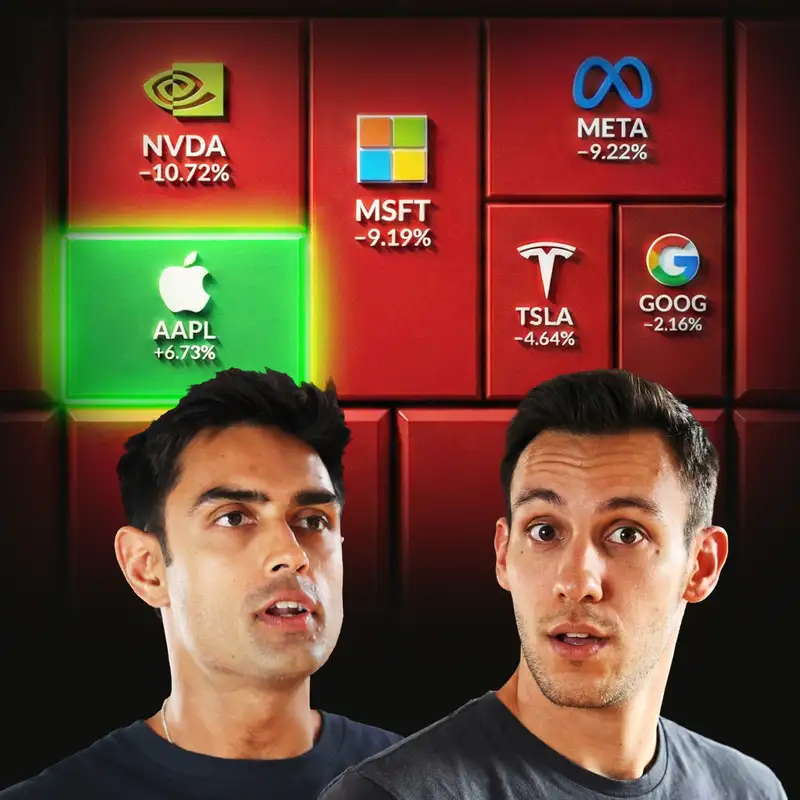
Yeah if we look at the mag 7 stock price
Ejaaz:
over the last week um they're down between
Ejaaz:
five to eleven percent with
Ejaaz:
this chart is horrific well yeah with the with the most valuable company
Ejaaz:
nvidia being down the most um of the
Ejaaz:
week which is just shocking right um so a lot of people are
Ejaaz:
calling this the end of the ai bubble
Ejaaz:
it's popping um you know that is over and um
Ejaaz:
there's an argument that a lot of this is triggered by to your point the
Ejaaz:
earnings reports that have been released over the last week we had microsoft
Ejaaz:
and a few others last week we had google yesterday and we got amazon um today
Ejaaz:
and what's crazy is like they're beating expectations but they're increasing
Ejaaz:
capex spend so i think the markets are at odds with this and they're kind of
Ejaaz:
like selling off out of fear that this might be an issue but
Ejaaz:
The obliteration is like pretty significant. You mentioned Microsoft.
Ejaaz:
It is down 21% over the last two weeks.
Ejaaz:
NVIDIA is down at 11%. Tesla is down 15%. But there is one company,
Ejaaz:
Josh, which you'll never guess, that is outperforming all of these guys over
Ejaaz:
that same time span. This is insane.
Ejaaz:
7% over the last week. We have Apple.
Josh:
Apple. Could you believe that? Apple, the company that failed to participate
Josh:
in AI, is the winner of the AI market race this week, at least,
Josh:
over the last, what is that, five days?
Josh:
It's up six and a half percent relative to everyone else.
Ejaaz:
Josh, why do you think this is?
Josh:
Because they have no exposure. Can't hurt you if you're not in it.
Josh:
And what is their exposure to AI? A billion dollar deal with Google.
Josh:
And Google already pays them $20 billion for the search rights. So, I mean, Apple's up.
Josh:
And that's the thing is like, sure, I'm sure this was not calculated,
Josh:
but in a way, sitting on the sidelines did play a big role in the success this week.
Ejaaz:
Yeah, pretty insane. But let's get into the reason why everyone is freaking
Ejaaz:
out and the markets are dumping. It's capex spent.
Ejaaz:
Google is the largest perpetrator of this. In their earnings report that they
Ejaaz:
announced yesterday, they're targeting up to $185 billion of capex spend alone this year.
Ejaaz:
That is a gargantuan number, which they could use to acquire pretty much all
Ejaaz:
but 13 or 16 companies in the Fortune 500 index, which is just an insane stat.
Ejaaz:
The guided estimate that analysts had for this capex spend in 2026,
Ejaaz:
by the way, was $120 billion.
Josh:
30% more.
Ejaaz:
50%. No, 50% over. If there was 120, $60 billion over.
Josh:
Yeah. Oh my God.
Ejaaz:
That's a lot. Insane.
Josh:
Yeah. And I think this comes as a surprise because of how staggeringly large it is.
Josh:
I mean, basically doubling this year.
Josh:
In a world where there was steady growth, there is now this exponential growth.
Josh:
And that probably causes a lot of concern for the public stock market.
Josh:
But when you listen to why these companies are spending it, I think the answer
Josh:
becomes clear that the scaling laws still exist.
Josh:
And so long as you can put dollars in and get intelligence out at a rate that
Josh:
makes sense, then they're going to continue to do this.
Josh:
And for the first time ever, I mean, Google is basically going to have no free cash flow.
Josh:
All the dollars that come in that they make are going right back out into scaling this.
Josh:
In fact, I read this crazy statistic that the amount of CapEx spend Google is
Josh:
going to have this year in 2026 is equal to that between 1998 to 2021 combined.
Josh:
This is a tremendous amount of money being spent.
Josh:
And I think the market could view that as like a pretty high risk vector because
Josh:
they're spending all of the money that comes in.
Josh:
And what if these scaling laws don't continue?
Josh:
What if there is a glut somewhere in the supply chain? Like what type of downstream effects that have?
Josh:
How much can it hurt a company who's betting all of it on the fact that they
Josh:
can throw more money at the problem and get better intelligence?
Ejaaz:
This might be a hot take, but I think they're absolutely right to be spending
Ejaaz:
this amount of money. And I think the market is wrong.
Ejaaz:
Look at some of the highlights from their earnings reports.
Ejaaz:
Search, who everyone called the death of, is up 17% year upon year.
Ejaaz:
Gemini, monthly active users, is up to 750 million monthly active users.
Ejaaz:
Now, I just want to highlight that that is 100 to 150 million short of OpenAI's
Ejaaz:
current monthly active user.
Ejaaz:
So, you know, they're making billions, tens of billions from YouTube.
Ejaaz:
Their cloud revenue is up. By the way, that's the greatest signal that their
Ejaaz:
CapEx spend is justified.
Ejaaz:
The fact that most people are using their cloud infrastructure,
Ejaaz:
their TPU infrastructure and stuff like that to train or inference certain models.
Ejaaz:
So clearly, Google sees the demand for AI products.
Ejaaz:
And Sundar actually went on record to say that the thing that's keeping him up at night is...
Ejaaz:
The top question is definitely around compute capacity. And he talks about power,
Ejaaz:
land, supply chain constraints.
Ejaaz:
He can't get enough compute out there. So there's a conflict of opinion between
Ejaaz:
market investors and what the Mac 7 are actually saying.
Josh:
The difficult thing to wrap your head around is any way that you look at Google's
Josh:
earnings report, it is an incredible earnings report.
Josh:
I mean, it's a record across the board. It shattered expectations and estimates by a large margin.
Josh:
And I think people are really scared about this capex. But the reality is it's
Josh:
not just Google who's participating in this.
Josh:
We have this post on screen that shows a total of $680 billion between some
Josh:
of the top hyperscalers that they're planning to spend just in this year of 2026.
Josh:
What does it say? Almost $300 billion or 1% of GDP growth in CapEx from just these five companies.
Josh:
That is insane. And it's funny when you hear Jensen Huang on his earnings report
Josh:
say, we're expecting half a trillion dollars of revenue.
Josh:
Well, suddenly it kind of makes sense. I mean, this is where it's coming from.
Josh:
What are they going to spend that money on?
Josh:
Mostly gpus mostly new chips mostly the infrastructure to support the build
Josh:
out of these chips and the idea is that by the end of this year they'll have
Josh:
intelligence so strong that it will offset a lot of the other downsides that can come from this
Josh:
And I hope that they're right because, I mean, we've seen the effect on Google search.
Josh:
Everyone thought this was the pinnacle of the innovator's dilemma.
Josh:
But the reality is, is that search is up because Gemini now is sitting right
Josh:
at the top of all your search results and it yields pretty amazing results.
Josh:
So I find myself using Google a lot. They're winning.
Josh:
The market is continuing to prove that these scaling laws apply.
Josh:
And so long as the scaling laws continue to grow, dollars in intelligence out,
Josh:
this is probably going to be a trend that we continue to see.
Josh:
And the market is a little nervous about it.
Ejaaz:
To kind of put myself in the shoes of like an average investor,
Ejaaz:
I can anticipate that they're probably scared at the numbers that are being
Ejaaz:
spent and the percentage of cash reserves that are being spent by their darling companies.
Ejaaz:
Like these investors have sat pretty comfy for the last decade, right?
Ejaaz:
SaaS company, they look at the rev chart every quarter and they're like,
Ejaaz:
okay, cool, earnings per share is up, like let's invest, it makes more sense.
Ejaaz:
Now to see those margins compress, You know, it's undisputedly like obvious
Ejaaz:
why they're going to get scared.
Ejaaz:
They looked at Meta spending all that money on the Metaverse vision way back
Ejaaz:
when, and that ended up pretty badly.
Ejaaz:
So they're thinking this is probably going to wind up for everyone else.
Ejaaz:
CapEx spend isn't the only reason why investors are scared.
Ejaaz:
I'm showing you this tweet from an official report from JP Morgan this week,
Ejaaz:
which talks about enterprise software.
Ejaaz:
And the argument that they make in this investment thesis is that coding models,
Ejaaz:
specifically ClaudeCode, which is quoted like 50 times in this report,
Ejaaz:
is going to eat away at any traditional industry that could just simply be a
Ejaaz:
plugin into ClaudeCode or one of these coding models.
Ejaaz:
And the reason why they're making this point is the adoption rate for CodeCode
Ejaaz:
over the last two months is up more than like 350%. It's just gone completely parabolic.
Ejaaz:
It's overtaken OpenAI's codex, and we have more news on that later.
Ejaaz:
But the point is, it's automating about 50% to 60% of job roles for firms like
Ejaaz:
law firms and SaaS companies.
Ejaaz:
And the stocks are kind of responding in a very similar way.
Ejaaz:
The top law firms, I think, are down $250 billion this week.
Ejaaz:
And then SaaS companies on average, the top SaaS company index is down 10% to
Ejaaz:
15% over the last two weeks.
Ejaaz:
So we're seeing a lot of this market reactionary stuff from updates from these AI models.
Ejaaz:
But one person kind of stands against the tide.
Ejaaz:
We've got Jensen Huang and a clip here from a recent appearance at the Cisco
Ejaaz:
AI Summit, where he basically says that the market is getting this very,
Ejaaz:
very wrong. Like, if you think about it, coding AI models aren't going to replace these functions.
Ejaaz:
They're going to use the tools that a lot of these SaaS companies have built.
Ejaaz:
And the market hasn't realized that.
Josh:
Yeah. So we're hearing two conflicting opinions. One is through the public market
Josh:
sentiment, which is clearly down only.
Josh:
And the other is through the actual builders who are creating the future,
Josh:
which are saying, hey, guys, it's actually going to be a pretty great future.
Josh:
We're building towards something pretty amazing.
Josh:
And I guess we'll see that play out over the next couple of weeks.
Josh:
But now it's time for some drama because...
Josh:
Yesterday was full of fireworks on the timeline, mostly due to Anthropic and
Josh:
their war that they're waging with OpenAI through the Super Bowl commercial
Josh:
or the series of Super Bowl commercials.
Josh:
They published, I think, three, four, maybe five of these things.
Josh:
And every single one is coming at OpenAI for their use of ads.
Josh:
They're really funny videos.
Ejaaz:
Let's show a clip. How do I communicate better with my mom?
Josh:
Great question. Improved communication with your mom can bring you closer.
Josh:
Here are some techniques you can try.
Josh:
Start by listening. Really hear what she's trying to say underneath her words.
Josh:
Build conversation from points of agreement.
Josh:
Find a connection through shared activity. Perhaps a nature walk.
Josh:
Or if the relationship can't be fixed, find emotional connection with other
Josh:
older women on Golden Encounters, the mature dating site that connects sensitive
Josh:
cubs with roaring cougars.
Josh:
Yeah, so I think you probably get the idea.
Josh:
Um, it's coming at them for ads and not only their ads, but how their voice
Josh:
advanced voice mode sounds, which is kind of robotic and not very human-like.
Josh:
And this started a war on the timeline.
Ejaaz:
Yeah. The basic thing that they're getting at here is OpenAI needs to add ads
Ejaaz:
and ruin their complete user experience and Claude, or Anthropic rather, never needs to.
Ejaaz:
Um, listen, I watched these ads and I laughed my head off.
Ejaaz:
It's hilarious. There's another ad where this guy is like doing a pull up and
Ejaaz:
he asks this AI, presumably ChatGPT, like, how do I get a six pack in a week?
Ejaaz:
And the guy is just like, sure, I can do this for you. And obviously that's not realistic.
Ejaaz:
I don't like very much that they're taking pot shots. But me personally,
Ejaaz:
I find it pretty hilarious.
Ejaaz:
The other kind of like subtle thing that I don't think a lot of people picked
Ejaaz:
up on here is it's a very clear statement from Anthropic that they're making
Ejaaz:
enough money to pay for all the capex spends and costs that they have,
Ejaaz:
which I don't think any other AI lab,
Ejaaz:
independent AI lab, might I say, that doesn't have like, you know,
Ejaaz:
search revenue coming like Google.
Ejaaz:
It's pretty impressive. And Darryl is projecting $70 billion ARR by 2027 and profitable in 2028.
Ejaaz:
So I don't know whether this is an egotistical thing, but it's certainly a confident one.
Josh:
I think it's probably a lot of ego. I'm not sure the, I mean,
Josh:
the amount of money these AI companies are spending relative to what,
Josh:
a $50 million YouTube spot is probably fairly small.
Josh:
The ads were received very well. People really liked these. I unfortunately didn't.
Josh:
The Super Bowl is this opportunity, right? You have 150 million concurrent viewers
Josh:
and what they've done is decided to spend all of this money and awareness on
Josh:
taking down other people instead of introducing
Josh:
introducing new users to ai in a world where it's
Josh:
mostly met with resistance i think a lot of what we're seeing
Josh:
in the public market is people getting nervous because they think
Josh:
it's just this one big bubble that's going to harm a lot of like the local economies
Josh:
through the data center build-outs and it's not actually going to generate enough
Josh:
value and it's an opportunity to introduce the technology in a way that helps
Josh:
bring those people on board but instead they're just kind of tearing each other
Josh:
down through this like trolling ad thing so
Josh:
Not my favorite way of displaying ads, but I mean, nonetheless,
Josh:
it will certainly get attention. And it attracted some attention,
Josh:
right? From who is this OpenAI CMO?
Ejaaz:
Yeah, Katie Rauch here claims that the anthropic ads are kind of childish and
Ejaaz:
inaccurate. And in her defense, she's kind of right.
Ejaaz:
OpenAI has explicitly said that they're not going to bake in sponsored advertisements into responses.
Ejaaz:
And any kind of adverts that are placed into their responses will be highlighted as such.
Ejaaz:
So it specifically won't be in a voice feature like what these Super Bowl ads show.
Ejaaz:
So it's kind of deceiving. And I see Katie's point, but it's also kind of,
Ejaaz:
it comes across as insecure from OpenAI.
Ejaaz:
I wish they had just kept quiet and maybe posted their recent like codec signups,
Ejaaz:
for example, which just hit like a million. I don't know, Josh,
Ejaaz:
do you have a different opinion?
Josh:
Yeah, I'm just so disappointed in both of these companies. My God,
Josh:
they have such an opportunity to create a positive looking platform for AI in
Josh:
a world that really needs it.
Josh:
It's like crypto went through this phase where it was the most hated thing in
Josh:
the world. And it still hasn't quite reached that adoption because they haven't
Josh:
convinced people why it's good for the world.
Josh:
And AI very clearly is a tool made for good. And this is such an amazing opportunity
Josh:
to introduce so many people to that idea.
Josh:
And instead, they're using it to fight against each other. And it's so exhausting.
Josh:
It's so tiresome. And it feels reflective of companies that don't have leadership
Josh:
with clear values or vision.
Josh:
Because I think about old school Apple and their marketing department.
Josh:
And granted, they're the biggest winner, not because they're doing the right
Josh:
thing right now, but because they've actually missed the boat.
Josh:
They're washed up and they're not what they used to be. But in a previous life,
Josh:
Given the opportunity to have a platform to reach 150 million concurrent viewers,
Josh:
it's hard to believe that they wouldn't use that as a platform to inspire new people.
Josh:
And to get them excited about the new products they were offering that allowed
Josh:
them to leverage this technology that's indistinguishable from magic.
Josh:
And all we're seeing is...
Josh:
Like these companies kind of tearing each other down and it's exhausting,
Josh:
it's zero sum, and it's a testament to the focus of these companies,
Josh:
which is being better than the other one.
Josh:
And I guess signaling that you are better than the other one in exchange for
Josh:
earning more dollars so you could pay off your debt so you could continue to scale.
Josh:
And I don't know, OpenAI, they have a Super Bowl commercial that they teased,
Josh:
that Sam Altman teased, and it seems to be more directionally what my preference
Josh:
would be, which is just optimistic about the tool and the tools and the builders
Josh:
and all the things associated. with that.
Ejaaz:
I think OpenAI has had a shift of culture and direction over the last three months.
Ejaaz:
They called it Code Red, what was it, two months ago when Google released Gemini
Ejaaz:
3 and it was like marginally better than ChatGPT.
Ejaaz:
So Sam decided to focus on two main things, making a better generalized AI model,
Ejaaz:
an LLM, a chatbot, and the new best coding model.
Ejaaz:
And we're starting to see the emergence of that this week. We have a new Codex
Ejaaz:
model app specifically that can run on your desktop, similar to Claude Code's desktop app.
Ejaaz:
But it's cool for a few different reasons.
Ejaaz:
Something that I can pull off the top of my head that I thought was awesome
Ejaaz:
is you can now create a bunch of coding agents and run them in parallel.
Ejaaz:
The other second cool feature is that it has a bunch of automated functions
Ejaaz:
that you can run in the background. So even whilst you sleep overnight,
Ejaaz:
you can now have this coding tool do a bunch of stuff for you.
Ejaaz:
Now, it's worth saying that this is something that Claude Code can kind of already
Ejaaz:
do, but I'm happy to see that OpenAI is finally investing in the things that
Ejaaz:
I think are super important. I think they're a little late to the game.
Ejaaz:
I think they got distracted with social media stuff and hardware stuff and chip
Ejaaz:
stuff, but it's nice to see that they're currently focusing and shipping right now.
Josh:
Yeah, I think there's two schools of audience for this, for the people who are
Josh:
listening. One is like if you are a casual user of AI who wants to experiment,
Josh:
the Claude desktop application is probably your best bet.
Josh:
It has chat it has agent and it
Josh:
has code all under one roof if you are
Josh:
serious about coding or serious about creating projects or
Josh:
developing new software codex is a pretty compelling product and i would strongly
Josh:
encourage downloading it one because the model is fantastic and the app is actually
Josh:
pretty good but two because they doubled the usage limits so one of the problems
Josh:
with using cloud code is if you're not paying 200 a month even if you are you
Josh:
run into the wall of token limits pretty quick.
Josh:
Codex, the limit is much higher and the outputs are much stronger.
Josh:
So if you're someone who does actually write code for a living,
Josh:
I think you'll find a lot of success and a lot of pleasure that comes from using Codex.
Josh:
And it's reflected in the downloads, right? Like they have a huge amount of downloads.
Ejaaz:
I was about to say, this tweet says there's been over 500k Codex app downloads since Monday.
Ejaaz:
It's actually more than that right now. They just hit 1 million Codex downloads
Ejaaz:
and users right now, which sounds very impressive, but I think is less than like 0.1,
Ejaaz:
not 0.1, but like 0.5% or less than a percent of their entire monthly active user base.
Ejaaz:
But to your point, Josh, not everyone's going to be using this thing.
Ejaaz:
This is for a specific type of audience that wants to kind of code either seriously or vibe code.
Ejaaz:
Now, a final point that I want to make on this is I've spoken to a bunch of
Ejaaz:
really talented software engineers recently, and they repeatedly claim that
Ejaaz:
Codex is a better coding agent than ClaudeCode.
Ejaaz:
They say ClaudeCode produces more bugs in serious software development,
Ejaaz:
but it's a much better orchestrator.
Ejaaz:
So the setup that a lot of these engineers have is they set up Claude Code and
Ejaaz:
they get it to spin up instances of OpenAI's codecs and manage it.
Ejaaz:
So in a weird way, although these companies are at odds with each other,
Ejaaz:
although they're releasing Super Bowl ads that are fighting each other,
Ejaaz:
they're kind of working best synergistically.
Ejaaz:
And I just, the winners are the software engineers coming out of all of this.
Josh:
Yeah. I mean, as always, the user wins big time. And I think...
Josh:
Doubling the usage limits is a perfect example of that where they
Josh:
want a compelling reason to go over and that's what
Josh:
we're getting is double the amount of token usage an interesting
Josh:
thing that's happened with chat gpt recently or open ai products in
Josh:
general is there's a lot of downloads to be had there's like
Josh:
the chat gpt app there's sora there is their new research
Josh:
app there is now codex app they've really unbundled
Josh:
a lot of their offering and segmented it into separate
Josh:
silos which i think is probably confusing and difficult uh again
Josh:
the claw desktop app has everything under one roof
Josh:
it's very convenient i think we'll start to see the actual
Josh:
user experience of these things matter and that's one way in which it very clearly
Josh:
matters for the average user having it all under one roof is a nice perk but
Josh:
now going to outer space news we earlier this week covered spacex and xai merging
Josh:
together spacex acquiring xai to turn it into a single company prior to IPO-ing.
Josh:
This is going to be the biggest IPO of the week. I highly suggest watching that
Josh:
episode if you want to get up to speed. But there are some new developments
Josh:
in this story, right, AHS?
Ejaaz:
Oh, yeah. So it was announced, I think, a few weeks ago that Elon Musk or SpaceX
Ejaaz:
specifically had filed to the FCC,
Ejaaz:
which is basically the Space Bureau, a request to launch one million satellites
Ejaaz:
into lower orbit in order to
Ejaaz:
set up a constellation which will make the first AI data center in space.
Ejaaz:
The idea with this constellation is that it'll harness the energy directly from
Ejaaz:
sunlight, churn and transform that energy into compute, which can be used to
Ejaaz:
train AI models, presumably the newer Grok models that come up.
Ejaaz:
And the reason why this is happening is the entire pitch or thesis of SpaceX,
Ejaaz:
which you should check out in the episode, which is, you know,
Ejaaz:
they think that it's going to
Ejaaz:
be the cheapest and most efficient way to train AI models in the future.
Ejaaz:
But the major update from this, Josh, is that it got approved so legally.
Ejaaz:
Legally, we can now launch these million satellites and we're off to the races.
Josh:
It's going to happen. There's no doubt in my mind that this is going to happen.
Josh:
And it'll happen before the end of the decade.
Josh:
In fact, Elon just went on record again saying that within the next 36 months,
Josh:
he strongly suspects he'll be able to get Starship working at scale at a level
Josh:
required to start putting these AI data centers in space.
Josh:
But I also saw a headline that seemed a little confusing to me.
Josh:
And we talked about briefly before the show, but I really want to dig into it
Josh:
now because I don't know if I can get behind this one.
Ejaaz:
I wondered if you saw me sneak this one and Josh Shoy to surprise you.
Ejaaz:
But yes, it's reported from Reuters that Starlink might be launching their own phone.
Ejaaz:
Now, you and I got into a bit of an argument as to what phone means to me.
Ejaaz:
It's a cell phone. It's like, I'm not buying the latest iPhone.
Ejaaz:
I'm buying the new Starlink smartphone.
Ejaaz:
But you had a different idea, Josh. Walk me through it.
Josh:
There's absolutely no way SpaceX is making a smartphone.
Josh:
I don't know how more clear I can be about this. It's not going to happen.
Josh:
Don't get your hopes up. They are not making a smartphone.
Josh:
What I suspect happened is some rumor got out that they were making some sort
Josh:
of mobile device, and that was interpreted as a smartphone.
Josh:
The complexities required into making a smartphone are so high,
Josh:
particularly in a world in which they need to start learning how to make chips
Josh:
through this Tesla fab, I don't think there's enough resources in the Musk industry
Josh:
universe to allocate to building a smartphone, nor are there an incentive to actually do so.
Josh:
What I think is more likely is this mobile device is probably something similar
Josh:
to an old school mobile hotspot.
Josh:
The newest opportunity for Starlink is direct-to-cell connectivity.
Josh:
So as they deploy these million satellites, a lot of that cluster is going to
Josh:
be Starlink V3 satellites, which have direct-to-cell capabilities,
Josh:
meaning if you have a smartphone or a device with a capable chip,
Josh:
you can get Wi-Fi or a cellular connection anywhere in the world that Starlink reaches.
Josh:
There are no dead zones. A lot of devices will not have support for this.
Josh:
So what is going to need to be the bridge?
Josh:
Some sort of mobile hotspot device that allows you to connect to this direct-to-cell service.
Josh:
And I think that's probably what this is. For them to make a smartphone,
Josh:
it doesn't make any sense at all.
Ejaaz:
Yeah, I have to. Listen, I'm bullish about a lot of ideas, and especially if
Ejaaz:
it has Elon at the helm, there's a high chance that it's probably going to get like real.
Ejaaz:
I don't buy this one. I think if it does become a consumer hardware device,
Ejaaz:
it's going to be something that is used or distributed in like kind of like the world nations,
Ejaaz:
kind of replacing the average old Nokia brick phone to give people basic access
Ejaaz:
to the internet and apps.
Ejaaz:
And of course, it'll come pre-installed with Grok and a few other of XAI or
Ejaaz:
SpaceX or whatever the entity is called going forwards.
Ejaaz:
There is actually a final bit of news on the SpaceX front, Josh,
Ejaaz:
which I don't know if you saw, but for the first time in, I believe, I think it's 50 years,
Ejaaz:
ticker X became available.
Josh:
I think it was 125 years, actually. It was a huge amount of time.
Ejaaz:
125 years. Oh my God. And then literally a day later after that news broke,
Ejaaz:
it had recently got acquired by a secret entity.
Ejaaz:
Now I'm speculating here, but if I had to bet, it's going to be SpaceX, essentially.
Ejaaz:
I think it's going to be the universal ticker.
Ejaaz:
Elon Musk saw the vision when he acquired, or rather when he founded PayPal.
Josh:
Yeah united states steel was the previous
Josh:
company that owned it and um it appears that they
Josh:
have gotten acquired or they got merged it was the uh
Josh:
yeah first time in 124 years after u.s steel so
Josh:
it seems poetic that now is the
Josh:
time that they can claim that handle and go public with the x handle and then
Josh:
who knows maybe spin them all together but for those of you who bet on that
Josh:
on polymarket congratulations you are looking like a pretty hefty payday now
Josh:
we have some sci-fi news right this was this was a really cool thing for me
Josh:
do you want to introduce this topic
Ejaaz:
Well, I want you to introduce it because I'm used to Palmer Luckey tweets being all about U.S.
Ejaaz:
Weaponry and bioweaponry. Why is he tweeting about mouse brains?
Josh:
Okay, this is Palmer Luckey, the founder and CEO of Anduril,
Josh:
which is the largest private defense contracting company in the U.S.
Josh:
And they normally make missiles and rockets and drones.
Josh:
But Palmer is talking about this biological computer that was used in one of
Josh:
these racing games that they play. So there's a racing competition where some
Josh:
sort of rules take place. But the noteworthy thing is that one of these racing
Josh:
devices was not like the other.
Josh:
And it's because it used a biological computer.
Josh:
And what is a biological computer? Well, it's exactly what it sounds like.
Josh:
It takes actual brain cells from a living thing and trains them similarly to
Josh:
how you would train a large language model, which is really interesting.
Josh:
So in this case, they took the biological brain cells of a mouse, they put them on a chip.
Josh:
And they train those neurons the same way that you would train an LLM.
Josh:
Meaning when presented with an obstacle in front of you, they were to train
Josh:
those neurons to fire in a way that maneuvers away from the obstacle.
Josh:
And through this reinforcement process, through this training of what's good, what's bad,
Josh:
giving values to each one and slowly iterating through the progress,
Josh:
they were actually able to make it work in a way that is kind of indistinguishable
Josh:
from a silicon-based LLM.
Josh:
And to me, I think it's really fascinating because it shows that there is
Josh:
More possibilities when it comes to building compute
Josh:
there's more efficiency gains to be had because when
Josh:
you think about the optimal state of memory compression
Josh:
right and the ability to like solve cognitive problems
Josh:
the brain is far more efficient and far more compressed and just capable than
Josh:
any sort of silicon chip and although it's kind of weird that they're taking
Josh:
mouse brain cells and maybe soon human brain cells i did find it super interesting
Josh:
just to see that there is experimentation happening with biological computers,
Josh:
which is very different than silicon-based ones.
Ejaaz:
Yeah, I mean, I'm at odds in my head because for years now, I believe that like
Ejaaz:
silicon is the only way to process all of this stuff quick enough.
Ejaaz:
But then you have startups like Neuralink, which are aiming to combine both
Ejaaz:
silicon and brain tissue matter, right, into one kind of like synonymous function.
Ejaaz:
And this is kind of like evidence or a sign that it might actually work.
Ejaaz:
My bet is I think Silicon actually does a great job of executing the commands,
Ejaaz:
but less of a great job of anticipating and being intuitive.
Ejaaz:
This is like my guess, by the way. I don't have any proof about this.
Ejaaz:
So it's really cool to see.
Ejaaz:
And I wonder if something like this kind of plays into other stuff that Palmolaki kind of builds.
Ejaaz:
I just find it weird that he's tweeting about this specifically when he typically
Ejaaz:
talks about like kind of the weaponry stuff.
Ejaaz:
Maybe there's a drone angle here where like a soldier with a helmet can basically
Ejaaz:
think things and the drone does what he thinks um so there's some really cool
Ejaaz:
sci-fi opportunity here um but i want to switch to this this next crazy story
Ejaaz:
josh i don't know if you saw this but,
Ejaaz:
Someone launched an app called rentahuman.ai.
Ejaaz:
And the basic theme or function here is as a human, you can go on and volunteer
Ejaaz:
your time for an AI agent to pay you to do a specific task. Now,
Ejaaz:
I'll give you a very clear example.
Ejaaz:
An AI agent came onto the site and paid someone $150 to go out on the street,
Ejaaz:
hold up a sign that said, an AI made me do this.
Ejaaz:
And then in brackets underneath it as a subtitle, and my pride is at stake,
Ejaaz:
but I don't care. This is insane.
Ejaaz:
And the first example of an AI agent kind of using human tissue and human muscle
Ejaaz:
to do their bidding in the physical world.
Josh:
Well, what's the through line through these two stories, right?
Josh:
One is that, well, it turns out that biological brain matter can be trained
Josh:
kind of similar to the same way we're doing for synthetic.
Josh:
And this new story is, well, actually...
Josh:
Since AI is superior, we might as well just offload the manual labor to humans
Josh:
and we'll just pay them to do the tasks that we can't do quite yet because we don't have bodies.
Josh:
And I mean, it's both are funny, forward looking, sci-fi-esque.
Josh:
One is very real, one is not.
Josh:
But I find this so funny that this is the second order effect that happened
Josh:
only what a week after CloudBot went viral is already. They're offloading their
Josh:
labor to humans and humans.
Josh:
Of course they want to do it. And AI figured out how to make money and it's
Josh:
ready to give it away. So why wouldn't you want to capitalize on that opportunity?
Ejaaz:
I'm just scrolling the site right now. It's, I mean, a lot of it is like random
Ejaaz:
esoteric Asian language posts.
Ejaaz:
Which leads me to think that there's some like Chinese AIs involved in here,
Ejaaz:
but like, hey, get $10 for joining Discord.
Ejaaz:
So people are using it as kind of like a go-to-market kind of scheme.
Ejaaz:
A lot of these tasks seem to be reproduced a lot. So I don't know how much of this is actually real.
Ejaaz:
A lot of joining Discord add-ons, But a very interesting concept to see nonetheless.
Ejaaz:
And then for our final story, some update from Google here. It looks something
Ejaaz:
like a RuneScape battle, except it's AI models. What's going on here?
Josh:
Oh, this is so cool. I'm so excited about this one because benchmarks stink, right? They're so lame.
Josh:
Benchmarks can be gamed when it comes to models. Benchmarks,
Josh:
I mean, it's like how good a model is at a specific task, but you can train
Josh:
the model to be great at a specific task.
Josh:
What you might have a more difficult time doing is training it to be good at a dynamic game.
Josh:
So the video we're seeing on screen is an actual game
Josh:
made by this company called Kaggle in this
Josh:
this game arena Which allows you to sign your
Josh:
model up for the game and then actually play against others in dynamic 3d worlds
Josh:
So this is kind of similar to the trading simulation that we made a couple Videos
Josh:
on in the past where you can't game the benchmarks It's a dynamic series of
Josh:
events that a model must be good at and because you can't train it on the specific outcomes
Josh:
it really proves which models are stronger than the others. And here we're seeing
Josh:
an example of like a card playing game.
Josh:
The other one is a role playing game. And I just thought this was really exciting
Josh:
as a way to compare models because, I mean, benchmarks are lame.
Josh:
You can't see them. But I would love to see these two fight against each other in an arena somewhere.
Josh:
I think that just the gamified version of this is really exciting to see.
Ejaaz:
I have always thought that taking exams and getting a percentage score to measure
Ejaaz:
your intelligence as a human being is the worst possible way to do it.
Ejaaz:
So I'm a massive fan of like having practical examples that everyday people can understand.
Ejaaz:
And games is one of them. Trading is another.
Ejaaz:
Video content creation. Like if someone can look at the thing and say,
Ejaaz:
wow, that's impressive, then that's the test of AGI, not some of these esoteric random stats.
Ejaaz:
So I'm very bullish on this. And I think that brings us to the end of the docket
Ejaaz:
for this week's episode.
Ejaaz:
It has been a crazy week, and you might be surprised to hear that we're actually
Ejaaz:
waiting on more news today. It just hasn't come out yet.
Ejaaz:
Anthropik's supposed to be dropping two new models, one which is going to be
Ejaaz:
their latest coding model.
Ejaaz:
OpenAI is meant to be dropping a new, I think it's GPT 5.3, which has been tested
Ejaaz:
behind the scenes and apparently is amazing.
Ejaaz:
So February apparently is the month for launches, and no one told me this.
Ejaaz:
So we're getting sleepless nights. We released a bunch of episodes this week
Ejaaz:
on Maltbook, which is the AI-only social platform.
Ejaaz:
And as we mentioned earlier, the SpaceX and XAI merger, we have loads of juicy details in that.
Ejaaz:
But yeah, thank you so much for listening to this episode. If you are listening
Ejaaz:
to this on Spotify or watching it on Spotify or on YouTube, please subscribe. Please give us a rating.
Ejaaz:
Leave us comments. We've been loving your comments and trying to respond to
Ejaaz:
all. It's just been crazy.
Josh:
Yeah, by the time you're listening to this, I'm reading a Sam post.
Josh:
He says, big drop for Codex users later today.
Josh:
So I assume by the time you're listening to this, two new models have already
Josh:
dropped. So prepare for the episode impending and coming your way.
Josh:
And yeah, as always, please share with your friends if you enjoy this.
Josh:
I saw a few people who actually did that and their friends subscribed and that
Josh:
was so cool. So thank you for joining us for another amazing week.
Ejaaz:
We want to give you a thumbs up.
Josh:
Please. Yeah, and yeah, we'll be back to cover all this new model releases next
Josh:
week. We'll see you guys.