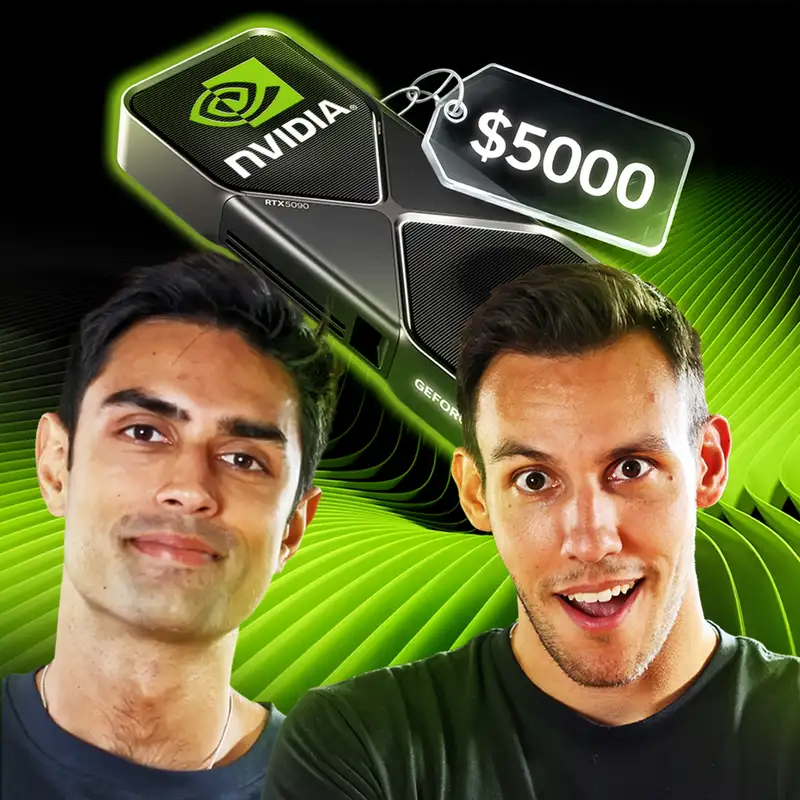
The Semiconductor Squeeze is Quickly Becoming The Biggest AI Crisis
Ejaaz:
We're not even a week into 2026 and AI's biggest crisis is already underway. The battle for memory.
Ejaaz:
What if I told you this ugly piece of plastic, a graphics card,
Ejaaz:
is now worth $4,000 when it was only worth $500 literally two months ago?
Ejaaz:
The reason? AI is consuming the entire memory chip supply and it's leaving behind
Ejaaz:
a $100 billion hole that needs to be filled ASAP.
Ejaaz:
You see, memory is a really crucial component for AI models.
Ejaaz:
It helps them store and access intelligence very much like how our human brains work.
Ejaaz:
In fact, it's so important that companies like NVIDIA and Google spend tens
Ejaaz:
of billions of dollars each year just on memory to build their GPUs.
Ejaaz:
The issue, though, is that manufacturers of memory like Samsung and Micron are
Ejaaz:
running out of supply, which means that prices for these things are skyrocketing.
Ejaaz:
In fact, it's so bad that companies like Google and Microsoft have each fired
Ejaaz:
their executives that live out in Southeast Asia because they weren't able to
Ejaaz:
secure capacity for 2026.
Ejaaz:
Everyone thought that GPUs was the main commodity to win the AI race,
Ejaaz:
but turns out it's actually memory.
Ejaaz:
Josh, you're kind of on the front line for this kind of stuff.
Ejaaz:
You've had experience like building out custom PCs and stuff,
Ejaaz:
and you've been tracking like the memory prices for a while.
Ejaaz:
Now, what's your take on this?
Josh:
This story for me hits very close to home because I've spent so much time building
Josh:
custom computers, custom PCs. I love gaming. That was my thing. And...
Josh:
Seeing this is really disappointing because throughout history,
Josh:
there's always been these reasons why my GPUs have gotten so expensive.
Josh:
First, it was for like crypto mining. Now it's for AI.
Josh:
And all the supply chain crisis that is downstream of PC gamers is such an annoying thing to deal with.
Josh:
There's this cool chart that i'm going to show on the screen right here which shows the.
Josh:
Ddr5 ram over time and i guess what i could do is kind
Josh:
of highlight why you need ram in a computer there's a
Josh:
few parts there's the case that holds it there's the power supply there's the
Josh:
gpu and the cpu which you think of as the brains and then there's memory and
Josh:
there's two types of memory there's one that you could think of as short term
Josh:
which is ram and there's one long term which is your storage what we're looking
Josh:
at here is the price of ram ram is the short term fast memory that's required
Josh:
to do a lot of heavy compute things.
Josh:
So if you think of your computer as a kitchen, maybe it's like the GPU and the
Josh:
CPU is the chef, the RAM is the countertop space where the ingredients are laid
Josh:
out, and then your storage is in the pantry somewhere else.
Josh:
The problem is that this countertop space where you quickly work on,
Josh:
very valuable and a lot of people really want that precious countertop
Josh:
space and what we're seeing here is the price of
Josh:
a 232 gigabyte sticks of ram which
Josh:
is very standard for a computer going from 200 to 800
Josh:
over the last couple of months and there's this great example of this post from
Josh:
this guy levels who we'd love following on twitter he was talking about his
Josh:
experience where he actually bought two sticks of ram for 64 gigabytes a few
Josh:
months ago at 350 and now they are $2,500 for that same exact thing.
Josh:
The markup is incredible.
Josh:
So if you are buying a PC, building a PC, or if you're buying any sort of consumer
Josh:
hardware, the idea is that these costs are going to have to find their way into the market somehow.
Josh:
And they're probably going to be hitting you in the wallet right where it hurts.
Ejaaz:
So I want to pause for a second and kind of rewind five months ago to when the
Ejaaz:
rumblings of all of this began.
Ejaaz:
Because to be frank, this kind of took me by surprise.
Ejaaz:
I didn't realize that memory was such a crucial component, more so that there
Ejaaz:
was a supply crunch for it.
Ejaaz:
So around five months ago, we were kind of like winding down the year.
Ejaaz:
You know, OpenAI probably announced their thousandth partnership and NVIDIA
Ejaaz:
launched their next GPU or whatever.
Ejaaz:
And we were reaching a point where some analysts on Wall Street started to sound
Ejaaz:
the alarm on prices of memory going up, but it didn't appear in GPUs or in any
Ejaaz:
part of the AI world, Josh,
Ejaaz:
it started appearing in consumer electronics or the cost of these graphic cards
Ejaaz:
that you were just talking about.
Ejaaz:
And so they started saying, well, this is going to eventually trickle down into
Ejaaz:
GPUs because they require a lot of memory.
Ejaaz:
So therefore, GPU cost is probably going to go sky high. So I started looking
Ejaaz:
into this and this tweet really summarizes this well.
Ejaaz:
Did you know that 80% of the average material cost to build a GPU is memory?
Ejaaz:
That is just an insane amount of like materials that you need to kind of like hike this thing up.
Ejaaz:
And so when you're looking at the cost of prices of these consumer electronics
Ejaaz:
going up, such as we have on the screen here, it starts to really put into place
Ejaaz:
that it's not just an AI specific thing.
Ejaaz:
This memory is required for pretty much any consumer electronics device that you have available.
Josh:
Yeah, Ijez, you mentioned earlier that you were tracking the prices of GPUs.
Josh:
You had one that you saved for $2,000 and now the price is like upwards of $4,000
Josh:
and you have to update your reference now because the price has gone up. so quickly.
Josh:
And I think I want to make this important clarification that it's not just RAM,
Josh:
it's a specific kind of memory that AI needs.
Josh:
So when people say RAM shortage, they mean the sticks you buy for your PC, which are DDR4, DDR5.
Josh:
But the AI world has its own special type of fuel, which is different than the
Josh:
things you plug into your computer, and that's called HBM. It's high bandwidth memory.
Josh:
And you could kind of think of it, it's like the Formula One pit crew of memory.
Josh:
It is the fastest thing that exists because it takes two-dimensional RAM,
Josh:
which is generally reserved for DDR4, DDR5, things you put in your computer,
Josh:
stacks them together in three dimensions to add a lot of bandwidth,
Josh:
a lot of capacity, a lot of additional speed that you wouldn't otherwise find
Josh:
in these traditional pieces of RAM.
Josh:
And the idea is that there's a lot of downstream effects on consumer products
Josh:
that come from this specialized HBM being absorbed by all these manufacturers.
Ejaaz:
So basically, each HBM is composed of a stack of DRAM, dynamic random access memory, as you said.
Ejaaz:
And it requires a lot of this, Josh. In fact, to create one unit of HBM,
Ejaaz:
it requires three times the capacity that it requires to build regular DRAM.
Ejaaz:
So why am I talking about these two things?
Ejaaz:
Well, DRAM is what you need in pretty much every single electronics device,
Ejaaz:
including, drumroll, the Apple iPhone.
Ejaaz:
So if you start to think about it, these companies need to start competing for
Ejaaz:
the very supply that is limited and that we're talking about right now.
Ejaaz:
And so when I think about the likes of NVIDIA, Justin Huang,
Ejaaz:
who needs all this memory and DRAM to build out his GPUs.
Ejaaz:
And then Apple, surely there's going to be some kind of price hike that levels up into the consumer.
Ejaaz:
And that's what we're hearing on the rumor mill here.
Ejaaz:
So Apple is releasing their new A20 chip this year, which is the upgrade from the A19 chip.
Ejaaz:
And the rumors say that it's going to cost 80% more than the A19 chip.
Ejaaz:
Now, I don't see a world where Apple doesn't pass this cost down onto the consumer.
Ejaaz:
Because there's now massive competition between basically NVIDIA and Apple as
Ejaaz:
to who pays more money to secure the capacity.
Ejaaz:
Now, Apple isn't someone that has a small wallet. They have a very large budget.
Ejaaz:
They're able to secure this supply.
Ejaaz:
In fact, they accounted for 24% of TSMC's revenue in 2024.
Ejaaz:
And rumors has it that they've secured 50% of TSMC's a memory packaging capacity in 2026.
Ejaaz:
So I think they're still able to compete, but for how long, I'm not entirely sure.
Josh:
There's this great example that we're showing on the screen where it shows a
Josh:
64 gigabyte memory package compared to a MacBook Air.
Josh:
And the funny thing is the prices are pretty much exactly the same.
Josh:
In fact, the MacBook Air only costs $15 more than the sticks of memory.
Josh:
So with Apple, you can essentially buy the RAM and get the MacBook for free
Josh:
because it is all packaged at the same exact price.
Josh:
And it shows that Apple does have this resistance to price impacts felt throughout the market.
Josh:
How long will this last? I don't know. I have to assume that Apple,
Josh:
like you said, they're very well capitalized.
Josh:
They have the ability to shrink their margins temporarily in order to gain more
Josh:
market share across the world.
Josh:
And if this is the case and the people are either looking to buy a PC or to
Josh:
buy a MacBook, and the MacBook is the cost of a single component of the PC,
Josh:
it's a very strong and compelling argument to buy Apple products.
Josh:
So how much of this increase is going to be felt throughout the products? I don't know.
Josh:
I guess the main thing we'll probably see is later this year with new iPhones,
Josh:
but they also have some series of Macs that are coming out early this year.
Josh:
And I guess we'll just have to wait and see if they're able to maintain this,
Josh:
to hold the line, because what a great deal now.
Josh:
If you're buying a computer, go buy a MacBook. It's the same price as a single component of a PC.
Ejaaz:
I want to push back on one thing, Josh. These are the MacBooks that exist today,
Ejaaz:
right? The models are already out. The supply is already out.
Ejaaz:
But wouldn't these price changes be seen in the future products that they release?
Ejaaz:
Like the next MacBook that they drop, the next iPhone that they drop.
Ejaaz:
I think that's where we're going to see the price hikes. Am I missing something here?
Josh:
No, it's possible. We'll see. The M5 MacBooks are coming out probably.
Josh:
The newer ones are coming out in the next few months. It's rumored to come out in Q1 of 2026.
Josh:
So we will have to wait and see.
Josh:
Historically apple has been pretty good at resisting these fluctuations and
Josh:
smoothing them out over a long period they.
Ejaaz:
Might eat the cost
Josh:
Perhaps it's it's incremental perhaps they eat the cost in exchange for getting
Josh:
larger market share we'll just have to wait and see but they can certainly afford
Josh:
it whatever whatever issue may come their way well.
Ejaaz:
What's interesting is uh jensen is not eating the cost he's passing that uh
Ejaaz:
memory price hike of cost straight down to the consumer so i think the average
Ejaaz:
cost of his gpu was like 35k he's now selling them for 45k per unit.
Josh:
With hefty margins.
Ejaaz:
Hefty, hefty. 80% margin. Don't ever forget that.
Ejaaz:
Manvidia is a huge monopoly. But speaking of monopolies, actually,
Ejaaz:
I think now's the perfect time to introduce the key players in the memory manufacturing game.
Ejaaz:
Now, let's call these the three musketeers. These guys have massive grins on
Ejaaz:
their face for many different reasons.
Ejaaz:
Number one, they are the primary and only providers of high bandwidth memory
Ejaaz:
and DRAM, which is what both Apple and NVIDIA need to build their respective products.
Ejaaz:
And Josh, what I'm showing on the screen right now is the timeline of memory
Ejaaz:
manufacturers, I think roughly over the last 25 years or so.
Ejaaz:
And you'll notice that when you pan from left to right,
Ejaaz:
for those of you who are just listening, you grow you go from
Ejaaz:
about 11 players in 2000 to three
Ejaaz:
players in 2013 and these three players samsung sk hynix and micron are the
Ejaaz:
major players that we're going to be talking about today they've had a fantastic
Ejaaz:
2025 josh do you want to do you want to guess what the average price increase
Ejaaz:
in their share prices has been over the last year
Josh:
Looking at this chart we lost 70 of the players over the last 20 years,
Josh:
which means the remaining 30% are capturing 100% of this unbelievable demand
Josh:
in the highest priced index.
Josh:
And industry in the world, which means surely they're up a good amount.
Josh:
How much? I don't know, but I would guess like perhaps Robin Hood or Palantir levels above.
Ejaaz:
You might be right. So I'm showing Micron Technology, which is the US ambassador
Ejaaz:
of memory supply right here. We're going to go USA over here.
Ejaaz:
Their stock is up 250% over the last year.
Ejaaz:
If we peek over at Samsung Electronics, which is the largest market cap already
Ejaaz:
out of all three of these companies, their stock is up a massive 150% over the last year.
Ejaaz:
And the same is for SK Honex, which is a Korean or Southeast Asian based company.
Ejaaz:
The point I'm making is these guys are in the perfect position because they're
Ejaaz:
the ones that are able to hike the prices up and say, hey, sorry,
Ejaaz:
NVIDIA, you got to pay 80% more, either take it or leave it or I'm going to
Ejaaz:
sell it to Apple. And Jensen's like,
Ejaaz:
fine, I'll spend that money. I'm fine with that. And Apple's doing the same as well.
Ejaaz:
So not only is all their supply booked up, but their supply for the next couple
Ejaaz:
of years in 2027 to the end of 2027 is also booked up.
Ejaaz:
So then the question becomes, which one of these three players are going to
Ejaaz:
fill the $100 billion supply hole that is currently there?
Ejaaz:
It's going to be a race between the three of them. Whoever can fill it will
Ejaaz:
be the richest and be king made out of this entire memory manufacturer race.
Ejaaz:
My bet, Josh, is it's going to be Samsung.
Ejaaz:
I have two specific reasons for this. Number one, Samsung has been the biggest
Ejaaz:
memory provider for over a decade now.
Ejaaz:
And they've been able to navigate this market through memory cycles up and down for decades now.
Ejaaz:
They have all the experience and funding to be able to do so.
Ejaaz:
Which brings me to my second point.
Ejaaz:
They're known as what is called a chaebel in Korea, which stands for basically monopoly.
Ejaaz:
They're able to pull funds from all of their other cash-making sectors of their
Ejaaz:
business, their electronics business, the mobile phone business,
Ejaaz:
to keep the memory business alive.
Ejaaz:
And even if it runs to a zero-cost margin type of race, they'll still be able to win and survive.
Ejaaz:
And the truth is, whoever survives the memory crunch that they're currently
Ejaaz:
in will end up being the winner. So I think Samsung's got a lot of legs here.
Josh:
So that's the case for Samsung, but we also have a bold case for Micron,
Josh:
which actually exited the consumer business entirely.
Josh:
So one of these three major manufacturers left the consumer business,
Josh:
meaning if you used to buy Crucial RAM, which is actually the memory that's
Josh:
in my computer, they no longer exist.
Josh:
They said, see you later. We're going for the big boys. We want the big bucks
Josh:
with these AI companies.
Josh:
And it's devastating for the
Josh:
consumers because this is where you're really seeing the price increase.
Josh:
One of these three major players is now gone. They're just catering to the large
Josh:
people in the market, but it also means that they are focused on bringing rates down.
Josh:
So if you are in the industry for a custom PC or any sort of consumer hardware,
Josh:
The apologies need to be made, but also the hope is that them doubling down
Josh:
on this will mean that they can produce a lot more and hopefully lower the downstream
Josh:
cost to these AI providers, which will then lower the cost down to you, the end consumer.
Josh:
They're locked in. If you ever wanted any indication that they're coming for
Josh:
Samsung's neck, this is it. They left the consumer market. They're all in on AI.
Josh:
And hey, give them a lot of credit. We'll see what happens.
Ejaaz:
I think what amuses me the most is just the raw power that these companies wield.
Ejaaz:
There was a news story that broke last week that SK Hynix, the third player
Ejaaz:
in this memory game, told Microsoft no to their extra requests for capacity in 2026.
Ejaaz:
To build their own chips and supply open AI in many different ways.
Ejaaz:
They also told Google the week before no as well, which led to that Google exec
Ejaaz:
being firing or reports of him being fired.
Ejaaz:
So the point of the matter is these three companies are going to control the
Ejaaz:
spice for all the Dune fans out there of whether you can build GPUs or whether
Ejaaz:
you can build iPhones at a reasonable cost without passing that on to the consumer.
Ejaaz:
But it's equally on them to be able to scale supply to be able to meet demand.
Ejaaz:
And that is going to be a really important battle to track in 2026,
Ejaaz:
which is probably a good point to transition on to the kind of future facing
Ejaaz:
section here, Josh, which is like, how does this play out in 2026?
Ejaaz:
And what are kind of like the key themes that we're going to see?
Ejaaz:
I think the main one is going to be, well, there's going to be a lot of fights
Ejaaz:
between all the AI labs and NVIDIA to get their hands on memory capacity.
Ejaaz:
And the companies that are able to do this and navigate this well will end up
Ejaaz:
being the winning AI companies in 2026, potentially.
Ejaaz:
Whatever it may be, OpenAI has taken the first punch or rather delivered the
Ejaaz:
first punch, reportedly locking in 40% of global DRAM wafer capacity supply through 2029.
Ejaaz:
I don't know how true this is, but I have a feeling this is linked to all the
Ejaaz:
partnerships that they were signing with Oracle and NVIDIA and stuff like that.
Ejaaz:
So, you know, it might be a bit kind of fluffy, but interesting to see.
Josh:
Yeah we find ourselves in this interesting situation where we're always on
Josh:
the lookout for these bottlenecks where are there going to be
Josh:
problems as we scale these systems and right now the
Josh:
largest and most important one outside of
Josh:
energy is ram but now we have two now
Josh:
we have this memory issue we have this we have this energy issue we
Josh:
are like kind of accumulating these problems along the way to
Josh:
the point where now ram is becoming close to worth its
Josh:
weight in gold if gold hadn't just gone up like 30 it would have
Josh:
been and just today it was announced we have this post on screen saying that
Josh:
the prices for ews for microsoft for google
Josh:
cloud the ramp prices are 70 percent higher than
Josh:
in the fourth quarter of last year so
Josh:
the ramp up is incredibly high and
Josh:
it's showing i guess how durable the industry is where they're ready to absorb
Josh:
this and keep going that's how important this progress is so things are getting
Josh:
a lot more expensive and there is a new gold rush on the block and that is for
Josh:
for RAM for random access memory in high bandwidth so they could deliver the tokens to you.
Ejaaz:
And finally everyone knows the story about NVIDIA spending 20 billion dollars
Ejaaz:
to acquire the licensing rights of this company called Grok which also makes
Ejaaz:
chips for AI models but the story that everyone missed was the fact that these
Ejaaz:
chips are made with a very specific type of memory called
Ejaaz:
SRAM, static random access memory, which is a different type of memory to DRAM.
Ejaaz:
So you can imagine that in a world where DRAM prices are skyrocketing and everyone's
Ejaaz:
dependent on DRAM, having a chip that's made of a different type of memory that
Ejaaz:
costs a fraction of the price of the competing memory type is probably a good thing.
Ejaaz:
And NVIDIA bought what is pretty much the only $20 billion get-out-of-jail-free,
Ejaaz:
very expensive get-out-of-jail-free card that was available.
Ejaaz:
So NVIDIA, even if DRAM prices continue to increase to an absorbent amount or
Ejaaz:
a crazy amount, they have this way out to basically still support scanning of
Ejaaz:
their GPUs without hiking the costs too much.
Ejaaz:
Just a masterful chess play from the Monopoly.
Josh:
Yeah. Jensen is, he's on fire, man. Every decision that he makes, he seems so calculated.
Josh:
He seems so aware of where the puck is headed to and acquiring Grok and getting
Josh:
themselves all of this power on the inferencing front is such a huge deal because
Josh:
now there is no real threat.
Josh:
They've absorbed the threat and they've made it their own advantage.
Josh:
So if I had to summarize this, the price of things are going up.
Josh:
Why? Because memory is in short supply and not the kind that you plug into your
Josh:
computer as a hard drive, you put your photos on, but the kind that allows your
Josh:
computer to think remarkably quickly.
Josh:
And the fastest version of this, this high bandwidth memory,
Josh:
has become the new gold rush for AI companies across the world who want to generate
Josh:
tokens as fast and efficient as everyone else.
Josh:
It is a new bottleneck that we need to monitor because there are now an increasing
Josh:
amount of things that can go wrong.
Josh:
So we'll be keeping a close eye on this, how resilient these companies are to
Josh:
that 70% price increase over the quarter, and how the consumer market's going to act.
Josh:
As me, being like a gamer, someone who uses a PC, this sucks.
Josh:
Things are a lot more expensive now, $2,000 to $3,000 more expensive per computer.
Josh:
But we'll just evaluate the situation and see where we stand.
Josh:
If you have built a computer in the past, or if you are affected by this,
Josh:
or if you think the price of an iPhone is going to go up, tell us how much, tell us your stories.
Josh:
I'm so curious to hear the firsthand accounts of how people are impacted by
Josh:
these things outside of the general scope that we talk about here on the show.
Josh:
So Share this episode with your friends if you enjoyed it. And don't forget
Josh:
to like and subscribe wherever you are getting your podcasts here.
Ejaaz:
The cost of this show has officially gone up 500% in the last two months because
Ejaaz:
of the memory required to run this entire show.
Ejaaz:
So guys, if you want us to still be alive and pump out three to four episodes
Ejaaz:
a week, please like, please subscribe.
Ejaaz:
We've got an awesome newsletter. We're dropping essays and highlights twice a week now.
Ejaaz:
Best source of information you can get