The Rise and Fall of Travis Kalanick... And His Return With Atoms
Ejaaz:
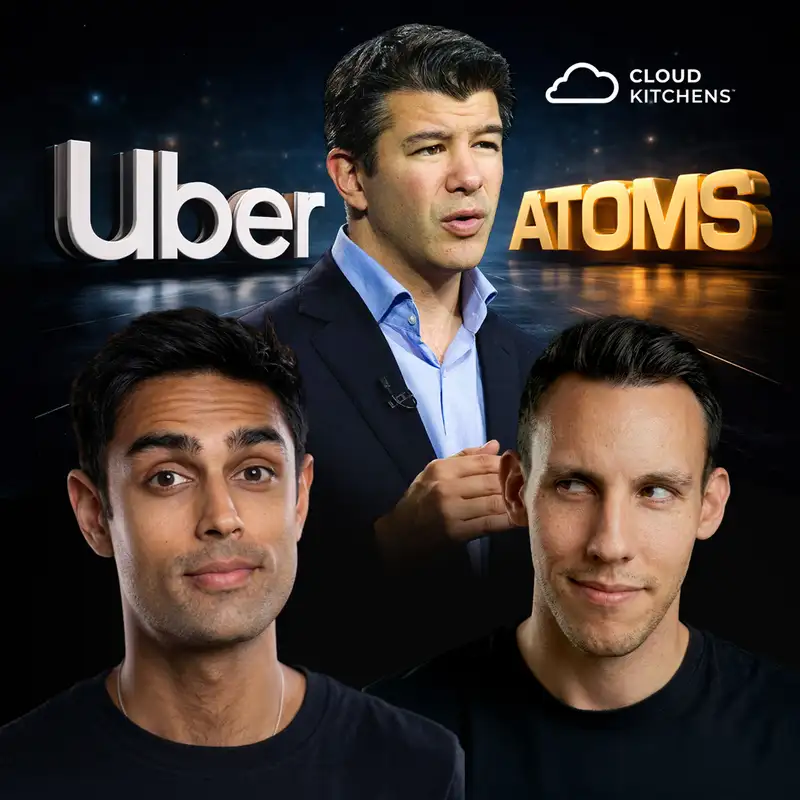
Just last week, one of the most controversial founders in tech history broke eight years of silence.
Ejaaz:
His name is Travis Kalanick, and he is the person who built Uber into a $70 billion company.
Ejaaz:
He got forced out in probably the most traumatic ousting since Steve Jobs,
Ejaaz:
and then totally vanished.
Ejaaz:
He was gone for eight years when he was secretly building this company in stealth
Ejaaz:
that was just unveiled this week called Atoms.
Ejaaz:
He's already acquired a self-driving startup founded by the engineer who went
Ejaaz:
to prison for stealing Google's autonomous vehicle secrets. And Uber,
Ejaaz:
the company that kicked him out, is reportedly funding this whole thing.
Ejaaz:
So there's a lot of crazy chaos, interesting parts to this story.
Ejaaz:
One of the most interesting is the fact that thousands of employees were forbidden
Ejaaz:
to put their company name that they were working in on LinkedIn.
Ejaaz:
There's a $15 billion valuation already reached in the dark.
Ejaaz:
They've raised $1.1 billion from Saudi Arabia's sovereign wealth fund.
Ejaaz:
But no one actually knows what this company does until last week.
Ejaaz:
This is a crazy story about one of the most notable founders in Silicon Valley.
Ejaaz:
I think it's important to take a step back and really understand who this character
Ejaaz:
is at the core of this new company that's really important to the future.
Josh:
Travis is one of those few founders where his backstory is actually...
Josh:
Equally as exciting as the story that we're breaking on this episode today about his new company.
Josh:
This guy's lived and died by the sword multiple times and then was resurrected.
Josh:
He actually founded two startups before Uber that surged dramatically and then failed.
Josh:
I think the first company was called Scour. It was like a peer-to-peer network
Josh:
where you can have kind of file sharing systems.
Josh:
So think of like Napster, but for like any kind of file system,
Josh:
kind of like LimeWire-esque, I guess.
Josh:
And he quickly got sued by a bunch of regulators for a quarter of a trillion dollars.
Josh:
Now, back then in 1998, that is a heck of a lot of money. $215 billion.
Ejaaz:
Today, that's a heck of a lot of money.
Josh:
Today, that's, I don't know, with all the AI CapEx stuff, maybe it's not.
Josh:
Maybe my mind's been warped. But that is a lot of money for four 22-year-olds to be sued with.
Josh:
So he had no choice but to file for bankruptcy.
Josh:
But he came back with the vengeance with his second company called Red Swoosh,
Josh:
which was pretty much a similar type of company, but aimed at a more professional market.
Josh:
Same thing kind of happened with them. They got sued, but they managed to get through it.
Josh:
And then Google poached all of his engineers. It was just him, a one-man company.
Josh:
And so he was about to fall for bankruptcy before, get this,
Josh:
Mark Cuban makes an entrance, gets into an argument with Travis Kalanick online.
Josh:
He's so impressed by Travis's response that he gives him $1.8 million.
Josh:
Travis moves to Thailand and he lives there for a year and a half,
Josh:
cuts down costs and runs this company, ends up selling it and makes $2 million and moves to SF.
Ejaaz:
Which is pretty good for someone in their early 20s. And this was the start
Ejaaz:
of a pretty unbelievable story.
Ejaaz:
I mean, in between this time and 2009, when he started Uber, he was also working.
Ejaaz:
There's a few funny stories that I like about Travis, one of which that I'd
Ejaaz:
like to tell briefly is the one with the Wii Tennis story, just to kind of understand
Ejaaz:
who this guy is. A famous investor named Chris Saka.
Ejaaz:
And Chris Saka back in the day,
Ejaaz:
I mean, still is, but one of the most legendary investors in the world.
Ejaaz:
He was a seed round investor in Uber and he was hosting Travis for the weekend.
Ejaaz:
And Travis was woke up in the morning and was playing Wii Tennis with his dad.
Ejaaz:
Just for fun. His dad liked playing Wii Tennis.
Ejaaz:
That's when Wii was very popular. He was kind of kicking his dad's ass.
Ejaaz:
He was getting a few points, but he was doing pretty well and he was playing
Ejaaz:
with his opposite hand and he wasn't really paying attention.
Ejaaz:
And then he switches over to his dominant hand and he starts playing seriously.
Ejaaz:
His dad doesn't score a point.
Ejaaz:
He moves over to the scoreboard and it turns out that Travis is number two in the world at Wii Tennis.
Ejaaz:
And it's a testament to the type of founder that this person is,
Ejaaz:
that we're going to uncover throughout this episode, is just hyper fixated on
Ejaaz:
winning and success and being the absolute best at what he does.
Ejaaz:
And this reflected itself in Uber, which is where I think a lot of people can
Ejaaz:
pick up the story where they're familiar with.
Ejaaz:
In 2009, he founded Uber, which went to go on to become the biggest ride sharing
Ejaaz:
application in the world.
Ejaaz:
And not only that, but created an entire sector of technology today that is ride sharing.
Ejaaz:
This simply did not exist prior to Uber's existence.
Josh:
And he kind of found or came across the idea for Uber as an accident after he
Josh:
sold his company read swoosh for and made two million dollars he moved to sf
Josh:
And he kind of started like the original incubator, which was just his apartment.
Josh:
And he had founders like come through all the time. And one such guy he went
Josh:
to Paris with to go to a conference and they couldn't hail a black cap.
Josh:
So he ended up kind of like creating this idea around an app that can call a
Josh:
black car for you, not necessarily a cab driver. And that's what ended up becoming Uber.
Josh:
But where he kind of like really doubled down on with the company and as the
Josh:
story goes was on like the regulatory arbitrage. So he just kept on hounding
Josh:
state regulators to allow them to legalize Uber because it was completely legal to start off with.
Josh:
And that's really how Uber became a massive boat. It's just a crazy,
Josh:
crazy story. But then...
Josh:
It ended up in him being ousted.
Ejaaz:
Yeah, so there's a few steps just before the ousting, one of which is an important
Ejaaz:
character in the store, which is Google.
Ejaaz:
Google Ventures invested a quarter of a billion dollars in 2013 into Uber at
Ejaaz:
a three and a half billion dollar valuation, which at the time was a pretty big deal.
Ejaaz:
Briefly afterwards, around 2015, this is when Google was creating their self-driving project.
Ejaaz:
Travis was aware of this because of their connection, and this self-driving
Ejaaz:
project eventually is what became Waymo.
Ejaaz:
And Waymo was viewed as an existential threat. If cars can drive themselves.
Ejaaz:
Uber doesn't need drivers, but neither does anyone else.
Ejaaz:
So whoever owns the autonomy owes us the future of transportation.
Ejaaz:
So this was an existential crisis they were having.
Ejaaz:
Travis goes ahead and he creates Uber's self-driving division in 2015.
Ejaaz:
This is where he recruits Anthony Lewandowski, who we mentioned earlier,
Ejaaz:
away from Google's self-driving program. Lewandowski was a founding member of what became Waymo.
Ejaaz:
And with him, what he didn't know at the time was many documents that were actually
Ejaaz:
stolen from Google and Waymo and eventually wound up putting him in jail.
Ejaaz:
So this created a lot of chaos.
Ejaaz:
This was, I guess, the beginning of the chaos that really started around February
Ejaaz:
of 2017, where there was a blog post published that was detailing some not so
Ejaaz:
favorable activities in the workplace.
Ejaaz:
There was a Waymo lawsuit where Waymo sued Uber, alleging that Lewandowski downloaded
Ejaaz:
14,000 proprietary files, which turned out was loosely true.
Ejaaz:
And these were There's secret files about trade secrets from Waymo's autonomous vehicle history.
Ejaaz:
And then there is a series of videos that come out, one of which was dash cam
Ejaaz:
footage from Travis inside of an Uber driver being not so nice to the Uber driver.
Ejaaz:
And there's just this really unfortunate cascading series of events that eventually
Ejaaz:
unfolds, like you mentioned, Ejaz.
Ejaaz:
He got kicked out of Uber.
Josh:
Yeah, so this headline says Uber CEO Travis Kalanick resigns following months
Josh:
of chaos, the events that you just referenced.
Josh:
But I don't think resigns is the right word here. In June of 2017,
Josh:
whilst Travis was interviewing someone to become a deputy head at Uber,
Josh:
two partners from Benchmark Capital, which were early and big investors in Uber,
Josh:
turned up at his hotel room, walked in, and hands him a draft resignation letter for him to sign.
Josh:
And they cite reasons of, we can't deal with the drama that you're creating,
Josh:
the fraud that is all over the media.
Josh:
We need you to step down or it's going to ruin the success of the business.
Josh:
Now, they keep hounding him. And about a month later, they sue Kalanick for
Josh:
fraud. And it ends up becoming this whole thing which forces him to resign.
Josh:
And the most brutal part about this is it comes right after his mother died in a boating accident.
Ejaaz:
It's pretty messed up. He almost lost his dad in that same accident,
Ejaaz:
too. It was a really traumatic time for him.
Ejaaz:
And he attended this board meeting two days after her funeral
Ejaaz:
and it's a six-hour board meeting it's this like horrific series
Ejaaz:
of events and you can't help but think that like bill
Ejaaz:
girley and the benchmark team were really just leveraging this really nasty
Ejaaz:
opportunity to impose their will on the company and then the day after uh travis
Ejaaz:
resigns bill girley he quit the uber board um so it was this really kind of
Ejaaz:
messy thing it destroyed travis this at this point this was the absolute love of his life.
Ejaaz:
He had spent his life as a founder, finally found some unbelievable levels of
Ejaaz:
success, and then at the darkest moment of his life got kicked out of the most
Ejaaz:
important thing in his life.
Ejaaz:
So it's this really difficult, tough time.
Ejaaz:
And Travis kind of goes dark for about nine months time where no one really hears from him.
Ejaaz:
And nine months later, he comes back very quietly in stealth and begins to work
Ejaaz:
on this company called Cloud Kitchens, or also known as City Storage Systems,
Ejaaz:
this weird unknown stealth company that was backed.
Ejaaz:
By the $2.5 billion that he had actually sold when he left Uber.
Ejaaz:
He sold all of his stock, he cashed out, and now he has this treasure trove
Ejaaz:
of money that he could use to build the next thing.
Ejaaz:
The idea is that he takes this controlling share of this company named City
Ejaaz:
Storage Systems for $150 million.
Ejaaz:
He becomes CEO. They own Cloud Kitchens, and Cloud Kitchens is a company that buys real estate.
Ejaaz:
They build commercial ghost kitchens and then rents them to restaurant for delivery-only operations.
Ejaaz:
So chances are, if you live in a major city and you've taken delivery from Chick-fil-A,
Ejaaz:
Taco Bell, a lot of these larger brands, they have come out of a cloud kitchen.
Ejaaz:
And the idea of a cloud kitchen is to automate the food delivery process.
Ejaaz:
So if you've ever used Uber Eats, you're familiar with Travis's engagement with
Ejaaz:
food delivery where Uber Eats is the food delivery version of Uber.
Ejaaz:
You take food from one place, you move it to another.
Ejaaz:
Cloud Kitchens is the automated version of that. You basically try your hardest
Ejaaz:
to remove the people, the cost of labor from that loop, and you decrease the
Ejaaz:
cost of these goods to get as close to the pure cost as possible by automating everything.
Ejaaz:
So these cloud kitchens are totally automated. They have a lot of robots.
Ejaaz:
They have a lot of automation.
Ejaaz:
You order a bowl, the robot builds its bowl, and it ships it off to you.
Ejaaz:
And it's a really effective, really efficient way of delivering food.
Ejaaz:
And this was the first step in this redemption arc. But again,
Ejaaz:
this was all silent. He's building in stealth mode.
Josh:
Yeah, I mean, it's a recurring theme. With Travis, his entire goal with Uber
Josh:
and with this company, Cloud Kitchens, is he's trying to automate moving of
Josh:
atoms of things, which suggests what his new company is called.
Josh:
He didn't tell anyone about this. I think his original investment was acquisition
Josh:
of a controlling stake in city storage systems was about 150 mil,
Josh:
didn't make any headlines. No one knew what the hell it was.
Josh:
And the concept itself, Cloud Kitchens, isn't something that you can kind of like visit publicly.
Josh:
Josh, actually, you told me a story where you tried to visit their site in Brooklyn, right?
Ejaaz:
Yeah, I'm obsessed with Travis, like disgustingly so. I think he's one of the
Ejaaz:
best entrepreneurs of our time by far.
Ejaaz:
And I suspect a lot more people will realize this over the coming years as he
Ejaaz:
builds this new company, which we're almost getting to.
Ejaaz:
We're almost there at the new company. But part of this fascination is wanting
Ejaaz:
to get close to him and just wanting to see what that was like.
Ejaaz:
So I was curious what it would look like to work at a company that Travis runs.
Ejaaz:
There is no way to actually apply to these places. They're outbound only because
Ejaaz:
they're totally in stealth.
Ejaaz:
So I'll stop by one of the kitchens to check it out. And of course,
Ejaaz:
it's a ghost kitchen. I mean, there's really, there's no one there. There's no markings.
Josh:
There's no branding.
Ejaaz:
Just a bunch of robots hanging out, right? I mean, there are people,
Ejaaz:
but it is a very inconspicuous building.
Ejaaz:
There's not much going on. It's fascinating because as an outsider looking in,
Ejaaz:
there's really no signs that anything special is happening here.
Ejaaz:
Meanwhile, they've deployed over 2,000 kitchen locations across America,
Ejaaz:
and they're accounting for, I believe, 18% of all U.S. food delivery.
Ejaaz:
And this was in 2024. So I'm assuming that number is going higher and higher and higher.
Ejaaz:
And they've quietly built this like really impressive empire as it relates purely
Ejaaz:
to food. This is just one pillar of the new company.
Josh:
So let's get into the actual story about the company Atoms.
Josh:
So collectively, since he left Uber, Travis has been in stealth for about eight years now.
Josh:
And he's employed thousands and thousands of employees, presumably to work on
Josh:
this cloud kitchen thing, but no one really knows what he's doing.
Josh:
They can't officially list their title or the company that they work for on
Josh:
their LinkedIn. So it's complete stealth mode for eight years.
Josh:
Now think about anyone else that can potentially hold that. Like he's getting everyone to sign NDAs.
Josh:
Like no one can really keep something hidden that large for that long,
Josh:
but Travis did end up doing it.
Josh:
Until Friday of last week where he announced his new company called Atoms.
Josh:
And the vision is kind of simple or rather follows on from his founding of Uber and Cloud Kitchens.
Josh:
He wants to do what he did with Uber. He wants to do what he did with food to
Josh:
every single part of physical delivery that exists in the world today.
Josh:
And he's gonna focus on three specific verticals. He's gonna focus on the mining industry.
Josh:
He's gonna focus on the food industry. That's with Cloud Kitchens,
Josh:
what he's rebranded it to Food Atoms. and he's going to do it with automotive transport.
Josh:
And the company follows a framework of three specific steps to figure out which
Josh:
industry and how to approach this.
Josh:
One, he wants to understand the current state of the physical world.
Josh:
So he's looking at food delivery, he's looking at the mining industry,
Josh:
he's looking at automotive transport delivery, and he's like,
Josh:
okay, this is how it functions right now.
Josh:
These are where the problems are going to be. And so this is what it might potentially turn into.
Josh:
So that brings us to step two, where he predicts what the future state of the
Josh:
physical world will look like.
Josh:
And then finally, step three, control the future state of that physical world.
Josh:
So creating a new app or a new product like Uber to transform transportation
Josh:
of humans or creating cloud kitchens to transform cooking of food and transportation
Josh:
and delivery of that food.
Josh:
And so how he plans to enable this is the coolest part for me,
Josh:
which is AI-powered robots, but not the humanoid type robots that you and I
Josh:
have spoken about on the show many times, Josh.
Josh:
Rather robots that are specifically designed to perform these acts, right?
Ejaaz:
Yeah. If you've ever been to LA and you've seen these like four wheeled robots
Ejaaz:
kind of riding around the sidewalk delivering food, that's kind of the vibe. It's wheel platforms.
Ejaaz:
And I think the way you could think about Atoms and the reason why it's named
Ejaaz:
Atoms is similar to the progress that we've seen in bits.
Ejaaz:
So I think one of the things that we talk about a lot is we've had so much progress
Ejaaz:
in the world of bits over the past few decades, meaning that all the software
Ejaaz:
has gotten much better. All of the chips have gotten much better.
Ejaaz:
Everything in our digital world has improved, while the external physical world
Ejaaz:
has not really gone a long way.
Ejaaz:
The goal of this company, the intention of this company, is to do what we just
Ejaaz:
did for computers to the real physical world using the same framework.
Ejaaz:
So if you think of this world of bits infrastructure, we have the chips,
Ejaaz:
which is the intelligence. We have the storage, which is how you store the intelligence.
Ejaaz:
Then we have the network, which is how you transfer that intelligence across the world.
Ejaaz:
What they're doing with atoms is the same three-level stack
Ejaaz:
you have the cpu you have the intelligence which
Ejaaz:
is these cloud kitchens which is these automation systems that are actually
Ejaaz:
deployed in the physical world you have the storage which is the real estate
Ejaaz:
one of the huge parts of this company is real estate they're owning a lot of
Ejaaz:
buildings they're building a lot of kitchens they own a lot of places to distribute
Ejaaz:
this compute and then the network is this autonomous part of the business it's.
Ejaaz:
Kind of what he envisioned for uber where you have truly fully autonomous
Ejaaz:
movement of these goods and services using these
Ejaaz:
robots so he explicitly said they're not building humanoids they're
Ejaaz:
not in the business of disrupting tesla with full self-driving or
Ejaaz:
their humanoid robots they're building supplemental things for their
Ejaaz:
world of atoms for delivering groceries
Ejaaz:
delivering food delivering objects and being
Ejaaz:
the full stack and revolutionizing the world in the way that
Ejaaz:
we did with bits but with atoms and it's a really grand plan
Ejaaz:
and he's rolled it out in a few places so far i mean
Ejaaz:
they have the mining they have the cloud kitchens and then they have otter which
Ejaaz:
is the third part of the business so there's a lot going on here but it's around
Ejaaz:
that one core thesis that atoms are the thing that really matters as we move
Ejaaz:
forward from this like i guess artificial intelligence artificial general intelligence age one.
Josh:
Thing that stood out for me is his approach to the design of robots i Like I
Josh:
was fixated on why he was so anti-humanoid.
Josh:
It kind of makes sense, right? The world is designed for humans.
Josh:
So you would create human-shaped robots. That's what Tesla is doing.
Josh:
That's what a bunch of robotic startups in the UK and China are doing.
Josh:
So why wouldn't he do the same?
Josh:
And he used, I watched his interview on TVPN and there's a story where he goes,
Josh:
I watched the Robot Olympics in China last year or a few months ago.
Josh:
And he was like, I was so impressed by all these robots dancing and running
Josh:
and winning these races. But what I couldn't help think was,
Josh:
This robot would be so much faster if it just had four wheels.
Josh:
And it just raced that way.
Josh:
And it made sense that this was his entire approach from first principles to
Josh:
moving atoms from one place to the next, whether it's food,
Josh:
whether it's mining and moving machinery from spot A to spot B,
Josh:
or whether that's doing the same for automotive transports, be it trucks,
Josh:
cars, delivering, whatever, right?
Josh:
What was interesting was I was curious, like, why did he do mining specifically.
Josh:
And looking into it, it just seems like an incredibly human-dependent,
Josh:
bulky machinery-operated industry that is ripe for consumption by AI robotics.
Josh:
And I don't think many startups are focused on this. The same could potentially be said for food as well.
Josh:
The way he framed it was cloud kitchens was R&D for food automation or transport
Josh:
automation, disguised as a cookout, as a kitchen that would just make food for you.
Josh:
So he's been doing R&D for eight years.
Josh:
And now he's expanding to these three very prominent sectors that no one else
Josh:
has really been focused on.
Josh:
I don't think even Tesla is like focused on like stuff like mining and stuff
Josh:
like that. So it's really ripe for like consumption.
Josh:
And I think that Travis is the perfect guy to do this because of what he pulled off at Uber.
Ejaaz:
It's important to really understand these three pillars because Travis is not
Ejaaz:
someone who reasons by analogy.
Ejaaz:
He has really, he thinks very deeply about what meaningfully matters and what
Ejaaz:
will actually impact the world going forward.
Ejaaz:
And mining is such a huge one because when you think about AI,
Ejaaz:
the world that we spend so much time I'm thinking about the common constraint
Ejaaz:
outside of energy is just these materials. Like we don't have enough memory.
Ejaaz:
We don't have enough raw materials.
Ejaaz:
We don't have enough for batteries and to create enough storage for this energy.
Ejaaz:
And mining is such a huge part of that.
Ejaaz:
And mining is this incredibly laborious process with a lot of labor rules and
Ejaaz:
laws. And it's not a very glamorous thing.
Ejaaz:
But if you automate a lot of this mining process like he intends to,
Ejaaz:
well, then suddenly a lot more areas open up for mining.
Ejaaz:
There's a lot more efficiency to be had. it's just a huge part of
Ejaaz:
how they plan to win. And you mentioned Tesla. I mean, he explicitly addressed Tesla,
Ejaaz:
I think, on the All In podcast earlier this week about how impressive Tesla
Ejaaz:
is and how much respect they have for it and how he's kind of in a way basing
Ejaaz:
his ideas off of the Tesla stack because he believes that Tesla is very much the Google of this era.
Ejaaz:
Meaning if you were to create a startup in the early 2000s, the first question
Ejaaz:
you get is, why isn't Google going to kill you?
Ejaaz:
Tesla is basically that for physical AI. They own the whole manufacturing stack.
Ejaaz:
They own full production from sand in to vehicle out and even intelligence out
Ejaaz:
through full self-driving.
Ejaaz:
And Travis argued that not enough people are taking this seriously and not enough
Ejaaz:
people are trying to be complementary to that.
Ejaaz:
You don't have to fight this force. You could actually just be a contributor
Ejaaz:
to the success and win as a result.
Josh:
Yeah, if I were to like zoom out and distill what he's trying to do with this
Josh:
company, what Claude Code did to automating software engineering,
Josh:
what ChatGPT did to replacing a bunch of high schoolers is able to write like
Josh:
PhD level essays, science,
Josh:
automating mathematics, he's doing for the physical world.
Josh:
So if you think of like mining as a technological stack, he is doing the sensors,
Josh:
he is doing the compute on top of that, he's operating the machinery,
Josh:
which is powered by the AI models that sit on top of this.
Josh:
So if you could automate all of that, then you can think about automated factories
Josh:
that sit on top of that. And then the produce that comes on top of that also being automated.
Josh:
And so if you could scale that, not necessarily at the speed of software,
Josh:
automated by AI, that's something pretty cool that we haven't seen in the world
Josh:
today because we're constrained by humans, by our biological brains,
Josh:
by making errors, by needing to sleep and a bunch of other things like that.
Josh:
The other thing that like fascinates me about this is Travis is very much building
Josh:
like a vertically integrated play here, right?
Josh:
Like if I think about it, he's doing the sensors, he's got the compute,
Josh:
he's got the AI models, and then he's like manipulating these atoms by physically
Josh:
delivering them using robots, which then accelerates manufacturing.
Josh:
He's owning the real estate. There's a bunch of energy production around that.
Josh:
He's involved in all parts of that.
Josh:
That reminds me of a bunch of other companies that we've spoken about on the
Josh:
show, like NVIDIA is doing that from Silicon all the way to AI agents that they
Josh:
announced with NemoClaw this week.
Josh:
Tesla is doing, or rather SpaceX, SpaceX and Tesla, they're all the same company.
Josh:
They're going to merge anyway, is doing that from everything from energy production
Josh:
to space transportation, to harnessing the energy from the sun itself,
Josh:
to training AI and distributing it on social media on X.
Josh:
Travis is doing the same with physical AI automation. And I think that it's a very ambitious task.
Josh:
But if he's able to pull that off, this is going to be a world changing company.
Josh:
And Travis is one of the few founders with the track record to be able to pull that off.
Ejaaz:
You mentioned Tesla rolling in SpaceX and Tesla into the same company.
Ejaaz:
I have a question about whether Uber will be doing the same because there's
Ejaaz:
reports that Adams is receiving major backing from Uber.
Ejaaz:
Travis has reportedly told people that he wants to be more aggressive in rolling
Ejaaz:
out self-driving technology than Waymo. So it makes sense that the company that he built,
Ejaaz:
he might actually be able to have the chance to play a meaningful role in.
Ejaaz:
And to that, I want to refer to Polymarket, because there's a Polymarket for
Ejaaz:
whether or not Uber will ask Travis to come back to the company.
Ejaaz:
And I have to ask the question, because when you think about Steve Jobs in the
Ejaaz:
past, Steve, I think he got kicked out of Apple in 1988.
Ejaaz:
And it was only in 1997, I believe it was.
Ejaaz:
The years could be slightly off, but 1997, when the company that he built was
Ejaaz:
purchased, by Apple next.
Ejaaz:
He came back to Apple. Apple was struggling at the time, and he rebuilt them
Ejaaz:
into the Apple that we know and love today after a huge hiatus.
Ejaaz:
Now, Travis has only been away for eight years now, so he's doing,
Ejaaz:
he's kind of speedrunning the Steve Jobs arc, and there is a world in which
Ejaaz:
he might come back to Uber.
Ejaaz:
Now, Polymerca says this is improbable at 14%. It's not looking very likely.
Ejaaz:
In fact, it was a 40% chance earlier
Ejaaz:
in the month, I guess prior to the announcement of this new company.
Ejaaz:
It seems like whatever they saw with this new company announcement it dropped
Ejaaz:
from 46% to 14% so perhaps it's not going to happen although man how cool would that be the.
Josh:
King is back yeah no someone knows something I mean that that that decline is
Josh:
like super steep and like almost instantaneous it like dumped 20% in like an hour or so that's crazy
Ejaaz:
Yeah pretty brutal well thank you to Polymarket for sponsoring that
Ejaaz:
segment of the pod and I think that leaves us with a comeback arc not complete
Ejaaz:
there's still a lot of work left to be done but this at least sets the stage
Ejaaz:
for what's next which is this new foundational company built on doing what we
Ejaaz:
just did to bits to the world of atoms and naming it after that by one of the
Ejaaz:
best entrepreneurs to do it.
Josh:
And that's the end of the episode thank you so much for listening a bit of a
Josh:
different flavor of the episode today we were passionate about telling the story
Josh:
of travis because it makes sense to explain why he's going after this big company
Josh:
versus just explaining the company itself.
Josh:
Let us know if you enjoyed this format of an episode. Also, a ton of new subscribers.
Josh:
We officially hit, as we're recording this episode, 40,000 subscribers,
Josh:
which is crazy because nine months ago we had, what was it, 10,000,
Josh:
Josh? Maybe even less than that.
Josh:
Pretty crazy growth from then, and we welcome all of you.
Josh:
A bunch of you have also subscribed to our newsletters. If you haven't, please do.
Josh:
We drop articles and pieces, highlights of the week, twice a week.
Josh:
And wherever you're listening to us, Spotify, Apple Music, or even on YouTube,
Josh:
if you're watching us, please give us a thumbs up and give us a subscribe.
Josh:
It helps us out massively. And we'll see you on the next one.
Creators and Guests