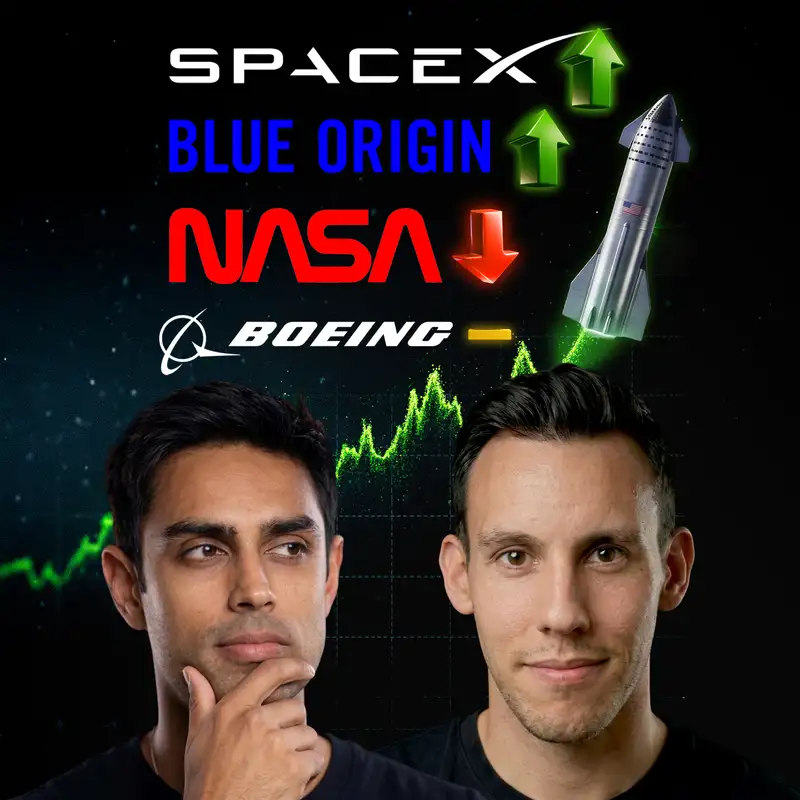
The Next Era of Space: Every Player You Need To Know
Ejaaz:
Three weeks ago, NASA committed $20 billion to putting a human settlement on the Moon.
Ejaaz:
Then two weeks ago, SpaceX saw for the largest IPO ever, valuing them at $1.75 trillion.
Ejaaz:
And then just last week, we sent humans around the Moon for the first time in
Ejaaz:
53 years, traveling 250,000 miles away from Earth. Just massive.
Ejaaz:
And then this morning, Amazon acquired Global Star for $11.6 billion.
Ejaaz:
And on Friday, Blue Origin is sending their third orbital rocket into space.
Ejaaz:
That's five events in three weeks, and the industry for space is coalescing
Ejaaz:
and mobilizing at a rate that we've never seen before.
Ejaaz:
And for the first time ever, you can participate by investing in these companies.
Ejaaz:
On this episode, we're going to explain the massive thesis around space and
Ejaaz:
why it's the new investment opportunity that's coming right after AI at an opportune time.
Ejaaz:
We're going to walk through all the different companies, all the different sectors,
Ejaaz:
and exactly which companies are the most opportune for you to get involved in.
Josh:
Space is a huge opportunity right now. It feels like the first time in history
Josh:
in which we have the technology now to actually make meaningful progress in
Josh:
space and generate actual value.
Josh:
And what happened just recently is the Artemis 2 kind of kicked this off and
Josh:
it made it seem possible.
Josh:
Artemis 2 was a wild success. 10 day mission, 700,000 total miles.
Josh:
They went, they took humans the furthest they've ever gone. They took them the
Josh:
fastest they've ever gone.
Josh:
They captured unbelievable photos along the way, like the one we're looking
Josh:
at on screen, which is a moon eclipsing the sun, which is something we don't
Josh:
get to. to see very often.
Josh:
And it was just this really unbelievable mission. They recovered them in a dinghy
Josh:
in the middle of the ocean.
Josh:
And I guess maybe if we show this photo, that is a testament to the beginning
Josh:
and the end of this new phase of space.
Josh:
Because, I mean, NASA has been around forever. The last time they put humans
Josh:
on the moon or the last time they went to the moon was over 50 years ago.
Josh:
None of us were born yet. And the way that they recovered these astronauts is
Josh:
it's in a dinghy. It looks a little old.
Josh:
This is the end of the NASA era. This is the beginning of the private industry
Josh:
era, where now NASA is going to be funding future missions to the moon and beyond
Josh:
through these private entities.
Josh:
And for those curious why, the numbers are a bit staggering.
Josh:
SLS, the space launch system that NASA has, costs about $4.1 billion for this launch.
Josh:
It's totally expendable. Every piece is thrown away. And it takes a very long
Josh:
time for them to build these things.
Josh:
Whereas SpaceX, on the other hand, a Falcon 9 launch costs $67 million,
Josh:
which is 30 to up to 60 times cheaper than what it costs NASA to do these things.
Josh:
And when you compare these two, we have to give a lot of credit to NASA for
Josh:
getting us here, for having this mission actually work successfully,
Josh:
for getting the astronauts home safe, for collecting all the data.
Josh:
But it is now time to hand over the reins to these private companies that are
Josh:
building unbelievable technology to do this at a far cheaper cost.
Josh:
I mean, Falcon 9 is $2,700 per kilogram.
Josh:
Starship is going to get that down to $10 to $70. So it's going to be a lot
Josh:
cheaper, a lot more efficient.
Josh:
And this unlocks a ton of opportunities in the market that we're going to get into.
Ejaaz:
Yeah, I mean, during the space shuttle era, to transport like a kilogram was
Ejaaz:
well over $50,000. And SpaceX has reduced that by 500 times, which is just insane.
Ejaaz:
When I look at the space economy for last year, it was valued at around $626 billion.
Ejaaz:
And it's projected to hit around $1.2 trillion by 2032.
Ejaaz:
I actually think that's massively understated because we have one of the biggest
Ejaaz:
IPOs ever, supposedly coming this year.
Ejaaz:
SpaceX filed a confidential IPO filing with the SEC, I think two weeks ago,
Ejaaz:
and valued it at $1.75 trillion, which will be the largest IPO that we've ever seen.
Ejaaz:
Now, looking at the market, it typically means that this IPO will happen sometime in June.
Ejaaz:
For some reason, people on Polymarket don't believe that that's going to happen too soon. I
Ejaaz:
think technically it is. Elon's made some very strategic moves recently to make this happen.
Ejaaz:
SpaceX has merged with X and XAI. XAI has merged with NX.
Ejaaz:
So there's a lot of moves that make this a necessity at this point. He needs the capital.
Ejaaz:
He's raising around $75 billion during this IPO to be able to fund a bunch of
Ejaaz:
these launches going forward.
Ejaaz:
He mentioned at one point recently that in an ideal world, within the next five
Ejaaz:
to 10 years, there's a space launch every 10 minutes, which is an almost impossible
Ejaaz:
fee to achieve given the context of infrastructure and investment that we need to have right now.
Josh:
Yeah. And at that launch cadence, it's important to understand that this is
Josh:
a huge change from what we have because currently in the first half of 2025,
Josh:
it was a launch every 28 hours, which is a lot.
Josh:
Don't get me wrong. That's a lot, but it is a far cry from the launch per every hour or two.
Josh:
But this is happening. And this is the year in which a lot of the attention
Josh:
is going to shift into space.
Josh:
And this is a year where in which there's a ton of opportunities both publicly
Josh:
and privately through this IPO through the
Josh:
success of Starship through the success of the Artemis mission so we're going
Josh:
to unpack that opportunity right here using this really cool artifact that we
Josh:
generated through perplexity which we'll actually link in the description below
Josh:
you can click through and engage with it yourself but it's this really nice
Josh:
interactive portfolio that we're going to use to walk through the opportunity in space and
Josh:
based on every category that there is. So we have launch providers,
Josh:
we have the satellite providers, we have lunar infrastructure.
Josh:
And it's very fitting because just today, there was a huge acquisition in this
Josh:
space already. So the market is hot.
Josh:
And let's get into the first segment, which is launch providers,
Josh:
because I think this is probably the most noteworthy one, starting with Rocket Lab.
Josh:
If you haven't heard of Rocket Lab, you should hear about Rocket Lab.
Josh:
They're a pretty interesting company. You guys, you want to walk us through?
Ejaaz:
Yeah. So if you've heard of SpaceX, which unless you've been living under rock, you definitely have.
Ejaaz:
You might think that $1.75 trillion is a little over the price tag that you're willing to pay.
Ejaaz:
There are other options for launch providers, and Rocket Lab is the major number two, basically.
Ejaaz:
It's valued at around $40 billion in market cap, and it is the second most active
Ejaaz:
launch provider globally.
Ejaaz:
They've launched around 85 missions, and they've signed contracts worth, I think,
Ejaaz:
$2 billion, or maybe it's like $1.8 billion. It's something in the billions of dollars.
Ejaaz:
And they use or are developing their reusable rocket.
Ejaaz:
Now, it's important to mention now that their latest reusable rocket,
Ejaaz:
I believe it's called Neutron, has been delayed for over a year at this point.
Ejaaz:
But that's pretty common amongst a lot of these space launch companies.
Ejaaz:
And Rocket Lab is currently at the frontier.
Ejaaz:
And if you look at their stock price here, it's currently sitting at around $73.
Ejaaz:
It IPO'd in 2020 at, I believe, $10.
Ejaaz:
So we've already got a 7x here. And a lot of eyes
Ejaaz:
are now focused on rocket lab because they think that spacex valuation might
Ejaaz:
be a little overblown and they're trying to do a lot more things rocket lab
Ejaaz:
in context is focused or hyper focused on building out reusable rockets and
Ejaaz:
being part of the highway into space right now spacex has the monopoly of this
Ejaaz:
but companies like rocket lab is a viable alternative yeah
Josh:
Companies that build these rockets that deliver payload to orbit are the foundational
Josh:
infrastructure layer of the economy without this launch structure nothing else
Josh:
works and currently spacex dominates 90% of this, but the market is expanding
Josh:
and the real competitors are actually scaling up. So we have Rocket Lab.
Josh:
We have another company that you may not have heard of called Firefly Aerospace.
Josh:
And the third, which is the most interesting, and unfortunately the private
Josh:
one currently is Blue Origin. Now, for those that aren't familiar,
Josh:
this is Jeff Bezos' company.
Josh:
He left Amazon, started working on this as a passion project,
Josh:
and they work fairly closely with Amazon.
Josh:
Now, Amazon was in the news today because it acquired one of the companies we're about to talk about.
Josh:
But I think Blue Origin is one to watch because they have access to not only
Josh:
the infrastructure through Amazon, but also Moneybags Bezos.
Josh:
And they are actually the second farthest along when it comes to these kind
Josh:
of larger spacecraft that can deliver more payload to
Josh:
orbit with their new Glenn rocket. So Blue Origin, very excited about them.
Ejaaz:
I'm starting to think that the private market is just almost worse than the public market.
Ejaaz:
Like, you have a better investment opportunity investing in some of these public market stocks.
Ejaaz:
Like, look at Blue Origin. Like, its market cap is estimated to be between $50 to $100 billion.
Ejaaz:
That's already, like, multiples more than Rocket Lab, who has live testing rockets
Ejaaz:
and launching. Now, granted, Blue Origin has done the same thing.
Ejaaz:
But, you know, TrackRocket has to account for something here but
Ejaaz:
i want to get into the acquisition that
Ejaaz:
you just mentioned so this morning amazon announced that
Ejaaz:
they are acquiring a company called global star which is basically
Ejaaz:
going to be launching or helping to launch satellites into lower earth orbit
Ejaaz:
now if that sounds familiar it's because elon musk and spacex specifically starlink
Ejaaz:
is doing exactly that they're building direct to earth satellite broadband which
Ejaaz:
will allow you to run the internet on any device wherever you are.
Ejaaz:
So in spotty areas where you're going on a hike, or if you're in a country that
Ejaaz:
doesn't get easy access to the internet, you now get seamless access,
Ejaaz:
you could be on a plane, you could stream games, play games, whatever it might be.
Ejaaz:
This is a similar competitor to that.
Ejaaz:
Listen, I got to take a moment aside here to just congratulate and like shill Amazon for a second.
Ejaaz:
They are so much more than an e-commerce company, which so many people kind of attribute them.
Ejaaz:
They're involved in the AI race, they're supplying the chips to train some of these top models.
Ejaaz:
They're the main distributor of it. And now they're also a space company as well.
Ejaaz:
It's important to note that this is separate to Jeff Bezos' Blue Origin.
Ejaaz:
In a way, they're kind of complementary to each other. But Jeff Bezos isn't
Ejaaz:
directly involved in this, at least from the best of my knowledge. Is that right, Josh?
Josh:
Yeah, well, he's still involved with Amazon. I believe he's still on the board.
Josh:
But I mean, you have to assume this is kind of not as direct as a SpaceX Tesla
Josh:
comparison, but both companies are going to actively work together to solve these problems.
Josh:
And you can see on the chart, it's doing very well. Now, this was not the only
Josh:
news from Amazon today, which the second headline I found even more interesting
Josh:
than the acquisition offer, which was that they made a deal with Apple,
Josh:
which I found interesting.
Josh:
So Amazon has now signed an agreement with Apple to become the primary satellite
Josh:
provider for iPhone and the Apple Watch, which is notable because it's not SpaceX.
Josh:
They didn't choose SpaceX.
Josh:
Apple customers are this, they go on to say Apple customers are already connected
Josh:
out of cell range, and they'll do that with Amazon Leo satellites in the future.
Josh:
So the low-Earth orbit satellites that I presume Blue Origin is going to be
Josh:
launching into orbit, they are going to be Global Star satellites,
Josh:
and they're going to be powering iPhones and Apple Watches. Now,
Josh:
I understand that they have been working with Global Star currently,
Josh:
where if you are currently out of service, if you point your iPhone at the sky,
Josh:
you're connecting to a globalized satellite.
Josh:
But I also understand that this isn't exclusive and this is kind of time based,
Josh:
right, Ejaz? It's not just Global Star that they're working with.
Ejaaz:
Yeah. And the time base or the timeline is pretty important to note here.
Ejaaz:
It's planned to launch in 2028, this partnership with Apple,
Ejaaz:
which by that time, you're probably going to have millions of Starlink satellites
Ejaaz:
out there. and it wouldn't surprise me if Apple signs a similar deal with Starlink
Ejaaz:
just because the service is better and already there.
Ejaaz:
One thing I was looking into with this Global Star acquisition,
Ejaaz:
because like $11.6 billion is a pretty hefty price to pay.
Ejaaz:
They currently have 24 satellites in orbit, Global Star specifically.
Ejaaz:
Now they're planning to launch 80 more satellites by the end of year.
Ejaaz:
For context, Starlink has around 10,000 satellites live in orbit right now,
Ejaaz:
and they're scaling, they just got approval, to scale to a million satellites over the next year.
Ejaaz:
So the point is, we're talking about orders of magnitude, different scale here,
Ejaaz:
and we already have a provable method via SpaceX to get payloads out there for cheap.
Ejaaz:
And we're going with the next Starship launch very soon.
Ejaaz:
So Blue Origin, Amazon, Leo, we have a bunch of catching up to do here.
Ejaaz:
It's a nice thesis to uphold right now, but the infrastructure expense that
Ejaaz:
they need to overcome right now is pretty massive.
Josh:
For reference, a fully loaded Falcon 9 rocket deploys 24 satellites per launch,
Josh:
which is a little interesting in the differences.
Josh:
But back to the companies, there's another one here under the satellite broadband
Josh:
and direct-to-device category, which is AST Space Mobile.
Josh:
They're up 3,000% in the last few years, which has been a pretty impressive launch.
Josh:
So there's a lot going on there. I think the next category is among my favorites,
Josh:
which is lunar infrastructure.
Josh:
Sure there's one company here but it is important to note that nasa just committed
Josh:
20 billion dollars to a permanent moon base so someone's going to have to start
Josh:
collecting those payments i know spacex and blue origin are on that list but
Josh:
there's another company,
Josh:
named Intuitive Machines. Their ticker is Lunar, which is the first private
Josh:
company to actually land on the moon in February of 2024.
Josh:
They did the damn thing, which is pretty cool.
Josh:
So they are clearly one of the front runners when it comes to lunar deployment.
Josh:
And I think lunar is going to be really important because, I mean,
Josh:
as Elon stated, we're going to be building a mass driver.
Josh:
We're going to be putting people on the moon, robots on the moon.
Josh:
We're going to start actually harvesting it for whatever resources,
Josh:
science, information we can get out of it.
Josh:
And I don't know the lunar industry it's it's pretty exciting to me.
Ejaaz:
It's it's not just fake either like um if
Ejaaz:
you're wondering like whether this company is just kind of like uh propagandering
Ejaaz:
itself um it signed a five billion dollar contract and it right now it's to
Ejaaz:
build the space um communications between earth and the moon when a settlement
Ejaaz:
is eventually built but uh you know think about it like you're gonna need to
Ejaaz:
be able to figure this out um but also elon has committed to also setting up a moon settlement,
Ejaaz:
probably in cohesion with NASA on the moon.
Ejaaz:
Is it by 2029 or is that when he wants to build the mass drive?
Ejaaz:
I can't remember. Some of the timelines inflect.
Ejaaz:
But the point is, there are around three concerted efforts or three major companies
Ejaaz:
or initiatives to put humans on the moon.
Ejaaz:
We just flew humans around the moon for the first time in 53 years.
Ejaaz:
So we know that it's feasible.
Ejaaz:
And the next step, we'll be figuring out whether the moon is habitable,
Ejaaz:
where to put them, maybe it's on the dark side, how to create infrastructure
Ejaaz:
around this to launch things like satellites or harvest moon resources.
Ejaaz:
So all of this is becoming a reality. And the aim is to, I think the consensus
Ejaaz:
is to do this within the next five to 10 years, which is, in my opinion,
Ejaaz:
much sooner than I expect.
Ejaaz:
And we're going to see that reflect in some of the prices of these companies,
Ejaaz:
which are working on the key infrastructure, such as communications,
Ejaaz:
such as intuitive labs, to be able to do this.
Josh:
And there's even more infrastructure on the observation and space data.
Josh:
So there's this funny thing in which you put satellites into space and then
Josh:
just point them back at us.
Josh:
And those high resolution images actually carry a lot of value for governments,
Josh:
militaries, insurers, commercial clients.
Josh:
There's a whole industry built on satellite imagery.
Josh:
And there's a few front runners in the satellite imagery space,
Josh:
particularly Planet Labs, which is the largest Earth observation satellite fleet.
Josh:
And they do daily images of the entire land mass of Earth, which serves defense,
Josh:
it serves agriculture, insurance, climate.
Josh:
There's a lot of science, a lot of money, a lot of security that's revolving
Josh:
around having these high quality images.
Josh:
These are the companies that are responsible for it. There's also Satellogic
Josh:
and Black Sky Technology.
Josh:
Those are the big three when it comes to satellite imagery. And this is something
Josh:
that is real recurring revenue today.
Josh:
They're actively selling products to clients, and they are actually making some
Josh:
money. So this is an interesting category for that reason.
Ejaaz:
I am looking at some of these market caps, Josh, and I'm struggling to understand
Ejaaz:
how random AI startups are worth like 10x more than these companies that are
Ejaaz:
actually building what I believe is going to be very useful and essential infrastructure
Ejaaz:
to building out a space economy.
Ejaaz:
I think primarily it might be because people don't believe the thing is here, that the thing is real.
Ejaaz:
But one of the reasons why we're creating this episode and speaking to you about
Ejaaz:
all of this right now is we believe not only is space a very viable industry...
Ejaaz:
Two, it's going to be gargantuan times or multiples more valuable than the current
Ejaaz:
AI space right now, simply because there are infinite resources and infinite
Ejaaz:
TAM to kind of like extrapolate a lot of this. And it enables AI itself.
Ejaaz:
We're going to be launching data centers and satellites into space.
Ejaaz:
NVIDIA and SpaceX are already working on a radiation-hardened satellites to
Ejaaz:
be able to pull this off, chips to be able to pull this off.
Ejaaz:
So we know that it's going to become a thing.
Ejaaz:
And three, this is going to happen very soon. Like we're going to start to see
Ejaaz:
the fruits of the labor over the next probably year to two years.
Ejaaz:
Last year, the space industry was worth around $626 billion.
Ejaaz:
It's estimated to be multiples more that, especially after SpaceX IPO.
Ejaaz:
So I want people to be able to keep an eye on some of these companies and track
Ejaaz:
their performance. We should have like a limitless portfolio at this point.
Josh:
Yeah. And it's important to understand a lot of this revolves around the Starship
Josh:
program working and getting those highways online.
Josh:
We have Rocket Lab that's working on it. We have Blue Origin that's working
Josh:
on it. the leader in this pack right now is SpaceX.
Josh:
And the moment they start to get the starships working and they get payload
Josh:
in those ships and they're able to launch them on a regular basis,
Josh:
that creates the highways that enable this infrastructure to get into orbit
Josh:
or beyond and then actually start making money.
Josh:
So that unlocks this entire space race. And I think a lot of the concern that
Josh:
people have is on the idea that we're not actually going to be getting enough
Josh:
payload to orbit quick enough.
Josh:
And the reality is that might not be true. And the downstream effects
Josh:
of all this payload getting to orbit are remarkable it unlocks this gigantic
Josh:
industry that people are predicting to grow faster than almost anything on earth
Josh:
and even the ai thesis even the ai play i mean data centers in space man that's
Josh:
going to be a huge market for anyone who wants to put a satellite on one of
Josh:
these rockets and send it into low earth orbit start training ai data centers,
Josh:
There's a huge opportunity and there's a few other categories that you can click
Josh:
through and get into if you're interested.
Josh:
Things like what space infrastructure manufacturing are, legacy aerospace,
Josh:
kind of like Lockheed Martin and Northrop Grumman.
Josh:
It kind of covers all those categories in this artifact. It'll be linked in the description.
Josh:
But the final thing we should mention maybe is just the ETFs in general.
Josh:
If you don't want to pick a specific stock, perhaps you can choose the basket
Josh:
of them. And I believe that there's a few that are publicly available right now.
Ejaaz:
Yeah, so one of my favorite ETFs from this list is the Arc Space Exploration
Ejaaz:
by Kathy Woods, which, by the way, her fund is just involved in everything from
Ejaaz:
Web3, crypto, AI, and space as well.
Ejaaz:
Now, typically when you're investing in space, we covered a lot of companies
Ejaaz:
today. You're probably like, which ones do I allocate to? How much do I allocate to them?
Ejaaz:
These ETFs kind of fix that for you. It's a basket of all the top companies.
Ejaaz:
Some of these baskets focus on a particular category, whether it's space infrastructure
Ejaaz:
or launch infrastructure.
Ejaaz:
And some just cover all categories in its entirety. It will cover launch providers,
Ejaaz:
lunar infrastructure, earth observation, etc.
Ejaaz:
ARK Space Exploration ETF covers things like defense systems,
Ejaaz:
rocket labs, communication, stuff like that.
Ejaaz:
And it's one of the most subscribed and invested in ETFs that we have in this
Ejaaz:
list. But there's some others here, right?
Josh:
Yeah, there's a few others. They're noteworthy. You can go through and click
Josh:
through or you could just take a screenshot of this and just kind of see which
Josh:
ones that you would be most interested in.
Josh:
The final part of this fun little artifact is the portfolio builder,
Josh:
where we can kind of build an emulated portfolio and choose a preset balance
Josh:
in order to kind of guess and estimate what the returns look like.
Josh:
So for example, with every $10,000 say that you invest in this,
Josh:
you can kind of gauge how much you want to allocate to each industry.
Josh:
And then the projected returns based on the conservative amounts of returns,
Josh:
the kind of high targets and the average gains that you could predict based
Josh:
on each industry and the projected gains that investors have been guiding for.
Josh:
I think a lot of this will end up being conservative if it works.
Josh:
If Starship version three does get to orbit quickly, if a lot of these other
Josh:
companies like Blue Origin are being able to rapidly reuse these rockets,
Josh:
we should see this projected portfolio increase far higher. But again, it's risky.
Josh:
These highways don't exist right now. A lot of rockets are still exploding.
Josh:
There is no proof that this is going to work on the timeline that we hope for.
Josh:
But in the case that it does, this is a tremendous opportunity. We are heading outward.
Josh:
We're there is no real market cap on that because of how untapped the potential
Josh:
is. This takes a long time. We're moving atoms instead of bits.
Josh:
Atoms are much more challenging, particularly when you're fighting against the
Josh:
atmosphere of Earth. But I think it's a really noteworthy opportunity that,
Josh:
you should at least be familiar with and understand.
Ejaaz:
So just to recap, space is having a bit of a moment.
Ejaaz:
In the last three weeks, we've had five major events, including filing for a
Ejaaz:
SpaceX IPO, sending humans around the moon, and all of this for a fraction of
Ejaaz:
the cost that it used to cost 53 years ago.
Ejaaz:
Space is now becoming an investable asset as well. There are a ton of companies
Ejaaz:
that are publicly invested in.
Ejaaz:
If there are too many for you to kind of comprehend, there are ETFs that you can look at.
Ejaaz:
We're going to link to this public artifact so you can get access to it and
Ejaaz:
you can do your own research as well.
Ejaaz:
But the point is, I don't think it's a coincidence that AI and space are galvanizing
Ejaaz:
at the same time. They're coalescing, they're overlapping.
Ejaaz:
There's a lot of overlap in the sense that AI data centers in space will need
Ejaaz:
space shuttles in the same way that satellite and broadband access will also
Ejaaz:
rely on the same types of infrastructure.
Ejaaz:
There are a few companies right now that are privately held that are very popular.
Ejaaz:
You've got SpaceX, you've got Blue Origin, but a lot of public companies as
Ejaaz:
well that are building out this essential infrastructure, not just for launch
Ejaaz:
shuttles, but also for communication and many other points.
Ejaaz:
The point is, we think that this industry will be worth well north of $626 billion,
Ejaaz:
which is what its total value was last year. And we look forward to seeing this expand.
Ejaaz:
It is a limitless portfolio that doesn't exist yet, but I kind of want to spin
Ejaaz:
up after this episode, Josh.
Josh:
We're going to just have to start our own portfolio, both for private and public
Josh:
industry, because I feel like we're on it.
Josh:
There's one called Mesh Optical that's really interesting. And all they're doing
Josh:
is just fiber optic cabling for these satellites, for these data centers.
Josh:
And when you really think about the downstream technology required to put these
Josh:
things into space and make them function at the level that we expect them to,
Josh:
there is just a huge amount of peripheral companies that are going to need to contribute to this.
Josh:
And there's a lot of upside for those that can actually do so in a meaningful
Josh:
way. So space as an industry is really exciting.
Josh:
There's plenty of opportunities in the public markets. There are plenty private,
Josh:
and there's going to be a lot more coming down the line.
Josh:
Now, the question is mostly the timeline. How quick is this actually going to happen?
Josh:
How quick are all of these launch companies that sit at the base layer of this
Josh:
infrastructure going to be able to get mass to orbit rapidly,
Josh:
reusably, and for a very low cost per kilogram?
Josh:
We will see, but we will be monitoring it right here on Limitless every day,
Josh:
as we do four times a week.
Josh:
So thank you all so much for listening. EJs, any final thoughts before we let people go today?
Ejaaz:
Yeah, I'm actually curious whether anyone listening to this has thought of a
Ejaaz:
company or knows of a company that we haven't covered right here.
Ejaaz:
One thing that I'm peripherally aware of is there are just so many of these
Ejaaz:
space companies and there are
Ejaaz:
too many to keep track of. So if you've noticed something, let us know.
Ejaaz:
Or if there's an angle or industry that we might be missing out on that might
Ejaaz:
be complementary to AI or space, let us know in the comments.
Ejaaz:
We would love to hear from you.
Josh:
Yeah, well, as always, thank you guys so much for watching. and we will see you in the next episode.
Ejaaz:
See you guys.
Creators and Guests