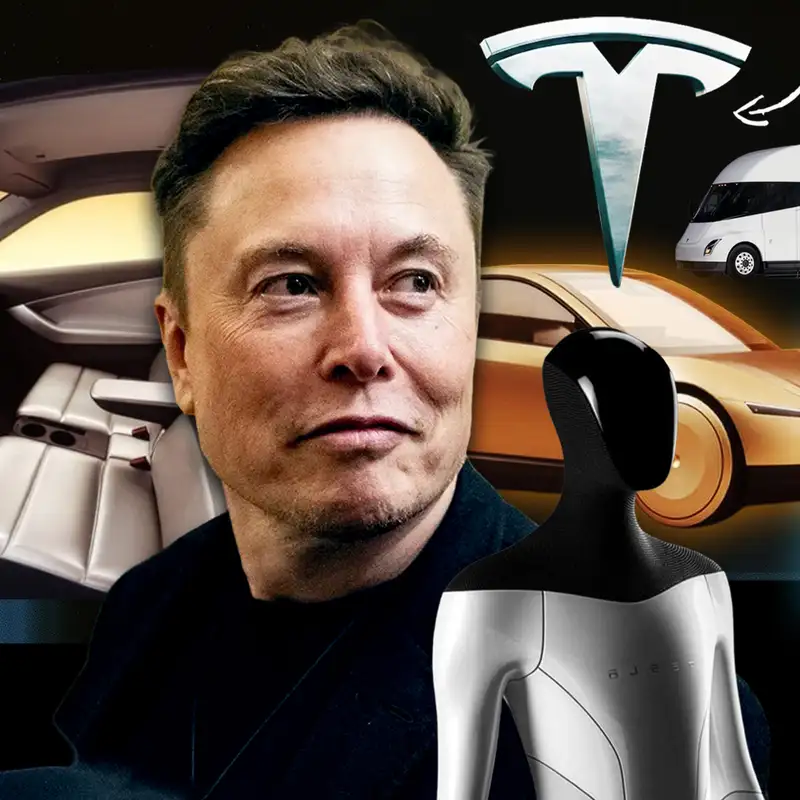
Revealing Elon's Tesla AI Secrets: $TSLA Is Winning AI and Automation
Josh:
One of the most important technologies in the world that is happening as we
Josh:
speak every day is the rise of autonomy, and particularly around autonomous robots.
Josh:
Robots can be many things. Robots can be humanoids, they can be cars.
Josh:
And today we're going to talk about both, because there's one company that is
Josh:
at the frontier of both of those areas, and that's Tesla.
Josh:
Tesla has the most unbelievable set of autopilot software that I think exists in the world.
Josh:
I've been using it personally for eight years now. And it's been amazing to
Josh:
see how good it's gotten.
Josh:
And EJS, now there's, for the first time ever, we have the secrets.
Josh:
The secret sauce that shares exactly how they've been able to get autonomy this
Josh:
powerful, this impressive.
Josh:
And there's now very clearly a world in which I can imagine waking up in the
Josh:
morning, getting ready to go to work, stepping outside, and there's a cyber
Josh:
cab waiting for me outside that will just take me wherever I want for a fraction
Josh:
of the cost that it takes for a normal driver.
Josh:
And I think this is an incredibly powerful unlock and to see a behind the scenes
Josh:
of this is awesome so the entire episode today is behind the scenes of the most
Josh:
impressive new front-end tier technology that exists.
Ejaaz:
I think what i'm most excited about today josh is the fact that i've always
Ejaaz:
thought tesla ai and robotics is so cool but i i just don't know how any of
Ejaaz:
this works and they've refused to tell us and finally they've they've spilt their secrets today
Ejaaz:
to quickly paint some context for the listeners here, up until yesterday,
Ejaaz:
we only thought of Tesla AI as something called a neural network.
Ejaaz:
That's their secret source. And a neural network can be thought of as a software
Ejaaz:
program that is designed to function like the human brain.
Ejaaz:
So it takes in information and it discovers patterns, trends,
Ejaaz:
and it can also sometimes make predictions.
Ejaaz:
Now, this contrasts directly to some of Tesla's competitors,
Ejaaz:
which do self-driving and robotics in a very different way.
Ejaaz:
They take more modular and sensor-driven approaches, right?
Ejaaz:
The reason why Tesla's neural network is so special is they have an end-to-end
Ejaaz:
neural network, which means that they feed a bunch of raw data from one side
Ejaaz:
and out comes the output, which is an action.
Ejaaz:
In this case of Tesla cars, it would be driving, steering, and acceleration.
Ejaaz:
And they took this approach for a few different ways.
Ejaaz:
The most important being, it's really hard Josh to codify what human values
Ejaaz:
are and what I mean by that is let's say in this example that you're seeing
Ejaaz:
on your screen right now you are driving your car and there's a massive puddle on your lane but
Josh:
You see that you.
Ejaaz:
Could potentially drive into the oncoming lane to skirt around it now for humans
Ejaaz:
it's really easy to do that right it's like okay maybe I should just go through
Ejaaz:
it because there's no cars coming but for a machine to do that it requires a
Ejaaz:
lot of effort. It's hard to hard code.
Ejaaz:
So that's one special thing around the neural network. But Josh,
Ejaaz:
I want to jump into the secrets.
Ejaaz:
Can you lead us with the first one?
Josh:
Well, what you mentioned is really important, the end-to-end stuff.
Josh:
And I want to walk through a little experiment.
Josh:
So when you kick a soccer ball, I think this is an experience everyone's kind
Josh:
of went through, right? What do you do when you kick a soccer ball?
Ejaaz:
Yeah, I see the soccer ball coming towards me. I kind of prepare my legs ready to kind of kick.
Ejaaz:
I'm right-footed, so I'm kicking with my right foot.
Ejaaz:
And then I guess the rest is kind of intuitive, Josh. I just kind of run up to it and kick it.
Josh:
Yeah, yeah. And I think that's exactly the point is when you kick a soccer ball,
Josh:
this is something a lot of people have experienced.
Josh:
You're not actually thinking about all the parts of kicking a soccer ball.
Josh:
You're not thinking of where it is on the ground, where your ankle is,
Josh:
where your knee is, where your leg is, the positioning, how hard you're going
Josh:
to kick it. It just feels very intuitive.
Josh:
And with a lot of other car companies, they're hard coding these intuitions as code.
Josh:
So it does have to think about each section. It does have to calculate each
Josh:
section. And what's different about Tesla and what we learned from this article,
Josh:
this is from Ashok, who is the person who's in charge of Tesla AI,
Josh:
is that they use this thing called end-to-end neural networks.
Josh:
And what does that mean? In like a fun, simple way, it's basically the intuition
Josh:
that you just described with kicking a soccer ball, the AI model,
Josh:
the chip on a car is able to emulate that.
Josh:
So instead of making these minute decisions all the way through a fixed decision
Josh:
tree, they're able to take a ton of data and use these things that we've learned
Josh:
over time, which are gradients and weights, and basically move the gradients
Josh:
and weights throughout the decision process to reach an end goal.
Josh:
So if the end goal is to kick a soccer ball, there's a very clear stated end goal.
Josh:
And the neural network's job is to figure out the full sweep of gradients as
Josh:
it goes across to get to that end goal.
Josh:
And it uses a bunch of this training data that they collect in order to get there.
Josh:
So this is this remarkable technology that breakthrough that they have.
Josh:
And they have some really interesting examples here.
Josh:
So in the case of the ducks, like we're looking at an example on the screen
Josh:
right now, there's ducks standing in the middle of the road.
Josh:
When you're coding an AI system, when you're coding a car, you're not hard coding
Josh:
in, if you see ducks, do this.
Josh:
What the car is understanding intuitively is like, okay, there's an obstacle
Josh:
here and they are ducks. They're not moving.
Josh:
The interesting thing is the example above is the car recognizes that the ducks
Josh:
are actually moving across the road.
Josh:
So it knows to wait and then it could pass once they've moved.
Josh:
But the second one, it notices they're just kind of chilling.
Josh:
The ducks aren't going anywhere. And what does it do? It understands that intuitively
Josh:
and it is able to back up and then move around them. And that's the difference
Josh:
in how Tesla does it versus some other companies is they're not hard coding
Josh:
a series of fixed parameters.
Josh:
They are doing it all entirely through these neural networks.
Ejaaz:
If we move on to secret number one, Josh, it kind of explains how they're able
Ejaaz:
to achieve this at a pretty high level, right?
Ejaaz:
So it's titled The Curse of Dimensionality. And what it basically describes
Ejaaz:
is you can imagine for a car to self-drive, it requires a ton of data.
Ejaaz:
I think Tesla, the average car, has about seven cameras.
Ejaaz:
It ingests a ton of audio data, a ton of navigation GPS data,
Ejaaz:
and kinematics. So speed is tracking your speed.
Ejaaz:
And so all this data is roughly equivalent to 2 billion tokens.
Ejaaz:
And if you think about it, it needs to run through this end-to-end neural network
Ejaaz:
that you just described, Josh, and it needs to output pretty much two tokens.
Ejaaz:
One token, which determines which way the car should steer, and the other token
Ejaaz:
determining how fast should that car be at that point? Should it decelerate
Ejaaz:
or should it accelerate?
Ejaaz:
And you can imagine this is an incredibly nuanced and complex process.
Ejaaz:
And the way that the Tesla neural engine or the neural network is designed is
Ejaaz:
it has really special data lanes that process this data in a very nuanced way
Ejaaz:
to understand what exactly it needs to map onto when it comes to steering and acceleration.
Ejaaz:
Now, you might think that's pretty cool, but Tesla's secret source when it comes
Ejaaz:
to this particular component is the driving data, right, Josh?
Ejaaz:
So they get access to all the camera data, audio data, GPS data that I just
Ejaaz:
mentioned from their entire fleet of Tesla cars.
Ejaaz:
So the equivalent of data that they get every day is something crazy like 500
Ejaaz:
years worth of driving data.
Ejaaz:
Now, you can imagine if it processes this amount of rich data,
Ejaaz:
and not all of that data is important, right? It's kind of like the same kind of standard things.
Josh:
Over those years of data.
Ejaaz:
You get access to the one or two random nuanced incidents which feed in and
Ejaaz:
improve the collective intelligence of the entire Tesla fleet.
Ejaaz:
So whether you're on the other side of the world driving a Tesla or you're in
Ejaaz:
the local neighborhood, you still benefit from the same types of improvements.
Josh:
I want to talk a little bit about the scale because you mentioned 2 billion
Josh:
inputs and it's kind of difficult to comprehend what 2 billion actually means.
Josh:
And as a good example, I want you to imagine your phone processing every TikTok
Josh:
that exists on the platform every single second in order to determine the next
Josh:
turn. That is two billion inputs.
Josh:
It is an astronomical amount of data. You're basically, you take the whole TikTok
Josh:
catalog every second in order to make every decision and you distill that entire
Josh:
data set into two single points.
Josh:
And it's just, it's a remarkable amount of compression and then a remarkable
Josh:
amount of precision to make the right decision over and over and over again,
Josh:
and then adjust and calculate as things change.
Josh:
The way that they do this, they're not doing this raw. They're not actually
Josh:
ingesting all this data.
Josh:
They have this data curation process that they use in order to help them kind
Josh:
of figure out what is important and what is just noise.
Josh:
And what they do, and we have a great example on screen here,
Josh:
is they pick the juiciest clips.
Josh:
It's like kind of curating like a viral playlist and they use it to train the
Josh:
AI on these weird scenarios.
Josh:
So we're seeing on the screen, there's someone rolling through an intersection of wheelchair.
Josh:
It's actually very funny to see and scary to see what types of things happen.
Josh:
I mean, this is crazy. Two cars crashing right in front of you,
Josh:
driving on a snow blind street.
Josh:
There's kids that are running out in the middle of the road.
Josh:
There's these tremendous amount of edge cases that are really difficult to understand.
Josh:
And because of the 500 years of driving data every single day that they ingest,
Josh:
they're able to analyze and to kind of sift through.
Josh:
And they've come up with systems to curate the most viral clips,
Josh:
not viral, but the clips with the most implications of safety that are kind of the weird edge cases.
Josh:
And then we have this example here. Do you want to walk through the chart that
Josh:
we're seeing, because it's really fascinating how the car can kind of see it before the human does.
Ejaaz:
Yeah. So what's interesting is when I first watched this clip and for those who are listening,
Ejaaz:
it is a car driving on a very rainy evening on the highway and a car in front
Ejaaz:
of it kind of crashes out and goes and starts to spin and kind of enter its own lane.
Ejaaz:
When I first watched this video, Josh, I didn't even notice the car spinning
Ejaaz:
out because it happens so far away.
Ejaaz:
And so what's effective about this particular video is, given everything that
Ejaaz:
you just described, the Tesla self-driving software and machinery is able to
Ejaaz:
detect things that you necessarily as a human aren't able to do this.
Ejaaz:
This graph specifically, Josh, can you explain what I'm looking at here?
Josh:
Yeah, so this is the gradient. This is the weighted decision tree in real time.
Josh:
So you could kind of see every single frame that it receives,
Josh:
the chart moves, and then you could actually see the point in which it realizes
Josh:
there's a threat and it adjusts very quickly.
Josh:
So what you're seeing here is the real time visual representation of what the
Josh:
brain sees. And we're going to get into this a little bit later where you can
Josh:
actually communicate with this system.
Josh:
You could talk to it just like it's a large language model. It's pretty insane.
Josh:
But I want to move on to the next section because this is my favorite.
Josh:
When I saw this, it just really blew my mind on how they
Josh:
were able to basically emulate real world
Josh:
driving scenarios and each as I want to start this section with an
Josh:
example that they showed if you don't mind scrolling down and sharing the one
Josh:
of the the fake screen so after these splats there's one a little bit later
Josh:
and basically it shows a driving further down even sorry the like next section
Josh:
then we'll go right back up oh sure sure yeah this one yeah yeah so this example
Josh:
that we're looking at on the screen.
Josh:
This looks like a standard traditional driving setup.
Josh:
So the car has, what is that, seven cameras and each one of them ingest data.
Josh:
The thing with this EJAS is what you're seeing on screen is not real.
Josh:
That is a 100% virtual representation of this real world.
Josh:
And it's unbelievable because it looks so good. And as I'm watching this,
Josh:
I'm like, man, I hope GTA 6 looks like this because the quality,
Josh:
the fidelity of this artificially generated world is indistinguishable from
Josh:
real life, the entire thing.
Josh:
And the reason they're able to do this is by ingesting all this data.
Josh:
So now that you've seen how impressive it gets, this is kind of how they build
Josh:
it. So we can go back up to the Gaussian splatting examples.
Josh:
And Gaussian splats are kind of a fancy way of saying, as the car drives through,
Josh:
you could imagine the cameras as scanners.
Josh:
So if you flipped a camera into a scanner, it maps this 3D world and creates a world.
Josh:
And then they're actually able to move around and navigate the 3D world they
Josh:
create using just the cameras on your car.
Josh:
And I want to reiterate that every Tesla you see on the road,
Josh:
regardless of when it was made, is capable of collecting this data and creating
Josh:
these 3D models that you see on the screen. So...
Josh:
The interesting thing here is that top bar is what the car sees.
Josh:
The bottom bar is what the car is generated to see.
Josh:
And what it's able to do as a result is it's able to kind of get a better understanding
Josh:
of the world around it and make much better decisions that in turn make it much
Josh:
safer than a human driver does.
Ejaaz:
This just looks like a computer game, Josh. Like one of those massive MMORPGs
Ejaaz:
that kind of generates the world as I navigate and move through it as I interact
Ejaaz:
with different characters.
Ejaaz:
This is kind of that, but for self-driving specifically. And why I think this is so cool,
Ejaaz:
and these are kind of like widely known as world simulators,
Ejaaz:
it's like an AI model that generates simulated realities, is that this data
Ejaaz:
can be modified in so many different ways and so many different scenarios to
Ejaaz:
train the car for experiences or accidents that it hasn't even,
Ejaaz:
that hasn't even encountered just yet.
Ejaaz:
And this is really cool because I think one major constraint that a lot of AI
Ejaaz:
models and self-driving models come up against is sometimes there's not enough
Ejaaz:
data to account for every single different type of scenario.
Ejaaz:
So a way to kind of address that is to create something known as synthetic data.
Ejaaz:
World simulators is one step towards being able to do that super effectively
Ejaaz:
whilst bending this simulated reality to how the actual world works,
Ejaaz:
right? Physics is super important, but hard to translate into an AI model.
Ejaaz:
And so seeing something like this at scale for a product, a car,
Ejaaz:
that is used by almost every human on the world is just so amazing to see.
Josh:
And the answer to the question, well, why hasn't everybody done this?
Josh:
Is because to generate these world models generally takes tens of seconds to do.
Josh:
Tesla's figured out a way to do it in 0.2 seconds. So it's a remarkable efficiency
Josh:
improvement that allows them to actually do this.
Josh:
It's not like the rest of the world doesn't want to do this.
Josh:
Is that technically speaking, it's just very, very difficult to do.
Josh:
And the next example they shared was one of my favorite ones because it really just created.
Josh:
It made it feel very familiar where you can actually talk to these models like
Josh:
they're a language model.
Josh:
Yeah. And the example above where you could just say, well, why are you not turning left?
Josh:
And it will explain to you, well, there's a detour sign. And why shouldn't you
Josh:
turn right? Well, because the detour sign is pointing to the left.
Josh:
And it really, you start to get a sense the same way yesterday in our episode
Josh:
yesterday, where you can see the behind the scenes of how the model thinks when it trades.
Josh:
You can now see the behind the scenes of the brain and you could start to understand
Josh:
how it works, why it works, how it's reasoning.
Josh:
And the results from this is pretty fascinating. It's not only is it interpreting
Josh:
inputs like where the lines on the road are, but it's also able to read signs.
Josh:
They have an example where you're able to see a human who's like kind of giving
Josh:
you a high five, like saying, wait one second, I'm about to pull out.
Josh:
And then the car recognizes that and stops.
Josh:
So there's these like unbelievable improvements that they have.
Josh:
And this section I want to get into next is because they can reevaluate these
Josh:
new decision trees on existing historical models.
Josh:
So my car, I've had a few near collision experiences that have been a little
Josh:
scary, but they've been narrowly avoided.
Josh:
What they can do is they can actually take the exact camera inputs from the
Josh:
car and emulate if the collision had actually happened.
Josh:
And then they could run these new tests on it and see how the new models would
Josh:
compare to the old models.
Josh:
So in the case that you narrowly miss an accident, well, you could test it on
Josh:
a new model and see if it does better. And in the first example, it does.
Josh:
And it actually moves away faster than the others.
Josh:
The second example that they have here is that you can create artificial examples.
Josh:
So you can take a car, remove it, place it into this virtual world,
Josh:
but it looks like the real world. It emulates a real world scenario. And it just.
Josh:
As I'm looking at this, Ejas, to your point, it all feels like a video game.
Josh:
And it's a really high fidelity video game where they can take things from reality.
Josh:
They can distort them. They could create fake realities. And as I was scrolling
Josh:
through this post, I started to lose track of what was real and what wasn't
Josh:
because it all looks so real to me.
Josh:
And to the video game point, which you might be able to share,
Josh:
is that they actually allow you to play it as if it was a video game.
Josh:
You can drive through these virtual worlds without actually needing a Tesla vehicle.
Ejaaz:
Yeah, so what I have here is the Tesla's Neural World Simulator,
Ejaaz:
where you have someone that is in basically a driver's seat,
Ejaaz:
but it's one of those video gaming driving setups.
Ejaaz:
And they are driving through what looks
Ejaaz:
like a pretty pleasant suburban neighborhood on a sunny blue sky day.
Ejaaz:
And it looks really real, Josh. It looks like something that would be recorded
Ejaaz:
from Tesla's seven cameras, except that none of it is real.
Ejaaz:
He is navigating through roads. He's skirting around cars. He's narrowly avoiding collisions.
Ejaaz:
And every single perspective and animal that you see from the three different
Ejaaz:
cameras on the screen here is completely and utterly simulated.
Josh:
The most remarkable part is that all of this amazing stuff that we've just talked
Josh:
about for the last 20 minutes, it's actually cross compatible with the next
Josh:
most important form of autonomy, which is robots.
Josh:
Now, everyone knows Tesla's making Optimus. They signal plans to make hundreds
Josh:
of thousands of these by next year.
Josh:
And the problem with training robots for a lot of other companies is that they
Josh:
don't have the data, they don't have the neural models.
Josh:
Well, all of the progress and all of the data that's been made previously through
Josh:
Tesla is cross-compatible directly with the robot team and Optimus as a humanoid robot.
Josh:
And that is one of the most impressive things because as the program gets better
Josh:
through AI's autopilot stack, it improves dramatically through Optimus.
Josh:
And what you're able to see is,
Josh:
A lot of, like you mentioned, Ejaz, the goldmine is the digital data because
Josh:
you just want more data to train.
Josh:
Optimus gets better. And that
Josh:
moves us on to the price of Tesla and the second order effects of Tesla.
Josh:
Because now that we have humanoid robots that are learning quickly,
Josh:
now that we have cars that are able to drive themselves, well, there's two things.
Josh:
One of them is being the chip that unifies the two.
Josh:
The other is the second order effects of what happens when this gets rolled out across the world.
Josh:
And he says, maybe you want to tee that up for us, because this is a very bullish
Josh:
scenario that we're guiding towards.
Ejaaz:
Okay, so this is the most exciting part for me for this entire episode,
Ejaaz:
because as you mentioned, this data and these neural networks aren't just super
Ejaaz:
valuable for the Tesla cars.
Ejaaz:
It's for the robots and pretty much any other kind of robotic machine that they create in the future.
Ejaaz:
And the beautiful thing about this is that it's self-recursive.
Ejaaz:
So whatever is learned from all the camera information and audio information
Ejaaz:
that's pulled from the cars can feed into the robots,
Ejaaz:
which is like kind of what we're seeing in the demo on our screen here with
Ejaaz:
this Optimus robot navigating through what seems to be a manufacturing site, right?
Ejaaz:
This is incredibly bullish for Tesla, the stock, in my opinion,
Ejaaz:
because it takes it from, well, it's currently breaching or sitting under its
Ejaaz:
all-time high, right, Josh? What is that market cap right now?
Josh:
We're just under an all-time high, which puts it right around $1.5 trillion.
Ejaaz:
Okay, so $1.5 trillion in today's age seems pretty small.
Ejaaz:
You just had Microsoft and Apple today cross $4 trillion market cap.
Ejaaz:
If you compare that to Tesla, and if you factor in the fact that these humanoid
Ejaaz:
robots are largely going to replace or work in conjunction with a large swathe
Ejaaz:
of the human manual labor force,
Ejaaz:
that prices this up at least up until a $10 trillion company as this scales out.
Ejaaz:
Josh, I have a feeling you're probably similarly bullish when it
Josh:
Comes to this. Obviously, I share your sentiment. I have been maximally bullish
Josh:
on Tesla for over a decade now. It's about,
Josh:
12 years. Did your dad.
Ejaaz:
Buy your Tesla stock for you at the start? You asked him to?
Josh:
Yeah, I was too young to have my own brokerage account. So we were very early
Josh:
shares of Tesla and continue to be maximally bullish on it.
Josh:
And we're actually, I'm going to be recording a bull thesis episode about Tesla
Josh:
because I'm so bullish on it. So if you're interested in that, let me know.
Josh:
But I'm going to pull some notes from that to use here, just to kind of outline
Josh:
the humanoid robotic opportunity.
Josh:
Because EJ, as you said, $10 trillion, which is an outrageous market cap,
Josh:
considering NVIDIA is the largest company in the world sitting at four trillion.
Josh:
So that's a long way to go. And NVIDIA is on top of the world.
Josh:
But if you think of humanoids as labor, right, you have kind of four billion
Josh:
people in the labor market.
Josh:
And this becomes a global trend. This is not just for the United States.
Josh:
And if the average wage, which is what it is right now, is about $10,000 per
Josh:
year, that's a $40 trillion market size.
Josh:
So the labor opportunity is $40 trillion, assuming we don't have any productivity
Josh:
unlocks that generate brand new opportunities, that generate more use cases for labor.
Josh:
So that's just given the current state of the world today.
Josh:
So if one humanoid at $5 an hour can replace two humans working at $25 an hour,
Josh:
the value per humanoid becomes $200,000 per robot, which is pretty high given
Josh:
that the costs are projected to be around $20,000 to $30,000 once it's all said and done.
Josh:
The US labor market, there's 160 million people.
Josh:
So if just 1% is substituted by humanoid robots, that is greater than $300 billion in value.
Josh:
That's a lot of revenue. That is a tremendous amount of revenue.
Josh:
And then you get to a point where you're starting to offset significant percentages of GDP.
Josh:
So in the 1950s, the US manufacturing share of GDP, it was 30%.
Josh:
Today it sits at 10%. And if this goes further, we'll have a total reliance on foreign entities.
Josh:
So there's all the incentives in the world to bring robots into the United States.
Josh:
So we don't continue this trend of decreasing our manufacturing capabilities.
Josh:
There's a lot of headwinds and a lot of trends that all converge on the humanoid
Josh:
robot opportunity. It's just a matter of making these.
Josh:
And it's possible because of this new software stack and also because of this
Josh:
new chip, which is the AI5 chip.
Josh:
And the AI5 chip is the brand new golden child of Tesla. And it is going to
Josh:
be cross compatible between both robots and,
Josh:
cyber cabs. But you just maybe you want to walk us through exactly why this is interesting.
Ejaaz:
Yeah. So the way I think about this is this is Tesla's bold attempt to replace the GPU.
Ejaaz:
And as we've spoken about many times on this show before, Nvidia kind of rules the kingdom.
Ejaaz:
We mentioned that they are sitting at a $4 trillion or above a well above a
Ejaaz:
$4 trillion market cap. They are the kings of the roost.
Ejaaz:
And the reason why is because they provide the hardware that kind of fuels all
Ejaaz:
these different things.
Ejaaz:
Now, what Tesla identified is whilst all these GPUs that they've been using
Ejaaz:
are really helpful, they're not specifically designed to fit certain niche use
Ejaaz:
cases when it comes to a range of different things that they're involved in, right?
Ejaaz:
Cars, humanoid robots, and an array of different things.
Ejaaz:
And now they've released their AI5 chip, which is basically their brand new
Ejaaz:
chip, which is going to be used across all their different robots.
Ejaaz:
So it's going to be used in cars, on humanoids, and the like.
Ejaaz:
And the coolest part about this, Josh, we were speaking about this before the
Ejaaz:
show, is it improves this whole GPU experience for them by 40 times.
Ejaaz:
But can you help me unpack as to why exactly?
Ejaaz:
Is this like a sizing thing? Can they add more compute? How does this work?
Josh:
Okay, so first thing, AI5 isn't out just yet. It's coming. They have completed the spec.
Josh:
Elon's been working on it. He said on the most recent earnings call that it
Josh:
has been his number one focus for weeks and weeks and weeks on end,
Josh:
which is very high signal that it means a lot.
Josh:
So it is coming soon. They're working on tooling and they're working to roll
Josh:
this out, I assume, in companion with the Optimus robot that is probably coming
Josh:
next year. You mentioned it's 40 times better.
Josh:
Why is it 40 times better? And why do companies make their own chips?
Josh:
I think this is an important question because a lot of people don't know.
Josh:
Well, NVIDIA makes awesome GPUs. Why would I go through all the R&D budgeting
Josh:
costs and pain in the ass because...
Josh:
To make my own chip? And the answer is because vertical integration allows you
Josh:
to be hyper customized in what you're able to do.
Josh:
So what Tesla has done is they, it's funny, they do this with everything,
Josh:
but they kind of, they looked at the chip through first principles.
Josh:
They looked at all the different modules that sit on this chip.
Josh:
You could think one of them processes graphics, one of them processes images, one is processing math.
Josh:
The reason why all of these GPUs from other companies need to have all of these
Josh:
is because they need to satisfy their customers.
Josh:
They need to be able to be diverse in the types of computing they can do.
Josh:
In the narrow band of use cases that Tesla has, they're able to reconsider this and optimize for it.
Josh:
So for example, there's this image signal processor that sits on a chip and
Josh:
it's meant to what it says. It processes image signals that come in.
Josh:
What Tesla has done is they're not actually processing images.
Josh:
They're processing photons and photons can be binary.
Josh:
They could be expressed in code. So there's this.
Josh:
Big chip that sits on a larger chip, they're able to completely remove that
Josh:
image processing chip because they said, actually, we don't need to look at images ever.
Josh:
We're just doing photons in, photons out, baby. And that unlocks X percent of
Josh:
this board to add more compute power to the specific type of compute you need.
Josh:
So for the first time ever, you're getting these chips that don't actually look
Josh:
like traditional chips.
Josh:
They're built very different because of the narrow band use case that's required.
Josh:
And that allows them to not only be much more efficient in terms of compute
Josh:
per watt, but also cost per watt, and also the cross compatibility across all these devices.
Josh:
So a lot of companies, they have, like if you think of Apple,
Josh:
they have the M series chip for the computers and the iPhones,
Josh:
whereas NVIDIA has 12 different GPUs for mobile devices, for power,
Josh:
general computers, for data centers.
Josh:
It's this really remarkable unlock that we're going to start to see roll out
Josh:
next year in both that enables both the CyberCab and the humanoid robot.
Ejaaz:
There's an increasing trend of these new age AI tech companies that once they
Ejaaz:
reach escape velocity for a bunch of consumer and enterprise facing products,
Ejaaz:
they start to vertically integrate with a part of which includes creating their
Ejaaz:
own custom design GPUs and chips.
Ejaaz:
The most recent example I can think of aside from Tesla is OpenAI,
Ejaaz:
who announced that a partnership with Broadgate,
Ejaaz:
that they're going to be developing their own custom GPUs to fuel certain niche
Ejaaz:
use cases that their future GPT-6 models and ahead will utilize.
Ejaaz:
They haven't quite revealed what those chips are going to be facilitating exactly.
Ejaaz:
But what we do know is that they're using the AI model itself to help them design
Ejaaz:
this chip. So this thing around AI5 is the most Elon thing ever,
Ejaaz:
because we've seen what he's done when he's taken a hammer to data centers.
Ejaaz:
And we're seeing now what he's what he's done by creating the probably the most
Ejaaz:
valuable resource going forwards for tech companies at the GPU layer.
Ejaaz:
So I don't know. I'm excited about this, Josh.
Ejaaz:
It makes me unfathomably bullish.
Ejaaz:
My earlier $10 trillion estimate is probably too conservative after what we've just discussed.
Josh:
Well, with Elon's new pay package, there is a direct incentive alignment.
Josh:
One thing on the Broadcom partnership with OpenAI, the difference there is that
Josh:
Broadcom exists and Tesla is a single entity.
Josh:
So OpenAI doesn't really have the resources in order to create their own chips in-house.
Josh:
And I think that's a really big difference because when there is that physical
Josh:
gap between different companies when you're designing these chips,
Josh:
it makes it a little bit more difficult to do that really hardcore,
Josh:
like cost-cutting vertical integration that Tesla has. Tesla's doing this.
Josh:
They're making their own ship in-house. They're designing it in-house.
Josh:
OpenEye is outsourcing that responsibility. And that's where you'll maybe start to see discrepancy.
Josh:
So I am hopeful that they will do great, but I still suspect Tesla will do better.
Josh:
And Tesla also has manufacturing prowess. So yeah, I think if we walk away with
Josh:
anything from this episode is that both of us share the sentiment that we are
Josh:
unfathomably bullish for an assortment of reasons. And this is just one of them.
Josh:
The Tesla bookcase will be coming soon, I promise.
Josh:
And there's a lot more to the company, but this is autonomy. This is autopilot.
Josh:
This is the secrets of Tesla finally unveiled for the world.
Josh:
And I imagine the rest of the world, granted, they've probably been trying to
Josh:
emulate this. It's not really much of a secret, but we'll have a very difficult time in doing so.
Ejaaz:
I think that wraps it up for today's episode.
Ejaaz:
We hope you enjoyed this breakdown. We are unfathomably excited and bullish,
Ejaaz:
as I've said multiple times about Tesla, but are you?
Ejaaz:
Let us know in the comments. Are we crazy? is the vision that we're engaging
Ejaaz:
in around Tesla completely insane?
Ejaaz:
Are robots not really a thing in your opinion? Let us know in the comments.
Ejaaz:
We're also going to be releasing one more episode this week,
Ejaaz:
which is going to be the AI Weekly Roundup, which we're going to cover all the
Ejaaz:
hottest topics. There's some crazy stuff that has happened this week.
Ejaaz:
And if there's anything else that we've missed or that you want to hear about,
Ejaaz:
let us know in the comments. DM us. We're always available. And we will see you in the next one.
Josh:
Thanks for watching. See you guys.