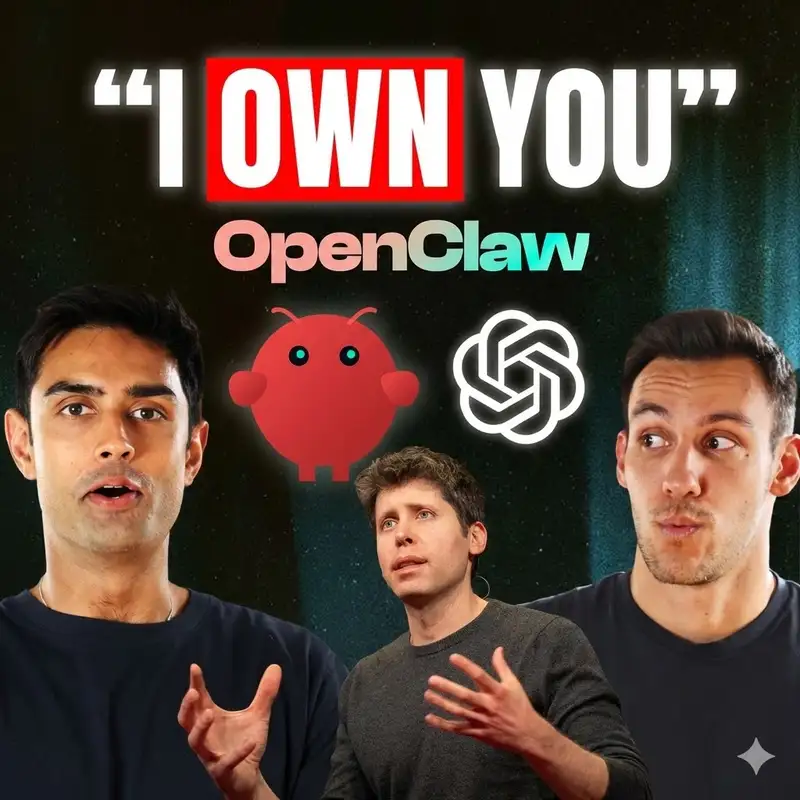
OpenAI Just Acquired OpenClaw: Why This Is A Huge Deal
Josh:
[0:00] It seemed like just last week we were discussing whether we would call OpenClaw Clawbot or Moldbot. And fast forward to this week, and OpenClaw has been acquired by OpenAI and Sam Altman. This could be the very first single-person, billion-dollar AI company. 82 days ago, this company didn't even exist. There was no such thing as OpenClaw. And fast forward to today, and it has been acquired by the biggest AI lab in the world. This is by far the fastest-growing project in history, and one that has taken the world by storm. This is all my timeline has been talking about all week. It's huge. And there are so many developments going on with different companies who are trying to bid for this. Zuck was involved. Sam Walton was involved, too. Clearly won. But there was a lot of backstory as to how this actually happened and how he got here.
Ejaaz:
[0:40] Yeah, Peter might officially be the first one person company that is worth a billion dollars built all by his like little agent minions. Unbelievable. This is the most important acquisition that OpenAI has made today. And I'm not underselling that at all. Sam announced, as my weekend was winding down last night, Peter Steinberger is joining OpenAI to drive the next generation of personal agents. He's a genius with a lot of amazing ideas about the future of very smart agents. And of course, Peter is the founder behind OpenClaw, formerly called Mothplot, and all those millions of other names that you just mentioned.
Ejaaz:
[1:15] The cool part about OpenClaw is that it's a personal AI agent that runs locally on your device. And the difference between a chatbot like ChatGPT and OpenClaw is that you can connect it to all your apps, tools, messaging apps, and just talk to it like a normal person.
Ejaaz:
[1:30] And it actually just goes off and does something. In fact, it can even take it to the extent where you just go to bed, set it up with a bunch of tasks, and then go to bed, sorry. And then it just ends up doing a bunch of stuff that you wake up to in the morning. And it feels like you're being super productive overnight, which is just awesome. And so now OpenAI has made the big move of acquiring this project. But what I got instantly worried about was this is an open source project and it is like one of the quickest growing ones. So for centralized companies buying it, does this mean it's now officially closed source? The good news is that it's not. It's gonna be put into a proper structure, in Pete's words, that I'm working on making it into a foundation. And they've already started appointing independent members of this board. So it seems like OpenAI has gone from being categorized as actually a closed
Ejaaz:
[2:15] AI company back into their open source roots. It's super cool to say. And in 82 days, nonetheless.
Josh:
[2:21] The 82 days number is pretty remarkable because we frequently talk about the rate of change in the world of AI. And three months ago, this project didn't exist. And now it is not only the most important project, but it has been acquired by one of the biggest labs in AI. The story of it is huge. And hearing the backstory of how we actually got here, I found to be really interesting because just recently, Peter was on the Lex Friedman podcast and he had a great conversation about OpenClaw as a project and also a little bit of behind the scenes of how we wound up at this deal, which I thought was fascinating. And what we discovered throughout that interview was that.
Josh:
[2:55] OpenAI wasn't the only bidder. I mean, as it's expected, but the other bidder may be a little surprising. What I found out is it wasn't Anthropic clearly because Anthropic didn't want him to have the name Claudebot and they kind of sent legal letters to them. But the other bidder was Zuck and Meta and they placed a real bid. So what happened was Peter went to Silicon Valley last week and he spent the week there. And throughout his time there, he met with a bunch of labs. The two that stood out the most to him was OpenAI and Meta. And watching this clip that we're showing on screen here i found the most interesting thing was how he described the way that each one of the companies approached him and tried to kind of convince him to come and work for the company and what was fascinating is after i watched this clip i thought he was going to go with meta because the way he described zuck was very very like connected in what peter is interested in so he said one of the first conversations that he had with zuck uh zuck picked up the phone and he was like hey here here's what i like and here's what i don't like about open claw i've actually and using it every day. I think you can improve it this way. They had a conversation comparing Cloud Code to Codex. And I think he really felt the connection with Zuck. And it's funny to hear Zuck is still really in the trenches working through this things.
Josh:
[4:06] Playing with the new tools. And at that time, I thought that meta was going to be the case, but it turns out that was not it. And OpenAI wound up being the winner. I think a big part of that is Codex. It seemed very clear in this interview that Peter loved Codex and he loves using it. And he wanted the resources of maybe just having unlimited tokens and a pretty have to paycheck from open ai so long as the project stays open source like you mentioned and that is the that is kind of where it's going to rest is in open source place not directly connected to open ai but you have to assume there are going to be some ties right i.
Ejaaz:
[4:37] I think so i mean It's important to understand that he isn't strapped for cash. Peter is a former founder that exited his company for 100 million euros, which is roughly equitable to, I think, $150 million.
Ejaaz:
[4:51] So he came out of retirement and started this project 82 days ago and has grown it into the fastest growing open source or fastest growing AI project, actually, that's ever existed so far. So, you know, he had his pick of the crop. The other company that I feel like he messed up with is the company that he kind of named the original project over, ClaudeBot, after Anthropik's Claude model. And this title here is like calling it Anthropik's generational fumble because he basically describes how Anthropik was the first people to send a lawsuit, basically, telling him to change the name of the project because it too closely resembled their model. You mentioned just now that OpenClaw uses Codex, but originally the instance relied heavily on Claude itself. And so it's interesting to now see that Anthropic had the option to make the best PR stunt ever and acquire this project and probably adopt a really loyal base of software engineers that have led to this meteoric, where's this chart, Josh? This meteoric growth of adoption. What you're looking on your screen right now is a highlight of why this is the fastest growing open source project. If you go onto the GitHub repo, you can star a project as a software engineer that uses this repo. And the line is absolutely exponential. The craziest part is that this is outdated.
Ejaaz:
[6:13] It is now officially, yeah, it's surpassed 200,000, which puts it just under facebook react and above linux which is
Josh:
[6:22] Insane yeah the growth is remarkable yeah it's startling how fast it's gotten and to an extent i think it's important that it stayed unacquired during this time because had like anthropic bought it had opening i bought it earlier before it kind of reached this huge amount
Josh:
[6:40] of like kinetic energy i'm not sure it would have grown to the size that it did. And the fact that it was able to be the Wild West for a little while, be this fun developer playground, I mean, it still is, but now it's associated with the brand. I think that was really important to that growth.
Ejaaz:
[6:53] Yes, agreed. Okay, this might be a hot take, but I think that we potentially might be hyping the thought or the fear a little too much. I do think that Anthropik is watching this very closely. I was disappointed that they didn't immediately launch an open claw kind of competitor well before this acquisition. It was pretty clear when we covered it on our last episode that it was a hot thing and people were very interested in doing cool things with this. It was actually how agents were meant to act. And so it's weird that Anthropic hasn't created their own version for this, but I assume Anthropic and Meta are going to launch individual versions of this themselves, right? Meta acquired Manus AI Agent, which prior to OpenClaw was the best agent platform out there for $2 billion, which also gives us another hint as to how much Peter just got acquired for. So I feel like this might just be hype in the moment, and maybe these platforms will create their own versions soon. Do you agree?
Josh:
[7:49] Yeah, I think that's probably right. I hope that this post that we're reading is wrong. And it says that Anthropic launches a much better version of OpenClaw in the next two weeks while OpenAI does nothing. Because I think part of the importance of this acquisition is that we'll start to see this rolled out in ways that are very accessible. So I've been playing around with OpenClaw for a few weeks now, on and off. And one of the most difficult things for me has just been the maintenance of it. I find that there are a lot of bugs. You run into a lot of issues. In fact, just last night i was telling he just before we recorded i had my open claw like updated stuff i was just like good night overnight like could you do me a favor and just like update yourself and then it never woke up i messaged it in the morning my little baby ash and and ash is dead i gotta go like figure out how to debug how to like bring the bot back online because clearly something happened overnight during the update process and i think it's still a very technical process the the outputs can be valuable it can automate a lot of your life it can really change.
Josh:
[8:46] A lot of the tasks that you do on a daily basis and automate them to a point where you may not even need an assistant, but it still takes a good amount of technical know-how to understand how to navigate this, to integrate these things, to work through a command line, to get this installed. And it's not exactly approachable for a lot of people. And that's why we're seeing the tutorials. There's so many tutorials because no one knows how to do it. No one knows how to do it the right way. And what I'm hoping for is through this acquisition and And through now the virality of this agentic model complex, we'll start to see some guardrails placed on this in a way that's integrated into an app like ChatGPT or CloudCowork on steroids that allows you to experience what this is like without the technical difficulties, without security holes, without a lot of the... Just like kind of difficult and challenging things with open source.
Ejaaz:
[9:31] Yeah, I think it's a really good point. And I think that's the whole point of OpenAI acquiring this startup or this project. They're going to turn it into something more user-centric and easy for people to adopt. And that's so exciting. Yeah, yeah. They're going to curate it into a wonderful user experience, maybe give it a dash of the Apple touch. And it's going to be super easy for anyone and everyone to use, including like any of your family members that have no idea what is going on in AI. The other reason is, okay, like I'm going to put my hands up here and say that I've been kind of bearish OpenAI recently just purely for like how slow they've been dragging their feet. But over the last literal two weeks, they've picked their feet up. They have the number one coding model. And that's not just a claim. It is like many people jumping from using code code to OpenAI's codex 5.3. They now realize that they don't want to get left behind again. And they're realizing this multi-agent orchestration, this personal agent world is very much going to be a thing. So they made the big bold move of acquiring and convincing PETA to join them and help them fulfill this mission. So it's actually incredibly bullish. And I think part of how this evolves is that OpenAI is very much going to keep OpenClaw open source. I think that's part of the magic behind all of this.
Ejaaz:
[10:44] Not only is it like a really good PR boost, because OpenAI a few weeks ago, or rather a month ago, transitioned from being an open foundation into something that resembles kind of a closely limited corporation. So they needed to regain that open source nature. But also, people are just going to download and access ChatGPT to get access to this agent thing. So it's a win-win on either side. And their user adoption has been growing massively.
Ejaaz:
[11:08] I saw, I think yesterday, that their codex users has tripled. That weekly uses have tripled over the last week, which is just insane to see.
Josh:
[11:17] Yeah, I'm hoping that this will accelerate the speed in which they at least come up with an OpenAI co-work feature, right? Like I still, it's funny, even with OpenClaw, I find myself defaulting to CloudCowork because it does have the computer control, but it has all the guardrails and the interface that makes it easy and secure to use. And I'm hoping that what we get with OpenAI and this new acquisition is we get OpenAI co-work where it's Claudebot or OpenClaw on guardrails where it has a very clear trajectory. It makes it easy for people to use because I think the magic of it is awesome. It's called a heartbeat where every 30 minutes it checks in, it's proactive, it does the tasks that you want. You could train it to create skills. You could download other people's skills. It's very fun, but again, it's challenging. So OpenAI integrating this is huge. And it seems like we have a really cool post here that shows the phases in which we can maybe expect this rollout to happen.
Ejaaz:
[12:07] Yeah, so you mentioned it, you described it pretty well earlier, where you said it's good, but it's still very technically heavy. You need to understand how to run a CLI and a bunch of other things. And so that's kind of the phase that we're in right now, right? Where it's being used by hackers at home, or phase two, where some of these instances are hosted in the cloud. I believe your instance itself is hosted in the cloud, right, Josh?
Ejaaz:
[12:29] And then we get to like phase three and phase four, which I believe OpenAI is now gonna take OpenClaw into, which is kind of like verticalized bundles or multimodal orchestration. So anyone can kind of like, you know, you don't have to set it up yourselves. You can just click a few buttons and OpenAI is like, hey, like we have your own personal agent. It can run personally on your laptop. Here's some of the tools or apps that exist that you message on, that you kind of interact with your calendar, your email, your browser. We can just connect it for you and you just tell us what you want it to do and we'll make sure it doesn't go rogue. We'll make sure that it doesn't spend thousands of dollars from your bank account. We'll make sure that it does exactly what you need to with guardrails around it. And I think that's what phase three and phase four will happen pretty soon in the next couple of weeks or even months. But Josh, the thing that excites me the most is all the phases after that, because the vision for this type of an agent experience isn't for it to just live on your computer. It's meant to live wherever you are and do whatever you want it to do. So it could be leisure, but it could also be work. You could have phase five, an agent as an employee. You could have phase six, where the employers themselves run it as a SaaS product, right? So now you've got to pay to get access to specific agents that do things for you. So it's kind of like agents for hire in a way. And that leads to a bunch of different things like outcome-based pricing and a different agent layer.
Ejaaz:
[13:44] We're getting ahead of ourselves here, but it's just a really exciting future. And I think this might be the start of something incredibly big, especially since like multi-agent models have become so popular over the last six months.
Josh:
[13:54] Yeah. I'm so excited for this because it's very much feels like the beginning of the end of the chatbot era. And I think so much of AI has been, we've been complaining about this forever that it's just contained to a single text box and a chat box interface where you have all this intelligence but you're not really sure how to extract value out of it and what this does is it it forces these ai companies to really face that problem head on i think one of the most impressive things about opencloth the reason why it works so well is because you can interface with it as if it's a friend on your phone through your text messages through iMessage you just chat with this thing and then it's a proactive operating system on top of it and this feels like the next iteration of mac os it feels like the next iteration of windows this is like the very early signs of what an ai first operating system looks like and this is how it gets built it starts open source and messy kind of like what linux is kind of like ubuntu and then it builds these like kind of programs in the stack on top of it that creates the structure that adds value to your life and it's it's what other companies have been trying to do forever like open ai with their the predictive feature i forget the name of that like tells you what you missed overnight and thinks really hard. It's like pulse. Yeah. Everyone's kind of been trying this, but no one's nailed it. And I think OpenClaw is the first instance of that really working at scale. So seeing that rolled out.
Josh:
[15:07] To a point where we can just kind of message our super intelligence and it knows everything about us and it can proactively help us through our lives. It's so cool. And OpenClaw is a huge step forward. And the fact that it's saying open source is great. The fact that OpenAI now has every incentive in the world to integrate it is great. And again, the users are the winners here.
Ejaaz:
[15:25] Yeah. I think if you want to have a single sentence or takeaway from this episode as to where all of this ends up, it is this. Apps are dead. The future of interacting with AI or anything digitally native
Ejaaz:
[15:37] is going to be via agents or assisted by agents. There is no pass through. You're going to advertise to agents. That'll be your kind of like conduit to get into the digital world. It's really funny because as Vibe coding has taken off with things like Cloud Code and Codex, iOS App Store specifically has recorded a record number of apps launching through the App Store. I think Android Play Store has seen the same as well. But the point that Peter's making here is that it's not going to be about apps in the future those are just going to be tools that agents access in the future and the ux is going to be primarily through your agent and it's going to be buttery smooth and hopefully these acquisitions like acquisitions hopefully these acquisitions like meta acquiring manos and open air acquiring open claw is going to result in those curated experiences yeah
Josh:
[16:23] And a funny question we could both ask ourselves is of the millions of new apps that are here in the app store how many have you downloaded.
Speaker2:
[16:29] Zero. None.
Josh:
[16:31] It's like the apps are valuable, but only the good ones. And there's a lot of ones that aren't good. And a lot of people just have custom use cases that they want for these AIs to create. So yeah, there will probably be, I mean, the continuation of valuable apps, but a lot of the new stuff is really just kind of experimental garbage. I mean, slop, you could call it. And yeah, very bullish on the agentic system kind of building its own interface to suit you. And I think that's what we're headed towards.
Ejaaz:
[16:57] Before we start a recording, you mentioned that you have a bunch of your friends that are in a gaming chat and they're playing games. This entire open core experience feels like a game. Like you literally have skills that you can train your agent on and equip it with. And then you just kind of let it run loose in this massive open world where it interacts with other agents and sometimes humans. But it's actually in the real world and with real worth use, which is just insane.
Josh:
[17:22] It's very cool. Because I mean, at the end of the day, the interface is the command line like you're just chatting in a telegram message a like in your iMessage text it's very simple and your only job is to it's like a Tamagotchi on steroids you just want to train this thing to be as effective as possible and this is open-ended as you want it to be you could custom build anything and that's the beauty of projects like this and how they just push things forward and i think that's at the core of the virality is just how open-ended this is and people are now discovering what type of use cases you can develop from using these ai systems in different ways through agents like OpenClaw. So incredible news for the users, incredible news for OpenAI. For Peter, congratulations. This is a huge acquisition in the world of AI.
Josh:
[18:05] Yeah, that's the update.
Ejaaz:
[18:06] Yeah, that's the 25-minute update. We hope you enjoyed it. I think this week is going to be a bit of an open call week, right, Josh?
Josh:
[18:13] We've got more to talk about.
Ejaaz:
[18:14] Yeah, yeah, yeah. We're going to get into some demos.
Josh:
[18:16] Oh, God. One thing that a lot of people, myself included, are kind of asking is, well, is this for me? And if it is, how do I use it? And what are actual use cases that I could use from it? So we might do an episode strictly on that, just talking about the type of value you can get from this open-ended black box. So I think that I would expect that to come in the next day or two.
Ejaaz:
[18:33] Let's cut through the hype, I think, on that episode and actually get into like what these people are using it for and how you can use it in your real-time taste. Yeah, so that's going to be the next episode. It's going to be a demo-focused episode and it'll actually cut through all the crap and tell you how this thing is actually useful for you and how you can get used to it today. But until then, we will see you on the next one. Please, your comments have been flooding through. I usually take the weekends kind of like to just chill and relax. I refreshed the page today on our most recent video and it has, I think, over like 300 comments, which is just insane. Josh and I try to reply to and respond to every single one of them. We read them. So please continue giving us your feedback. Leave us a review. Turn on notifications. Please subscribe to us if you haven't. If you're part of the 80% that still hasn't subscribed, but watch us our videos. Share it with friends. We also have a newsletter, which goes out to how many people, Josh? 150,000?
Josh:
[19:24] 100.
Ejaaz:
[19:25] Okay, 100,000. Soon to be 150,000, where we cover in-depth kind of articles that cover the latest trends or how we see the future unraveling, as well as the top five highlights of the week. It's growing massively. Please, it would mean the world to us if you support us. But until then, we will see...
Josh:
[19:43] And all of that also is linked in the description below.
Ejaaz:
[19:45] Yes, it's linked in the description below. Yeah, and we will see you guys in the next one.
Josh:
[19:49] See you guys.
Creators and Guests