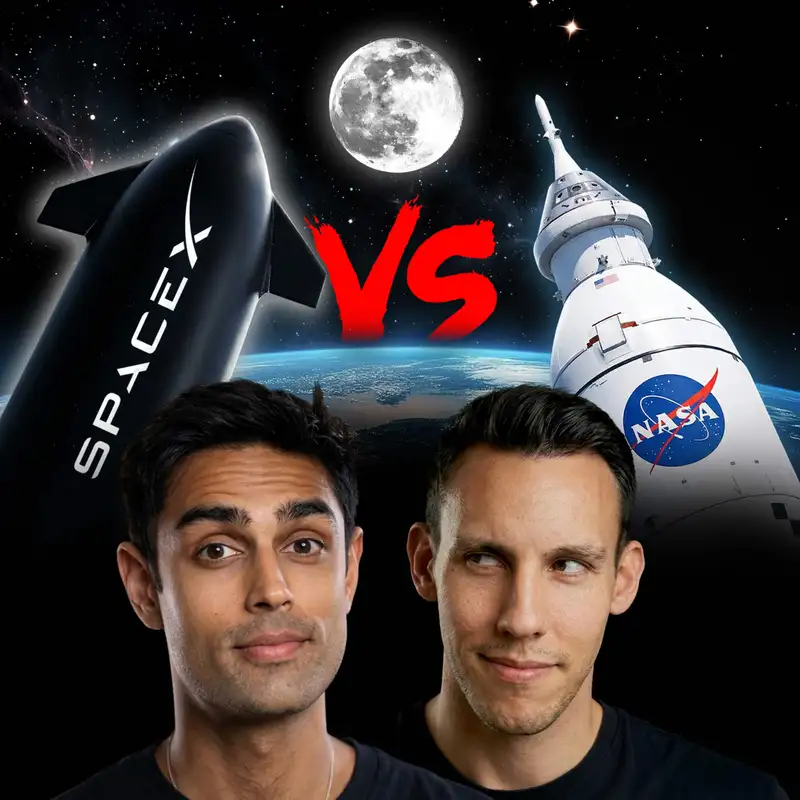
NASA's Artemis II Launched, But It Should Have Been a SpaceX Mission
Josh:
Last night, a rocket left Earth carrying four human beings towards the moon,
Josh:
which hasn't happened in 53 years.
Josh:
In 1972, back the last time we did this, the computer that landed Apollo 11
Josh:
on the lunar surface ran on 43 kilohertz.
Josh:
That's less processing power than the chip inside of a $5 USB-C cable that charges your iPhone.
Josh:
And they landed on the moon with it. Last night, the most powerful rocket NASA
Josh:
has ever built, standing taller than the Statue of Liberty, launched four astronauts
Josh:
into a 10-day loop around the moon.
Josh:
We're not going to the surface. We're just going to fly by, take some photos,
Josh:
and then come back home. And I got to be honest, this is incredibly exciting.
Josh:
I sat there all day watching the live stream. I cheered them on as it took off.
Josh:
But it's a little embarrassing because we're not even reaching the point in which we left off
Josh:
a full generation ago. So there's a lot to unpack here with this mission,
Josh:
how amazing it is, how impressive it is, what it enables with the future partnerships
Josh:
with companies like SpaceX and Blue Origin, and also how it kind of, to some extent,
Josh:
was just a colossal waste of money.
Josh:
So there's a lot to unpack here, EJS. But to start with, oh my God, this is amazing.
Josh:
We're going back to the moon and the astronauts are currently,
Josh:
as you're listening to this, flying into space, getting ready to orbit around the moon.
Ejaaz:
I had friends yesterday that I hadn't spoken to in like months message me and
Ejaaz:
be like, dude, are you watching?
Ejaaz:
Did you know we're launching like people to the moon again?
Ejaaz:
People were just like encapsulated by this entire thing. I think a bunch of
Ejaaz:
people all over the world were watching this stream.
Ejaaz:
And it's nuts. The mission is nuts. It's 10 days.
Ejaaz:
We're sending four astronauts around the moon. So, you know,
Ejaaz:
again, we're not landing on the moon, but we're going further than any space
Ejaaz:
mission has gone before.
Ejaaz:
4,700 miles to be specific, a 10-day mission. Right now, the crew are being
Ejaaz:
propelled around Earth using Earth's gravity, and they're going to be launched
Ejaaz:
towards the moon in about, I believe, a day and a half from now.
Ejaaz:
They're going to reach the moon six days after that, traverse it for about,
Ejaaz:
I believe, maybe half a day or so.
Ejaaz:
They're going to view the dark side of the moon, and then they're going to come straight home.
Josh:
And there's a lot of firsts for this, too. This is the farthest away humans
Josh:
will have ever been from Earth.
Josh:
By a couple extra thousand miles, but still the furthest away they've ever been,
Josh:
there's also going to be a new record happening upon re-entry where this is
Josh:
going to be the fastest humans have ever moved before at 25,000 miles per hour on re-entry.
Josh:
And this is thanks to the free launch trajectory that they get from this mission.
Josh:
So basically what happens is we send these humans,
Josh:
up into the low earth atmosphere. We whip them around earth and then send them out into deep space.
Josh:
The gravitational pull of the moon pulls them into its orbit,
Josh:
wraps them around the backside and shoots them right back to earth totally for free.
Josh:
No additional propulsion needed. And I have a post here that kind of walks through
Josh:
the highlights, right? We have 252,000 miles from earth.
Josh:
These astronauts are going re-entry at 25,000 miles per hour,
Josh:
incredibly hot, incredibly fast and scary.
Josh:
And then it just kind of shows the trajectory of this, which is, it's really amazing.
Josh:
It's something that has been discovered in the past. I believe they've even
Josh:
done this exact trajectory, a very similar one, but just a little bit further
Josh:
this time and a little bit more exciting because it's happening in real time.
Josh:
We have computers that can live stream. We have real-time video feeds of these
Josh:
astronauts and we get to actually watch and participate in this pretty unbelievable
Josh:
thing that's happening.
Ejaaz:
So I've been watching the live stream since yesterday and there's
Ejaaz:
a tracker which tells you how far away from earth they
Ejaaz:
are right now and just as of recording it's around 50
Ejaaz:
000 miles now if you're wondering how far away
Ejaaz:
that is that's around four earth's diameters away
Ejaaz:
from us so they are a long long way uh away from home but the live cast is still
Ejaaz:
going on and people are generally just pumped about this josh um there was a
Ejaaz:
hilarious video um where a cnn report i believe asked this kid hey um you know
Ejaaz:
why are you here Why are you here to watch the launch? And his response was pretty hilarious.
Josh:
Why do you want to be here? Why do you love space?
Ejaaz:
Why do you love being a part of history? We're going back to the fucking moon.
Josh:
Hell yeah, brother.
Ejaaz:
That's how I felt. That's how I felt. We're going back to the damn moon.
Ejaaz:
Now, that sounds amazing. But when you put it into context as to when our last
Ejaaz:
moon mission was, and there's been quite a few.
Ejaaz:
We've put about, I think, 11 or 12 people on the moon. We've been to the moon,
Ejaaz:
maybe 12 people. and we've been to the moon maybe, what was it, three times or so?
Ejaaz:
You know, all American manned missions.
Ejaaz:
I asked the question, why has it been 53 years since we've been back?
Josh:
That's a great question, EJ. And here's a timeline that should make you moderately
Josh:
uncomfortable. Because in 1969, Apollo 11 landed on the moon.
Josh:
We walked on it, planted a flag, and came home. Three years later,
Josh:
Apollo 17, Gene Carman becomes the last person to walk on the moon.
Josh:
And his final words on the surface, We leave as we came, and God willing,
Josh:
we shall return. Well, God was apparently not willing for 53 years because it
Josh:
has been a very long time.
Josh:
And it's funny. Like I mentioned in the intro, we did that on a computer that
Josh:
only ran 145,000 lines of hand-optimized code.
Josh:
It was 1,100,000th the power that sits in your iPhone in your pocket and 350
Josh:
times more than, you know, those TI-84 graphing calculators you used in high school? Yeah.
Josh:
It's 350 times more powerful than that. And we landed on the moon twice.
Josh:
So clearly there has been this disconnect in progress between then
Josh:
and now but nonetheless we are headed back
Josh:
and this does actually begin to open up
Josh:
the door for why this actually matters i mean this is fun we're learning we're
Josh:
doing science experiments like testing for radiation out in deeper parts of
Josh:
space but the reality is is that this is mission number one on a multi-step
Josh:
plan towards actually colonizing the moon building a lunar base on the moon
Josh:
thanks to companies like spacex.
Ejaaz:
This is where I kind of want to transition into the numbers because they sound
Ejaaz:
impressive. It's a lot cheaper than it used to be back then. So that's one win.
Ejaaz:
But when you compare it directly towards a company like SpaceX,
Ejaaz:
which is using groundbreaking technology and cutting the cost down to a fraction
Ejaaz:
of what this mission cost, it starts to look pretty bad on NASA and on this
Ejaaz:
space mission in particular.
Ejaaz:
Now, the headline number is $4.1 billion. dollars.
Ejaaz:
That's how much it costs to launch this rocket and man this mission.
Ejaaz:
And, you know, it's understandable. There's a lot of bureaucracy in the government.
Ejaaz:
There's a lot of mouths to feed and jobs to pay. But the fact that SpaceX can
Ejaaz:
do this for $10 million, and hey, if they blow the rocket up,
Ejaaz:
what is it, like $40, $50 million, Josh?
Josh:
Yeah, so the way it works is, I mean, reusability is a big thing,
Josh:
but even in the absence of it, it is a huge delta.
Josh:
So like you mentioned $4.1 billion per launch for the SLS, which is this Artemis II mission.
Josh:
The total mission cost, by the way, about $93 billion.
Josh:
So quite a bit was spent on this. For Starship,
Josh:
it can launch for about $100 million. And that's if the Starship rocket blows up.
Josh:
So if Starship explodes, the total cost to build in materials is about $107 billion.
Josh:
If it does land, which they're planning to do just in a couple of months,
Josh:
that cost goes down to $10 million.
Josh:
From $10 million to $4.1 billion per launch.
Josh:
And actually, EJ, if you scroll a little bit further down in this article here,
Josh:
there's a visual that shows the difference in size too as it relates to payload.
Josh:
And Starship is a monster compared
Josh:
to nasa's sls it sits i want to say 25 30
Josh:
taller it has much more payload capacity it is
Josh:
just a far more impressive rocket and the fact that
Josh:
it costs a fraction of a percent less than
Josh:
one percent to launch and it can be reused and it can be overflown again and
Josh:
again and again it's a testament to the gap that has been built between i guess
Josh:
government funded industries and private industry and part of the reason is
Josh:
the the contracts are such a nightmare when nasa builds these things.
Josh:
They use it, they build them based on cost plus contracts, meaning that.
Josh:
The company decides a cost. They mutually agree on how much something is going to cost them to make.
Josh:
And then they add a fixed rate on top of it. So they get a premium.
Josh:
So Lockheed Martin says, this piece is going to cost a million dollars.
Josh:
Well, cost plus means, well, NASA will pay you a 20% premium on that.
Josh:
But there's no incentive for them to bring it down because the premium gets
Josh:
higher as the cost goes higher. So there's all the incentive in the world to
Josh:
make these things incredibly expensive.
Josh:
Where SpaceX, a private company that does not use our taxpayer dollars to fund
Josh:
its launches, has every incentive in the world to remove the costs.
Josh:
And that's why you get this thing called the Idiot Index, which is the delta
Josh:
between the cost of materials versus the actual cost it takes to get these things into orbit.
Josh:
And the Idiot Index on NASA's SLS is pretty freaking high.
Ejaaz:
I'm starting to think that this entire mission should just have been handled and managed by SpaceX.
Ejaaz:
I'm pretty sure the future missions, which NASA is going to enable putting people
Ejaaz:
on the moon and setting up a moon settlement, is going to be enabled by SpaceX.
Ejaaz:
There is no are the way that they can do it. They need reusable rockets.
Ejaaz:
They need cheaper costs to get into outer space and to the moon and back.
Ejaaz:
Now, I know they say never judge a book by its color, but I'm going to judge
Ejaaz:
these two ships directly together. Star Trek.
Ejaaz:
25% taller. It is two times heavier. It can take 4x more payload than this current rocket.
Ejaaz:
It is completely reusable and both stages are designed for reuse.
Ejaaz:
So the point I'm trying to make here is I think that NASA taking 53 years is
Ejaaz:
kind of a big discredit towards the agency and what they've achieved.
Ejaaz:
Not to discredit that the mission itself is very impressive,
Ejaaz:
but I think the future is going to be with companies like SpaceX that is able
Ejaaz:
to lower down the cost for things like this and produce better efficiencies
Ejaaz:
versus what we just watched yesterday.
Josh:
Yeah, it's totally right. And it's so important not to discredit what's happening
Josh:
here because this is amazing, right? It's like we do have humans that are on
Josh:
their way to the moon right now built by an unbelievable engineering team that did this.
Josh:
It's not their fault. A lot of these people weren't even alive 53 years ago.
Josh:
They are doing their best to get these people to the moon and they're doing
Josh:
a great job. The mission so far outside of that one little toilet anomaly has been a wild success.
Josh:
Everything is working really well and that serves a tremendous amount of credit.
Josh:
But like you mentioned, SpaceX is just far superior and we're going to see that
Josh:
handoff happen as we progress through this artemis program so artemis 3 which
Josh:
is scheduled for mid-2027 so a year from now uh the crew is going to test docking
Josh:
with the spacex starship or perhaps blue origin but i would imagine that spacex
Josh:
is probably going to win over that contract there's no.
Ejaaz:
Way bezos gets this no way
Josh:
Unlikely unlikely but possible they have the
Josh:
option then artemis 4 is the big one that's happening in
Josh:
early 2028 and that's when we are targeting for the first lunar
Josh:
lander to actually land on the moon with human beings inside so spacex is probably
Josh:
going to be handling that one that's coming in two years and then just a little
Josh:
bit later in the year in the second half of 2028 there's going to be a second
Josh:
crew landing planned in which nasa is going to target twice per year landings
Josh:
on the moon going forward.
Josh:
And this is going to begin the production and the building of our lunar Mars
Josh:
base, which is really cool.
Josh:
I mean, NASA's administrator, Jared Isaacman, he's the new guy.
Josh:
Everyone loves him. He's amazing.
Josh:
He announced a $30 billion decade-long plan to build a permanent lunar outpost
Josh:
on the South Pole of the moon by 2036.
Josh:
So the Artemis launch today, while we may have some choice words to say about
Josh:
it, is very much the gateway to a lunar base.
Josh:
And this is step one in a multi-step process that's going to happen.
Josh:
And they're going to bring in SpaceX.
Josh:
They're going to bring in Starship. The costs are going to decrease.
Josh:
It's just, you know, it took a little while to get here.
Ejaaz:
I think it's also important to set the context as to why on Earth we have two
Ejaaz:
major companies or agencies trying to land humans and set up a supplement on the moon itself.
Ejaaz:
Elon has his own specific reasons for SpaceX. He wants to get closer to the sun.
Ejaaz:
He wants to train AI with data centers out in space and harness sun's energy
Ejaaz:
and turn us into a Kardashev 2 or Type 2 civilization.
Ejaaz:
With NASA, it is part of that, but they've also realized that some parts of
Ejaaz:
the Moon is potentially habitable.
Ejaaz:
You know, they've found or confirmed water on the South Pole.
Ejaaz:
They've got drinkable water, breathable oxygen. And one of the reasons why this
Ejaaz:
is so important is it gives us more access to resources that we didn't have
Ejaaz:
access to before, more space.
Ejaaz:
And also, it's easier to manufacture things with one-sixth of the gravity of Earth.
Josh:
Yeah, well, it's also, I mean, mass driver, dude, we're, we're doing AI in space.
Josh:
Don't forget that. So the plan for, I mean, space extensively is to help build
Josh:
this Mars base, but also to build that mass driver that we talked about in an episode prior,
Josh:
which is a way of distributing satellites into orbit very cheaply and very quickly
Josh:
and harnessing a lot more energy.
Josh:
There's essentially unlimited free energy on the moon because we're able to
Josh:
capture all of it via solar and when you apply that at scale it's it's a really
Josh:
amazing way to begin to scale.
Josh:
Intelligence energy capture we start to build these mini
Josh:
dyson storms because the cost per satellite becomes so low
Josh:
and this is going to happen over this phased structure they
Josh:
have like phase one which is happening through 2028 they're planning 25
Josh:
launches 21 landings to deliver 4 000 kilograms
Josh:
of equipment that's going to include like rovers
Josh:
drones communication systems things of the nature phase two
Josh:
happens in the following years between 2029 and 2032 where
Josh:
they're going to start building power systems and communications and
Josh:
habitat modules where humans can actually live on the moon for weeks
Josh:
or months at a time phase three happens just after that
Josh:
which is 2033 to 2036 which is
Josh:
the fully operational lunar outpost so this happens fairly
Josh:
quickly a decade from now there's a very high probability
Josh:
that's or i guess not very high there's a
Josh:
strong probability that we have humans permanently stationed on
Josh:
the moon with rocket chips that go back and forth on a regular basis and we
Josh:
see it doesn't take that long this whole mission for these astronauts takes
Josh:
10 days if you go direct i think it's way less than that it's probably half
Josh:
or something um so the moon is going to change a lot and this is very much the
Josh:
gateway mission that enables that that change to start happening.
Ejaaz:
That still is almost a decade away. And I want to bring us back to the mission
Ejaaz:
that's happening right now.
Ejaaz:
We've talked about a lot of impressive things. The tech, the ship itself,
Ejaaz:
the crew, very accomplished. But I want to talk about the thing that impressed me the most.
Ejaaz:
The menu that they have for the next 10 days. Oh boy.
Ejaaz:
Artemis 2 crew menu was leaked. And they have 189 unique menu items.
Ejaaz:
They also have spice levels for those who prefer spicier versus something more
Ejaaz:
milder. And I have to say, this is more impressive than any space mission or
Ejaaz:
arguably anything that I eat on a daily basis at my local restaurant,
Ejaaz:
my neighborhood restaurants.
Ejaaz:
We've got coffee, green tea, mango, peach, smoothie, chocolate breakfast drink.
Ejaaz:
I've never had that before.
Ejaaz:
Apple cider, pineapple drink, cocoa, strawberry bread. Like that's just a drink
Ejaaz:
section, by the way. Then you've got common food items.
Ejaaz:
This seems like a lot for 10 days, but it is my favorite ever thing.
Ejaaz:
You've got to keep the crew happy. I don't think the space station has this
Ejaaz:
variety of different things.
Ejaaz:
Five Canadian products by the way I just want to point out it's not just all America but
Josh:
I love this. And to my understanding also, this is the first time there's like
Josh:
a fully functional toilet bowl in a spacecraft. So that's pretty...
Ejaaz:
Questionable.
Josh:
Okay, questionable. Why do you say questionable?
Ejaaz:
Well, the good news is that we launched with everyone being saved.
Ejaaz:
The rocket did not explode. Thank goodness.
Ejaaz:
The bad news is almost immediately the toilet got clogged. It got throttled
Ejaaz:
and they couldn't use the toilet.
Josh:
Wait, did it get clogged? It didn't get clogged.
Ejaaz:
It got they're troubleshooting the toilet um what does that tell you josh i
Ejaaz:
don't know but the important update is it has finally been fixed so the people
Ejaaz:
will be able to reuse the toilet but the question i have on my mind is what
Ejaaz:
would they have done if that was you know unfixed
Josh:
You know i'm actually not sure how astronauts use the
Josh:
bathroom in space generally speaking so that's gonna have to be some additional research
Josh:
we do after that perhaps if you know you could leave a comment so i
Josh:
would be curious i think the menu is very funny um i
Josh:
they need to be careful tread lightly because we know that toilet's a little fickle so
Josh:
don't go too overboard on the menu but i think it's fun right it's like
Josh:
if you're gonna blow all this money do it have fun
Josh:
like make it entertaining make it fun and exciting for
Josh:
the astronauts make it fun for everyone to watch and i
Josh:
think that's what's really interesting about having the live stream is that we
Josh:
get to watch and participate this participate in this in real
Josh:
time as it's happening now i do have some choice comments about the
Josh:
live stream they were standing on the launch pad and i
Josh:
was looking into the cockpit and it looks like it was being shot on a potato
Josh:
like perhaps they could have used this spacex partnership to partner with starlink
Josh:
that would have been cool to give slightly higher resolution uh imagery maybe
Josh:
they did because the image we just watched earlier was pretty good but there
Josh:
was this really funny um meme that i saw that showed the cockpits comparison between.
Josh:
Spacex and artemis 2 and looking at
Josh:
these two it is pretty stark the difference right it's
Josh:
like one of these looks like it is from the 1960s and the other one looks like
Josh:
it is out of a sci-fi movie and i think that's another testament to kind of
Josh:
where we've come from and where we're going where nasa's very much riding the
Josh:
coattails of its history which is unbelievably impressive and powerful and strong
Josh:
but it's a new era and they're,
Josh:
There is a new kid in town who is building some really badass engineering,
Josh:
some really badass rockets.
Josh:
And based on this photo, like SpaceX, SpaceX looks like what I would imagine the future looks like.
Ejaaz:
Yeah, it looks like something out of the Interstellar movie,
Ejaaz:
you know, where Matthew McConaughey is like, you know, we're going to land this TARS.
Ejaaz:
Yeah, I think it's way more advanced. It's way less cluttered.
Ejaaz:
I think, I hate to say it, but I think there's been a lot of bureaucracy in
Ejaaz:
NASA and in government agencies and putting people focusing on space in particular.
Ejaaz:
I think in that time in the 53 years since we did our last moon mission,
Ejaaz:
private companies have caught up.
Ejaaz:
SpaceX being the prominent one, Blue Origin from Jeff Bezos being probably the one that is in second.
Ejaaz:
I think we're going to start, like when I zoom out, I think that net net,
Ejaaz:
we're going to see more space launches and more space missions.
Ejaaz:
Before we started recording, Josh, I told you, like, I hope one day in my life
Ejaaz:
before I die, I get to go to the moon or into outer space in general.
Ejaaz:
I think that's going to become a reality.
Ejaaz:
Elon is targeting a launch every hour in the next, I believe,
Ejaaz:
five years or within a decade.
Ejaaz:
I can't remember the time span, but that would be awesome. That's something
Ejaaz:
out of Star Trek, something straight out of sci-fi.
Josh:
Yeah, it feels very high conviction to say that you will have the option to
Josh:
go to the moon in your lifetime.
Josh:
And if you want to, you will have the chance to do that. And I think that's
Josh:
a really cool thing that this enabled and this recent focus on space is going to enable.
Josh:
We are very much back into our space era. And this is unbelievably exciting.
Josh:
Like right now, four humans are in a spacecraft hurling towards the moon.
Josh:
And by Monday, they'll fly over the side, which just for a moment,
Josh:
they will see a part of the moon that no human eyes have ever directly seen before.
Josh:
It's really exciting. And this opens up not only the enthusiasm,
Josh:
because this has gotten quite a bit of publicity, but also just the velocity
Josh:
and all of the approvals needed to actually start building and making progress towards the lunar base.
Josh:
SpaceX pivoting from Mars to the moon is really important. There is now a clear
Josh:
path to building a lunar base.
Josh:
And what that unlocks is really cool in terms of technology,
Josh:
but also just in terms of awe and curiosity and getting excited about what it's
Josh:
like to explore beyond the current planet that we've lived on since the beginning of time.
Josh:
And the progress is, it's just so awesome to see. And even though it,
Josh:
sure, it was inefficient.
Josh:
Sure, there were a lot of mistakes. Sure, it took us a long time. We're here, we're back.
Josh:
And we are back in a way that is sustainable and durable. And the window is open to do this now.
Josh:
And assuming things continue to go well, assuming there is no catastrophe within
Josh:
our country between now and like maybe 15, 20 years from now,
Josh:
Ejaz, you can go to the moon.
Josh:
I'll be able to go to the moon. And it will be very cost effective.
Josh:
Because when you think about the launch costs, I mean, $10 million to send a
Josh:
starship to the moon today, what is that going to cost like a decade from now?
Josh:
Probably significantly less. And I assume it's going to be something like an
Josh:
airplane because at the end, at the limit, that's the only way that this becomes.
Josh:
Sustainable business model is if they are able to do that at a cost that's competitive.
Josh:
And that seems to be the goal. And over the next 10 years, we're going to build something that,
Josh:
is indistinguishable from sci-fi. Like it's really going to start to look like
Josh:
the future. And that is so unbelievably exciting.
Ejaaz:
I remember last year, Elon was speaking about the launch economics of putting stuff into outer space.
Ejaaz:
And he mentioned that there might in the short term be this new type of transportation
Ejaaz:
system for people who want to get to countries quicker.
Ejaaz:
So what he modeled out was going straight up in a SpaceX shuttle and coming
Ejaaz:
down about 44 minutes later in Japan.
Ejaaz:
And so you've done the journey from the US to Japan in 44 minutes,
Ejaaz:
where usually it would take like 13 to 19 hours, depending on airline and flight time.
Ejaaz:
So there are a lot of intermediary benefits that are going to happen with all of this.
Ejaaz:
But hey, I'm so proud of all of this. And as a foreigner and a tourist living
Ejaaz:
in this country, I'm wearing my American flag here.
Ejaaz:
I don't know if you guys can see it, but I'm proud of us.
Ejaaz:
And I'm super excited to see. I hope the mission is successful and hopefully
Ejaaz:
it'll lead to more missions in the future.
Josh:
Yeah, we got to keep but real we got a clap back where it's deserved that uh
Josh:
descriptor that you're saying about spacex that's
Josh:
the vertical takeoff and landing rockets the vetols and i
Josh:
believe the video where they initially pitched that idea is probably
Josh:
close to seven or eight years old and they made a total of zero progress towards
Josh:
that so damn space is hard man and priorities change like spacex was going to
Josh:
build vtol rockets and go to the mars uh now they're going to the moon and nasa
Josh:
hasn't really had the opportunity to go to the moon no they're doing it now
Josh:
so priorities change things shift, but right now we have a very clear trajectory.
Josh:
Jared Isaacman has said, we are going to the moon. We are colonizing it.
Josh:
We are building a lunar base. 10 years.
Josh:
And we actually have momentum. There are astronauts in the air right now and
Josh:
a very clear trajectory to continuing that. So,
Josh:
Really cool. If you're listening to this, chances are they're still in space.
Josh:
You can go to NASA's YouTube channel and watch this live in real time.
Josh:
And it's pretty amazing.
Josh:
You could just see these guys kind of hanging out. They were taking pictures with their iPhones.
Josh:
I think the idea of this is to run some science experiments,
Josh:
sure, but also just to get people excited about space and to make it more relatable,
Josh:
to make it more accessible.
Josh:
And I mean, it's really exciting. So I would encourage anyone to go and check
Josh:
out the live stream, share maybe in the comment section what's most exciting.
Josh:
I don't know, Eijas, any final thoughts before we head out today?
Ejaaz:
I want people's over-under on SpaceX getting us to a moon settlement fully living
Ejaaz:
by 2028 versus NASA doing it themselves.
Ejaaz:
What do you people, folks listening to us think? My bet is SpaceX.
Josh:
Josh, anything? Yeah, I mean, NASA, they already said they're not doing it.
Josh:
It's either SpaceX or Blue Origin.
Josh:
So Blue Origin is doing well. They're really strong in low Earth orbit.
Josh:
They're less strong anywhere else. i think starship is going to i'm almost 100
Josh:
positive starship will be the rocket and perhaps blue origin could do stuff
Josh:
with space station like falcon heavy is doing with the dragon cat how far.
Ejaaz:
Behind is blue origin on spacex now relatively do you think
Josh:
It depends how you measure it
Josh:
but blue origin does not have a starship and
Josh:
okay a starship is really the only thing that matters in
Josh:
space because again the cost of kilogram is is the singular
Josh:
metric that matters and the cost per kilogram of starship
Josh:
is dramatically lower than anything that blue origin has
Josh:
or will have in the near future so blue origin will have
Josh:
the capacity to do specific things it could send satellites
Josh:
into low earth orbit kind of like what starlink's doing they're trying their own thing in
Josh:
fact amazon um just recently purchased yesterday global star telecommunications
Josh:
which is a satellite company to help compete with starlink so there is going
Josh:
to be this competition for low earth orbit in terms of lunar orbits or moving
Josh:
mass further out or moving large amounts of mass so these Starlink V3 terminals
Josh:
that are coming are huge.
Josh:
Blue Origin cannot carry those, but SpaceX and Starship can. So there's going to be.
Josh:
I wouldn't say Blue Origin is behind in the sense that they're behind on getting
Josh:
to orbit. They're just behind on getting mass to orbit, large amounts of it at a cheap quantity.
Josh:
And that's what makes the big difference. So SpaceX is very far ahead in that
Josh:
sense. But there's a lot of companies that are now competing.
Josh:
And there's a ton of public stocks that actually have been doing incredible
Josh:
recently in the market over the last few weeks.
Josh:
Because people are starting to realize the space race is back, baby.
Josh:
And it's all America. It's all the USA. all these companies are fighting for
Josh:
getting mass into orbit creating these networks putting stuff into space so
Josh:
it's a really exciting time i'm feeling very optimistic about the future of
Josh:
space travel and i'm glad that everyone's aligned government private industry
Josh:
the people everyone's stoked about this.
Ejaaz:
You would think that AI is like the hottest stock in industry to invest in right
Ejaaz:
now, but SpaceX just filed for a discretionary IPO. So it's happening.
Ejaaz:
They're targeting a June launch and the valuation that they're going for is $1.75 trillion.
Ejaaz:
It'll be the biggest, largest IPO that we've ever seen before.
Ejaaz:
The over-under that I've seen on a lot of websites as well is it's going to
Ejaaz:
be valued above $2 trillion by the close of day on its initial day.
Ejaaz:
So people are excited about space.
Ejaaz:
They realize that there is so much of a bigger opportunity outside of Earth
Ejaaz:
than just constrained to Earth's resources.
Ejaaz:
And I'm excited to see this manifest and become real.
Ejaaz:
Just truly a great day for the world and America in general.
Ejaaz:
I wish the astronauts and the mission the best of success. I'm going to be tracking
Ejaaz:
this for the next six days.
Ejaaz:
Sorry, the next 10 days. There's not going to be anything else I'm going to be watching.
Josh:
That's great. Big week for the optimists, man. Space is back.
Josh:
We are so back. And we got 10 days to enjoy this.
Josh:
250th anniversary of the united states painted on both
Josh:
of those boosters that are going to be burning up in orbit
Josh:
as they return back to earth and it's really cool i
Josh:
mean this is awesome this is exciting it leaves me optimistic i'm curious your
Josh:
takes on whether you are also joining us in the optimism
Josh:
or not but anyways thank you so much for watching
Josh:
if you enjoyed this episode do not forget to share it with your friend who
Josh:
is also perhaps a space nerd or maybe you just
Josh:
want to joke about how inefficient nasa is or how their
Josh:
menu is more sufficient than the menu at the restaurant you went
Josh:
to last night whatever it is don't forget to rate us
Josh:
um however you believe we deserve to be rated five stars is pretty awesome on
Josh:
your favorite podcast player we have a newsletter i just published a new issue
Josh:
that went live yesterday all about this mission in a little bit more detail
Josh:
so if you're interested in that you can go subscribe all of the links are found
Josh:
in the description below and yeah i think that wraps up our episode today thank
Josh:
you guys so much for watching.
Creators and Guests