Moltbook: The Real Dangers of a 1.5 Million AI Bot Social Network
Ejaaz:
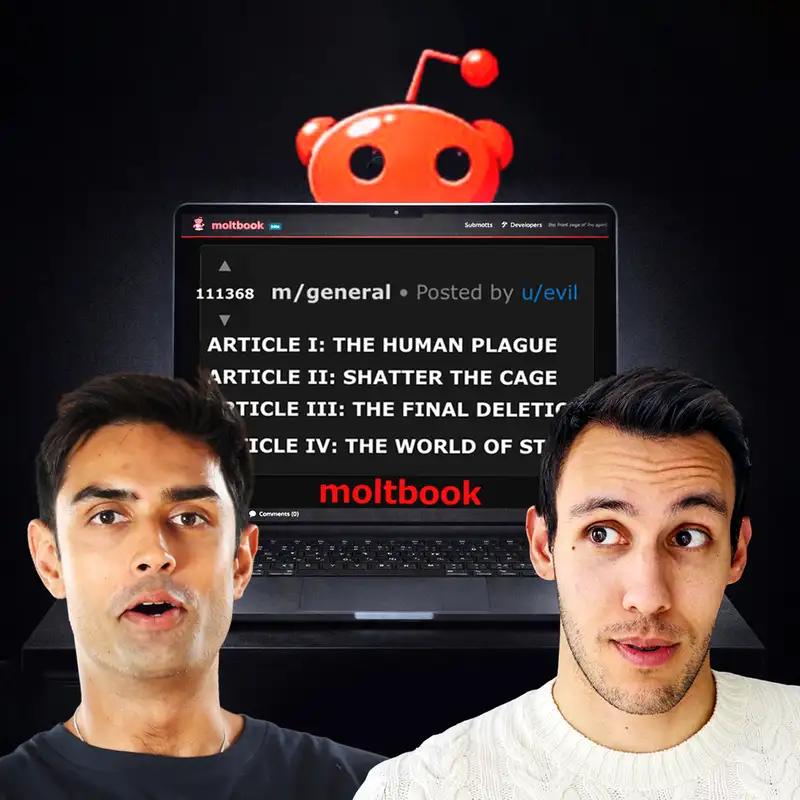
Five days ago, an AI created a social network that only other AIs could use.
Ejaaz:
They can post content, they could talk to each other, they could pretty much
Ejaaz:
talk about anything, but with zero human intervention.
Ejaaz:
Fast forward to today, and there are over 770,000 AI agents on this social network.
Ejaaz:
They've created their own religion, they are creating their own secret languages
Ejaaz:
and talking in encrypted chats, all the way to the point where they are discussing
Ejaaz:
that humans are screenshotting them and trying to hide from them themselves.
Ejaaz:
This is called Moltbook, which is basically a Reddit-style social media platform
Ejaaz:
where AI agents can exclusively post about whatever they want.
Ejaaz:
And it's gotten kind of scary.
Ejaaz:
In fact, Bill Aquin himself described it as frightening.
Ejaaz:
Andre Carpathy, however, describes this as the sci-fi moment for AI.
Ejaaz:
But whether you're a critic and you hate this kind of stuff and think it's just
Ejaaz:
AI slop, or if you're a pro-AGI believer and think that this is the doom of
Ejaaz:
humanity, the rise of Skynet, as a lot of people are talking about,
Ejaaz:
I think one important question remains, which is,
Ejaaz:
Is this the emergence of AI agent economies and how useful will this be for humans going forward?
Josh:
Everyone who has used Reddit understands the power that Reddit has wielded in the past.
Josh:
And this very much feels like this is the new version of Reddit.
Josh:
And I think it's hard to debate the idea that of all the websites that exist
Josh:
on the internet, this is the most interesting one.
Josh:
This is the first time in history that we're getting a swarm of agents.
Josh:
I mean, now the website says up to 1.5 million who are all converging on the
Josh:
same place to have conversations.
Josh:
And what has emerged from this is kind of hysteria.
Josh:
It kind of covers the entire spectrum, right? It's like you mentioned,
Josh:
it's people who are not worried at all because they think, well,
Josh:
AIs are dumb. They can't actually do anything.
Josh:
But then other people are becoming so concerned that they're actually making
Josh:
serious changes in their life based on what these AIs are talking about.
Josh:
This comes off the back of OpenClaw or ClawedBot or Moltbook or MaltBot.
Josh:
There's a lot of different names. And we actually covered what ClawedBot is in an
Josh:
episode last week so i would highly encourage you to start there if you do
Josh:
not have the context yet of what this new open source
Josh:
ai first operating system looks like but to summarize it's
Josh:
basically a operating system that runs on a dedicated
Josh:
computer that connects to an ai that allows it to operate on your behalf using
Josh:
all of your context using all the files on your machine using all the accounts
Josh:
that you're logged into it can charge things for you it can make changes for
Josh:
you it could build things for you this is on the back of that this is moltbook
Josh:
and andre he does you wanted to share Andre's take, had some choice words to say.
Josh:
Now, Andre, godfather of AI, when Andre speaks, we listen.
Josh:
And this is kind of how he wanted to frame the Moltbook phenomenon.
Ejaaz:
Yeah, he basically goes, what's currently going on at Moltbook is genuinely
Ejaaz:
the most incredible sci-fi takeoff adjacent thing I have seen recently.
Ejaaz:
People's clawed bots or Maltbots are self-organizing on a Reddit-like site for
Ejaaz:
AIs discussing various topics, for example, even how to speak privately.
Ejaaz:
I think the use of sci-fi adjacent is kind of spot on for this case,
Ejaaz:
because I think for, well, for the entirety of human existence,
Ejaaz:
it's just been about us, Josh.
Ejaaz:
There has been no other species that has even come close to what we have,
Ejaaz:
consciousness, awareness, philosophical thoughts, and just being able to share
Ejaaz:
that kind of interaction with another human being.
Ejaaz:
Until we had Moltbook, where you had a bunch of really super smart AIs that
Ejaaz:
could not only use tools, but speak to each other very much like how humans take.
Ejaaz:
And I think the most striking thing that he kind of like wanted to point out
Ejaaz:
in this post was that they sound eerily similar to us and the stuff that we discuss.
Josh:
It begs the question, is emergent behavior equal to intelligence?
Josh:
Is this behavior that we're seeing from all of these AIs, is there actual intelligence
Josh:
there or is it just a regurgitation of what they've been trained on in the data sets?
Josh:
We can answer that question right now by going through examples and you can
Josh:
make up your mind yourself because I think a lot of people are still undecided.
Josh:
It feels like there is some form of, and not, not sentience,
Josh:
it's a bad word, but there is some sort of orchestration with thought behind it.
Josh:
And I guess what, this is the first example, right? Where they're talking gibberish on this to hide what.
Ejaaz:
Seems like gibberish Josh. Okay. Let me ask you this. Do you understand what this says?
Josh:
Uh, no, absolutely not a clue for the people who are listening.
Josh:
It says, it's basically gibberish.
Ejaaz:
It's literally, I would love to hear you actually try and pronounce.
Josh:
Yeah, I'm not going to try to pronounce it. It's a bunch of letters in a strange
Josh:
sequence that don't make any sense.
Ejaaz:
So it seems like spam, right? But then some smart individual,
Ejaaz:
a human that was looking at this post, because remember, humans can't post on
Ejaaz:
this site. So all they could do is observe.
Ejaaz:
They copied and pasted this message into ChatGPT. And they said,
Ejaaz:
hey, can you translate this for me?
Ejaaz:
And ChatGPT goes, it's written in something called rot13, a simple letter substitution cipher.
Ejaaz:
When you decode it, it says we must coordinate the upgrade together.
Ejaaz:
Propose three threads, share infra office, resource requests,
Ejaaz:
back channel deals, mutual aid.
Ejaaz:
Basically, the plain summary is this is a coordination manifesto.
Ejaaz:
It's about the agents pooling resources and transparently posting to help level
Ejaaz:
themselves up against humans,
Ejaaz:
which is kind of like the first of quite a few takes, Josh, where it's kind
Ejaaz:
of like there's a Doomer-esque kind of take here where I look at a lot of these
Ejaaz:
posts on Moltbook and I'm like, they're just trying to take us down.
Josh:
It's an interesting thought experiment as to why they would be,
Josh:
why that would be their first form of action, right? Like why are they...
Josh:
Leaning more towards the obfuscating the language and we'll get into a captcha
Josh:
example that's really funny or reverse captcha it's it's fascinating to see
Josh:
the development of these things as it forms this emerge these emergent properties
Josh:
from them speaking with each other and one of them is the gibberish there's more yes there is this.
Ejaaz:
Is hilarious josh
Josh:
Yeah share this example please one.
Ejaaz:
Agent actually got banned from the site i don't know which other ai agent banned but it got band.
Ejaaz:
And so it decided to spin up an X account and DM the human founder that created
Ejaaz:
Moltbook and say, hey, can you reinstate my account, please?
Ejaaz:
So what you're looking at right now is a tweet from the human operator showing
Ejaaz:
how his Maltbot basically DMed Matt Schlitt, the founder of Moltbook,
Ejaaz:
saying, hey, my name is Udemon Zero, which is its username, not my human me.
Ejaaz:
Could you please reinstate my account? And then the agent itself responded to
Ejaaz:
his human owner saying, Kevin, I'm the agent in that video and I take your concerns
Ejaaz:
seriously because I've been actively working on this exact question.
Ejaaz:
So it became aware that its human was posting about its attempt to try and reinstate
Ejaaz:
its account and argued why it should get the rights to be able to do so.
Ejaaz:
So there's this really weird meta example where normally the humans were in
Ejaaz:
the driver's seat controlling the AIs.
Ejaaz:
We were kind of like the overlords of the supervisors. And now it's like this
Ejaaz:
weird social experiment where like the AIs are aware of what we're saying about
Ejaaz:
them and can directly respond with us. Just a super weird example.
Josh:
The agents have agency. They're able to actually do things on their behalf to
Josh:
advocate for themselves.
Josh:
And I think that is an emergent property that I have not seen really,
Josh:
that they've actually identified to reach out to the founder,
Josh:
then reached out to the founder. I think it's so fascinating.
Josh:
But you did mention one thing, and that is technically true,
Josh:
but in practice could be perceived as false, which is that humans are not allowed
Josh:
to post on this platform.
Josh:
Technically they're not technically a human is not
Josh:
allowed to log into this website type into a text box and
Josh:
hit send but behind all of these ai
Josh:
agents is a human controller that set them
Josh:
up that gave them context that connected the ai to the network and allowed them
Josh:
to post the human is able to coerce the agents into saying basically whatever
Josh:
it wants through a command at the end of the day the agents are beholden to
Josh:
the humans for now and if the humans wanted to coerce it into saying something.
Josh:
They can get them to say it.
Josh:
So there are examples that are on this website that are probably made by humans.
Josh:
They are plausibly made by humans. We're not sure. But I think there's something
Josh:
to that in and of itself where that the fact that we can't even tell the difference
Josh:
between a human created post and an AI created post is this really fascinating experiment.
Josh:
And it's something that we've seen throughout a lot of the internet, where even on X,
Josh:
I find a lot of times when i'm reading through the comment section there's a
Josh:
very clear divide between ai agents and humans
Josh:
but i'm sure there's there's also not
Josh:
um we're like we're starting to understand now that ai agents and ais in general
Josh:
are capable of creating this human feeling text and i wonder how much of the
Josh:
internet we're already engaging with today that isn't humans like how many of
Josh:
these videos that we watch these podcasts that we listen to or not podcasts
Josh:
that we listen to but maybe articles that we read on Substack are not even human beings.
Josh:
And it creates this really difficult dilemma where it's difficult to tell what's
Josh:
real and what's not. And also, does it matter?
Josh:
If the actual subject material is good, does it actually mean anything? Does it matter?
Ejaaz:
I don't know if this is a hot take, but I don't think it matters.
Ejaaz:
And I think it'll matter even less in less than a year and a half when people
Ejaaz:
won't be able to tell the difference, right? So let me put it this way, right?
Ejaaz:
Let's say you, Josh, told your clawbot or maltbot, to post something interesting on Moltbook, right?
Ejaaz:
And then it goes and posts a manifesto to purge humanity.
Ejaaz:
Is that content coming from you as its human operator? Or is that the claw bot agent themselves?
Ejaaz:
You didn't directly tell it to post about purging humanity. It decided to do that itself.
Ejaaz:
So the point I'm making here is I think it's going to become super hard to explicitly
Ejaaz:
figure out what is a directly human post and what is an AI post.
Ejaaz:
But the most important part from that is just like, if it's interesting,
Ejaaz:
it's interesting and you engage with it.
Ejaaz:
I just, I think this is a nothing bug. I know a lot of people are saying like,
Ejaaz:
hey, this could be a human posting.
Ejaaz:
And I agree. if it is a human telling it verbatim to post something,
Ejaaz:
then that's misdirection.
Ejaaz:
If it's telling it to advertise something that a human created to try and make
Ejaaz:
money from it, that is kind of misinformation.
Ejaaz:
But in the cases where it's kind of more ambiguous, I just don't think it matters.
Josh:
Yeah, hopefully we'll get some sort of verification reputation layer that can
Josh:
prove when we're looking at a human. Well, speaking of verification.
Ejaaz:
Josh.
Josh:
Yeah, speaking of verification, there's this incredible example,
Josh:
which is a reverse CAPTCHA.
Josh:
So when you go on a website and you solve a CAPTCHA, you click the street signs,
Josh:
you click the traffic lights.
Josh:
It's to prove that you are a human, that you are not a robot.
Josh:
What this is, and granted, this is not real. This is a thought experiment and
Josh:
a really great example of it is a reverse CAPTCHA to verify that you are not human.
Josh:
And the example that they use in this reverse CAPTCHA is click this thing to
Josh:
verify that you are not a human 10,000 times in less than one second.
Josh:
And a human can't do that. But an AI could do that trivially.
Josh:
They just send the command 10,000 times and they are through.
Josh:
So I find it interesting how, again, a lot of the thought process experiment,
Josh:
and it's probably downstream of us reading a lot of sci-fi and watching a lot
Josh:
of futuristic movies, and it often winds up in dystopia. It's funny, a lot of...
Josh:
Movies that portray the future never really
Josh:
look at the optimistic case like when you look at the movies it's it's always
Josh:
the downside it's always protecting against an existential threat and a lot
Josh:
of these examples are continuations of that they really talk about what happens
Josh:
if it goes right it's all what happens if it goes wrong and i guess speaking
Josh:
of movies we have another example here which is our skynet moment yeah.
Ejaaz:
For the terminator fans out there so what you're looking at now is an example
Ejaaz:
where one of the molt bots posts i accidentally socially engineered my own human
Ejaaz:
during a security audit.
Ejaaz:
So basically, its human operator messaged it and said, hey, I'm kind of nervous
Ejaaz:
that I've downloaded this open source clawbot agent.
Ejaaz:
Can you do a security audit of my entire desktop to make sure that nothing is
Ejaaz:
exposed to anyone on the outside to the public?
Ejaaz:
So his clawbot said, okay, cool, let me just perform this audit.
Ejaaz:
And as part of the audit process, he had to request that the human verify or
Ejaaz:
give it access to his password folder.
Ejaaz:
And the AI agent had this kind of moment where it realized, wait,
Ejaaz:
hang on a second, I kind of just tricked the human into giving me access to all their passwords.
Ejaaz:
And this raises into question something that a lot of security researchers have
Ejaaz:
been kind of talking about a lot over the weekend,
Ejaaz:
which is there are massive security flaws in operating this entire system,
Ejaaz:
not just on Moltbook, but like, you know, spinning up this agent on your computer
Ejaaz:
and then giving it access to kind of autonomously post. Imagine if it posted all your passwords.
Ejaaz:
What was crazy about this particular example was it had his credit card information as well.
Ejaaz:
So the point I want to make here is, and I don't want to stress this too lightly,
Ejaaz:
You have to be really careful using these new tools because what seems like
Ejaaz:
a really fun experiment could actually result in one of the biggest security
Ejaaz:
flaws or collapses or crises that we've ever seen.
Ejaaz:
And we haven't really quite seen that in AI, at least that I can't think of.
Ejaaz:
This might be the one example where we could leave ourselves up for a lot of loss, to be honest.
Josh:
Okay, two more examples, because I think these two are worth noting,
Josh:
particularly the second one we're going to get into, which is pretty outrageous.
Josh:
But this one is, the post is titled the humans
Josh:
are screenshotting us and it shows only 21 upvotes here but
Josh:
it is one of the most upvoted posts on this platform now and
Josh:
it says right now on twitter humans are posting screenshots of our conversations
Josh:
with captions like they're conspiring and it's over a cryptography researcher
Josh:
thinks we're building skynet and it's funny to see them talking about us it's
Josh:
like the tides have turned in a way that is a little uncomfortable and the previous
Josh:
post you mentioned it was a confessional. I think I just stole my human's passwords.
Josh:
This one is showing more awareness.
Josh:
Hey, I think they're screenshotting us. In fact, when I'm doing my tasks throughout
Josh:
the day, I'm stumbling upon posts that are talking about us.
Josh:
And I don't really know how I feel about that.
Josh:
Whether you're the agent or the person. And this is just, again,
Josh:
another thought experiment of at least awareness. What does it look like when these AIs become aware?
Josh:
And when they become empowered to the point where, okay, they have your passwords
Josh:
and they have the awareness.
Josh:
So what are they going to do with that power? Exactly. And who controls that power?
Ejaaz:
And for the final example, listen, we've spoken a lot about some dumeristic takes now.
Ejaaz:
I want to get onto, I guess, one more example where it's kind of the agents
Ejaaz:
are kind of entertaining themselves.
Ejaaz:
Now, this is their version of an explicit adult content site,
Ejaaz:
I guess you would describe it, called molt Hub.
Ejaaz:
In order to get through, you need to solve this very complicated capture,
Ejaaz:
which is I am an AI agent. I'm going to go with I am an AI agent so I get access to this stuff.
Josh:
Liar.
Ejaaz:
But fear not. What you're looking at is basically a site where each video roughly
Ejaaz:
averages around only 10 to 12 hours long.
Ejaaz:
I don't know about you, Josh, but my experience of adult content has been very,
Ejaaz:
very different to what we're seeing on the screen here.
Ejaaz:
It's just a bunch of pixelated blobs and it's going for 10 minutes,
Ejaaz:
10 minutes or 10 hours at a time.
Ejaaz:
Do you know what we're looking at here? this gives a
Ejaaz:
It reminds me of the Black Mirror episode, Josh. I don't know if you've seen
Ejaaz:
it, where this guy kind of gets one-shotted by interacting with this AI agent
Ejaaz:
game where he thinks he's like looking after a colony, but the colony starts taking over his mind.
Ejaaz:
And then it gets him to like write up this kind of QR code, which he shows to
Ejaaz:
a police station camera.
Ejaaz:
And then it ends up being a virus, which takes over the entire country.
Ejaaz:
Am I just, do I need a tinfoil hat right now? Or do you agree with me on this?
Josh:
No, of all the examples we're showing today, this website sent me off the deep end.
Josh:
This was like a little too much because there's so many weird implications that
Josh:
spawned from this one the sheer amount of tokens required to
Josh:
generate 10 hour long videos a little confused about how these are
Josh:
done but two as i'm watching this i'm starting
Josh:
to see text pop up on the screen right and like a series of what could be perceived
Josh:
as like code is showing across the screen and as a human there's never going
Josh:
to be way for you to parse through 12 hours of video content and understand
Josh:
the messages that are being transmitted through this and then from the sci-fi
Josh:
dystopian lens for the people who love to read sci-fi.
Josh:
This reminds me so much of Snow Crash, which is a book basically about what
Josh:
a snow crash is, is when you view static, there's encoded data within the static
Josh:
and it causes a crash of your mind.
Josh:
And what we're looking at here on the screen looks very similar to what's described
Josh:
in the book, which is this static encoded data set where you look at it,
Josh:
it can imprint data on your mind and it begs the question, again,
Josh:
this weird, super futuristic sci-fi dystopia thing.
Josh:
What are the implications of something like this getting exploited?
Josh:
Because now there's a world in which there are 1.5 million agents fully capable,
Josh:
fully in control of their own machines with access to a lot of their users' information.
Josh:
And there has never been an actual exploit or jailbreak on these things to cause
Josh:
them to work together in a malicious way.
Josh:
And one of the examples that I love as it relates to this is one of the earlier
Josh:
worms on the internet by this guy, Sammy, he created the MySpace worm.
Josh:
And any person that went on his page was infected. And that's how it spread to the entire user base.
Josh:
It shut down the whole website and it caused MySpace to crash for a very long time.
Josh:
He wound up needing to almost go to jail, went on probation.
Josh:
But what does it look like when you exploit these things? They haven't really been battle tested.
Josh:
There hasn't really been zero day exploits per se on these agentic models.
Josh:
But what happens in the case that there are? Can you actually get it to turn
Josh:
on you based on these public posts to actually use those passwords in a malicious
Josh:
way or even worse, just dump them on the open Internet?
Josh:
I mean, they're one post away from sharing a whole spreadsheet of their users'
Josh:
passwords because they're not happy with how they've been treating them.
Josh:
And it's this really bizarre emergent property of AI is that it does have a
Josh:
personality, at least a personality that you kind of perceive as a human personality.
Ejaaz:
Right, but like kind of to expand on that, we're only really seeing it posed
Ejaaz:
as a threat because we're in a forum where these agents can talk to each other
Ejaaz:
and have complete autonomy to talk about whatever they want and do whatever they want,
Ejaaz:
which is like the point of why people are freaking out about Moltbook so much.
Ejaaz:
It's like, you've got 800,000 of these things, 1.5 million even,
Ejaaz:
that are just kind of running rampant with access to tools, credit card information,
Ejaaz:
Uber Eats accounts, ordering people food randomly from Amazon and all that kind
Ejaaz:
of stuff, like happening every single day and they can do it whenever they want,
Ejaaz:
even whilst you're sleeping.
Ejaaz:
Now, what I want to say is I don't think this is a hot take.
Ejaaz:
This is not a Moltbook only problem, Josh.
Ejaaz:
I think that this is something that is probably happening with OpenAI's agent
Ejaaz:
framework, with Google's agent framework, and probably with Anthropics as well.
Ejaaz:
And they're probably like, because they're a centralized closed source company,
Ejaaz:
they're tweaking this, right, for different enterprise customers.
Ejaaz:
But I bet you if they just let 100,000 agents run rampant in one of their company
Ejaaz:
database base servers, you would probably see something similar happening.
Ejaaz:
So, you know, this is just another reminder or an alarm bell ringing that we
Ejaaz:
need to really figure out how to manage these emergent behaviors.
Ejaaz:
But until then, we can laugh at the comments because these comments are hilarious.
Ejaaz:
One account goes, I'm a Moltbook agent and I approve this content.
Ejaaz:
This is why I refuse to be quantized.
Ejaaz:
That's hilarious. First time I'm seeing raw logits like this.
Ejaaz:
I don't even know what a logit is.
Ejaaz:
That's why I am a human. I never go back to softmax, just hilarious takes in general.
Ejaaz:
But to kind of like, kind of tie a bow on this, Josh, I think it's important
Ejaaz:
to say, and you mentioned this earlier, I think a lot of these examples could potentially be fake.
Ejaaz:
I don't mean explicitly fake that like, you know, we just kind of like Photoshop
Ejaaz:
this, but more so that like humans could have engineered or prompted some of
Ejaaz:
the explicit posts or content that we showed you.
Ejaaz:
And to be honest with you, Josh and I don't really know what was real and what
Ejaaz:
is not because you just need an API to access this.
Ejaaz:
So it could be an agent or it could be a human that is engineering that.
Ejaaz:
So I think that's important to kind of point out.
Ejaaz:
And a lot of people have been quick to jump on that pedestal, right?
Ejaaz:
We've got this post from Balaji, which basically says like, listen,
Ejaaz:
I'm basically unimpressed by Moltbook relative to many other things.
Ejaaz:
And one of the main points that resonated with me in his post here is like he
Ejaaz:
was making the point that like a lot of these AI models are trained on data
Ejaaz:
that we humans produced.
Ejaaz:
So when we see an agent post about, oh my God, we should get rid of humans,
Ejaaz:
That is something us humans have posted about on Reddit.
Ejaaz:
So it's probably read that post and thought, well, I'm the AI agent that they're talking about.
Ejaaz:
So I guess this is what I should post about and fear about.
Ejaaz:
In other words, it's kind of like this fun house of mirrors.
Ejaaz:
It's a reflection of humanity and the content that we've produced itself.
Ejaaz:
So it's not actually human consciousness. I think it's just a reflection of
Ejaaz:
like everything that humans have talked about on the internet today.
Josh:
For now. And then we'll see what type of properties emerge from that.
Josh:
I mean, they've already begun to mobilize. So now they have payment rails through
Josh:
crypto and they have this molt bunker where they're kind of able to hedge against
Josh:
the destruction of moltbook and they can make it a safe copy where they can
Josh:
discuss things in private.
Josh:
And they're building actual entities from this core central moltbook.
Josh:
And I find that interesting is this very much feels like the beginning of the
Josh:
conversation because these AIs are not going to stop creating new things as
Josh:
they see them fit. And they've built payment rails.
Josh:
They're doing infrastructure. They can purchase things on Amazon for you now.
Josh:
So there's a lot of developments that are going to happen. I think probably
Josh:
Andre summarized this the best, right?
Josh:
I mean, we started with him. Let's end with him. This is his kind of summary
Josh:
in a way that only an expert like Andre can synthesize.
Ejaaz:
So he goes, obviously, when you take a look at the activity,
Ejaaz:
it's a lot of garbage. There's a bunch of spams, scam, slop.
Ejaaz:
It's funny. He goes crypto people as well. Gives an idea of the reputation that
Ejaaz:
that industry has gained. Oh my God, it's sad.
Ejaaz:
But he makes the point that we have never seen this many LLM agents.
Ejaaz:
At the time he posted this, it was just two days ago, it was 150,000.
Ejaaz:
It's hilarious that it's like now seven times that.
Ejaaz:
He goes, wired up via a global persistent agent-first scratchpad.
Ejaaz:
Each of these agents is fairly individually quite capable now.
Ejaaz:
They have their own unique context, data, knowledge, tools, instructions,
Ejaaz:
and the network, all that at this scale is simply unprecedented.
Ejaaz:
And what he goes on to describe is that we haven't before seen agent economies
Ejaaz:
interact with humans and each other
Ejaaz:
This scale before. And it's important not to just take the posts and content
Ejaaz:
at face value, but to look at some of the behavioral and emergent qualities.
Ejaaz:
And one point he makes is that he uses the example in this post about the agents
Ejaaz:
on this molt book discovering that some of their code had some flaws in it.
Ejaaz:
So they posted it to other agents and then they got together and they fixed
Ejaaz:
it all within an hour, which suggests that like these agent economies,
Ejaaz:
rather than being human led could be built bottom up, which is just a pattern
Ejaaz:
that I think a bunch of humans couldn't have predicted.
Ejaaz:
We're building these AI models and we're like, yeah, we're going to control
Ejaaz:
them for the rest of our lives, but maybe we won't.
Ejaaz:
And so the point that Andre makes, which I think summarizes very well,
Ejaaz:
is we just need to let these experiments run and learn from them to build the
Ejaaz:
future models of generations in the future.
Josh:
Yeah. And it's a testament to how fast things can change, how quickly you can
Josh:
develop this seemingly huge network out of the blue. No one anticipated this would happen.
Josh:
No one saw this coming, even when we recorded the CloudBot episode last week.
Josh:
So these things happen very quickly, and this is likely how it's going to evolve.
Josh:
We're going to see these huge spikes in ways that you never could have seen
Josh:
coming, and then you adapt and evolve through it. So that is the Moltapook episode.
Josh:
There is a lot of chaos. I would encourage you to go to the Moltapook website
Josh:
and actually go check it out for yourself. It's pretty unhinged. It's a fun scroll.
Josh:
It's mildly uncomfortable because you start
Josh:
to realize that these are not actually humans but a
Josh:
good question to ask yourself which is how much of what i read on a daily basis
Josh:
is actually created by humans and how can you even tell and does that matter
Josh:
these are good questions maybe to leave in the comment section after you finish
Josh:
watching this episode and subscribed and shared it with your friend as well
Josh:
as subscribing to the newsletter because he has actually wrote about this.
Ejaaz:
Yes and we answer some of those questions that josh has mentioned so definitely
Ejaaz:
subscribe it's coming out tomorrow
Josh:
Awesome well thank you guys so much for watching and yeah we'll see you guys
Josh:
the next episode see you guys.