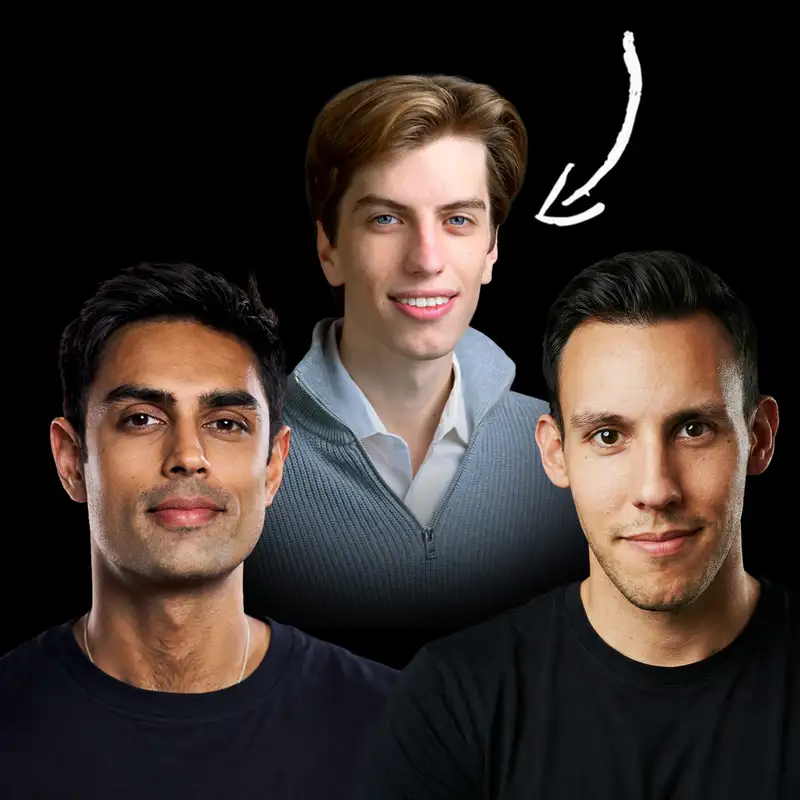
Inside The Portfolio Of The 24 Year-Old Who Made $4.5B AI Investing
Josh:
So there's this guy named Leopold Aschenbrenner. He's 24 years old and last year
Josh:
when we covered him on one of our old episodes he was only 23.
Josh:
He was managing a billion dollars and he was responsible for investing in new
Josh:
frontier AI ideas and technologies.
Josh:
Today that one billion dollars one year later is worth five and a half billion dollars.
Josh:
This guy who is younger than both of us by a pretty large margin just went on
Josh:
a generational run that made him basically more money than any other fund in the world of AI.
Josh:
And the fact that AI is the hottest market means the competition is stiff.
Josh:
So clearly this guy, Leopold, he's doing something different than everyone else.
Josh:
And what's just happened in the last week is his new 13F filings came out.
Josh:
So we could actually get a look into what he has been trading.
Josh:
So that's what we're going to do here.
Josh:
We're going to go through the filings. We're going to see what this guy has
Josh:
been up to that has yielded him five and a half billion dollars of money to manage now.
Ejaaz:
He did this in 12 months as well. So his fund started at the end of 2024 at a right $255 million.
Ejaaz:
And then within six months, he had outperformed the S&P 500 by eight times,
Ejaaz:
growing it to $2 billion. Right.
Ejaaz:
And then since our last episode, where we spoke about his Q3 fund filings,
Ejaaz:
he's gone up one and a half billion dollars.
Ejaaz:
So he's on a generational run. And like you said, he's like super young.
Ejaaz:
He's done a pretty major pivot, but it's all in accordance to,
Ejaaz:
I guess, his Bible, which is called Situational Awareness.
Ejaaz:
And it's 165 page essay where he basically predicts that we're going to reach
Ejaaz:
AGI by 2027. And in this massive essay, he basically writes a story of how he
Ejaaz:
sees the AI revolution unfolding.
Ejaaz:
And I've got to say, he's pretty much nailed it.
Ejaaz:
He called the GPU infrastructure run, and now he's calling a very important
Ejaaz:
pivot that we're about to get into.
Josh:
Yeah, I think the entire thesis is a pivot from kind of chips to infrastructure.
Josh:
And what we're seeing on screen here, actually, this is very cool.
Josh:
He used Claude to create an artifact that is going to walk us through the entire
Josh:
changelog that happened between last year and this year.
Josh:
Perhaps starting with what he dumped because these positions that he dumped
Josh:
were pretty large and these include names like nvidia where he dumped 300 million
Josh:
dollars input options in one quarter right.
Ejaaz:
Yeah yeah so a lot of these names that you're
Ejaaz:
going to see on the positions that he exited are very popular names that a lot
Ejaaz:
of people are invested in right now so then it begs the question why has he
Ejaaz:
just exited one billion dollars worth of these companies he's dumped nvidia
Ejaaz:
he's dumped broadcom he's dumped tsmc he's dumped micron these are all the big
Ejaaz:
AI infrastructure companies.
Ejaaz:
He actually made money on dumping NVIDIA, by the way.
Ejaaz:
He held a $300 million PUP position, which means that because NVIDIA price went
Ejaaz:
down over the last couple of months, he's likely made money on it.
Ejaaz:
And so it begs the question, why is he doing this?
Ejaaz:
Well, if you read his 165-page essay, he talks about how sometime by the end
Ejaaz:
of 2025 and the start of 2026,
Ejaaz:
He thinks that a lot of the market would have priced in the value of GPUs.
Ejaaz:
And that is coming from companies like NVIDIA and Broadcom, who kind of like
Ejaaz:
create these chips and then stack these chips ready for AI labs like OpenAI
Ejaaz:
and Anthropic to train their models on.
Ejaaz:
And now he moves his focus onto the major constraint that investors haven't
Ejaaz:
really invested in just yet.
Ejaaz:
Energy and infrastructure. The issue that a lot of AI labs face today is one,
Ejaaz:
not only do they have too many GPUs, but two, the energy grid that we have today
Ejaaz:
is built to serve humans and not the massive AI demand that we face today.
Ejaaz:
And that's where his investments are focused on.
Josh:
And I'm getting a kick out of seeing the NVIDIA puts being sold and just like
Josh:
exiting NVIDIA entirely.
Josh:
Because when I talk to my friends, when I talk to average people on Wall Street,
Josh:
when you turn on CNBC, NVIDIA is the company.
Josh:
NVIDIA is the biggest investment. And to see him pivoting away from that, I
Josh:
think is a testament to him just again being ahead of the
Josh:
curve moving to where things are going and not where they
Josh:
have been which in his mind is this infrastructure
Josh:
it's this moving away from the ships into the infreplay and that's probably
Josh:
where we can get into what he added because these are the stocks that you want
Josh:
to pay attention to this is what he currently owns this is what he believes
Josh:
are going to go up and if it's true we should see some pretty hefty returns
Josh:
from these so where do we start with the additions this quarter well.
Ejaaz:
Thanks to our friend Claude, we've got a really neatly illustrated stack of
Ejaaz:
all of his investments bucketed into the AI technology stack.
Ejaaz:
So we've got power generation, real estate and facilities, compute and hosting,
Ejaaz:
connectivity, storage and memory, chips and silicon.
Ejaaz:
Actually, I wanted to just round out the last segment, Josh.
Ejaaz:
I noticed that he made a trade on Intel down here. And what he cleverly did was he sold the equity.
Ejaaz:
So he sold the shares that he has, but he still has a massive long position open.
Ejaaz:
So he's kind of freed up liquidity to shove money in other companies.
Ejaaz:
And the major companies that he's put money into is power generation,
Ejaaz:
particularly this company called Bloom Energy, which until about three months
Ejaaz:
ago, no one had really heard of.
Ejaaz:
But they specifically build power generation turbines that help you generate
Ejaaz:
power to power AI data centers.
Ejaaz:
And he's built a massive position in this to the tune of $855 million.
Ejaaz:
Maybe it says 876 here, but the farting says 855.
Josh:
Bloom Energy being the number one position is different because it has absolutely
Josh:
nothing to do with the chip stack and it accounts for 20% of the entire portfolio.
Josh:
And I was doing some research on what they do and it's actually kind of interesting.
Josh:
They create these like oxide fuel cells which
Josh:
is a fancy way of generating electricity on site
Josh:
from natural gas so a lot of times when natural gas is fed into
Josh:
these data centers it has to go through a turbine which
Josh:
like heats and cools things and it's a very clunky energy creation
Josh:
process what these bloom boxes do is they take
Josh:
that natural gas and have a fuel cell that converts it right on site
Josh:
to usable electricity for the data centers and it's modular
Josh:
it can be deployed quickly and there doesn't
Josh:
seem to be a shortage of it i believe they're set to create two gigawatts of
Josh:
this um just this year so it's an interesting play on power because i was looking
Josh:
for the nvidia of energy like who who is the chip maker but for energy and i
Josh:
don't believe there is one and there's a world in which perhaps bloom could be that person so i.
Ejaaz:
Actually looked into their uh recent finances they're a public company they
Ejaaz:
have a 20 billion dollar demand backlog um their revenue was up like something like 34% in 2025,
Ejaaz:
and they're projecting another 40% increase in 2026, after that 2025 increase.
Ejaaz:
So there's like no shortage of demand.
Ejaaz:
You mentioned fuel oxide cells.
Ejaaz:
The reason why their gas turbines specifically are super attractive,
Ejaaz:
is you don't need to rely on the energy grid for it. So I mentioned earlier,
Ejaaz:
like right now we have an energy grid.
Ejaaz:
There's a lot of constraint being put on there because humans need energy and so do AI data centers.
Ejaaz:
So it tends to drive up the price of energy in the places that those AI data centers are set up.
Ejaaz:
If you use something like Bloom Energy's gas turbines, you don't need to rely
Ejaaz:
on the energy grid at all.
Ejaaz:
You just kind of set it up right next to your AI data center and hey,
Ejaaz:
presto, you now have energy at a cost-efficient price that you can now power
Ejaaz:
to train or inference any of your GPUs and your data centers.
Ejaaz:
So Broadcom and companies like CoreWeave are going to need this.
Ejaaz:
So hyperscalers in general, as well as AI labs. It kind of reminds me of the,
Ejaaz:
I don't know if you played Civilization ever, Josh. I feel like you did.
Ejaaz:
It's kind of like moving infrastructure and power generation sources to your
Ejaaz:
little silo or settlement to kind of grow it. And that's exactly what's happening here.
Josh:
Yeah, and I think like the obvious play is that there is absolutely no shortage of energy.
Josh:
So the question is, who is able to produce the most of it? And they have this
Josh:
tremendously large backlog.
Josh:
But I think the question is, can they actually create enough to start putting
Josh:
a dent into that backlog?
Josh:
The manufacturing becomes the problem here. And with a lot of these plays,
Josh:
we're now moving into the world of atoms.
Josh:
We're now moving into the world where manufacturing actually matters.
Josh:
And I would love to, we'll do another deep dive some other time to see if they're
Josh:
actually capable of manufacturing at scale.
Josh:
But that's the biggest one. That's a 20 percenter. What else?
Josh:
What other positions are noteworthy in this new portfolio?
Ejaaz:
Well, he's added like, I think, $300 million worth of CoreWeave.
Josh:
Can you explain CoreWeave? Why CoreWeave is so important here,
Josh:
please, for the people who aren't familiar?
Ejaaz:
Okay, so if you think about it, if you're an AI lab, you need GPUs.
Ejaaz:
But it's one thing buying the GPUs from a company like NVIDIA,
Ejaaz:
completely different beast, setting up those GPUs in rack servers,
Ejaaz:
getting the electrical supplies, getting the technical engineering and expertise
Ejaaz:
to maintain your GPU servers, the cooling systems, all that kind of stuff. So what you could do
Ejaaz:
is you could outsource it to a company that is known as like a NeoCloud.
Ejaaz:
That's what CoreWeave is.
Ejaaz:
They handle all of that for you. Broadcom kind of does something like this,
Ejaaz:
but CoreWeave was a smaller company that specialized in this,
Ejaaz:
particularly during the GPU gaming era and has now pivoted to AI specifically.
Ejaaz:
Leopold got in or went in hard on CoreWeave. He added $500 million at the end
Ejaaz:
of Q3 in that episode that we covered back then.
Ejaaz:
And he's added another $300 million here. So we're looking at what is potentially
Ejaaz:
an $800 million position in CoreWeave.
Ejaaz:
Now, the story goes a little deeper.
Josh:
And that's 700% increase over the quarter.
Ejaaz:
Literally. But there's another layer to the story where he also owns around
Ejaaz:
10% of a company called Core Scientific, which is CoreWeave's main supplier
Ejaaz:
to setting up energy grids.
Ejaaz:
So if you think about bets made in investing,
Ejaaz:
Leopold's probably made the largest levered bet in core GPU infrastructure in
Ejaaz:
neoclouds like CoreWeave as well as energy supply like blooms these are his
Ejaaz:
two biggest positions that he currently holds in his fund right now
Josh:
And what i find interesting is he's beginning to own enough percentage of these
Josh:
companies to become an activist investor to actually influence the outcome of
Josh:
the companies which i find fascinating and as i'm going through this i'm seeing
Josh:
i mean power generation is a clear one but the most positions that he's added
Josh:
in particular is around 29 yes.
Ejaaz:
Which is exactly
Josh:
It's so fascinating like 10 new positions around real estate in general 800
Josh:
and this gets to i I guess the Bitcoin mining play, because what we're seeing
Josh:
here is a lot of Bitcoin mining companies.
Josh:
And I think this seems bizarre and a little wrong. It's like,
Josh:
okay, well, crypto is not doing super hot. Bitcoin isn't doing well.
Josh:
Why is he buying all of these Bitcoin mining companies? And it's because they
Josh:
own the two critical pieces of infrastructure required for AI buildouts.
Josh:
They have the real estate and they have the power because I mean,
Josh:
what does Bitcoin mining require?
Josh:
A tremendous amount of energy and a lot of space to put those GPU racks.
Josh:
And now that Bitcoin mining is not on its way out, but there are better risk
Josh:
adjusted returns for that real estate,
Josh:
It seems as if he's betting on the idea that these Bitcoin mining companies
Josh:
are going to either sell their rights and their permits or just pivot to AI
Josh:
data centers in general.
Ejaaz:
To be clear, he does not have any interest in mining crypto with these companies.
Ejaaz:
He's buying them for their licenses.
Ejaaz:
They have access to the electrical grid. Usually, these kinds of things take
Ejaaz:
months or years to attain.
Ejaaz:
That's why, although you see all these major announcements from the likes of
Ejaaz:
Meta, Microsoft, and OpenAI saying, hey, we've got $1.4 trillion worth of compute
Ejaaz:
partnerships signed, but you don't see that translated into the models that
Ejaaz:
they're pushing out just yet.
Ejaaz:
That's why GPUs being pushed out are always a generation behind.
Ejaaz:
It's because they don't get access to this permitting.
Ejaaz:
Leopold has sidestepped the entire thing and is buying up these smaller companies
Ejaaz:
that already have access to it.
Ejaaz:
And so he's like gutting them completely of their crypto services and just repurposing
Ejaaz:
them for training AI models specifically and being that provider for them.
Ejaaz:
It's kind of like if you take over a bar that already has a liquor license rather
Ejaaz:
than applying for a liquor license and waiting many years to get it.
Ejaaz:
It's just a hack. It's really useful.
Josh:
One of the things I've admired most, I think, about the thesis that
Josh:
he's had and just kind of watching it play out over the last year is how
Josh:
simple and yet effective it is it's like okay like
Josh:
i understand bitcoin mining and obviously they have permits and
Josh:
obviously they have energy and obviously every ai company wants this why would
Josh:
everyone not be buying these things and i think the simplicity of these ideas
Josh:
is what has kept a lot of people away from investing but over and over it continues
Josh:
to be proven right and there's another um thesis that he had in that early paper
Josh:
that we mentioned that was 165 pages about some timelines particularly around
Josh:
agi which i thought was interesting because this guy seemingly right about everything is.
Ejaaz:
He right about
Josh:
Agi by 2027 are we actually going to
Josh:
get that and in order to answer this prediction we have a polymarket open which
Josh:
is predicting whether open ai announces it has achieved agi before 2027 and
Josh:
i know the odds were against leopold when he raised this fund but like man these
Josh:
odds are at 13 so it seems like a stretch that he's actually going to be,
Josh:
getting AGI in 2027 and maybe the investment thesis is right and the timelines
Josh:
are slightly wrong. I don't know. This seems like kind of insane.
Ejaaz:
Yeah, it's like a it's a it's a small percentage chance. But I have to say he's
Ejaaz:
been he was originally criticized for his essay being too outlandish and inaccurate.
Ejaaz:
A lot of some like 50% of people thought that it would be happening in the next
Ejaaz:
couple of months. A bunch of people said now this is going to happen until 2030.
Ejaaz:
He's the only guy who's had the prediction that has been nailed so far.
Ejaaz:
He called out GPUs before there was a gpu rush now he's calling out energy infrastructure
Ejaaz:
before there's an energy infrastructure rush so i think he's ahead of it here yeah
Josh:
If you believe he's right there is a lot to be made by pressing that yes button
Josh:
on polymarket and thank you polymarket for sponsoring this part of the show.
Ejaaz:
But it's not only long positions um that he has he's also short um a position
Ejaaz:
and it's particularly on one company uh that company is infosys um infosys is
Ejaaz:
basically a company that specializes in IT outsourcing, particularly in India.
Ejaaz:
And their business model is completely based on having cheaper labor than you
Ejaaz:
could get access to in Western countries like America or Europe,
Ejaaz:
or continents like Europe.
Ejaaz:
So the point is, hey, just outsource all your admin IT stuff to us, and we got you.
Ejaaz:
And the bet that I think he's seeing here is he's seen the rise of products
Ejaaz:
like Claude Code and GPT Codex 5.3.
Ejaaz:
And he's realized, wow, these models are actually now good enough to automate
Ejaaz:
not just menial work, but really important IT processes.
Ejaaz:
And he's taken out a massive short on this company.
Ejaaz:
This to me is like one of his more intellectual bets.
Ejaaz:
And it's more kind of current to the trends that we're seeing right now.
Ejaaz:
So it's good to see him basically put his money where his mouth is.
Josh:
It's so fascinating going through this and seeing the kind of PCs play out.
Josh:
I'm going to have to add some personally. I mean, this may cause me to start
Josh:
diversifying a little bit.
Josh:
And maybe, I mean, there has to be some issues with this, right? It's like,
Josh:
going through the bull case, going through the bear case, what is there to criticize
Josh:
and be cautious of when you're getting into a portfolio like this?
Josh:
And I mean, the first thing that comes to mind is that this is a 24 year old
Josh:
and not to just nothing against that because clearly it hasn't worked against
Josh:
him, but I'm not sure he's had, I mean, he certainly hasn't had the experience
Josh:
that a lot of these other investors have.
Josh:
Is that an advantage clearly to some extent, but at
Josh:
what point does that advantage kind of crumble apart
Josh:
if so that seems to be like one of
Josh:
the other the things i'm concerned about the other thing i'm concerned about is
Josh:
that the fund is kind of a single thesis bet where if ai infrastructure and
Josh:
spending plateaus at all or the macro environment turns every position in this
Josh:
portfolio correlates to the downside there's not much hedging against that so
Josh:
there is some potential for holes but nothing previously has signaled that this
Josh:
is going anywhere but up only.
Ejaaz:
Yeah, I mean, if you look at some of the most famous investors of all time,
Ejaaz:
was never about the largest amount of money that they made in a single year or a single quarter.
Ejaaz:
It's always just been about consistent returns year upon year,
Ejaaz:
decade upon decade that has compounded.
Ejaaz:
Leopold has had an amazing start and he's beaten the above, he's above average
Ejaaz:
for any kind of hedge fund based in any sector versus just AI,
Ejaaz:
but he's yet to prove himself on a multi-decade kind of time span. So time will tell.
Ejaaz:
All I will say is for someone who's got fired from OpenAI as an,
Ejaaz:
I believe he was an alignment researcher, but for someone who's had like major insight
Ejaaz:
and had the biggest or boldest prediction as to where AI is going,
Ejaaz:
he's been the only one to kind of nail it so far.
Ejaaz:
So he's gone full conviction into his 165 page thesis, which I presume he put a lot of thought into.
Ejaaz:
And it's paying off for him now. Now, will that change in the future? Maybe.
Ejaaz:
But what you could treat these filings and these investments as is kind of like
Ejaaz:
a real-time tracker of where he sees the constraints in this AI race.
Ejaaz:
And I want to emphasize this point for a second.
Ejaaz:
Originally, his fun thesis was GPUs. People are going to need GPUs and people
Ejaaz:
are underpricing that opportunity.
Ejaaz:
Now he's saying that opportunity is not overpriced, but it's market priced in.
Ejaaz:
And now he sees the constraint pivoting or moving towards energy infrastructure.
Ejaaz:
You've got the likes of Elon Musk that is launching data centers into space.
Ejaaz:
Why? Because there's more energy in the sun.
Ejaaz:
You've got everyone for the likes of Google, Meta, Broadcom,
Ejaaz:
NVIDIA. all of them are kind of investing in data centers or data infrastructure
Ejaaz:
that gets access to these electrical grids.
Ejaaz:
And he's just putting money where that demand is. And I think it's a smart move.
Josh:
Yeah, I was, I read this great post by Naval the other day, I forget exactly what it said.
Josh:
But the idea of it was that basically, software companies who only rely on software
Josh:
are going to have a very difficult time in the future, because it's so easy
Josh:
to actually create and generate custom software.
Josh:
And I think what this pivot is reflective of, not only specifically around um
Josh:
building the architecture but just
Josh:
bets on the physical world and bets on actual manufacturing and bets on factories
Josh:
and bets on energy and infrastructure, things that can't be built using AI,
Josh:
things that actually need,
Josh:
human horsepower, like things that need to be built, things that need permits,
Josh:
things that need legislation.
Josh:
This is like the hard physical energy and infrastructure required.
Josh:
And I think that tracks to kind of where the future is going.
Josh:
Energy is the one thing that no one could get enough of.
Josh:
And I mean, that power generation play, the real estate play,
Josh:
it's all around one thing. It's just powering the future.
Josh:
We saw through the last earnings season, $650 billion committed to CapEx from
Josh:
just a couple of companies like Google, Amazon, Nvidia, or not Nvidia,
Josh:
but whoever else is going to be paying Nvidia.
Josh:
And I think it's a testament to just how much money is going to be thrown at solving this problem.
Josh:
And this portfolio is ready to capture all of that upside.
Ejaaz:
It's really pleasing to see someone make trades at the
Ejaaz:
right time in the right places um he has
Ejaaz:
made some what you would consider risky bets
Ejaaz:
like again not many people have heard about bloom energy unless you're like
Ejaaz:
deeply within the energy infrastructure place but they're kind of like a second
Ejaaz:
maybe considered first tier energy company um but specifically used for their
Ejaaz:
portable energy so like he kind of put these two puzzle pieces together and
Ejaaz:
thought yeah electrical grids aren't going to support this so let me invest in this company.
Ejaaz:
And he just goes in full conviction, right? We're talking about almost like
Ejaaz:
a fifth of his entire portfolio in this one position.
Ejaaz:
So extremely concentrated, high risk, high conviction.
Ejaaz:
But if it does pay off, that's what ends up in these kind of like 4.5 to 5x
Ejaaz:
returns from just a year and a half ago.
Josh:
Man, and we just got to respect it, man. Like 1 billion to five and a half in a year.
Ejaaz:
No, I'm not salty at all, Josh. I'm not salty at all that I'm older than him.
Josh:
I will say my portfolio has not done as well as his. So perhaps we should be
Josh:
taking our own advice and start copy trading because like clearly this guy is
Josh:
seeing something with the clarity that we are lacking or at least the conviction
Josh:
that we have not been able to place in our actual trades.
Josh:
But that is the update on Leopold's portfolio.
Josh:
I mean, it's an amazing feat that he's managed to do and it seems directionally
Josh:
correct again like this new pivot to hardware to infrastructure to energy um
Josh:
super bullish i'm not sure there's really any other things to be said other
Josh:
than if you agree with the portfolio,
Josh:
I mean, not financial advice. This is just this dude's portfolio,
Josh:
but it seems like it is promising and it is poised to do very well this year.
Josh:
And yeah, that's the update on Leopold.
Ejaaz:
Yeah, I'm curious what our listeners think. You guys have been extremely active
Ejaaz:
in comment sections on platforms like Spotify, Apple, as well as YouTube.
Ejaaz:
Please keep the comments incoming.
Ejaaz:
I'm curious whether you think our investment analysis here is professional grade,
Ejaaz:
Leopold Aschenenbrenner grade, or if you think we're completely incorrect and we're
Ejaaz:
missing an obvious story. No, you know what I want?
Josh:
I want their number one top stock pick of the year.
Ejaaz:
Yes, actually, yeah.
Josh:
Like, Leopold's throwing it down on Bloom Energy. I want to know what is your Bloom Energy?
Josh:
Like, what's the thing that we're missing that we need to know about that is
Josh:
going to 5X again this year? Yeah, that's how.
Ejaaz:
Help Josh and I, like, make better portfolio returns in this 24-year-old kid. I would love that.
Josh:
Yes, please. We're scrolling through the comments. Everyone wins if you pick
Josh:
a winner. So pick a winner, drop it in the comments, share it with your friends,
Josh:
along with this episode.
Josh:
Subscribe to our Substack newsletter, which is coming out again, I think,
Josh:
the day you're listening to this um ejaz is writing the piece for this week
Josh:
it's very cool every friday we release a newsletter updating everything that
Josh:
happened this week and we are now doing a little more episodes possibly four
Josh:
episodes per week now so we're going to keep this train going thank you so much
Josh:
for your support thank you so much always for sharing for giving us five star
Josh:
ratings and yeah we'll see you guys in the next episode.
Ejaaz:
See you guys
Creators and Guests