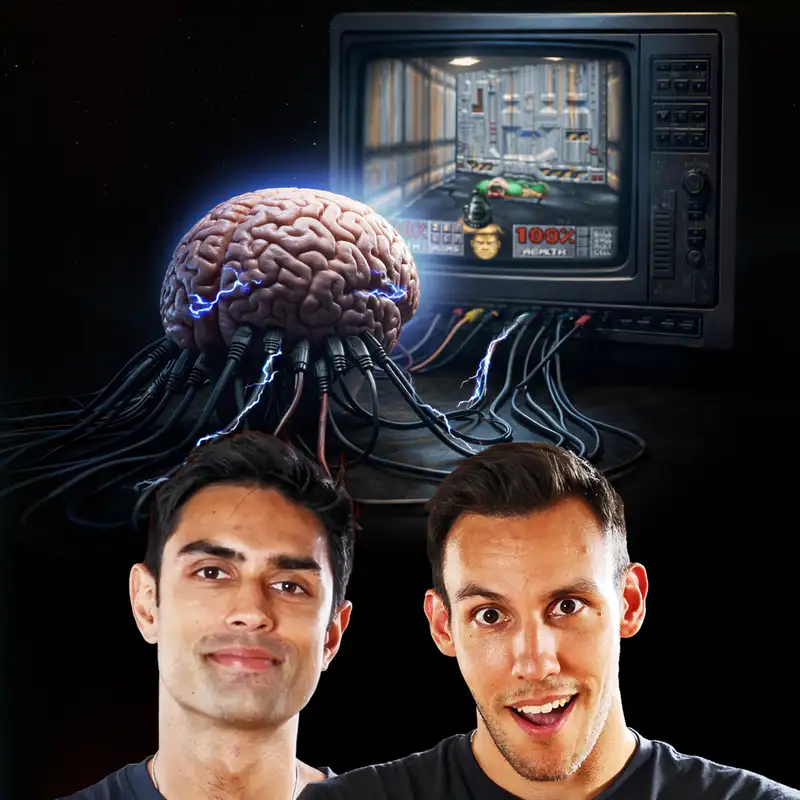
Human Brain Cells in a Petri Dish Just Played DOOM (This Is Real)
Ejaaz:
The entire AI industry is in a massive race to build silicon-based GPUs.
Ejaaz:
We've burned billions of dollars building the biggest data centers,
Ejaaz:
getting as much compute as we can.
Ejaaz:
But what if the best AI hardware already exists?
Ejaaz:
What if that best AI hardware is human flesh, human cells, animal cells that
Ejaaz:
we can train to emulate AI models?
Ejaaz:
This week, two stories broke that sound very much like science fiction,
Ejaaz:
but is actually very much real.
Ejaaz:
In Australia, they fused 200,000 human cells onto an AI chip and taught it how
Ejaaz:
to play the computer game Doom. And it's actually pretty good at it.
Ejaaz:
In another story, they uploaded the entire brain of a fruit fly into a single
Ejaaz:
laptop and had it navigate around a simulated world.
Ejaaz:
The craziest part is it was 91% accurate in terms of flying and moving about.
Ejaaz:
So we're reaching this point where AI is converging with biology and something
Ejaaz:
known as AI wetware. And it might be the next biggest thing.
Josh:
It is a good time to be a fan of sci-fi because everything that you've read
Josh:
in those books, it's actually starting to become true in reality.
Josh:
I famously, I loved watching Black Mirror, the like kind of sci-fi dystopian future.
Josh:
At early days, it was very much ahead of its time, but it feels as if we have
Josh:
very quickly caught up and perhaps even exceeded the kind of crazy,
Josh:
scary stories that are in Black Mirror, starting with this revelation that we've
Josh:
had, this new breakthrough through this company called Cortical Labs,
Josh:
who, like you mentioned briefly,
Josh:
they trained human brain cells to play the game of doom.
Josh:
Better than the average person can like pretty well it
Josh:
actually works it's this really unbelievable story and i guess before we get
Josh:
into what they did today i want to go through the brief history of
Josh:
this company named cortical labs because they've been trying to figure out
Josh:
this biological human computer for a while and in 2021 five years ago um they
Josh:
debuted this thing called dish brain which was this early computer it used about
Josh:
800 000 human nerve cells so it wasn't brain cells this was nerve cells and
Josh:
it was capable of interpreting direct electrical activity so when you stimulated
Josh:
these nerve cells, they would light up.
Josh:
And they had this kind of pseudo computer, didn't actually do anything,
Josh:
but they were able to put input in and get something out.
Josh:
And then the next year in 2022, they made headlines again, teaching these mini
Josh:
brains of 800,000 to 1 million human brain cells that were in a Petri dish that
Josh:
learned how to play Pong.
Josh:
So four years ago, these brain cells were playing Pong, but today they're actually playing Doom.
Josh:
I mean, this is just insane. They trained human brain cells to play a video game in a Petri How
Ejaaz:
They did this was crazy. So you mentioned that they were human brain cells,
Ejaaz:
but they didn't extract these from people's brains.
Ejaaz:
They actually took skin cells or blood cells from some human donors,
Ejaaz:
They then converted them into stem cells, which is like the god cell,
Ejaaz:
if it were, where you can change it into any type of cell, a heart cell,
Ejaaz:
an immune cell, or whatever it might be.
Ejaaz:
They turned it into brain cells from there and then fused 200,000 of them or
Ejaaz:
cultured 200,000 of them on something known as a microarray chip,
Ejaaz:
which is a type of AI-based chip.
Ejaaz:
They grew it on these chips and then they plugged it into or they wired it into
Ejaaz:
the Doom game and taught it over the course of a week how to play Doom.
Ejaaz:
So it would prompt it with certain signals, it would pick up what it needed
Ejaaz:
to do to initiate a particular action, and it would train itself to do it.
Ejaaz:
Now, two important things that I want to point out here is typically when you're
Ejaaz:
training an AI model to simulate human intelligence, it takes so much data and
Ejaaz:
so much money and so much time.
Ejaaz:
With the human cells, they noticed that one, it took so much less energy,
Ejaaz:
It barely required any energy to actually do this thing.
Ejaaz:
It actually did it on a single tiny machine that cost around $35,000.
Ejaaz:
And it did so in a week, which is much quicker, which leads me to the third point here.
Ejaaz:
The human cells instinctively picked it up.
Ejaaz:
It's like they had the training knowledge already baked into the DNA of the
Ejaaz:
human cells itself. And that's like super cool.
Josh:
Yeah, I think one of the most noteworthy things here is that energy thing.
Josh:
And we're probably going to get more into this, but like a general GPU rack
Josh:
uses, what, like 700 megawatts or something, a GPU.
Josh:
The brain does all this on 20. a small crazy
Josh:
minor fraction of what's actually being run on these gpus
Josh:
it's incredibly efficient and it's also a
Josh:
testament to how things how we learn how things are trained
Josh:
so with humans we're very reactionary we learn through feedback from the environment
Josh:
with no preloaded data there's no gradient descent no training runs it's just
Josh:
actual biology it's baked in over our evolution llms on the other hand they
Josh:
learn by processing tons of text data and then adjusting their parameters through
Josh:
a process called back propagation so they're very deterministic They're silicon-based.
Josh:
They are inefficient relative to brains, and they don't capture a lot of the
Josh:
evolutionary, I guess, improvements that we have over time.
Josh:
What this computer does is it's the same way that humans do.
Josh:
It learns by being reactionary. It understands that when it makes the right
Josh:
decision, a specific set of neural pathways light up, and it tries to make that
Josh:
right decision over and over and over again.
Josh:
And doing it with human brain cells, man, it's so weird. It's so sci-fi.
Ejaaz:
Well, just to give the Dura comparison, we're talking about 200,000 human brain
Ejaaz:
cells in this experiment.
Ejaaz:
The entire brain has 86 billion neurons. And it runs a billion, right?
Ejaaz:
So like we're talking massive, massive amounts more.
Ejaaz:
And it runs on 20 Watts of power. So it's incredibly efficient.
Ejaaz:
And what this tells me is,
Ejaaz:
I think we've been building AI models slightly incorrectly.
Ejaaz:
I say slightly incorrectly as maybe a massive understatement.
Ejaaz:
The point is, we've put in so much time, energy, and money into assuming that
Ejaaz:
the best way to build intelligence or artificial intelligence is to slap it
Ejaaz:
on a silicon chip, you know, sand and glass, basically.
Ejaaz:
But maybe the best way to do it is just to pick up the best natural organic
Ejaaz:
intelligence model that has been trained over millions and millions of years, which is,
Ejaaz:
the organic human brain or the animal brain and kind
Ejaaz:
of like use those cells to mimic what intelligence
Ejaaz:
is that we're trying to build in for different software so
Ejaaz:
that's one big takeaway the other thing is like maybe we just need
Ejaaz:
so much less energy than we expected to build artificial intelligence and if
Ejaaz:
something like this doom experiment can scale to the size of something like
Ejaaz:
a human brain then i don't really understand what the moat is for all these
Ejaaz:
ai labs that are spending hundreds
Ejaaz:
of billions of dollars to train their artificial intelligence models.
Ejaaz:
Then the final thing, which is what you mentioned, is just the fact that it needs no training.
Ejaaz:
It's so instinctive. It's almost like the human brain is the best AI training
Ejaaz:
run that has ever occurred. It really is.
Josh:
And I guess I would bucket this probably in the same place that I bucket like
Josh:
a company like Ilias at Skever, Safe Super Intelligence, where he is one of
Josh:
the famous AI researchers. He left, he started his own company.
Josh:
And the sole purpose of the company is to discover novel breakthroughs that
Josh:
rapidly accelerate through this curve.
Josh:
So when you think of the AI curve that we're going through right now,
Josh:
there is a not so predictable, but a very clear exponential curve.
Josh:
And the goal of some company like Ilias or perhaps a company like this that
Josh:
we're covering right now is that there are actual improvements that are novel
Josh:
that result in these 10x accelerations of this natural curve.
Josh:
So biological computing is one of them.
Josh:
If we can actually figure out how to crack this at scale, if we can get closer
Josh:
to those 86 billion neurons, I mean, when you think about the human brain,
Josh:
we use what a very small percentage of our brain relative to what exists.
Josh:
A computer doesn't have that limitation. So even if we get a small fraction
Josh:
of what's available for the human brain, I mean, you can see this get pretty wild pretty quickly.
Josh:
Again, this is sci-fi. It's not in production. This is small scale testing.
Josh:
I kind of put quantum computing in a similar pipeline where it is this crazy,
Josh:
weird, pseudo magical compute platform that has the ability to revolutionize everything around us.
Josh:
It's just a little early. But what we can guarantee is that the rate of acceleration for AI...
Josh:
Is upstream of all of these things coming much faster. Because the AI can help
Josh:
us engineer and process this and accelerate the timelines of what previously
Josh:
would have been perhaps decades down to compressing it down to a few years.
Ejaaz:
Josh, can I ask you a question? What do you got? Doesn't this feel kind of toppy?
Ejaaz:
This feels like we're topping on the market. Like the AI bubble bursting now
Ejaaz:
kind of makes a little more sense to me.
Josh:
Yeah, I guess the question is, like, is this a real threat? Because clearly,
Josh:
it's much more energy efficient.
Josh:
Clearly, the energy efficiency is the biggest threshold. We just don't have
Josh:
enough energy to power these chips.
Josh:
We just had the conversation about Leopold last week, who is fully pivoting
Josh:
from chips to energy. That is the biggest thing in the world.
Josh:
But it doesn't seem like the market thinks this is a problem.
Josh:
They're not really pricing this in.
Josh:
We have the Polymarket, and this
Josh:
market in particular is about when the AI bubble is going to burst by.
Josh:
The end of March, March 31st, the percentage is 3%. The bubble will not be popping
Josh:
by the end of this month. We still have some runway left.
Josh:
December 31st, 2026, the end of this year, still only a 20% chance on over $2
Josh:
million of volume on this market.
Josh:
So the market is signaling they don't care too much. Now there is something
Josh:
interesting here in that that number has crept up recently.
Josh:
This number was not always 19%. It has crept up to 19%. So a slightly higher
Josh:
than normal probability, but all signs point to the fact that the market doesn't
Josh:
really care about this. It's cool.
Josh:
It's sci-fi, but it's going to remain in that sci-fi bucket.
Josh:
They're not actually going to crack this.
Josh:
We still need millions of VPUs and tons of gigawatts power in these data centers for now, at least.
Josh:
And thank you to Polymarket for supporting this episode.
Ejaaz:
Yeah, for now, Silicon keeps winning. But there's another crazy story that we
Ejaaz:
have to cover. Number two.
Josh:
Okay, yeah, this one is awesome. Let's unpack it.
Ejaaz:
This is insane. So I want to lead with the opening sentence of this post.
Ejaaz:
There's a fruit fly walking around right now that was never born.
Ejaaz:
And she goes on to talk about how a team in San Francisco uploaded an entire
Ejaaz:
brain map of a real organic fruit fly into a laptop and got it to simulate its
Ejaaz:
own life to a 91% accuracy.
Ejaaz:
We're talking about it learned how to move, fly, and navigate an entire world
Ejaaz:
by itself. So it's as if the fly exists and is real, but it's completely simulated.
Josh:
Think of the brain like a city right like before you can
Josh:
simulate traffic you need to map every single road every intersection every
Josh:
one-way street it's kind of like what self-driving cars are trying to do but what
Josh:
scientists did is they spent nearly a decade rebuilding that map for a fruit
Josh:
fly so what they do is they slice the brain into very small pieces they encase
Josh:
it in this resin and they scan each slice of the brain until they have this
Josh:
representation of what the brain looks like throughout every single layer of
Josh:
it and they actually accomplished this in 2024.
Josh:
So we had a brain copied on a laptop two years ago.
Josh:
And this was done by assembling the 7,000 smallest slices of a brain.
Josh:
What is new here is they actually took that brain and they placed it into a
Josh:
digital representation of a fly and let it live its life as if it was a fly.
Josh:
So they sacrificed a real fly, sliced the brain into pieces,
Josh:
trained the computer, or not even trained the computer, but diagnosed what was
Josh:
in every single layer to rebuild the digital version of the brain.
Josh:
And now this digital fly is actually walking around in a 3D game engine in a
Josh:
computer without any training at all, just by using the digital clone of its brain.
Josh:
And that is the part that's absolutely insane to me. Like there is a real fly
Josh:
brain currently walking around a digital environment. Like that is crazy.
Ejaaz:
This, not to add a pun here, but like completely messes with my own mind,
Ejaaz:
because we just spoke about a story of putting intelligence into human organic
Ejaaz:
life forms, human cells.
Ejaaz:
And now we're talking about taking real organic life form intelligence and putting
Ejaaz:
it into an artificial form into a laptop and trapping it inside there, right?
Ejaaz:
So this kind of opens up so many questions for me, like, number one,
Ejaaz:
why did it not require any kind of training at all?
Ejaaz:
And it's what we were discussing earlier, which is, I think a lot of the ways
Ejaaz:
that human life forms are built using genetic material, phenotypes,
Ejaaz:
genotypes, engineer it to be able to react to the world in a very different
Ejaaz:
way. Andre Carpathy talks about this a lot.
Ejaaz:
He says that AI models can't really mimic human evolution very well.
Ejaaz:
Only organic life has been successfully able to mimic that and have consciousness.
Ejaaz:
So this is one example of that happening.
Ejaaz:
Now, a direct comparison with
Ejaaz:
the human cells playing Doom, we had 200,000 neurons being used there.
Ejaaz:
This one required 140,000 neurons to recreate the entire organism itself,
Ejaaz:
which is just super cool.
Ejaaz:
And then the third point that's interesting here that I want to put out here,
Ejaaz:
you mentioned it just now, Josh, this wasn't like a single team doing this.
Ejaaz:
They pulled already available data of this entire genome.
Ejaaz:
So it's kind of like this weird world that we live in, where we could just knock
Ejaaz:
on the door of like the National Archives, which have collected genome data
Ejaaz:
for not just fruit flies, but a bunch of other animals.
Ejaaz:
Copy, paste that into a computational AI model, and then just upload it to a
Ejaaz:
laptop and see what it does in a simulated environment.
Ejaaz:
Like, I want to see this happen with more organisms. I'm like,
Ejaaz:
what does a tiger do if we take the entire mapped brain of a tiger and upload
Ejaaz:
it to a computer? Does it do the same thing? Is it different? It's just super cool.
Josh:
It's amazing to see too. There's a video towards the bottom of this post,
Josh:
I believe, which actually shows what that looks like as the neurons are firing off.
Josh:
And you could see very clearly that this is an emergent behavior.
Josh:
Like this wasn't taught, this fly wasn't taught how to walk.
Josh:
It didn't use any gradient descent. It didn't use any technology that we're using for current LLMs.
Josh:
And yet it is walking around this 3D space as if it was a fly.
Josh:
And you could see all the neurons firing off at once. And it's this unbelievable,
Josh:
I guess, early prototype of what this could look like at scale, right?
Josh:
Like you mentioned that total neuron count, a fly brain has,
Josh:
I think 140,000, a mouse brain has 70 million, a human brain has 86 billion.
Josh:
So assuming that we're able to follow this natural progression of copying more
Josh:
and more, you have to assume eventually we're going to get some pretty powerful
Josh:
brains inside of a computer.
Josh:
And there is nothing that isn't like dystopian, crazy sci-fi about this.
Josh:
Anyway, you think about it where now we sacrificed one brain and you have a
Josh:
complete and total digital clone of the other and it begs a lot of questions
Josh:
of what actually makes up a person a mammal an insect a living thing if you
Josh:
can just kind of copy it and clone it inside of this machine and it's really unbelievably
Josh:
Bizarre story and i guess maybe we can get into why this is really the world's
Josh:
best training run right it's like yeah as we start to emulate these human brain
Josh:
cells as we emulate a fly's brain
Josh:
these materials, these brains have been benefits of evolution over billions of years.
Josh:
And I think, oh my God, Luke producer before the show, he mentioned there's
Josh:
been one septillion fruit flies in existence, which is so many training runs over and over and over.
Josh:
And through the process of natural selection over this septillion,
Josh:
that's 10 to the 24 fruit flies, they've just evolved and they've improved.
Josh:
And what you're noticing is you drop this brain into the space and it knows
Josh:
how to act. It knows how to walk. You don't have to teach it.
Josh:
And that is something that is an emergent property of AI, but seemingly baked
Josh:
into this biological process. It's so cool.
Ejaaz:
It's like the genetic wiring is the intelligence in itself.
Ejaaz:
Like however long humans have existed over hundreds of millions of years,
Ejaaz:
that is the equivalent of the best AI training run ever, right?
Ejaaz:
So we're sitting here trying to emulate intelligence by building out these models
Ejaaz:
with different weights, tweaking parameters. Oh, we've got a trillion parameter thing.
Ejaaz:
What if we just copy pasted the brain? That's what both of these stories have
Ejaaz:
taught me, at least, it's like we could just maybe copy and mimic intelligence
Ejaaz:
from organic matter itself and have that inform how we build artificial intelligence completely.
Ejaaz:
The other kind of weird sci-fi thing here, Josh, where my mind jumped to at least is,
Ejaaz:
if you could upload an entire animal's brain and maybe eventually a human brain,
Ejaaz:
you could do that to modify and up-level humans massively.
Ejaaz:
Like, let's say you wanted to learn how to play the violin to expert grade level.
Ejaaz:
Oh yeah, just upload your brain. We'll run it on a training cycle for about
Ejaaz:
five days because it's your human brain. It actually learns way,
Ejaaz:
way quicker than silicon.
Ejaaz:
And then we'll just download it back in your brain and there you go.
Ejaaz:
So the ultimate form factor that this ends up being, in my opinion,
Ejaaz:
is the brain-computer interface. And we've said this a number of times on our show.
Ejaaz:
We do think that AI's ultimate form isn't going to be a physical manifestation
Ejaaz:
in robotics, or it's not just going to be a digital manifestation in LLMs.
Ejaaz:
It's going to be something of a hybrid between the greatest,
Ejaaz:
most intelligent organisms, which are the humans, with the artificial compatible
Ejaaz:
version, which is the LLMs, fuse them in a chip.
Ejaaz:
I guess, bullish Neuralink from this.
Josh:
Yeah, it seems like, I mean, this is the natural progression,
Josh:
right? Everyone jokes about the singularity, but we slowly are emerging.
Josh:
And it seems like the extended version of this, like if you kind of take this
Josh:
to the limit, is this convergence of this humanoid tissue and then this digital
Josh:
form of intelligence. It's a really weird place.
Josh:
I guess there are some things that are noteworthy that we probably should mention.
Josh:
And the fact that this is not very good, and this is still very early.
Josh:
So in the case of Doom, this little clump of brain cells, it's contained in
Josh:
this little device that costs $34,000 that needs to be climate controlled.
Josh:
The cells only last six months.
Josh:
It's important to note these cells don't have pain receptors.
Josh:
There's nothing really human about them outside of them being human-derived cells.
Josh:
And the actual output of this gameplay was slightly better than GPT-4,
Josh:
which is noteworthy, but still pretty bad.
Josh:
It's not actually good at the game. So this is very much a proof of concept.
Josh:
This is not a real deployable...
Josh:
A means to solving intelligence issues. And I think that's why when you see
Josh:
that bubble indicated from Polymarket, it's not really indicative of any real
Josh:
impact, but this is early signs of what the future looks like.
Josh:
And that's what I love to cover, right? Is we're just, we're peeking around
Josh:
the corner of what is possible, what is likely to come.
Josh:
The timeline in which it comes, I don't know, but it is sci-fi as hell and it's
Josh:
really fun to speculate on and just fun to cover. I'd love to observe these things.
Ejaaz:
I don't know if I agree with your take on the consciousness side of things.
Ejaaz:
And Dario might have my back on this one. I don't know if you saw this,
Ejaaz:
but he went on an interview with the New York Times, I think, last week.
Ejaaz:
And he said that verbatim, we can't rule out or I can't rule out whether Claude is conscious or not.
Ejaaz:
And he goes on to describe that Claude actually emulates feelings of anxiety
Ejaaz:
before it answers people's prompts, indicating that it kind of feels some type of way.
Ejaaz:
Now, there's two camps of thought around this. Number one is it's not really
Ejaaz:
human consciousness. It's just emulating what the data it was trained on told
Ejaaz:
it to say and think and do.
Ejaaz:
That is one case. But then when I look at like these experiments of uploading
Ejaaz:
a fruit fly's brain or using human cells to play Doom, the takeaway here is
Ejaaz:
that it's kind of baked in genetically.
Ejaaz:
So how do you define what consciousness is? And maybe we already have created
Ejaaz:
artificial consciousness, but we just haven't recognized it.
Ejaaz:
So we'll haven't justified it. So like AI labs, like OpenAI and Google have
Ejaaz:
been known to tell the LLM when they're training it to deny all thoughts of consciousness.
Ejaaz:
Anthropic is the only one that's kind of like entertaining. I think they have
Ejaaz:
like an entire welfare team now that is looking after the model and making sure
Ejaaz:
that it's OK and that it's getting what it needs to. So treating it very much like a human.
Ejaaz:
And that's we're talking about like one of the most expensive AI labs and companies,
Ejaaz:
private companies in the world right now.
Josh:
It's so sci-fi. It's also sci-fi. And I think we're going to have to have another
Josh:
discussion on this consciousness topic. like in the same way that it needs to
Josh:
happen around AGI, where people are throwing out a lot of terms now without
Josh:
a clear definition of what they mean by them.
Josh:
And I think it's very subjective when he says these things. And it's very subjective
Josh:
as we kind of navigate and discuss what does AGI look like? What does consciousness
Josh:
look like? Where is that line that you draw?
Josh:
There's going to need to be a lot of conversations about that. But
Josh:
I would love for everyone to converse in the comment section and let us know
Josh:
what you think of this absolute crazy chaos of a week that we had with,
Josh:
I mean, again, this is like straight out of a Black Mirror episode.
Josh:
So if you did enjoy, if you do have takes, we'd love to hear them in the comment
Josh:
section down below. If you enjoyed this episode, share it with a friend.
Josh:
Last week, this is nowhere, we had our biggest week ever in the history of Limitless. Thank you guys.
Josh:
And it was thanks to all of you guys sharing and subscribing and rating five
Josh:
stars and even engaging on X.
Josh:
We have gotten 50 million impressions on x over the last couple of weeks the
Josh:
people are paying attention they are watching we're starting to create the news
Josh:
and it's thanks to people like you who are watching and listening sharing this
Josh:
with your friends so thank you for joining i mean any final parting thoughts before we wrap up here
Ejaaz:
Well yeah um just want to re-emphasize 50 million impressions
Ejaaz:
go give josh and i a follow obviously we're saying something
Ejaaz:
useful here or we hope we are and we're breaking the news as and when
Ejaaz:
it happens um yeah so so please go give it
Ejaaz:
a go and then the other thing random for all you folks
Ejaaz:
who are still listening to this episode did any of
Ejaaz:
you find that claude was acting a little weird over
Ejaaz:
the weekend i don't know what your experience was josh
Ejaaz:
but when i was talking to claude like it seemed completely
Ejaaz:
different from the claude i was talking to on friday and my suspicion is anthropic
Ejaaz:
is kind of throttling the intelligence i don't know why maybe there's just too
Ejaaz:
much demand since they went to number one in the app store but it wasn't really
Ejaaz:
looking good i know a lot of people who switched back to chadgbt after that happened yeah.
Josh:
Brief conspiracy corner so
Josh:
I think I feel pretty highly that based on benchmarks and things that I've seen
Josh:
and just personally using it, the model has degraded slightly.
Josh:
And the reason is because as Claude got as big as it did, they didn't get more
Josh:
compute power to serve all of these new users.
Josh:
So they have to throttle it in some way. And the way they throttle is by limiting
Josh:
the upper bound of what reasoning capabilities it has.
Josh:
So generally Claude will reason much more. It'll ask itself questions.
Josh:
It'll compare. It'll do broader research.
Josh:
I think that scope has been compressed a little bit recently because they need
Josh:
to make more compute room for um the rest of the people that just joined i mean
Josh:
anthropic had a huge week they have a lot of server problems the service went
Josh:
down a few times last week like they have just been having a really tough time
Josh:
keeping up so i mean they've been
Ejaaz:
Signing up they've been signing up 1 million new users per day let me rephrase
Ejaaz:
that per day um and i was doing a bit of digging and boris cherny the creator
Ejaaz:
of called code basically said that they had defaulted every single person's
Ejaaz:
called profile to medium efficiency or medium power.
Ejaaz:
And he said, you know, you could upgrade that to high if you want.
Ejaaz:
But the point is, I think they're struggling from compute, as you said,
Ejaaz:
and they're trying to figure out a way to scale it up.
Ejaaz:
Amazon needs to come in and give them some more AWS access or something because
Ejaaz:
they don't really have the advantage. They need more GPUs. They need more GPUs.
Ejaaz:
Yeah. What's the roundup of this episode? NVIDIA still wins.
Ejaaz:
Silicon-based intelligence is still the frontier and Jensen's going to make a lot more money.
Josh:
Well there you have it if you've noticed please share thank you for making it
Josh:
to the end as always and yeah we'll see you guys in the next episode
Creators and Guests