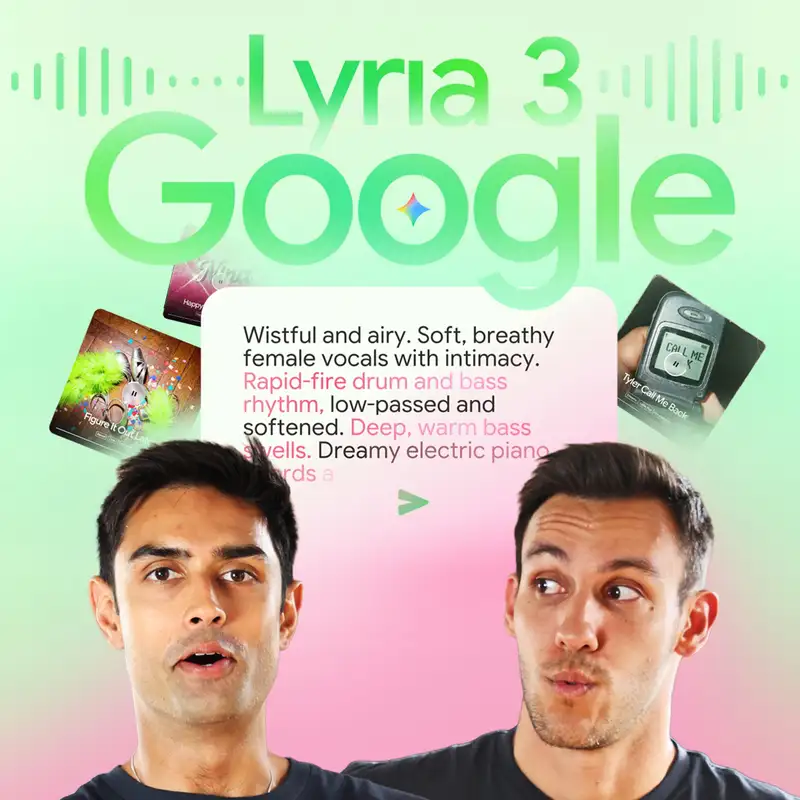
Google's Lyria 3: The Music AI that Changes Everything
Josh:
Just in the last week, Google unveiled some pretty unbelievable new AI software.
Josh:
One of my favorites being this new thing called Lyria 3.
Josh:
So on screen here, I have a music generator that I actually am going to prompt to make a song for us.
Josh:
So what I've loaded up here is make me a 2010s Kanye style stadium anthem about
Josh:
the Limitless podcast hosted by us.
Josh:
And what I kind of want to do is, is have it do this in real time while we discuss
Josh:
the product while we discuss the software.
Josh:
So Lyrae 3, what you noticed on screen there, which was super cool,
Josh:
is you choose the genre you want, you feed a prompt to the model,
Josh:
and after you fed the prompt to the model, it will go and generate you lyrics, the full production,
Josh:
and a full 30-second song about whatever it is you want.
Ejaaz:
Yeah, I saw a hilarious example of a lady asking her husband to do the dishes,
Ejaaz:
but instead she wrote it as a message and created a song and sent it to Dan,
Ejaaz:
her husband and it played just like hilarious music all jokes aside i think
Ejaaz:
this is more than just a gimmick or a novel you're about to see the quality
Ejaaz:
of this thing through the jingle it's just generated but this could replace
Ejaaz:
a music series entirely at least for for 30 second excerpts for tiktok or whatever that might be are
Josh:
You ready to listen to it we have our output ready.
Ejaaz:
Let's go
Josh:
Whoa, even an outro too. Wow, okay, that's pretty good.
Ejaaz:
Just to be clear, that was generated in about under two minutes.
Josh:
I'd say less than one, fast. And the production is good. Like the lyrics sound good.
Josh:
It's like a proper rap song. And I think that's one of the novel breakthroughs
Josh:
with this technology is that a lot of these tools that Google in particular
Josh:
has been releasing recently are really enabling creators to have this powerhouse
Josh:
suite of tools that let you do things like create music.
Josh:
If we want to have an intro song, we can actually use that or you can kind of
Josh:
workshop it and change a few of the lyrics and change the style.
Josh:
But I think what's really fun is that you can actually choose the types of songs
Josh:
that you want to create and you can embed them into whatever content you're making.
Josh:
So there's a second feature to Lyria 3, which is around generating photos or
Josh:
generating songs through photos.
Josh:
So what I have here is a photo of cold and snowy New York. We just got a blizzard
Josh:
last night, and I'm going to say, generate me a song that reflects the mood
Josh:
in this very snowy picture.
Josh:
And yeah, I mean, we were under a blizzard warning lockdown last night.
Josh:
Things are really bad here in New York, and maybe it will.
Josh:
Yeah, well, that's right. EJ's went to Florida, but maybe what we can do here
Josh:
is kind of synthesize that feeling through music. So we'll see what it does.
Ejaaz:
This is something that Google is really well known for, which is multimodality when it comes to AI.
Ejaaz:
It's not just a great LLM or chatbot.
Ejaaz:
It understands visuals such as videos and images. It understands sounds.
Ejaaz:
Remember, this isn't the only, I guess, sound model that they've created before.
Ejaaz:
They've had live translation with their AI that translates any kind of,
Ejaaz:
I think, 40 plus languages into whatever language that you want.
Ejaaz:
They've had experience in this. And the fact that their models now have this
Ejaaz:
intuition and this judgment, this capability to be able to see a snowy day and
Ejaaz:
say, hmm, maybe I'll generate a vibey song for that is pretty impressive.
Ejaaz:
It looks like we have it already. Wow, that was under 30 seconds.
Josh:
Yeah, you ready to give it a listen?
Ejaaz:
Yeah, play it.
Ejaaz:
Are your spirits lifted?
Josh:
Sonically, it sounds nice. I feel like I'm listening to a like kind of knockoff
Josh:
Demi Lovato, like main character energy type thing. And I like it.
Josh:
And to your point, I think this is something unique to Google in the sense that
Josh:
because they have these world models, they have that understanding of what they're
Josh:
seeing in a way that I think is more intuitive than a standard language,
Josh:
text-based language model would do.
Josh:
And another interesting thing that I learned while kind of
Josh:
playing around with this is they have this tool called synth id and
Josh:
what it is is it's a digital watermarking service that's baked
Josh:
into these files that we're listening to so that
Josh:
if you have an algorithm that can detect it it can actually know with high levels
Josh:
of certainty that ai was used to generate the music which is good for copyright
Josh:
and for kind of trademark issues and the way it works is it injects this unhearable
Josh:
waveform within the music that we just heard that we can't detect as human beings
Josh:
but should you feed it to an AI,
Josh:
it'll be very easy for it to decrypt that and let you know that this was AI generated.
Josh:
So pretty cool stuff. I really enjoyed Lyria 3. And I think a lot of people
Josh:
would have fun playing with this. It's free to use, available in Gemini.
Josh:
And yeah, super fun for people who,
Josh:
wanted to be producers or just want to send their friends a funny birthday song.
Ejaaz:
Well listen my take on this is that it's actually
Ejaaz:
i'm going to go back on what i said earlier it's probably not going to take over music labels
Ejaaz:
anytime soon but for like v1 or v3 you can imagine what this probably looks
Ejaaz:
like in about six months time and if it's taken if it improves at any of the
Ejaaz:
rate that any of the llms have like this is going to be a pretty insane thing
Ejaaz:
to do um on the synth id thing josh the reason why i was wondering why when
Ejaaz:
you were explaining it why it sounds familiar to me
Ejaaz:
they do this with AI images as well where they kind of like mix up a few certain
Ejaaz:
pixels in an image that is generated to tell you that this is AI generated.
Ejaaz:
They do this with text as well where they subtly kind of like change certain
Ejaaz:
word choices to do the same thing.
Ejaaz:
My question to you is or rather to both of us is can you create models now that just don't do that?
Ejaaz:
Like this is a baked in watermark that Google kind of put up,
Ejaaz:
right? But presumably you could create a model that just
Ejaaz:
I guess, illegally copyrights a bunch of this stuff?
Josh:
Well, my assumption is that if you can detect it, then you can reverse what
Josh:
it's detecting by using the same tool.
Josh:
So like if an AI can be aware of the trademark, it can probably reverse engineer
Josh:
those few pixels or that waveform that exists and remove it entirely.
Josh:
So I suspect it probably goes both ways, but it is nice to know and nice to have.
Josh:
And I think it's funny because we are following this trend of,
Josh:
again, reverse CAPTCHAs, where we're building things for AIs to recognize and
Josh:
not humans to recognize and this is another step in that direction.
Ejaaz:
Well why i like it as well is um if
Ejaaz:
you are a music creator that's listening to this or even like an artist
Ejaaz:
that creates images you might be thinking well they might be stealing my work
Ejaaz:
and i get nothing for it with watermarks like this it'll be recognizable to
Ejaaz:
your attributes or brands and maybe you end up getting paid out for this something
Ejaaz:
like in some kind of future system that doesn't really exist right now and it
Ejaaz:
definitely beats any kind of archaic royalty system that existed before so So I don't know,
Ejaaz:
I just like the technology. I think it's more than just a watermark. It's pretty cool.
Josh:
Yes, and that is not the only Google Labs cool new thing because there was another
Josh:
really fun creation that they had that they published to the Google Labs team
Josh:
called Pomelli. Do you want to walk us through what this post says?
Ejaaz:
Yeah, so I mean, I hate to say it, but it's true.
Ejaaz:
From a single image of your product, you can now generate several thousand dollar
Ejaaz:
worth photo shoot, which includes people that feature your product,
Ejaaz:
different types of lightings and textures,
Ejaaz:
backgrounds, all in a matter of seconds.
Ejaaz:
And the reason why that's a crazy thing to say is
Ejaaz:
there's a lot of photographers that spend a lot of their time and expertise
Ejaaz:
creating these photo shoots that now are pretty much out of a job.
Ejaaz:
And I'd also take that a further step and say that there are a lot of fashion
Ejaaz:
models that also may not be able to benefit from this as well.
Ejaaz:
But I have to say the feature is so cool. The fact that you can go from a single
Ejaaz:
person sitting at home that's ordered or generated their own product to a full-on
Ejaaz:
advertised kind of website that features these slick different images. It's just so cool to me.
Josh:
Yeah. And we have some examples of this. I mean, one of them I used for the
Josh:
bankless website that we use and posted about it.
Josh:
And it got like a million views because it's really awesome.
Josh:
What it does is, is you feed it a URL. So if you have a personal brand,
Josh:
if you have a website, if you have any sort of content on you,
Josh:
you feed it the URL and then it populates this business DNA sheet where it shows
Josh:
you your logo, the fonts, the colors, your tagline, all the values.
Josh:
And it It extracts this kind of identity that you can then use to create this
Josh:
marketing material with.
Josh:
And another fun example that we generated with the Bankless stuff was a hat.
Josh:
We had a hat in the merch store and it's just this very basic bland hat.
Josh:
But what I did is I fed it through Pomelli and I asked it to do a product shoot.
Josh:
And what it generated on the other side was really impressive.
Josh:
It shows, yeah, we could see here it has a model wearing the hat that looks
Josh:
like it was shot professionally. The lighting is very cool.
Josh:
The everything looks real. I can't really like if if you were to show me this
Josh:
in a magazine or just scrolling on x I would think that's zooming.
Ejaaz:
In here josh this
Josh:
Like there's really incredibly real indications and
Josh:
this took 30 seconds to generate all by feeding him
Josh:
the hat and then it created this really epic product shot that was
Josh:
just this fun kind of hero image showcasing the hat
Josh:
showcasing the logo in the middle of it and I think to
Josh:
your point I mean this is something that a lot of creators would see as a huge
Josh:
barrier where it it costs a lot of money to get these professional looking shots
Josh:
to hire models to have the lighting and the photo shoots and the reality is
Josh:
is that it's really not that difficult to do if you use this tool so what i figured we could do,
Josh:
is we can try to use Pomelli here live and do a demo for Limitless.
Josh:
So I actually have it loaded up right here.
Josh:
We can run through exactly how it works and create our own business DNA.
Josh:
So when you click let's go, it asks you to use the website. We kind of have
Josh:
a website, limitless.bankless.com if anyone wants to go check it out.
Josh:
And I'll feed it in there. And what you'll see is it takes a few minutes.
Josh:
It'll analyze everything. It clicks through and it starts to understand what
Josh:
colors you use, what images you use, what type of copy you use.
Josh:
And while that's thinking, maybe we could kind of describe a little bit more
Josh:
about how it works and what it's used for.
Ejaaz:
Yeah. So the rough kind of steps would be you can enter your website URL and
Ejaaz:
Pomelli basically just scans your entire business and extracts,
Ejaaz:
as you mentioned earlier, something that would be referred to as, I guess, a business DNA.
Ejaaz:
So it kind of judges your vibe. It gets your vibe. And it's a theme of all these
Ejaaz:
different products. Google's models are very good at kind of gauging sentiment.
Ejaaz:
So it'll understand kind of like the tone of your voice, the color palette,
Ejaaz:
the fonts, the brand identity, stuff like that.
Ejaaz:
And it generates a completely kind of novel marketing campaign that hasn't existed
Ejaaz:
for any other product before or is based on the type of vibe that you generally like.
Ejaaz:
And with all these things, I think that, well,
Ejaaz:
For example, like in previous jobs that I've worked, Josh, I've worked with
Ejaaz:
massive marketing departments and a large chunk of their time and money is spent
Ejaaz:
on creating these types of photo shoots, gauging the sentiment.
Ejaaz:
Now, what I will say, OK, I have to argue the other side here, right?
Ejaaz:
I've seen a bunch of demos of these product shoots. And after a while,
Ejaaz:
you kind of see a kind of similar sense and style.
Ejaaz:
Some of the product shoots and angles are kind of repeated. So if you want to
Ejaaz:
get something unique, you do need to be very descriptive and kind of know and see what you want.
Ejaaz:
And that argues in favor of the product shoot photographers,
Ejaaz:
which already have the ideas and experience, kind of like a movie director.
Ejaaz:
They're not going out of job because of video models.
Ejaaz:
They kind of know the artistic shots and they just need to kind of upgrade their toolkit per se.
Ejaaz:
So I think we're going to see something similar like that rolling out.
Ejaaz:
I don't think it's at its final form just yet.
Josh:
I think you're right in the sense that like it can get you 80% of the way there,
Josh:
but it's not going to give you that professional look so for the
Josh:
people who don't have these budgets this is awesome for the people who
Josh:
do i mean there's clearly a a gap still that
Josh:
exists but you have to assume that gap is going to be filled fairly quickly
Josh:
so it generated our dna and you could see it's already working on generating
Josh:
these automatic um kind of images that we could use perhaps to post on twitter
Josh:
to get people excited i mean it shows master the llm power shift it understands
Josh:
the topics that we're talking about the trends um opus the deep dive context mastery This just.
Ejaaz:
Jogged my memory. This reminds me of the live demo we went through with Nano Banana.
Ejaaz:
And I believe this is using Nano Banana on the back end, right?
Ejaaz:
Google's image generation model.
Josh:
I believe so. So we're using Nano Banana Pro. And we're going to test that by
Josh:
using it for a photo shoot. So what I did is I stole a little hat.
Josh:
And I'm going to drop the hat in here.
Josh:
And we can have it do a photo shoot in real
Josh:
time that allows us to generate our
Josh:
own limitless branded imagery so
Josh:
we'll load that up we'll change the format to
Josh:
be let's say square and then we could choose the photo shoot template so maybe
Josh:
we'll choose flat lay in use and then we'll do two of these product shots here
Josh:
and we'll say it looks good and generate and now while that generates we can
Josh:
talk about yeah maybe the things that are powering this so one is nano banana
Josh:
pro but two is i mean this is using gemini 3.1 pro as well which is the new model,
Josh:
brand new just came out.
Ejaaz:
Last week a lot of a lot of new launches um
Ejaaz:
i was also looking at the costing for a typical product
Ejaaz:
photo shoot josh it's between 500 bucks to
Ejaaz:
5 000 bucks on the high-end scale and a lot of the images
Ejaaz:
that we're seeing here are on that high-end scale it takes
Ejaaz:
a while to kind of like edit in post-production and make
Ejaaz:
things like really crystal clear so that's super impressive um
Ejaaz:
what i'm also impressed by is this is like available to quite a few uh different
Ejaaz:
regions so typically when google launches their ai products it's just for the
Ejaaz:
u.s only but this is available in the u.s canada australia new zealand so think
Ejaaz:
of like the entire swathes of people that now get access to a tool that cost
Ejaaz:
them cents instead of these thousands of dollars it's just so cool yeah
Josh:
It's um it's amazing and i think it's a testament to the direction that they're
Josh:
going towards which is just kind of complete and total value creation for anyone out there.
Josh:
Like they're working on, they have their coding agent, they have their IDE,
Josh:
they have their video generation with VO3, they have audio generation now, they have brands and...
Josh:
Brand DNA and I guess marketing and understanding of that. And there really
Josh:
is no industry that's safe from these tools.
Josh:
And as these tools continue to get better, they're just going to become way
Josh:
more proficient and way more optimal as it relates to kind of not replacing
Josh:
these jobs, but enhancing and augmenting people's abilities that work in these spaces.
Ejaaz:
But let me ask you this question, Josh. Do you feel that way about all these products in unison
Ejaaz:
today because my take is it's great individually but i want an entire suite
Ejaaz:
that can manage all of this for me and they're working towards that right with google ai suite
Josh:
Yeah there's going to be a single comprehensive tool
Josh:
that has all of these things and it's exciting
Josh:
so we have the outputs here which um i didn't load the
Josh:
logo onto and i didn't ask to load the logo onto so perhaps
Josh:
that's why our logo isn't actually on there but i mean
Josh:
to your point you can see the bankless one that showed you earlier looks very
Josh:
similar to this one yep and the model actually looks
Josh:
like kind of similar to the last one and you can see there are
Josh:
some i guess kind of restraints and limitations
Josh:
as it relates to the quality of the outputs but to have something this good
Josh:
this quickly this easily it's really impressive and it's a fun tool to use um
Josh:
and like i mentioned earlier under the hood gemini 3.1 it just came out last
Josh:
week um there's a lot of good and bad news about it so maybe we should talk about that next.
Ejaaz:
Yes okay let's get back to being suited and booted uh gentlemen we have to get
Ejaaz:
into the llms um google dropped a brand new model and on paper
Ejaaz:
it's pretty damn impressive. What I've got in showing on the screen right here
Ejaaz:
is the ARC AGI2 benchmark.
Ejaaz:
Now, just for context here, there was an ARC AGI1, but the models became so
Ejaaz:
good that they needed to create a brand new test to make sure that these models
Ejaaz:
were actually getting more intelligent.
Ejaaz:
So ARC AGI2 is a benchmark that was set.
Ejaaz:
And I just want to focus on a little difference here. And by little, I mean a lot.
Josh:
This is more than a double.
Ejaaz:
That's more than a double. It's a 46 percentage point increase from Gemini 3 Pro.
Ejaaz:
And I want to point out that this is a 0.1 version update.
Ejaaz:
We've gone from 3 to 3.1. This isn't even Gemini 4 yet. And we've seen such
Ejaaz:
a major leap in intelligence and reasoning. And the reason...
Josh:
I just looked this up, actually, just real quick. It came out in November 18th of 2025.
Ejaaz:
So this is
Josh:
Less than four months.
Ejaaz:
The iteration cycles for these model updates are getting astounding, to be honest.
Ejaaz:
We've spoken about Claude Opus 4.6 and ChatGPT 5.3 Codex.
Ejaaz:
These are the new coding models from Anthropic and OpenAI, respectively.
Ejaaz:
Those released within a week, sorry, within an hour of each other.
Ejaaz:
And their previous model version updates were three weeks prior to that.
Ejaaz:
So the fact that these models are improving at a rapid rate doesn't surprise me.
Ejaaz:
The secret source behind that is these models are most likely working on themselves,
Ejaaz:
i.e. they're reviewing their own code and updating themselves,
Ejaaz:
which is a scary topic, which we'll get into another time. But back to Gemini 3.1 Pro.
Ejaaz:
It excels in two major leaps. Number one, what you're seeing on the screen here, AGI 2, reasoning.
Ejaaz:
So it understands what you're saying. It goes deep into the weeds of your prompt
Ejaaz:
and gives you a really well thought out answer.
Ejaaz:
Again, on paper. The other thing that it's really good at is coding.
Ejaaz:
It's insanely good at generating visuals specifically using code and understanding
Ejaaz:
the physics of simulations that you create.
Ejaaz:
But I have to point out that there's been a bunch of bad feedback from people
Ejaaz:
actually testing these things.
Ejaaz:
So what I've just explained to you has been on paper, but in practice,
Ejaaz:
people observe that the reasoning actually kind of defeats its own self.
Ejaaz:
It starts getting into these thinking loops where it starts doubting itself,
Ejaaz:
questioning its own answers, and you end up waiting 10 minutes for what would
Ejaaz:
otherwise be a very simple answer.
Ejaaz:
And then other people's experience is when they use the web app version to access
Ejaaz:
Gemini 3.1, it's actually a much more reduced model that just agrees with them.
Ejaaz:
So it kind of sounds a lot like GPT-4.0, which is known for being very agreeable,
Ejaaz:
which OpenAir actually decommissioned last week. So there's a lot of mixed reviews for this.
Ejaaz:
There are a few cool examples from the big man himself, Jeff Dean.
Ejaaz:
He's showing us an example here of Gemini 3 Pro on the left and Gemini 3.1 Pro on the right.
Ejaaz:
As you can see, the SVG generations are just a stark difference, right?
Ejaaz:
The physics is super cool. The animations, look at the backgrounds on these things. It's so cool.
Ejaaz:
This is a really cool demo of someone using it to do urban planning.
Ejaaz:
I'm going to mute it so I can show you the start over here.
Ejaaz:
Um, it's just super cool how we can map track and figure out spatial awareness.
Ejaaz:
It's a really spatially astute model, which is just super cool for creating
Ejaaz:
kind of games or any kind of simulated demos.
Ejaaz:
But yeah, the, the actual practical feedback from people hasn't been that great.
Josh:
It's funny to see the evolution of these models in between major releases,
Josh:
because I mean, what happens during these incremental releases,
Josh:
they're not doing this huge pre-training loop where they're,
Josh:
they're building an entirely new model.
Josh:
They're taking the existing core model and they're kind of building on top of it.
Josh:
And what you find is that these incremental models become spiky in some different areas.
Josh:
So some are much better at some things, but the trade-off is that it gets worse.
Josh:
I mean, a good example we had is GPT 4.5, I think it was, which was trained
Josh:
to be an excellent writer, but it was actually so bad at everything else and
Josh:
so expensive that they had to depreciate it.
Josh:
And I think what you see throughout these kind of incremental evolutions,
Josh:
3.1 being one of them, is that they're trying to improve them and they will
Josh:
improve them in some areas, but there are some unexpected areas in which the
Josh:
net quality actually declines.
Josh:
So each one has its own personality. It has its own skill set.
Josh:
Net net they're better because they've been refined and they've been distilled
Josh:
down into just a highly refined model but there are going to be those like downsides
Josh:
that we see and i think that's just the natural part of these incremental releases
Josh:
is kind of seeing how these these models evolve over time from that huge core base model my.
Ejaaz:
Major lesson from this uh i think which is one that we've learned a while ago
Ejaaz:
is just don't trust the benchmarks just trust your own experience and obviously
Ejaaz:
different people use these models for different things um do i think this is the end of Google?
Ejaaz:
No, but they did go on a gargantuan winning streak.
Ejaaz:
And this may have subdued them just slightly.
Ejaaz:
The good news is I hear that Gemini 4 is cooking up an absolute beast.
Ejaaz:
And what I like is that they're integrating. Yeah, I'm integrating.
Ejaaz:
What I like is that Google's integrating a lot of these models into a singular
Ejaaz:
interface. I mentioned this earlier.
Ejaaz:
The one thing that annoys me is I need to go one place for Nano Banana.
Ejaaz:
I need to go another place for VO3, their video generation model.
Ejaaz:
And then I need to go another place to access Gemini 3.1.
Ejaaz:
Sometimes you can access it through the API, sometimes it's through the web
Ejaaz:
app, sometimes randomly it's for free through Google search.
Ejaaz:
And so I'm like, I just want one place to go to. I'll give you my money.
Ejaaz:
Just let me combine all these things into one experience.
Ejaaz:
And that's all I want for like a single price, a single Netflix subscription.
Ejaaz:
And they're moving towards that phase, which I think is great.
Ejaaz:
And so my guess is maybe they kind of dropped the ball here because they're
Ejaaz:
focusing on all that other stuff.
Ejaaz:
The other part I want to mention is Google's distribution is just insane.
Ejaaz:
Just through the other two features, Liria and Pomelli, they've been able to
Ejaaz:
distribute these to tens of millions of people on day one.
Ejaaz:
And that feedback loop cannot be understated.
Ejaaz:
So whereas Google, you know, may have this initial reaction,
Ejaaz:
they have been the quickest to bounce back.
Ejaaz:
Don't forget where Google was two years ago when they had the worst AI model.
Ejaaz:
And now they're like fighting for the throne pretty much. So I wouldn't count them out. It's cool.
Josh:
Yeah, it feels like the Adobe Creative Cloud Suite on steroids for Google and
Josh:
for creators. And I think that's something...
Josh:
I can get really excited about. And what you saw with these demos today is it's
Josh:
real technology that's here today and it's improving very, very quickly.
Josh:
So I'm excited for 3.2, 3.3, and then 4.0 whenever that comes,
Josh:
which I'm sure is going to shock the world.
Josh:
But that wraps everything up for our fun little demo day.
Josh:
I would encourage you to go and try these things. I mean, a lot of them are
Josh:
just available for free, which is pretty cool.
Josh:
You can just go and test them out, create a song, send it to your friend,
Josh:
roast them, whatever it may be.
Josh:
It's a fun way to kind of help creators, help marketers.
Josh:
These tools are awesome and they're coming so quickly so if
Josh:
you enjoyed please don't forget share it with a friend subscribe
Josh:
to our newsletter it comes out twice a week every single week last week we had
Josh:
our biggest week ever we never had more views than last week so the mission
Josh:
is working and it's thanks to you guys for sharing it with your friends and
Josh:
liking it and commenting rating five stars on your favorite podcast platform
Josh:
each has any final notes before we sign off here i.
Ejaaz:
Have one small piece of feedback sorry feedback i have a small piece of homework
Ejaaz:
for those of you who are up to it um i'm desperate to hear your music creations
Ejaaz:
um or even your product photo shoots so try and find josh and i uh on twitter
Ejaaz:
we'll link to our handles or uh profile pages below
Ejaaz:
and dm us i want to hear some of your creations because i'm genuinely uh interested
Ejaaz:
in how creative people can get um and maybe it's a breakup text or maybe it's
Ejaaz:
telling your girlfriend to uh i don't know make something for you by the time
Ejaaz:
you get home i don't know i'm gonna i'm gonna try it out later and see what
Ejaaz:
it's like. But yeah, let us know your questions. I want to see what you guys are up to.
Josh:
Awesome. Well, thanks so much for watching. And yeah, we'll see you guys in the next one.
Creators and Guests