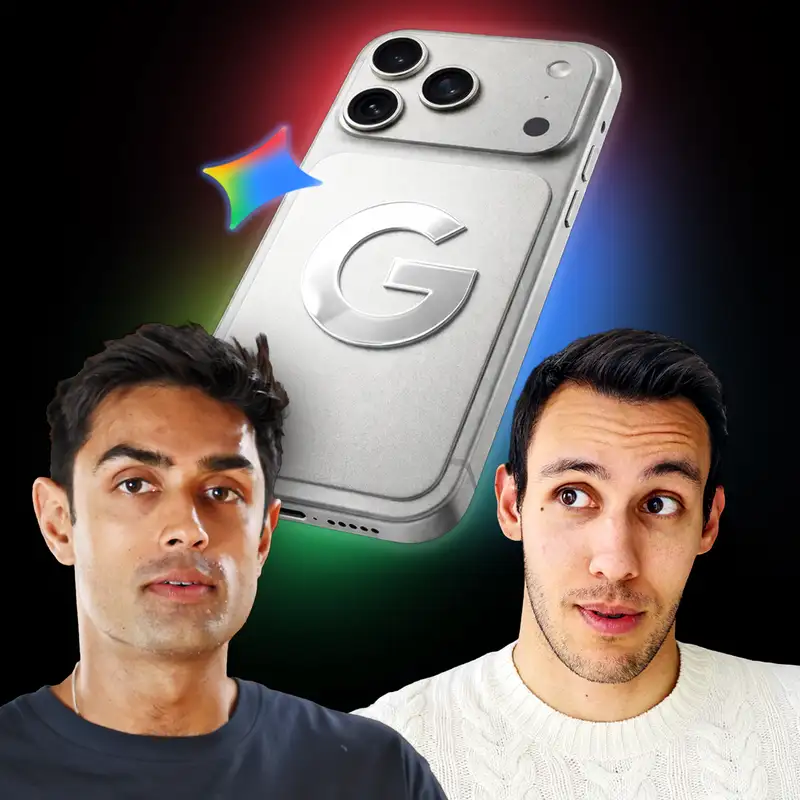
Google Took a Bite Out of Apple: The Gemini Masterplan
Ejaaz:
Get this, in the span of just one week, Google got Apple to admit that their
Ejaaz:
tech is superior and pay them $1 billion for the privilege of putting Gemini
Ejaaz:
in every single Apple device. That's 2 billion devices.
Ejaaz:
Not only that, Google launched Gemini for Gmail, which now means that over 2
Ejaaz:
billion inboxes worth of data is ripe and ready for them to train Gemini on
Ejaaz:
into the most personal, best AI assistant you could have ever hoped for.
Ejaaz:
But there's a third thing as well, Google also launched a product that might
Ejaaz:
make them the backbone of the e-commerce industry.
Ejaaz:
If your name is Jeff Bezos or Amazon, you're sweating buckets right now.
Ejaaz:
There was also one little thing.
Ejaaz:
Oh yeah, they became the second most valuable company in the world,
Ejaaz:
surpassing a $4 trillion market cap, beating Apple for the first time since
Ejaaz:
2019 and coming in second under NVIDIA.
Ejaaz:
Now, most people saw three separate headlines from Google this week.
Ejaaz:
But on this episode, we're going to show you the master plan that connects all
Ejaaz:
of them and why Google might have just pulled off the most important week in AI in 2026.
Josh:
Man, what a week. I mean, they didn't even ship features. They just captured choke points.
Josh:
This was like a huge power consolidation week for Google. And it very much feels
Josh:
like they're assembling this full stack mode.
Josh:
And I mean, I guess as a visual, you can imagine your iPhone's brain is Gemini.
Josh:
Your inbox is Gemini. Your shopping checkout is Gemini.
Josh:
It's not an assistant. They're creating this operating system for your life.
Josh:
And this started early on where I think the common joke and how I use my phone
Josh:
personally is I have an Apple iPhone for hardware, but I use all of the Google apps on my phone.
Josh:
And this is taking it to the next level where Apple has failed to generate
Josh:
artificial intelligence, Apple intelligence on device. And now they've had to
Josh:
defer to Google to do this for them. Is it a bad thing?
Josh:
No. In fact, I think everybody wins. But maybe we could start there.
Josh:
And we'll get into what exactly is going on with this new Apple and Google AI deal.
Ejaaz:
Yeah, I mean, before we do, I mean, it's worth considering that Google three
Ejaaz:
years ago was the laughingstock of the entire AI industry. They had a terrible model.
Ejaaz:
Open AI was running laps around them. And then in the last year,
Ejaaz:
their market cap has gone up 65%. And I think you were telling me before we started recording.
Josh:
This is crazy. Wait, so from April 2025 until today, Google's market cap went
Josh:
from 1.8 billion, or sorry, 1.8 trillion to 4.8 trillion.
Josh:
In the span of like, what is that? Nine months, 10 months? That's like unbelievable
Josh:
levels of growth for the second most valuable company on earth.
Ejaaz:
I think it's because they have this very multi-pronged strategy, right?
Ejaaz:
Like the typical AI company is like, hey, we have this cool model.
Ejaaz:
Isn't it awesome? Here's a chatbot for you.
Ejaaz:
Google has that, and they have the infrastructure via TPUs and cloud,
Ejaaz:
and they have the distribution via Gmail, Google Maps, and pretty much any kind
Ejaaz:
of internet app you use today.
Ejaaz:
They're just kind of like this all-in-one unicorn behemoth, and it's showing, right?
Ejaaz:
So let's get into the Apple deal. Josh, run me through the highlights. What's going on here?
Josh:
Yeah, so TLDR, Apple is changing its brain over from Siri to Gemini,
Josh:
except it is keeping it under the Siri branding.
Josh:
So what you're going to get is all the promises of Apple intelligence,
Josh:
hopefully, except instead of powered by Apple intelligence, it's actually under
Josh:
the hood powered by Google.
Josh:
Now, this might come as a confusing headline to some people because previously
Josh:
it was announced that Apple was working with OpenAI.
Josh:
In fact, if you asked Siri a difficult question, it would offload that question
Josh:
to chat GPT. That is no longer the case.
Josh:
Apple decided, wait a second, we actually don't really think OpenAI is the best
Josh:
fit. We think Gemini is the best fit. And here we see the reasoning why.
Josh:
They said they've entered into a multi-year collaboration under which the next
Josh:
generation of Apple Foundation models would based on Google's Gemini model.
Josh:
After careful evaluation, Apple determined that Google's technology provides
Josh:
the most capable foundation for Apple Foundation models. So this is a big deal.
Josh:
One, because they're now paying Google a billion dollars a year
Josh:
for this right but two because now they actually have a smart
Josh:
intelligence that they can integrate into the os in
Josh:
a way that everyone had always hoped for right like they
Josh:
they pretty much failed version one of apple intelligence it was just a complete
Josh:
and total failure but now they have an opportunity to do it again and they're
Josh:
doing so with the model that i mean we believe to be most capable from a company
Josh:
that we really appreciate and they have a relationship that has been standing
Josh:
for a really long time if you remember from was it's got to be close to 20 years
Josh:
ago, like over a decade ago,
Josh:
Apple started paying or Google started paying Apple for the exclusive rights
Josh:
to have Google as the search engine on Safari.
Josh:
Well, now Apple's paying it forward. And instead of $20 billion,
Josh:
they're paying $1 billion, so it's 5%. But this is a really harmonious deal.
Josh:
I think everybody wins in this situation. And as an Apple user, I'm excited.
Josh:
I've always used Google Apps, and now I could use Google AI in addition to those apps.
Ejaaz:
I think Google was the only option that Apple could really consider when it
Ejaaz:
came to putting an AI model in their devices.
Ejaaz:
Why? Google is the only company that can scale to the lengths that Apple has.
Ejaaz:
OpenAI is still a small startup. Anthropic, still a small startup.
Ejaaz:
Google has the entire full stack, right? They have cloud, they have TPUs,
Ejaaz:
they have all the distribution, and they have all the money and resources to
Ejaaz:
be able to kind of scale this out to the size that Apple wants it to be.
Ejaaz:
The other important thing is the quote you mentioned, which is,
Ejaaz:
they believe Google has the most capable foundation.
Ejaaz:
I think that's a signal and a hint that the way that Google's model is created,
Ejaaz:
The fact that you can ingest video.
Ejaaz:
Audio, as well as text makes it this kind of like all-knowing model,
Ejaaz:
which is way more useful for Apple, who builds products and apps and software in a very similar way.
Ejaaz:
The other thing that I think is important to point out here is there's this
Ejaaz:
kind of like platform play that is interchangeable between Apple and Google.
Ejaaz:
As you mentioned, they've had a very long relationship.
Ejaaz:
And in fact, Google has been the one that typically pays Apple for the privilege
Ejaaz:
of making Google search the default search engine in Safari, right?
Ejaaz:
And they pay them, I think it's $20 billion a year, and that's existed for so long now, right?
Ejaaz:
But now we see the first instance of it going the other way around,
Ejaaz:
where Apple is paying Google for the privilege of having their model embedded in their phone.
Ejaaz:
And they're going to use it to train the personalized version of Siri and their
Ejaaz:
own Apple foundational models.
Ejaaz:
And I can't help but think that there's a non-zero a chance in the future that
Ejaaz:
this trend flips and Apple ends up paying Google more.
Josh:
Do you think that world would ever happen? So then how did they get to 5% of
Josh:
that total number if the expectation is that it can actually grow to $20 billion?
Josh:
What does that look like if they're paying Google $20 billion? What is that for?
Ejaaz:
Okay, so my take on this is if, or when rather, they do end up paying Google
Ejaaz:
more, Apple will be making way more on the top end.
Ejaaz:
The reason being is Apple is a product consumer-oriented company,
Ejaaz:
And they are amazing at building exactly that, the consumer user experience.
Ejaaz:
They do this through devices, integrated software stacks.
Ejaaz:
It is just the best available ecosystem that you can access.
Ejaaz:
You and I have used Apple for God knows how long, right?
Ejaaz:
I think they're going to continue to do this. That's where their bread and butter
Ejaaz:
is. But they need the brain to be able to pull this off.
Ejaaz:
To kind of simplify this, I think if Google builds the best AI model,
Ejaaz:
Apple will build the best apps for everyone in the world to use.
Ejaaz:
And that typically ends up making the most money if you look at every single
Ejaaz:
tech cycle to date. Do you have a different take?
Josh:
I feel like they would swap out before getting to the $20 billion mark.
Josh:
Like I'm just struggling to understand how they would be paying such a huge
Josh:
premium relative to where they are today. Like where is that difference made up?
Ejaaz:
Well, the switching cost becomes way too high, right?
Ejaaz:
Imagine if every personal version of Apple's AI model that you use or that any
Ejaaz:
of their iPhone users use is trained on Gemini,
Ejaaz:
I'm guessing some portion of that data is trained on Gemini or rather Google
Ejaaz:
servers to some extent, right?
Ejaaz:
Apple can't hold all of that data unless you think they're going to expand their
Ejaaz:
private cloud to own that part.
Ejaaz:
I don't see Google giving that part up, right? That's what is going to make
Ejaaz:
their models more competent in the future.
Josh:
Yeah, it seems like the strategy is going to be this twofold thing where they
Josh:
have Google in the cloud, and that's their foundation model that handles the difficult tasks.
Josh:
But they also have these really precise and very effective hyper-local models
Josh:
that run very efficiently and are very small to kind of handle the local on-machine compute.
Josh:
And we've talked about this in a few episodes before, but it feels like this
Josh:
is still an underrated strategy for Apple where they've all floated this AI
Josh:
responsibility, I guess, to Google in a big way.
Josh:
But in the little way, there's still a huge opportunity on the local devices
Josh:
for Apple to run their own completely, totally private models that run on this secure enclave.
Josh:
And again, if you're a developer who's building for these platforms, that's free inference.
Josh:
So maybe Google will give you really great rates and it'll give you really great
Josh:
results. But there's still this huge opportunity to unlock for anyone who wants
Josh:
to run these local AI models on Apple devices.
Josh:
And I'm hopeful that the developer community is going to start to see this because
Josh:
the cost of inference on these devices is zero.
Josh:
And I mean, if Google does continue to ramp up the price, I assume it will be
Josh:
kind of in correspondence to the increased compute of these chips that can then
Josh:
run more and more capable models even on a local device.
Josh:
So maybe there's a world in which Google doesn't actually need to provide a
Josh:
ton of the intelligence, just the really hard stuff.
Josh:
And eventually Apple's local models will catch up. I don't know,
Josh:
but it's an exciting thing to say a new paradigm shift, that they're actually
Josh:
taking it seriously now because Apple intelligence, as serious as it felt, was certainly not that.
Ejaaz:
Listen, there's a perspective that would say Apple is actually the genius in
Ejaaz:
the AI race here because they haven't spent tens of billions of dollars to try
Ejaaz:
and highly likely fail at building an AI model.
Ejaaz:
We've seen that with Meta so far, right?
Ejaaz:
So, you know, they've just waited for the cream of the crop to rise to the top,
Ejaaz:
and then they've picked the best model, and now they're going to go do what they do best.
Josh:
Oh, we'll take that for a billion, thank you.
Ejaaz:
Yeah, I'll take it for, exactly, I'll take it for a billion dollars.
Ejaaz:
Also, you're still paying me $19 billion net to have the default search thing, right?
Ejaaz:
So there is a world where Apple licenses the model, builds the best AI agent,
Ejaaz:
which supposedly is going to be the main interface that will replace the search
Ejaaz:
engine and the internet browser itself, which would mean that they could end up winning overall.
Ejaaz:
So I guess I'm bullish Apple, Josh, which is funny because on previous episodes,
Ejaaz:
I just haven't been that.
Ejaaz:
So yeah, I'm feeling optimistic about Apple's deal here.
Josh:
Bullish Apple, bullish Google. I mean, hey, Apple doesn't have to worry about
Josh:
this data center craziness. They're in a pretty good spot.
Ejaaz:
One man isn't happy, though. One man isn't happy, Josh.
Ejaaz:
Who's that? That is Elon Musk. Oh? He commented on this whole news,
Ejaaz:
and he said, this seems like an unreasonable concentration of power for Google,
Ejaaz:
given that they also have Android and Cruf.
Josh:
All right, well, Elon, unless you're going to go make an iPhone,
Josh:
I don't know what to tell you, dude. I think the consumer is happy about this one.
Ejaaz:
Look at this tweet. from quinn yeah nobody wants to license grok little bro it's god just.
Josh:
Wait until 4.2 comes until grok 5 anyways that's the apple and google news we
Josh:
have more google news as it relates to gmail if you are not using gmail i don't
Josh:
even know what you're using um but gmail has some good updates this week from
Josh:
gemini so you just can you please share the cool new gemini features that we'll
Josh:
be getting in our inboxes starting today i think
Ejaaz:
Yeah. So the highlight is Gemini 3 Pro is now available in your inbox in Gmail.
Ejaaz:
It can do a bunch of cool things. It can get rid of all the garbage emails that
Ejaaz:
you're never going to respond to, all those unreads, just get rid of them.
Ejaaz:
And it can prioritize the ones that you need to respond to.
Ejaaz:
But also it can train on all of your emails and understand your voice and what
Ejaaz:
you want to say in your responses. So it can start writing up responses for
Ejaaz:
you and automating a bunch of work that you just don't want to do.
Ejaaz:
But the thing that I found the most interesting, Josh, has got nothing to do
Ejaaz:
with Gmail, ironically.
Ejaaz:
It's to do with Google Workspace, which it also has access to.
Ejaaz:
So it's not just your inbox.
Ejaaz:
It has access to your Google Drive, your Google Documents, your Google Sheets,
Ejaaz:
which is just a plethora of data that no other company has access to.
Ejaaz:
Which brings me to one of the key takeaways here, and the story that I think
Ejaaz:
a lot of people missed with this headline is...
Ejaaz:
Google just unlocked the mother of all data modes. Think about it.
Ejaaz:
Claude has access to your conversations.
Ejaaz:
OpenAI has access to your conversations. Google has access to 2 billion inboxes.
Ejaaz:
It has access to all your Google Maps data.
Ejaaz:
It has access to your search engine history. It has access to Android.
Ejaaz:
It has access to all of this data, which they can feed into their model and
Ejaaz:
train a better model, which ends up becoming more addictive for a person to
Ejaaz:
use, a better experience, which then feeds into this kind of like whole data mode.
Ejaaz:
And to your point, they own the monopoly on email. I think it's something like
Ejaaz:
30% of the email market share.
Ejaaz:
And Josh, get this, 90% of US startups also use Google Drive and Gmail,
Ejaaz:
which means that they get access to all this data as well.
Ejaaz:
Now, I think it's important to state that Google has said that they're not going
Ejaaz:
to use the data to train their models, but it doesn't stop them from using trend
Ejaaz:
analysis and pattern matching to train their models, which is where the goldmine is anyway.
Josh:
Yeah, so as you were saying this, I was looking at how many people on earth
Josh:
use the internet, and the number's about 6 billion.
Josh:
And Google says about 3 billion of those, 50%, rely on Gmail,
Josh:
which is just this unbelievably large amount.
Josh:
So like you described, it's great for data, it's great for Google in terms of user modes and lock-in.
Josh:
But I think there's an argument to be made that it's also great for the user too.
Josh:
I mean, in a way, email is the closest thing we have to a life database.
Josh:
Like normally normal people they kind of maintain everything
Josh:
through there it's like this is where your receipts live where you buy something
Josh:
this is where your meeting invites live this is where the contracts that you
Josh:
sign live this is where the intros to people who you meet live it's kind of
Josh:
the place where all of the receipts all the cataloging of your life lives and
Josh:
applying Gemini on top of that becomes this really powerful thing where
Josh:
It builds this life operating system on receipts that you've collected since
Josh:
you've started this Gmail account.
Josh:
And one of the really cool things that I've been playing around with recently
Josh:
is clawed code this week.
Josh:
And I use this tool named Obsidian where I've just like written notes into it
Josh:
for years and years and years.
Josh:
And for the first time ever, it's able to take that backlog of data and actually
Josh:
parse through and make sense of it and connect things in ways that weren't intuitive.
Josh:
And this feels like the lazy man's version of that, where even if you haven't
Josh:
been writing into this like entry database for years,
Josh:
you've been collecting these kind of things along the
Josh:
way you've collecting receipts you've been collecting meetings and you've collecting whatever it
Josh:
is and now Gemini is able to parse through that make sense of
Josh:
it and build a more global model that understands you
Josh:
well so in that sense alone it's awesome the other sense is
Josh:
actually for writing emails are we getting to a place now
Josh:
where AIs are just going to be emailing AIs like you guys
Josh:
you email me and you're just like oh just tell Josh this that and the third
Josh:
and then I have my AI reply with whatever it thinks that I'm going to know and
Josh:
then suddenly your gmail just becomes automated so this can this can go a various
Josh:
amount of directions but i think directionally it's great this is like really
Josh:
exciting for anybody who's a user of gmail your experience just got way better
Ejaaz:
Yeah it's funny technology which is supposed to connect humanity as a whole
Ejaaz:
is ending up becoming the disconnecting engine of the and you.
Josh:
Know what it's just because we're lazy man it's great at it and like why would
Josh:
i go write a long email when it could do it better than me faster than me more
Josh:
effectively than me more convincing than me it knows everything about me it's
Josh:
like this it's this unbelievable thing it's
Ejaaz:
Weird it's it's so true you know you mentioned you're using
Ejaaz:
cloud code um i i've been using called uh
Ejaaz:
co-work which is basically cloud code for all the non-technical stuff over the
Ejaaz:
last like 24 hours and dude i currently have called co-work doing a bunch of
Ejaaz:
tasks that i have like put off for an entire year and it's great we're going
Ejaaz:
to be putting out an episode of this later this week yes oh.
Josh:
It's my favorite thing i'm
Ejaaz:
So stoked for that it is so cool um but
Ejaaz:
anyway to kind of like wind up the gmail point
Ejaaz:
um i think it's a really good example of ai
Ejaaz:
coming to the people and meeting the people where they're
Ejaaz:
at right now ai has existed as this chatbot interface you need to kind of download
Ejaaz:
it pay a subscription and now it's kind of this useful tool um that everyday
Ejaaz:
people can use it's not just you or i josh it is my mom it is my sister it is
Ejaaz:
pretty much anyone that has a gmail account you know there's three billion users
Ejaaz:
which i think is cool the second thing is,
Ejaaz:
This just kind of locks in people to using Gemini AI.
Ejaaz:
We had a conversation before we recorded this where you kind of raised the point,
Ejaaz:
why wouldn't I just connect Claude code to this and connect to it via API?
Ejaaz:
And the simple answer to that is most people aren't going to go through setting up an API account,
Ejaaz:
which is a separate thing to Claude's subscription, by the way,
Ejaaz:
and then connecting it, adding the API key, if they just have Gemini baked into
Ejaaz:
it, which is just a full stack experience. Three billion users. Google wins again.
Ejaaz:
Yeah, the switching costs go up. Why would I want to just install this other
Ejaaz:
thing? It's already here and it's good enough.
Ejaaz:
It may not be better than this particular benchmark, but I don't care.
Ejaaz:
It's already here. It's trained on my memory. I'm locked in.
Ejaaz:
I'm not using anything else.
Josh:
Yeah, and that's why distribution is so important. You just meet the people
Josh:
where they are and you have three billion people waiting to receive whatever
Josh:
you give to them. And today, it's AI.
Josh:
Now, Ejaz, for our third and final topic, I want you to explain this Because
Josh:
if I remember just a few weeks ago, I read a newsletter published by you that
Josh:
said Amazon is going to be one of the biggest winners of 2026.
Josh:
And as I'm reading the news this week from Google, and particularly Sunar Pashai
Josh:
with this post, it's telling me, well, actually, Google is going to work to
Josh:
build a competitor to Amazon.
Josh:
And maybe I'm reading this right, maybe I'm not. But they're teaming up with
Josh:
companies like Walmart, Shopify, Etsy, Wayfair, Target, to create this universal
Josh:
commerce protocol. So maybe you could explain the bull and bear case for this
Josh:
new protocol, what it is, how it works.
Josh:
What's going on here? Is this a real problem for Amazon?
Ejaaz:
So let's get into this. Google released a product or protocol called the Universal Commerce Protocol.
Ejaaz:
And it basically will allow you or anyone that uses Gemini to make purchases
Ejaaz:
and shop via the Gemini chat interface.
Ejaaz:
And the way that they do this is they hook up APIs from various different shopping
Ejaaz:
partners. like you mentioned, Shopify, Walmart, etc., connects to your wallet.
Ejaaz:
And now there's this seamless experience where Gemini...
Ejaaz:
Via the context that you've provided it to previous conversations. Also,
Ejaaz:
by evaluating your shopping history, we'll suggest products as you're having
Ejaaz:
conversations with it or useful tools that might help you with a task that you're
Ejaaz:
trying to kind of resolve by talking to Gemini and say, hey,
Ejaaz:
do you want me to buy this for you? I'll get it delivered to you and it'll arrive tomorrow.
Ejaaz:
Now, we've seen various instances of this appear. I think Codex,
Ejaaz:
which is OpenAI's first version of an agent, offered something like this,
Ejaaz:
but it just never manifested.
Ejaaz:
This is the real deal. It's still in a beta testing period, which is why I can't
Ejaaz:
really comment on it thoroughly, but it's supposedly meant to do the thing that
Ejaaz:
we've been promised for over a year now.
Ejaaz:
So then the question becomes, if everyone is doing their shopping via Gemini
Ejaaz:
or via an AI chatbot, what happens to Amazon?
Ejaaz:
And that's a real problem, Josh, because what this ends up putting Google in
Ejaaz:
a position is, is the intense layer. What do I mean by that?
Ejaaz:
What I mean is it'll know exactly what you want to buy, and it'll purchase it for you.
Ejaaz:
And it'll know why you want to buy the thing, which is really important.
Ejaaz:
Amazon, which currently has this ability because you go on Amazon,
Ejaaz:
you scroll, so it kind of looks at you use this habit,
Ejaaz:
we'll get that removed completely. So they'll just end up becoming the warehouse
Ejaaz:
and delivery fulfillment center.
Ejaaz:
Now, that's not exactly a bad thing. And I would actually argue,
Ejaaz:
Josh, that that has been Amazon's bread and butter, right? What's the biggest moneymaker, Amazon?
Ejaaz:
It's not their shopping or e-commerce platform. It's AWS.
Ejaaz:
They are an infrastructure fulfillment center company.
Ejaaz:
To your point, they move atoms more than any other company in the world.
Ejaaz:
Big time. And I think they'll just continue doing this.
Ejaaz:
And Google will just be the layer on top that routes arguably more purchases
Ejaaz:
to Amazon if they fulfill their vision of being the biggest distributor.
Josh:
Yeah, it's a good take. It seems right. It seems like in a way Amazon is kind
Josh:
of like the mall and then Google wants to be the credit card network plus the front door to that mall.
Josh:
And what we discussed in the last section where Google has 3 billion people,
Josh:
they have the people where they are.
Josh:
In the case of Amazon, you kind of have to seek that out. You go to Amazon to
Josh:
buy something, you go there with intention, but the intention is always fairly intentional.
Josh:
With Google, you're just there, you're searching for carry-on luggage,
Josh:
you're searching for trips and then it could integrate these recommendations
Josh:
like we're seeing on screen with this example into the search results.
Josh:
So that point about intention is really important because, I mean, is this bad for Amazon?
Josh:
No, because Amazon still owns the fulfillment, Prime, the last mile dominance
Josh:
that they have but yes, in the sense that Google does own that upstream intent
Josh:
and the moment you decide to buy something,
Josh:
Google can be there to capture that. So it's interesting.
Josh:
We'll see how this plays out. I mean, OpenAI earlier this year did something
Josh:
similar where they partnered with a lot of these companies and they integrated
Josh:
it into the search results.
Josh:
But I haven't actually experienced that. I'm not sure if it's working.
Josh:
I haven't bought anything through ChatGPT.
Josh:
And yet they rolled this out months ago. So I think the actual execution on
Josh:
this really matters because on paper, it seems great.
Josh:
But is this actually going to convert sales using these new customers?
Josh:
That remains to be determined like have you have you seen any have you booked
Josh:
anything through chat gpt post integration no
Ejaaz:
No i thought it was actually a terrible product um and
Ejaaz:
i remember being super excited by it but it just never took
Ejaaz:
off and maybe we'll see the same story here uh the real litmus
Ejaaz:
test will be if my girlfriend starts using it um i'll
Ejaaz:
end up with a problem at that point right um two two
Ejaaz:
other important points here is google was
Ejaaz:
also kind of like the doormat to internet shopping
Ejaaz:
right like the search links josh 10 blue
Ejaaz:
links but then you had to kind of like figure it out
Ejaaz:
from there you had to browse and find the right product and now
Ejaaz:
they're saying hey we got the product for you do you want me to buy it and send
Ejaaz:
it to you right so there's this like interesting evolution where um kind of
Ejaaz:
unexpectedly the monopolist is still trying to monopolize on the new frontier
Ejaaz:
which is like pretty cool to to see the other thing i just thought of, Josh, is,
Ejaaz:
we mentioned a stat earlier, which is 90% of US startups use Google Drive,
Ejaaz:
Gmail, the entire suite.
Ejaaz:
So that technically means they
Ejaaz:
could sell their product through Gemini in this new commerce protocol.
Ejaaz:
Which would be insane, right? And would cement Google's distribution at this
Ejaaz:
shopping layer. It would just be insane overnight.
Josh:
Yeah, so that's it. I mean, big week. In conclusion, I guess this is how you
Josh:
become unstoppable, right? You don't just build the brain. You buy the distribution.
Josh:
You embed it into the memory layer. You standardize the checkout rails.
Josh:
You kind of like capture the whole thing.
Josh:
And it feels like if 2024 and 5 were the model wars, 2026 is becoming the,
Josh:
I guess, maybe the default war. Like, where do you go by default to engage with AI?
Josh:
And if that answer is Google products, it stands to be a very good year for them.
Josh:
And we're seeing that in the chat GPT and open AI, a degration of weekly active users.
Josh:
I mean, the relative market share of Gemini, of Claude is having an unbelievable month.
Josh:
They're starting to kind of chisel away.
Ejaaz:
I think Gemini hit 21%, right, of AI traffic.
Josh:
Something like that. It's happening quick. It's happening quick.
Josh:
And one thing that I haven't heard in a while is an update to that 800 million
Josh:
weekly active user number from OpenAI.
Josh:
And I really am wondering how they're planning to deal with this because now Claude is building.
Josh:
Did you see Claude built the health app this week too? They launched the health
Josh:
app. We're going to have to talk about this in the roundup. There's so much
Josh:
stuff that happened this week. It's unbelievable.
Josh:
But there's been big changes here and lots of paradigm shifts happening.
Josh:
And in terms of Google, this is a huge win across the board.
Josh:
It feels like it's a huge win for everyone, for Google users,
Josh:
for Google customers, for Google shareholders, and for Apple users as well.
Josh:
So big wins across the board, maybe not for Amazon, maybe not for anyone competing
Josh:
with these companies, but nonetheless, a really...
Josh:
Exciting week for Google and giving probably everyone listening to this at least
Josh:
something new to try out and play with.
Ejaaz:
Yeah, I agree. I bought more Google stock this morning before recording this episode.
Ejaaz:
But I know a lot of you listening to this kind of hate Google.
Ejaaz:
I might be wrong here. But if you do, let us know why. Let us know your thoughts on this.
Ejaaz:
I'm down. We do it every day anyway. A lot of you like to argue and we're there for it.
Ejaaz:
But if you have any kind of opposing views and opinions we
Ejaaz:
want to hear it because like we we want to be able to know whether we're
Ejaaz:
kind of like on the right track or not josh and i take this stuff
Ejaaz:
pretty seriously and we see a huge amount of potential in google and we kind
Ejaaz:
of don't see how they can fail which is either a great opinion or a really really
Ejaaz:
bad one so let us know in the comments um if you aren't subscribed or you don't
Ejaaz:
have notifications turned on please do both of those things it's around 80 of you um,
Ejaaz:
in 2026. We would like to get that down to what, Josh?
Ejaaz:
30%, 20%, 0%?
Josh:
Yeah, we got to hit 30k subs too. We're right there and we need like 500 more.
Josh:
So if you want to help with that cost, tell your friends, tell your friends,
Josh:
friends, hit the subscribe button.
Josh:
It goes a long way in helping us start off strong in this new year.
Josh:
Because by the end of this year, there's a lot, there's lots going to happen.
Josh:
And it's going to be crazy. It's
Josh:
going to be chaotic. And you're going to want to be here for the ride.
Josh:
So we'll cover it three or four times a week, every single week so
Josh:
tell your friends that it comes hopefully packaged in these 25 minute episodes we
Josh:
did pretty good today i think we were we kept it moving today so hopefully this
Josh:
was enough for you to squeeze it into whatever window that you're listening
Josh:
to these episodes in we'll see you next time where we talk about claude because
Josh:
it's freaking awesome so you're going to want to stay tuned for that one uh
Josh:
really cool paradigm shifting platform um but yeah until then hope you enjoyed
Josh:
this episode and we will see you guys on the next one see you guys