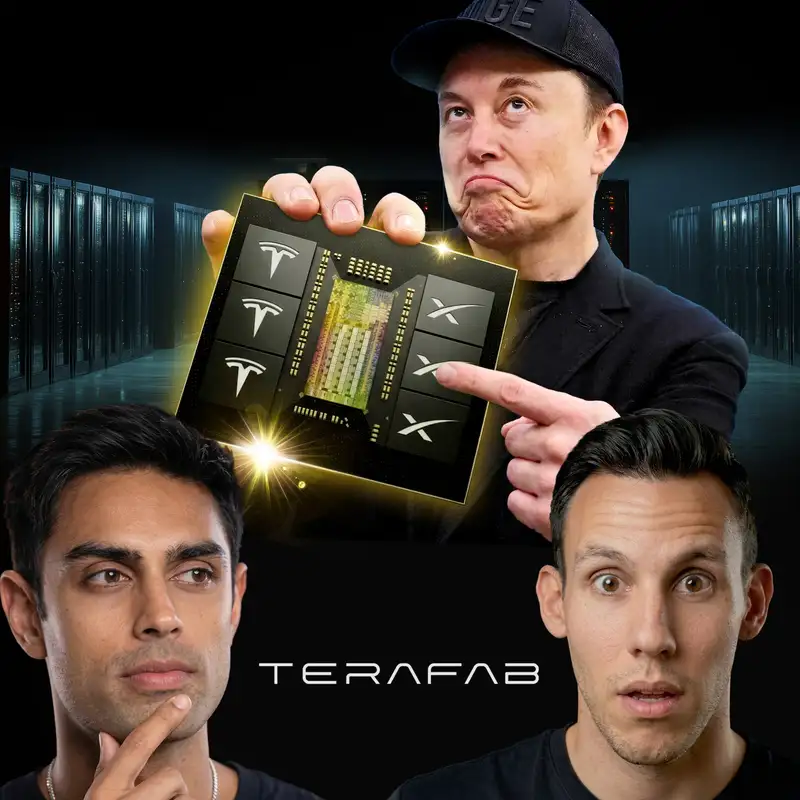
Elon Musk's Terafab: The Impossible Plan for a Galactic Civilization
Josh:
[0:00] What you're about to hear over the next 25 minutes is going to sound absolutely ridiculous, almost indistinguishable from science fiction, but you should listen
Josh:
[0:07] to all of it and ask yourself the single question, what if they actually pull it off? What if they pull off this thing that Yulon announced just last Saturday when he went on stage inside of a decommissioned power plant in Austin, Texas to announce a project called TerraFab. This is a joint effort between Tesla, SpaceX, and XAI to take on what's probably the single most difficult industrial challenge that exists on the world and off of it today, which is making chips. And making chips probably doesn't sound that complicated until you come to the conclusion that there's one company that makes all of them. All of the technology, all the devices that exist in the world today come from a single company that does this thing called lithography. And that company is called ASML. They cost $400 million per machine. They weigh 165 tons and take 250 engineers six months to assemble. China has tried. EU has tried. No one has been able to successfully succeed. And if you succeed, then you could package those chips into things that are actually usable by consumer devices. There's only three companies on the planet that do this. TSMC, Samsung, and Intel. That's it. That's the entire list. Every piece of technology is created by these four companies.
Josh:
[1:14] So the plan, well, Elon said he's just going to go do it himself. He's going to build an R&D lab. He's going to build a TeraFab. He's going to build a.
Josh:
[1:22] Then once they do this, they're going to take those ships and send them all into orbit. And they're going to build AI data centers in space. And this plan that he announced this weekend is absolutely outrageous. And no one really believes it until you look at the math. It's like, well, the physics work. The FCC filings are real. SpaceX is probably going public this year to raise $50 billion to make this happen. So when you converge the three most impressive talent engineered companies in the world with the best operator in the world, suddenly there's a very real chance that this actually might happen.
Ejaaz:
[1:52] Yeah, so the TerraFab is basically the most epic AI chip factory that will ever exist if he pulls it off. I think the price tag is like $20 to $25 billion. And the goal, as you said, is to produce one terawatts worth of computing. So to put that into context, if you combine all of the existing AI chip manufacturers today, so we talk about Samsung, Intel, TSMC, they collectively produce around 20 gigawatts worth of AI chips per year today. Elon said that that is only 2% of what he needs specifically to produce AI chips. It's so crazy. So the TerraFab AI chip factory that he's building, if it fully realizes its potential, at full scale will produce 20 gigawatts worth of AI chips per year.
Ejaaz:
[2:33] And the craziest part about this is 80% of those chips are going to outer space. So there's loads of crazy numbers, loads of ambitious goals here, but I need to know how this works.
Josh:
[2:43] Yeah, maybe we start with the first thing that was actually announced and shown in the presentation, which is their advanced technology fab. It's basically their R&D center. And they're building this one in Texas. And they have this great visual of what it looks like. And what the purpose of this station is, is to put everything under one roof. It's to put that lithography, the packaging, all the elements of chip making in one roof so that they can iterate quickly. Traditionally, what happens is you submit a chip design, and then it takes months to years to go through the revision cycle to actually improve the chip design what they're doing here is under one roof they have everything in one place and they can design build and then test over and over and over again so they could iterate very quickly on these chips and what's amazing is the current output for this or the projected output that they're hoping to reach is one terawatt of energy per year and for reference the united states of america, annually, consumes half of that. So we have some visual references here. Elon says this large factory, the actual TerraFab, not the R&D center. So once they've gone through the R&D, they figured out the chip architecture, they deploy it to the Tesla TerraFab. That TerraFab is going to be 100 million square feet. For reference, on screen, we're seeing some examples of this. That is equivalent to three New York City Central Parks, 15 US Pentagons, 2,300 acres, 555 Walmarts.
Josh:
[4:01] 1736 football fields i mean this is almost 10 the size of paris and bigger than the footprint of san francisco this is ginormous and as a result they haven't actually picked the location for this because that's going to take a little while but i think it's important to just reference the scale of how big this vision is how grand this vision is this is bigger than anything humanity has ever built by a large margin the current gigafactory is one mile long and let me look at that it looks I.
Ejaaz:
[4:30] Can't even fit this inside the screen, Josh. Yeah, it's nothing.
Josh:
[4:33] So it's this unbelievably ambitious project that they're planning to make.
Ejaaz:
[4:36] Okay, so if I understand this correctly, the TerraFab basically seeks to vertically integrate the entire AI chip stack, right? So there's two parts of this. There's the R&D lab, which does all the experimenting,
Ejaaz:
[4:48] perfects the chip design. So we're talking about, we're getting the lithography machines, the ASML, $400 million machines, which we're going to talk about in a second. They're going to nail the chip design here, wafer fabrication, memory production, advanced packaging, all of these things which are typically split between TSMC, Samsung, Intel, and a few other operators. Elon's planning to build from scratch and own the entire operation under one single roof. And then the TeraFab itself, which is the reason why we're looking at this gigantic comparison here, is going to be responsible for scaling manufacturing of these chips. Do I have that right?
Josh:
[5:20] Yeah, that's right. So there's basically going to be two fabs but one singular chip architecture fab one is going to have the terrestrial inference chip that's for the vehicles for the robot taxes for optimist robots and then fab two is we're bringing dojo back dojo three space hardened chip that's for orbital ai satellites, what i did is i took this information and i actually created this little visual on screen shared it in a post and elon retweeted it which was very exciting because this was early confirmation prior to the announcement that this was actually happening and i think it's it's important to note the differences between these two chips so one is going to be ai5 and ai6 we've referenced this a lot on the show that's the edge computing that is projected to be in like small batch production by the end of this year and then volume production by next year, Dojo 3, the space one, is new. This is what we just learned last night. That is radiation-hardened, it runs hotter than tridestrial chips, and that's what's going to scale to what Elon believes is Kardashev Type 2, which is harnessing just an unfathomable amount of energy. And that's when the lunar mass driver comes into play. We're going to get to the space play. We're not there yet, we will get there, hang in with us, and we'll get there. But just this part itself is pretty amazing. So basically, two chips, one for Earth, one for outside, that are both optimized for a very specific thing.
Ejaaz:
[6:34] But there's a distinction between how much he's going to produce of each of these chips, right? So I think he's planning 20% of the chip production to be to the AI-5 chip. So the first chip that you just described. This is a cool chip because, you know, I read that it was like 40 to 50 times more powerful or compute processing than its predecessor. And it has way more memory. And the idea of this is that it lives on the robots that Tesla is going to be producing. So the Optimus humanoid robots and the cars itself.
Ejaaz:
[7:01] So it becomes like a distributed compute network and loads of cool things can prosper from that. But the D3, the Dojo 3 chip, is this space-specific AI training chip. And I think the idea here is to create a satellite constellation network where you can just kind of like beam data between each satellite and train gargantuan AI models. That's the big bet that he's going to make. And to your point, you get basically around, I think, five times the solar energy and just in lower orbit Earth. There was a sexy term that you were describing before we recorded this show. Can you tease it for us, please, Josh?
Josh:
[7:34] Sun sync, baby. Sun synchronous orbit. Satellites that can orbit in a way so that they never go in the darkness. They're always synced with the sun. They will always be collecting energy and then always, therefore, be able to generate compute. So when you have access to space, space is gigantic. It's huge. And when you have the satellites that can get constant access to energy from the sun, it's a really strong advantage. So maybe now's a good time to get into the core problem as to why they're actually doing this. Because, I mean, Elon's ambitious, but I don't think he needs to bite off more work. He's plenty busy as it exists. So this is where we get into the why. What actually happened here? And it started in their Q4 earnings report for Tesla, which I actually listened to. And Elon described that there's going to be a serious glut of chips that are going to happen sometime over the next couple of years. And basically, all the current fabs on Earth are going to be able to generate, like you mentioned earlier, only 2% of what the companies will actually need by somewhere around the end of this decade. So the idea is that.
Josh:
[8:33] He will buy all of the chips from everyone. And still, it is only a small fraction of the amount of chips that are required to build a hundred million Optimus robots, 10 to 50 million autonomous cybercabs. And what he has to do now is build his own. He has no choice but to go and do the vertical integration play that he's done with every one of his companies and create a fab that actually creates these chips. Because otherwise,
Josh:
[8:54] there's going to be this roadblock. And even if Elon does buy all of those chips, well, there's none left for everyone else. and clearly OpenAI, Anthropic, Google, all these companies are going to continue to scale their compute. So instead of fighting with everyone else, he's just going to go and do it himself. Yeah, and if.
Ejaaz:
[9:08] You haven't been keeping track, we are basically in an AI chip supply crisis. It's not just ASML, but it's also memory, it's packaging, it's pipeline manufacturing. There's so many things that are constrained that we don't have enough of. And Elon, I think this weekend quoted that he wanted or he planned to produce at least one to 10 billion Optimus robots per year. And if he's doing that just for human robots, can you imagine how much he's scaling for, for his cars and then for his satellites as well? The idea around like 2% of the entire world's current chip manufacturing supply being what he requires in the future isn't an exaggeration. So if he scales that out, it makes sense in all of his estimations that he needs to build this in-house. It makes sense.
Josh:
[9:52] And again, the scale is like really difficult to wrap your head around. This is far larger than anything anyone's considering doing by like an order of a hundred. And the puzzle pieces have slowly been falling into place to actually make this happen, right? It's back in February, we had the XAI SpaceX merger. That was huge. Simultaneously, Tesla invested $2 billion in XAI. There's 100 gigawatts of domestic solar push. Then there's Optimus Starship, Grokky Tesla vehicles. Everything is merging together. and this is the first formalized version of that where he's really combining all of these entities into one and i think that's the only chance they have and if someone's going to solve this it's going to be them it's going to be the engineering teams that have built reusable rockets and full self-driving cars and then after they figured out that front now it's the time that we could get into space now is the time we could talk about the moon and mass drivers and satellites and this is the truly sci-fi part so after you've built the biggest factory on earth you've designed the chips that are impossible to make, what is the plan to bring them in space?
Ejaaz:
[10:51] The plan is to send 80% of those chips into space because it's simply more effective to train AI models here. Now, let's rewind a second. About a month and a half ago, I believe, or two months ago, Elon made a very bold claim or bet. He said that in two to three years' time, it'll be cheaper to deploy and train AI models in outer space than it is on Earth. And he quoted a bunch of different problems. Number one being regulations. Number two being humans being blockers in generally setting up and creating these decisions. There's a lot of attention and maintenance that is required. And the third thing is, we just don't have the resources to generate enough energy for both AI and humans alike. If we did it for AI and humans, the price or cost to support yourself at home, your energy bill is basically going to go to sky high. So Elon did the math and was like, oh no, we need to put these things in outer space. Why?
Ejaaz:
[11:44] Well, there's five times more solar energy that can be harvested. It can be 24-7 because satellites can basically just roam. What was it? Sun-synchronous, Josh?
Josh:
[11:52] Sun-synchronous, baby.
Ejaaz:
[11:54] There you go. 24-7 harvesting the sun's energy. And most importantly, Elon's talked about making Earth a Kardashev Type 2 civilization for so long now. That is the type of civilization that can harness the sun's energy and use it for our own need. He is pushing us towards that thing and he's confident that the cost of it will be cheaper than that on Earth. So it just makes more sense. But it's based on one principle, where if he's wrong, it would be a major flaw. And that is more compute equals a better AI model. Elon is putting all his eggs in one basket and we have to see how it plays out. But there's some pretty crazy numbers involved here, right?
Josh:
[12:29] Yeah. Well, also just the size of the satellites, what we're showing on screen now is the AI satellite mini. This is not the large, this is the mini. Now for reference, it's sitting next to Starship. Starship is about 408 feet tall, which for those curious is equivalent to a 40 story skyscraper that they're sending into space. It is gigantic. Now next to it is a single mini satellite, which for reference is 558 feet long. It's about 50% taller and larger than the Starship rocket stack. So how do they do this? Well, they fold it up really tightly for launch. And it's not heavy. It's, I mean, it's about a ton. It's 2,000 pounds. But relatively speaking, it's not that heavy. And then when it reaches satellite orbit, it unfolds itself. And those things that are unfolded are actually radiators. Because space is a vacuum, there's no way to effectively dissipate heat. You must have a lot of surface area. So I'd say, I mean, this is a rough guess just based on it that over 90% of this satellite is just radiators. It just exists to cool the chip. And what's unique about this chip that we mentioned earlier with the Dojo 3 that they're sending into space is it's built specifically for this to be radiation proof and to exist at very hot temperatures because it's not going to really be cooled the same way that you can cool something here on Earth. The numbers are pretty crazy when I'm looking at this.
Ejaaz:
[13:44] Josh. I think he plans or he said he plans to produce around one terawatts worth of compute or harvest one terawatts worth of compute in space. That's around 50,000 of these space launches or these space shuttle launches per year. And each of these shuttles can like hold around 200 tons and he's aiming to do a basically 10 million plus or upwards of 10 million tons per year. Do you think he's gonna be able to feasibly pull this off? That's like a launch every 10 minutes, every day.
Josh:
[14:12] Well, when you think about airlines, which is probably our best comparable guess, airlines do tens of thousands of flights a year, maybe even hundreds of thousands of flights a year. They're very frequent. So if you measure it that way, then it makes sense that they can do it. I haven't done the math myself, but it sounds like this is something that Elon would have figured out. Like, I'm sure there is an equation here where X amount of mass to orbit per launch, X amount of launches to orbit, you reach a certain amount of energy output. You reach a certain amount of intelligence in space and if they can get comparable to an airline where they can land these starships over and over and over again then they will achieve this and granted that's a big if they still haven't figured out how to land the ship yet they've only landed the booster so far and starship v3 hasn't even launched yet they haven't even done a test launch so there's a lot of progress that needs to happen, They are not constrained by anything that is physically impossible. And I think that's the important thing is like all of this on paper is possible. Therefore, it's just an engineering challenge. Therefore, we will put our best engineers on the job and hope that they can figure out a way to solve it as fast as possible.
Ejaaz:
[15:17] Okay, well, let me lean into this a bit more then, because there is a project that they're also working on where I don't think the math has been figured out just yet. And the numbers get impossibly large, right? What on earth is a mass driver and why are they trying to put it on the moon?
Josh:
[15:31] This is so cool. okay this is this is like the final grand finale star wars josh yeah so elon actually ended his presentation saying i want to live long enough to see the mass driver on the moon because that's going to be incredibly epic and what we're seeing on screen right now is a rendering of what this mass driver is going to look like there's an important distinction between the moon and earth in that there is one sixth of the gravity on the moon that exists here meaning it's much easier to get things out of the atmosphere you don't need a rocket with a tremendous amount of propulsion to push you through an atmosphere, you can just glide your way off of it. So if you've ever been on a really fast roller coaster, maybe Kingda Ka or something that was incredibly quick, even if you've ever been to Japan, you've been on one of those bullet trains. They exist using this technology called maglev. It's magnets. There's no friction. They choose inverse polarity to balance an object and then propel that object at very high speeds. And because there's no friction, because there is this natural magnetic force, it acts as shock exorbitant. And the reality is, is that you can actually just shoot these satellites off into space because you don't need to move too much atmosphere in order to get out. So the lunar mass driver is essentially going to be a...
Josh:
[16:37] Space launcher for these satellites that get produced on the moon. And because you can launch so many of them so cheaply, because you don't need to build rockets for them, you can deploy terawatts and eventually petawatts of energy and compute into space. And this is the grand vision. And it is incredibly sci-fi, but it sounds like they have a very clear plan on actually making it happen.
Ejaaz:
[17:00] Yeah, I think a lot of it is theory right now because he has to solve that little thing. Oh, yeah, that's right. Launching, you know, a terawatts worth of satellites that are going to be in low orbit space and harvest the sun's energy. There's that little thing that he needs to figure out. But if he manages to figure this out, what fascinated me the most is how he's going to do it. So we're talking about building an impossible AI chip factory here on Earth. He plans to do the same on the moon, but it's not going to be humans that are doing it. He wants to send his Optimus humanoid robots to go out and do that. So he's talking about sending humanoid robots with artificial intelligent brains that are going to orchestrate everything that a human would and work 24-7 around the clock to build a settlement that eventually humans and robots can coexist on. Then he's talking about creating a railgun-like catapult that is going to launch satellites even further into deep space, closer to the sun, and harvest even more energy. Presumably, they need to be even more radiation resistant, more than the ones that NVIDIA and Tesla are working on today. So we're talking about a very far-fetched vision right now that sounds just about, or just enough amount of crazy that it resonates a lot with Elon's character. Because I remember learning about Tesla and SpaceX back in the day, years ago, and thinking, this guy is mad.
Ejaaz:
[18:17] And then years later thinking, okay, he was right all along. So I think this is another case of where he's putting his foot down,
Ejaaz:
[18:23] Prodding the flag in the ground and saying, this is what we're going to build, this is how we're going to do it. And you either get on the train or you don't. And personally, I think he's going to pull it off, presumably because of the data and history of what he's done previously with other companies.
Josh:
[18:36] Everyone has said that it's impossible to reuse rockets, to build electric cars, to build full self-driving fleets. Everything's been done. So if there's someone to do this, this is going to be the guy. This is going to be the team that makes it happen. And it's like so exciting. Oh my God, what a great decade for the optimists. This is awesome. And again, like this is not really pure fantasy. It's all based in actual physics. Like the idea of an electromagnetic mass driver is well understood. NASA has been studying this since the 1970s. And even like the Navy, they built working electronic railgun prototypes like this is well studied. They're just taking the technology that exists and moving it onto the moon.
Ejaaz:
[19:11] You know, listening to all of this, I can't help but think that Tesla needs SpaceX and SpaceX needs Tesla.
Ejaaz:
[19:19] So why don't they just become the same company? My bet, and I said this on a previous episode a few weeks ago, I think these companies are going to merge. Now, I know that there are the talks of SpaceX going public this year and then Tesla is already a public company. and there's some weird kind of ways that these entities can merge together. But it seems increasingly so that the companies are reliant on each other. And I don't see why Elon wouldn't do this. I think there are pretty high or decent odds of this happening, no?
Josh:
[19:45] Well, thanks to our friends at Polymarket, we have the exact odds of this happening. And unfortunately, they're fairly low. They're at 10% chance that this happens by June 30th. So that's not to say that this won't happen. It's just to say that by the time that SpaceX goes public, seems like it's probably going to be in the middle of the year based on another polymarket that we looked at it seems like they will not be together now that means spacex is going to go public without tesla there will be two publicly facing companies what is the actual market cap of spacex going to be and if you look at this chart on the polymarket that shows the closing market cap of when it goes live and you'll notice this is the higher strikes version because the lower strikes was almost at 100 certainty would be over a trillion so now we're on our way to two trillion and now 56 of these people believe, the SpaceX IPO will be greater than $2 trillion. That would be the largest IPO in history by far. I'm not even sure it'd be close. And Polymarket knows its stuff. So it looks like it's almost a guarantee we're going to open up over $1.75 trillion. And that's going to raise more money than is required to build this tariff app. I mean, we mentioned $25 billion. They're going to raise far more than $25 billion. And therefore, the only constraint now is engineering. It won't be money. And thank you to our friends at Polymarket for showing us this great data. It's always so helpful.
Ejaaz:
[21:00] I mean, I think when I look at these numbers, $2 trillion IPO, it sounds crazy until you realize like the vision that they're trying to realize and build here with all these robots. If we do have 10 billion robots being produced per year from one single company that requires 2% of the current global chip manufacturing output, it makes sense that these companies will be worth well into the trillions. Now, a lot of this is still unproven. I know, Josh, you said that a lot of this technology has been mapped out physically, but the actual execution is kind of hard to do.
Ejaaz:
[21:29] That being said, Elon has proven time and again that he is the man to execute. Is this one step too far? We will find out, but he's literally sending things into space. To kind of tie this all up, the TerraFab is the most gargantuan AI chip factory that will ever exist. It is going to be huge, the size of San Francisco, as you mentioned earlier, Josh, and it's going to produce two killer types of chips. One for local edge inference for your Optimus humanoid robots and Tesla cars. And then the other 80% being sent to outer space, radiation-hardened, heat-proof to be able to train the best AI model, presumably Grok, in the future. So if you want to take a big bet on Elon, it seems like now is the time to do it. Hopefully we can publicly express that investment in a SpaceX IPO later this year.
Josh:
[22:15] Yeah, it's going to be exciting. It's like, none of this is really constrained by physics. All of this is possible. It's purely a matter of execution. And if we were to allocate anyone to execute on the most challenging industrial problem ever, it would be Elon and these teams at Tesla, at SpaceX, at XAI. I mean, this is the convergence of... A lot of impressive brainpower that has solved impossible problem after impossible problem over the course of the last two decades. So it leaves me feeling very optimistic. And these things take time. This is not going to be done tomorrow. This won't be done next year. But it's an ambitious project that has a high probability of working. And if it works, the world around us and the world outside of the world, the interplanetary solar system actually changes. And we really make meaningful civilizational progress in a way that's never been done before. So watching Elon on stage, I would advise everyone go and watch it. It leaves you feeling very optimistic, very hopeful for the future. You wake up in the morning a little more excited to be on this adventure because of where we are going and where we're heading and where Elon is hoping to take all of us. So that's the update. That is everything you need to know about the TerraFab. It is incredibly ambitious, but they're going to do it. We're going to cover it. Ejaz, any final notes before we wrap up here?
Ejaaz:
[23:26] No, I mean, what are your thoughts for those of you who are listening on this entire project? I know there's a lot of Elon fans in the comments, but I also want to hear from the people that maybe don't particularly agree with our views. Check us. Where are we wrong? Where might we be incorrect in our estimates and in the numbers itself? Elon has consistently delivered in the past on impossible numbers. Maybe it takes a couple extra years than he's actually said. But the point is, this is going to take a while to realize and I want to hear your thoughts.
Josh:
[23:54] Yeah. All right. Well, don't forget to share this with a friend if you enjoyed the episode, to subscribe on YouTube, to find us on your favorite podcast player rss feed anywhere we get podcasts you can find us we're also prolifically posting on x elon's retweeting our stuff you don't want to miss out on that so go give us both a follow on x you can see the handles pop up on screen here thank you so much for watching as always and we will see you guys in the next one see you guys.
Creators and Guests