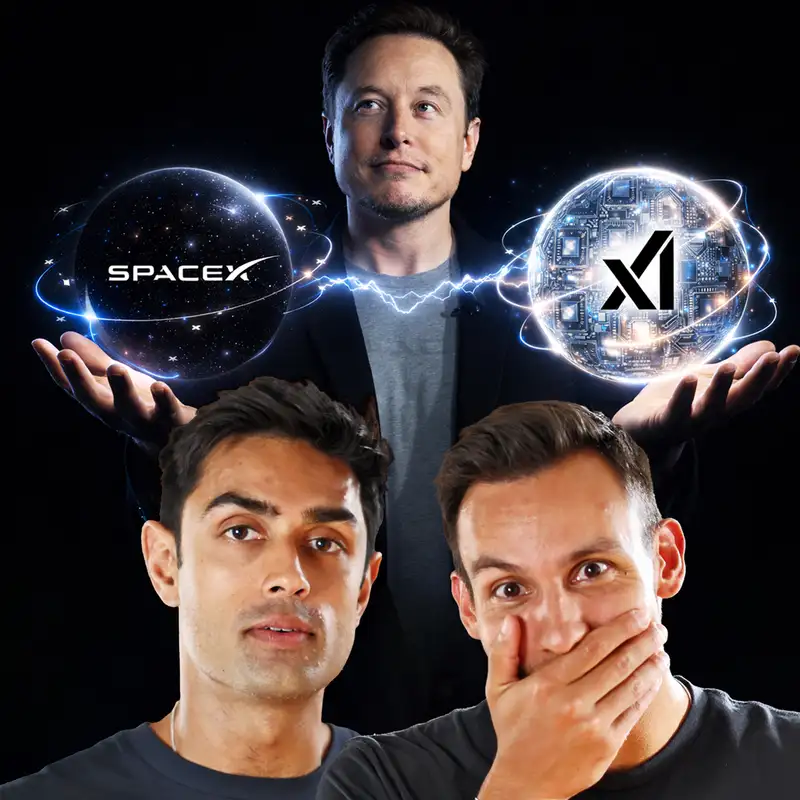
Elon Joins SpaceX and xAI in the Biggest Merger Ever. Is Tesla Next?
Josh:
SpaceX has acquired slash merged with XAI. They are now one company.
Josh:
Musk Industries has condensed once again. And if you are a shareholder in Twitter,
Josh:
you have now owned Twitter, X, XAI, and now you are owned by a space exploration company.
Josh:
This is the largest merger and acquisition in history.
Josh:
No one's ever done anything at this scale before.
Josh:
And the downstream implications of this are fairly huge.
Josh:
The amount of value that's gonna be unlocked for public markets once this goes
Josh:
public in the middle of this year is going to be a really big deal.
Josh:
So throughout this episode, we're going to talk about why this matters and how
Josh:
you can actually make a buck from this.
Josh:
How do you participate in the upside of this merger as it relates to Musk Industries
Josh:
with SpaceX and Tesla and all of the companies that are underneath the umbrella?
Josh:
So Ejaz, maybe we'll start with the actual announcement from Elon himself talking
Josh:
about the merger and why specifically they decided this was the right time to do it.
Ejaaz:
Yeah. So this merger officially makes this company the most valuable private
Ejaaz:
company in the world, $1.25 trillion.
Ejaaz:
It valued XAI at $250 billion and SpaceX at $1 trillion.
Ejaaz:
And if you've been watching the show, you know that there's a rumored IPO of SpaceX.
Ejaaz:
So now that rumored IPO has just got a lot, lot bigger, probably going to be
Ejaaz:
the biggest one that we've ever seen.
Ejaaz:
And on the back of this, the idea here is that XAI investors will get roughly
Ejaaz:
around 0.15 SpaceX shares per share that they invested or got from XAI.
Ejaaz:
So a pretty good deal for a company that is currently already losing money.
Ejaaz:
That's XAI and SpaceX is kind of like profitable on their way towards profitability.
Ejaaz:
But what isn't quite clear to, at least from face value, Josh, is like,
Ejaaz:
Why did this even happen? And how does a SpaceX company and a Frontier AI lab make sense to merge?
Ejaaz:
And Elon does a really good job of explaining his core thesis in this post,
Ejaaz:
which is simply, he's going all in on space AI data centers.
Ejaaz:
Now, you and I have gone back and forth a lot on this thesis.
Ejaaz:
And what we've ultimately landed is that space is the most cost-efficient and
Ejaaz:
performant place to train AI models. Now, does it exist today? No.
Ejaaz:
In fact, prototypes so far are very minimal with a couple of GPUs being out there.
Ejaaz:
Elon is leaning all in on this. And his idea is compute is going to be the most
Ejaaz:
scarce and valuable resource in the future.
Ejaaz:
Why? Because you need it to train frontier AI models.
Ejaaz:
It's been proven with the amount that he's investing in Colossus 2 and Colossus
Ejaaz:
3 as data centers on Earth.
Ejaaz:
And if you kind of like scale this out towards like, say, a decade or decades
Ejaaz:
long timeline, it kind of makes sense that the winning AI models are going to
Ejaaz:
be ones that have the cheapest tokens per cost.
Ejaaz:
And so his bet is it's going to be in space. Why space?
Ejaaz:
Because you can harness the entire energy of the sun. It is natural cooling.
Ejaaz:
And ironically, you have so much space in space.
Josh:
Yeah, it's like how many megatons of mass can you get into orbit?
Josh:
And that's what SpaceX is doing.
Josh:
So the idea is that SpaceX has the launch capability to send AI data centers into space.
Josh:
In addition to the Starlink constellation, in addition to the moon and the Mars
Josh:
missions that they're planning, they have basically the highway to get AI into space.
Josh:
The problem is that building AI on Earth isn't that horrific.
Josh:
It's challenging, but people are able to do it.
Josh:
And the cost of getting AI into orbit is far more expensive than it would be
Josh:
on Earth. So people don't do it.
Josh:
With the Starship program, as they're able to launch the Starship in a reusable
Josh:
way, the cost per kilogram to orbit will decrease to an amount that it will
Josh:
be economically unviable to build AI data centers anywhere else but outer space.
Josh:
And that's the bet that SpaceX is taking, that they will be able to work with
Josh:
XAI to build these data centers and get them into outer space and build the AI in space plan.
Josh:
And I loved Elon's ambitious mission that he outlined in the acquisition post,
Josh:
talking about ascending the Kardashev scale, which we'll get into a little bit later.
Josh:
And it feels like a sci-fi futuristic mission, where actually in this post,
Josh:
he describes what it looks like to build
Josh:
A small base on the moon and to send satellites from the moon in order to get
Josh:
to 100 terawatts of energy per year.
Josh:
This unbelievable scale that he's planning to build this thing at.
Josh:
And it's hard to read it and not feel like you're reading a sci-fi novel because
Josh:
of how futuristic this sounds. But he's very serious.
Josh:
And I think the market is reflecting that and how high this is being priced
Josh:
already before it's even gone public.
Ejaaz:
Do you want to know how much it'll cost currently um to send us into space roughly oh please.
Josh:
Tell me because they have a rideshare program right
Ejaaz:
Okay listen i would never ask a woman this but i'm gonna ask you this how much
Ejaaz:
do you weigh in kilograms specifically please in.
Josh:
Kilograms so i just did the math and it's about 86.2
Ejaaz:
Kilograms okay so i'm around 85 so let's call
Ejaaz:
it one we call 170 let's call it 170 all right that's 170 uh for those of you
Ejaaz:
who aren't watching this um there is a rideshare program but a very different
Ejaaz:
rideshare program that you're used to on SpaceX's website that allows you to
Ejaaz:
calculate how much it is to send a particular weight into space right now.
Ejaaz:
And right now, to send Josh and I to host Limitless, to be the first podcast
Ejaaz:
in outer space, lower orbit space, it is $1.2 million.
Ejaaz:
Now, that sounds like a lot of money. And of course, it is. We don't have that
Ejaaz:
money to splurge right now.
Ejaaz:
But back in the day, a decade ago, how much did that cost? How much would this
Ejaaz:
have cost, Josh? Probably billions.
Josh:
It would have been billions of dollars. and this is cheating because this doesn't
Josh:
include life support systems which are probably going to quadruple that cost
Josh:
maybe even more but if you just
Josh:
pushed our bodies into a box and put it on a starship that's what
Josh:
it would cost and that is several orders of magnitude more like
Josh:
that would have been billions of dollars and now a single individual can
Josh:
actually pay for that and as starship becomes economically viable or reusable
Josh:
that price is going to go down significantly so it's not only for ai and space
Josh:
there's so many other things that you'll be able to send like the starlink direct
Josh:
to sell terminals that will actually replace companies like verizon and t-mobile
Josh:
at&t because it will work directly with the cell phones.
Josh:
And it's rumored that this year, the iPhone 18 Pro is going to have compatibility
Josh:
with the Starlink Direct-to-Cell network.
Ejaaz:
Yeah, so actually, I have this post from Brett Winton at ARK Invest here,
Ejaaz:
where I think he really beautifully describes the synergies between the two companies.
Ejaaz:
And he makes two big points. One, which we've already made, which is they're
Ejaaz:
placing the big bet on compute.
Ejaaz:
And Elon thinks that the number one way to get the most
Ejaaz:
compute per dollar spent is going to be
Ejaaz:
in space and by merging spacex the cheapest
Ejaaz:
way to get mass into space um plus
Ejaaz:
starlink that you mentioned earlier um with his satellite constellations to
Ejaaz:
train ai grok will eventually end up becoming the best model because of scaling
Ejaaz:
laws with compute so that that's the compute argument but then if you look at
Ejaaz:
it from the xai perspective you know what what is the model uh got to benefit from this.
Ejaaz:
Rather than thinking about it as being the frontier AI model,
Ejaaz:
think about what comes downstream from that.
Ejaaz:
If you put yourself in the shoes of a major enterprise on Earth that is making
Ejaaz:
billions and billions of dollars a year, you are only going to want to spend
Ejaaz:
money on the best AI model.
Ejaaz:
Why? Because it's going to be the smartest AI model, which is going to help
Ejaaz:
you end up making the most money.
Ejaaz:
It's kind of like a vector towards projecting how much money you make as a company,
Ejaaz:
no matter what industry that you're in. Now, he predicts, Brett specifically,
Ejaaz:
that this is a $20 trillion enterprise opportunity for XAI that they cannot lose.
Ejaaz:
And the reason why he makes this point is, if XAI ends up having the best model
Ejaaz:
because they're training on tons of compute from space via SpaceX,
Ejaaz:
then enterprises are most likely going to lock in Grok as their number one model,
Ejaaz:
feed it off of all of the data that they kind of produce back into Grok,
Ejaaz:
and it becomes this kind of recursive loop.
Ejaaz:
And I think that that's something that people can't quite piece together,
Ejaaz:
including myself, because it's such an ambitious goal to say,
Ejaaz:
hey, we're going to launch AI data centers in space when we don't even have a single one here.
Ejaaz:
But Elon predicts that this is going to be explicitly the case,
Ejaaz:
not just in a decade, but in two to three years, which is just an insane prediction.
Josh:
Yeah, and it seems outrageous. But then you look at the track history of a company
Josh:
like XAI and you start to realize like what they say they actually mean.
Josh:
And XAI, oh yeah, here we have the timelines of this.
Josh:
October 2022, Elon acquired Twitter for $44 billion.
Josh:
In March 2023, less than three years ago, XAI was founded. This company did not exist.
Josh:
While companies like Anthropic and OpenAI have existed for far longer than that,
Josh:
XAI raised a bunch of money in 2024.
Josh:
Then by July, it has completed its super cluster, which took it 122 days.
Josh:
And nvidia uh nvidia ceo johnson huang is on record saying generally this takes
Josh:
18 months to do and they did it in 122 days so this unbelievable rate of progress
Josh:
and you see from july 2024
Josh:
January, 2026, they went from zero to a $230 billion valuation,
Josh:
a quarter of a trillion dollars.
Josh:
And this is a result of their ability to engineer things faster and more efficiently than everyone else.
Josh:
And in this game that we're playing, in this race to superintelligence,
Josh:
the company and the entities that can deploy the resources fastest and most
Josh:
efficiently are going to win.
Josh:
And SpaceX and XAI have this unique advantage that they're able to build actual
Josh:
hardware in the real world that is done at a rate that other companies just can't compete with.
Ejaaz:
Dude, I'm just thinking of Larry Ellison's investment in XAI.
Ejaaz:
Do you remember that email exchange that due to some court case was made public?
Josh:
Yeah, it was like a billion, maybe two, whatever you think.
Ejaaz:
Yeah, yeah. It was actually a text message. Elon messages Larry Ellison,
Ejaaz:
the founder of Oracle, and he goes, hey, man, would love to have you as an investor in this.
Ejaaz:
And Larry goes, sure uh i'm in
Ejaaz:
for two billion question mark thumbs up and elon
Ejaaz:
says honestly i think you should throw in like double this it's
Ejaaz:
a great opportunity and larry just responds with sure
Ejaaz:
and now like two years later that's
Ejaaz:
a 2.2x uh return already on his investment so that's like probably one of the
Ejaaz:
greatest individual trades so far but yeah like the rate of speed that this
Ejaaz:
has happened josh is just pretty honestly insane and and i i kind of like uh
Ejaaz:
puts into perspective like I remember when he took over X and then X became acquired by XAI.
Ejaaz:
Back then it seemed like a shocking thing. And now we have like that being,
Ejaaz:
those two entities being completely consumed by this one entity,
Ejaaz:
which is just kind of like crazy to think about. Mm-hmm.
Ejaaz:
I kind of, okay, I'm really bulled up right now. I just want to take literally
Ejaaz:
60 seconds to kind of ground myself.
Ejaaz:
XAI isn't making enough money to pay for itself, right?
Ejaaz:
So there are the camp of people, Josh, that are kind of arguing that this is
Ejaaz:
just kind of like a way for Elon to save his investors money.
Ejaaz:
To give you guys an insight into the numbers, XAI is currently burning about
Ejaaz:
a billion dollars a month.
Ejaaz:
Now, there's a lot of reason for that because it's capex spend on training or
Ejaaz:
creating data centers and also training their models, etc.
Ejaaz:
And they're only making around $500 million per year.
Ejaaz:
So they're losing quite a lot of money. That ratio is much larger than,
Ejaaz:
let's say, what Anthropic is losing a year or OpenAI is losing a year.
Ejaaz:
But the idea is once they have enough compute, they will end up having the best
Ejaaz:
model. And I think that's what this entire merger is about.
Ejaaz:
It's a big bet, but if it pays off, it's going to pay off massively.
Josh:
Yeah, I was going to say, no other AI lab is making money yet.
Josh:
In fact, no one's losing even no one's losing more money than OpenAI.
Josh:
So XAI really isn't in a bad position. In a way, this gives XAI the advantage
Josh:
that Google has to some extent, where they have access to a larger balance sheet now.
Josh:
And they can afford to make bolder bets because they can not only raise more
Josh:
money, but deploy it more efficiently.
Josh:
And not every decision is existential. We're seeing a lot of issues,
Josh:
particularly with OpenAI, because it's just difficult to fulfill their debt obligations on time.
Josh:
And giving yourself a larger war chest and more resources in order to handle
Josh:
the profit generating aspect of these
Josh:
companies is going to be hugely beneficial. And I mean, here we have a
Josh:
What it actually looks like if the optimists win, if they're right.
Josh:
And I guess to preface this post, maybe I'll just explain the Kardashev scale,
Josh:
which is interesting in what this reference is. The Kardashev scale is basically
Josh:
three types of civilizations.
Josh:
Type one is a civilization that could harness the amount of energy on its own planet.
Josh:
So that's if Earth can harness all the energy within us. If we have nuclear
Josh:
reactors that can convert all this nuclear material to energy, that is type one.
Josh:
Type two is harnessing the amount of energy from the star in your galaxy.
Josh:
And then type three is to harness the energy of the entire solar system.
Josh:
Elon has a plan to reach type two, which is funny because we are less than 1% of the way to type one.
Josh:
So what is the plan to reach type two, EJS? Please walk us through what that
Josh:
looks like without sounding too much like a sci-fi novel.
Ejaaz:
Less than 1% for type one sounds crazy, but I don't know if I want to ever reach
Ejaaz:
or live in a world where it is 100% for type one.
Ejaaz:
Are we all just going to be fighting for scraps at that point?
Ejaaz:
I don't know. I kind of have maybe like a dystopian.
Josh:
Well, no, type 1 would be amazing abundance. Like imagine a world in which we
Josh:
had essentially infinite energy because we could harness the amount.
Ejaaz:
But is that coming directly from Earth, Josh, in a way that like doesn't,
Ejaaz:
like other people don't suffer? Or am I misunderstanding that?
Josh:
Yeah. So like imagine that we had nuclear reactors at scale that can turn the
Josh:
small trace uranium in your backyard rocks into energy to power your entire house.
Ejaaz:
Okay, okay.
Josh:
To heat all the roads in New York City so we don't have to stretch through the snow for the last month.
Ejaaz:
So it's economically efficient, Kodeshev type one.
Josh:
Exactly, yes. And that would be a downstream effect of unlocking abundant energy
Josh:
because abundant energy solves
Josh:
so many of the societal problems that we face. So this is a good thing.
Ejaaz:
Right, right.
Ejaaz:
Yeah. Okay. Okay. So it sounds like Elon is kind of like given up on him personally
Ejaaz:
accelerating type one and is moving straightforward to capitalize on type two
Ejaaz:
because he has the means to do so and the only space company that can put out
Ejaaz:
mass there for a cheap enough cost.
Ejaaz:
So I call this a product roadmap, which Elon retweeted and confirmed.
Ejaaz:
This tweet goes, step one is to move AI off Earth and into space.
Ejaaz:
Step two is to use Starship specifically to build AI orbital data centers.
Ejaaz:
Step three is to make space the cheapest place to run AI, which is,
Ejaaz:
again, the thesis for this entire merger.
Ejaaz:
Step four, expand manufacturing to the moon.
Ejaaz:
Josh and I have spoken about this before on a previous episode.
Ejaaz:
We're talking about crazy sci-fi things like mass drivers to propel satellites
Ejaaz:
even further into deeper space so that we can get closer to the sun and harvest
Ejaaz:
more energy per mass that's being pushed out.
Ejaaz:
And then finally, step five a very easy one harness the entire sun at civilizational
Ejaaz:
scale which of course is the end goal for katashev type two um now this sounds
Ejaaz:
like theory right now and some people might point out that like hey it's just
Ejaaz:
a merger but we're still gonna wait two to three years until this thing is actually yeah bro.
Josh:
We're not harvesting stars it's just two companies merged today
Ejaaz:
And I agree. Like, I agree. Like, that is true to an extent.
Ejaaz:
But it's not like Elon and SpaceX hasn't already started taking steps towards fulfilling this.
Ejaaz:
As you know, there are new Starship launches that are coming out.
Ejaaz:
We've got an upgraded booster system to launch this rocket into space.
Ejaaz:
And we have the new Starlink satellites that are going to be sent out soon,
Ejaaz:
which I believe are like 2.5x the performance.
Ejaaz:
Josh, you definitely have a better stat than me about that.
Josh:
Per launch, Starlink V2 versus Starlink V3.
Josh:
Um starship compared to a falcon rocket each starship launch will be 20 times
Josh:
the output of a of a current falcon 9 launch so it's about 20 times multiple
Josh:
on the amount of internet that will be provided per launch wow
Ejaaz:
That is huge and.
Josh:
In addition to that those v3 satellites have
Josh:
much more powerful direct to cell connectivity so it
Josh:
it enables a world in which people who have
Josh:
a verizon cell plan may not need it because you can just get service anywhere
Josh:
from the starlink satellites and they're going to need a tremendous amount of
Josh:
bandwidth to do that but the i forget how many terabits for launch it is with
Josh:
starship is going to be enough where if they can do that at scale and they can
Josh:
launch as many as they're projecting then the network becomes incredibly powerful very quickly
Ejaaz:
That's insane. That's insane. So I remember reading somewhere yesterday where Elon,
Ejaaz:
if he's able to deliver on the millions of satellites that he wants to create,
Ejaaz:
the constellation that will basically act as the AI data center in space,
Ejaaz:
that'll result in about 100 gigawatts per year to train.
Ejaaz:
That's only in the nearest time schedule, so like three to five years.
Ejaaz:
But after that, he's planning to multiply that by 10 or 102 terabytes.
Ejaaz:
So about 50 to 100 terabytes which is just a gargantuan terawatts sorry terawatts
Ejaaz:
which is just an insane amount of energy but to to go back on my point also just quick.
Josh:
Point for reference the united states currently generates 1.3 terawatts of energy annually
Ejaaz:
All right so he's going to 10x that of.
Josh:
The entire united states is the plan correct that's
Ejaaz:
Yeah and i guess his argument there then is like we can't do this on earth because
Ejaaz:
it's going to come at the cost of other people's daily livings and requirements for energy.
Ejaaz:
So his idea is to just kind of offload that into space so that it doesn't affect
Ejaaz:
any of the water resources, minerals, and all that kind of stuff that would
Ejaaz:
be required to reproduce the same type of effects on Earth.
Ejaaz:
So he filed a request, or rather a proposal, I don't know what the difference
Ejaaz:
is, with the FCC to spin up the first million satellite constellation.
Ejaaz:
I don't know how soon he's going to spin that up, but if he's projecting two
Ejaaz:
to three years where this is going to become the norm, then I'm guessing he's
Ejaaz:
aiming to do this within the next year and a half.
Ejaaz:
Or is this an Elon prediction, Josh? What do you think?
Josh:
It's an Elon prediction, but the way that these scales work is...
Josh:
It can happen. It happens very quickly. Like when you look at an outcome,
Josh:
when you look at an exponential chart, the rate at which goes vertical is very quick.
Josh:
So if you miss a window by a year of your prediction, you could be off by a
Josh:
significant amount, but it will catch up very quickly.
Josh:
So if it's not 2028 and it doesn't look like it's going to be even close,
Josh:
there's a world in which 2029, it actually happens because the way that these things scale.
Josh:
So I think it will happen and in order
Josh:
for them to achieve this ai data center thing
Josh:
at scale the current trajectory needs to
Josh:
be about 10 000 launches per year and a
Josh:
major airline they fly about 100 000 airplanes
Josh:
per year so if you think in terms of that
Josh:
if you can get to one-tenth the output of an airline then at
Josh:
that scale you can get the cost per kilogram to orbit low enough that it
Josh:
becomes economically inefficient to train ai anywhere else
Josh:
but outer space and like you mentioned it offloads a lot of the burden that
Josh:
humans face if we don't go to space the impact
Josh:
that ai training will have on society will
Josh:
continue to grow the amount of grid strain it will have is going to continue
Josh:
to grow the amount of footprint that it's going to consume in terms of resources
Josh:
in terms of instability in terms of just dealing with legislature to get it
Josh:
built will grow at a crazy rate and this offsets all of those problems and removes
Josh:
the burden and places it into outer space and i think for that alone it's a huge win for everybody
Ejaaz:
Yeah. Wow. That's insane. Okay. So I'm going to lay out the stack that is created
Ejaaz:
by the merging of these two companies, Josh, and let me know what I miss.
Ejaaz:
But the way I have it in my head is SpaceX is basically going to be the literal
Ejaaz:
physical launch pad to get the satellites and data centers out into space.
Ejaaz:
And then the satellite specifically, so Starlink in this case,
Ejaaz:
will be the connectivity layer.
Ejaaz:
So you're going to have like satellites basically beaming data to train AI models,
Ejaaz:
Grok presumably, and maybe whoever else wants to pay for the service,
Ejaaz:
but Grok primarily out there.
Ejaaz:
And then you have Compute Back on Earth provided by Colossus 2,
Ejaaz:
Colossus 3, and presumably Colossus 4, 5, and 6, which kind of like handles
Ejaaz:
the Earth's resources to train Grok 5 there.
Ejaaz:
And then you have the model Grok 5, and then you have the distribution through
Ejaaz:
X, the social media platform. Am I missing anything?
Josh:
There's a lot going on there. i think this might
Josh:
be a good time to introduce the third company of musk industries
Josh:
which is tesla please and we see here um in this
Josh:
post from bev jazos about the like convergence of
Josh:
the three and particularly how they're going
Josh:
to relate to one another and i think if i could summarize this even
Josh:
more so than what we're seeing here is that um xai
Josh:
is the intelligence xai turns the sand to thought
Josh:
and then tesla powers that and embodies
Josh:
that through optimus robots through cyber cabs
Josh:
it gives it a physical body in which it can live in while xai
Josh:
exists as the orchestration layer so once you embody this
Josh:
ai xai can also orchestrate millions of these humanoid robots to do something
Josh:
valuable and productive and then spacex is the expansionary layer that takes
Josh:
all of these resources that have been generated here on earth and sends it into
Josh:
outer space which has a few benefits the first is that it's much more economically
Josh:
viable to improve the intelligence of these models out in space.
Josh:
And then it's also an unlock in terms of exploratory value.
Josh:
We can send humanoid robots to the moon at scale. You have access to low-Earth orbit networks
Josh:
you get all of the benefits that come from having all of this untapped real
Josh:
estate and untapped energy source, which is just being closer to the sun and
Josh:
being able to deploy solar at scale to reach the energy requirements to actually
Josh:
train these models at scale.
Josh:
So it's this unbelievable convergence that's happening between these two companies.
Josh:
I'm sure Tesla will play a huge role. And it's going to be so hard to compete
Josh:
with this at scale. My God.
Ejaaz:
I have a question for you, Josh. Yeah. Do you think, okay, what are the odds
Ejaaz:
that Tesla merges with this new SpaceX XAI X entity?
Josh:
I would like for them to be high. And I think they're probably somewhere around
Josh:
50%. But I don't think that it's likely now given that SpaceX has chosen to merge with XAI.
Josh:
This benefits investors, generally speaking, because when companies are spun
Josh:
out of each other, the net is generally worth more than if they exist as a conglomerate.
Josh:
We see this at Google, where Google's assets are actually worth a lot of money.
Josh:
And if you spun out Waymo, it would probably trade at a pretty large premium.
Josh:
But because they're all compressed under one roof, they do get this discount. I think...
Josh:
If I had to bet, I would say by the end of this year, SpaceX is public and it
Josh:
trades separate from Tesla.
Ejaaz:
Okay. I'm going to take the opposite side of that. I think that Tesla and SpaceX
Ejaaz:
might merge, will merge this year, and it might actually happen pre-SpaceX IPO.
Josh:
And I hope you're right, because that would be so awesome.
Ejaaz:
Yeah, it's going to be one equity instrument that you can basically invest in
Ejaaz:
to get exposure to all of Elon's efforts. Musk Industries.
Ejaaz:
It doesn't, yeah, it doesn't include Neuralink until that inevitably gets acquired
Ejaaz:
by frigging X or something.
Ejaaz:
But until then, this tweet actually lays it out pretty well or the hypothesis.
Ejaaz:
He goes, the real genius is this. Elon is effectively running what's called a dual track.
Ejaaz:
A dual track is when a merger and an IPO are prepared simultaneously,
Ejaaz:
creating maximum competitive pressure.
Ejaaz:
He's referring to a merger between SpaceX and now Tesla.
Ejaaz:
Tesla shareholders who would ultimately have to sign off on any deal are then
Ejaaz:
faced with a stark choice.
Ejaaz:
Disapprove the deal and suffer a catastrophic outflow of Tesla holders because
Ejaaz:
they're going to be selling to get into SpaceX XAI or approve,
Ejaaz:
some begrudgingly, a merger with epic dilution. I don't know why it would be dilutive, actually.
Ejaaz:
And avoid the Tesla exodus to SpaceX XAI. This maximizes shareholder buy-in. Brilliant.
Ejaaz:
Now, I think some of this is tinfoil hat, But if I think back to a tweet that
Ejaaz:
I saw Chamath post mid last year, where he predicted that this merger between SpaceX,
Ejaaz:
XAI would happen, and everyone laughed at him, including myself,
Ejaaz:
now I'm kind of like, maybe this will happen.
Ejaaz:
And he believes that there's a strong chance that it will.
Josh:
I certainly hope so. So maybe we can answer the question now of how do you actually
Josh:
participate in all the subside that we're describing?
Josh:
Because clearly, I mean, XAI is private, SpaceX is private, they will go public,
Josh:
but it's difficult to acquire shares. So, yeah.
Josh:
What are the ways you can get involved? I think the first one is through Tesla stock.
Josh:
What we have on screen is a post from Elon who says, I've mentioned something
Josh:
like this before, but if any of my companies goes public, we will prioritize
Josh:
other longtime shareholders of my other companies, including Tesla.
Josh:
Loyalty deserves loyalty. So I think that's stating it as about as clearly as you can get.
Josh:
If you want access to the upside, the only public instrument you can really
Josh:
own right now is Tesla stock.
Josh:
And the hope is that there will be some preference for
Josh:
the shareholders in addition to just owning shares of
Josh:
an amazing company the other interesting way that you can get
Josh:
involved is through another company
Josh:
who just so happens to own quite a bit of shares of spacex stock
Josh:
which is actually google believe it or not google owns
Josh:
seven and a half percent of spacex it's one of the largest shareholders on the
Josh:
balance sheet and that's in addition to owning about 15 or 14 maybe of anthropic
Josh:
stock so google has kind of become this holding company for major AI labs in
Josh:
that if you want access in public markets,
Josh:
then your best bet is either buy SpaceX or buy Google.
Josh:
And those seem to be the, ironically, the two companies that I am most bullish on.
Josh:
I just, we released an episode on Bankless earlier this week talking about why
Josh:
We're so bullish on those companies.
Josh:
And those are probably the ways that I would suggest, if interested,
Josh:
getting some level of exposure to this prior to IPO.
Ejaaz:
Yeah, Google is one of the greatest investment entities of our time,
Ejaaz:
if they weren't considered one of the top technology companies.
Ejaaz:
It actually brings up a question that I want to kind of propose to us,
Ejaaz:
Josh, which is, how would other frontier AI labs theoretically compete with this new entity?
Ejaaz:
They're going to have all the compute in the world that they could desire.
Ejaaz:
They're going to have first rights of access to this compute because SpaceX
Ejaaz:
is the only one launching satellites into space for cheap enough cost.
Ejaaz:
And then they're going to use the scaling laws to make Grok into the biggest beast ever.
Ejaaz:
Now, granted, all of this is theory right now because we haven't seen a new
Ejaaz:
Grok model in kind of a while, rumored to be a new model released this month, actually.
Ejaaz:
But assuming the scaling laws prove effective which is what Google's Gemini
Ejaaz:
actually proved then, you know, how did they get beat?
Ejaaz:
OpenAI doesn't have access to their own space company that could get access to this.
Ejaaz:
They're either going to have to pay SpaceX a huge premium or go with someone
Ejaaz:
like Blue Origin, Amazon maybe bullish Amazon as well there.
Josh:
And even in the absence of space-based data centers the XAI team currently has
Josh:
the largest coherent training cluster.
Josh:
They've been deploying these gpus faster than
Josh:
any other company and it feels that on a raw compute raw
Josh:
intelligence level xai has already
Josh:
won and kind of similar to google where they have these tpus
Josh:
and they have this accelerated compute and they have the cap table to weather
Josh:
the storm in a way that other companies cannot we see xai already subsidizing
Josh:
everything they're they're offering ads and they're trying to claim percentage
Josh:
points of innovations that's made on the platform and Google has the balance
Josh:
sheet to subsidize this.
Josh:
So it's going to be really difficult to compete in the absence of space.
Josh:
With space data centers and with the Tesla free ride to outer space,
Josh:
that's going to make things incredibly difficult.
Josh:
And it seems like the only real solution that they have
Josh:
is to, one, move faster, but two, just create unbelievably great products that can compete with XAI.
Josh:
Like to build a moat as strong and as tough as possible, as fast as you can,
Josh:
so that users and customers, they don't want to leave.
Josh:
But those incentives to leave are going to grow very, very strong as a company
Josh:
like XAI kind of realizes its final form, deploys these at scale,
Josh:
and just continues to build super intelligence at a rate that I'm not sure any
Josh:
company is able to match.
Ejaaz:
Yeah, intelligence just becomes a function of compute, I guess.
Ejaaz:
Correct. So it all comes down to compute.
Josh:
Yeah, it's an energy problem. The more energy you can throw at these chips,
Josh:
the greater the intelligence is.
Josh:
And there is seemingly no limit to where that ends. The person who collects
Josh:
the most amount of energy and the most amount of chips wins.
Josh:
Tesla is building their own chip fab.
Josh:
Tesla has the battery infrastructure, they have the solar panels,
Josh:
And now they have a company that can actually take that into outer space and
Josh:
leverage the benefits that come with space.
Josh:
Things like eight times more efficiency on solar panels and sun synchronous
Josh:
orbit where you can actually sync up your satellites to never go out of the
Josh:
sun's rays and to stay in the light side of orbit for like perpetually.
Josh:
So there's a lot of huge advantages that come from this run by the best operator in history.
Josh:
And it's like, you're really fighting an uphill battle here.
Ejaaz:
Josh, I have a question for you before we run up the episode.
Ejaaz:
Let's give it till 2030. And we assume that SpaceX IPOs, and this may be with
Ejaaz:
or without a Tesla merger.
Ejaaz:
What's the valuation of that entity?
Josh:
Without a Tesla merger, there's probably a clear path to $5 trillion.
Josh:
With a Tesla merger, there's probably a clear path to $10 trillion.
Josh:
The reasoning behind that would be, by 2030, they should have Starship working at scale.
Josh:
The cost per kilogram to orbit should be low enough where it becomes economically
Josh:
inefficient to build AI anywhere else but space. And SpaceX owns a total monopoly.
Josh:
They'll also have the value of the Starlink network mostly realized by then,
Josh:
where they'll have deployed enough Starlink V3 and probably V4 or V5 satellites
Josh:
into space that they will be able to network the entire globe at a level that
Josh:
competes with Verizon and all of the other cell providers.
Josh:
And then Tesla by that time will have Optimus at scale, will have CyberCabs
Josh:
at scale, will have displaced a lot of the physical labor
Josh:
in the country or at
Josh:
least some extent by then and optimists should be ramping up production
Josh:
by then to a point where the cost per optimist is
Josh:
twenty thousand dollars thirty thousand dollars and the cost per task in the
Josh:
workforce goes down significantly and like these companies are really going
Josh:
to move the gdp of the world higher and as that gdp rises so does the market
Josh:
cap of these companies and there really is no limit at the limit of what these
Josh:
companies could scale to It's going to be unbelievable.
Ejaaz:
Yeah, I don't know if I could prescribe a number to the market cap,
Ejaaz:
but I think it will be the most valuable company in the world.
Ejaaz:
Who's the most valuable company in the world right now? It's NVIDIA.
Ejaaz:
Why? Because they produce the raw bones to train AI models, GPUs.
Ejaaz:
If GPUs end up getting replaced by orbital satellites produced by SpaceX themselves,
Ejaaz:
then I don't really see how NVIDIA maintains its position as number one.
Ejaaz:
And in addition to this they'll own the number
Ejaaz:
one distribution network through um x specifically
Ejaaz:
number one model with x ai and if the
Ejaaz:
merger goes ahead with tesla physical embodied ai
Ejaaz:
as well the raw components and bedrooms the batteries uh like you said that
Ejaaz:
that is needed to power this entire infrastructure kind of probably the most
Ejaaz:
ambitious thing ever um this is literally sci-fi in the making that is materializing
Ejaaz:
right now um the fictional character that kind of springs to mind immediately, is Tony Stark.
Ejaaz:
This is Musk Industries live and well and actually materializing.
Ejaaz:
This is the craziest timeline.
Ejaaz:
And it's only the start of the second month of the year. Yeah,
Ejaaz:
I'm exhausted. I haven't slept.
Josh:
It's really exciting because the world actually is materially changing for the
Josh:
first time in a very long time.
Josh:
Like we haven't had progress like we're on the verge of since the late 1800s, early 1900s. And
Josh:
These companies have a very clear path to getting there. And I think there is
Josh:
this mispricing happening where a lot of the expectations and valuations are
Josh:
based on the past 20 to 30 years of progress.
Josh:
That's why Tesla's trading at $1.3 trillion relative to a company like Google
Josh:
at $4 plus trillion or NVIDIA $4.5 trillion.
Josh:
And it seems like there's a
Josh:
lot of catching up and repricing that needs to happen as we move forward.
Josh:
And I suspect the SpaceX IPO will be one of the first versions of
Josh:
kind of like a slap in the face like oh wait a second this this
Josh:
world that we're going to isn't like the world that we're coming from and as
Josh:
a result things need to change things need to be repriced and we're probably
Josh:
going to see that significantly happen as spacex and xai
Josh:
go public so that's going to be incredibly exciting along with
Josh:
all the other amazing stuff that's happening this year it's just this week even
Josh:
this week every week feels like a month the progress is happening so fast it's
Josh:
tough for us to keep up with so thank you for listening and keeping up with
Josh:
it with us it's been really fun to just continue to to cover all this crazy
Josh:
news as it happens and there's more coming this week too
Ejaaz:
Yeah, yeah, there's a lot more coming. So before we started recording this episode,
Ejaaz:
there are strong rumors that Anthropix is going to be dropping a new model that
Ejaaz:
is going to be even better than Opus 4.5 at coding.
Ejaaz:
And then yesterday, we got a new coding interface from OpenAI.
Ejaaz:
So we're going to have an episode that's probably going to compare the two with
Ejaaz:
some really awesome demos.
Ejaaz:
So you guys can actually figure out how to use these things. Really stoked for this.
Ejaaz:
We had the merger news that we covered today, obviously, and we just put out
Ejaaz:
an episode on Maltbook, which is the air-only social media platform. It's a banging episode.
Ejaaz:
We had so much fun creating it. So please go check it out. We also broke 30,000
Ejaaz:
subscribers, but we gained another 200 over the last like day and a half.
Ejaaz:
So the episodes have really been paying.
Josh:
Smash that subscribe button.
Ejaaz:
It tells me that you guys are really enjoying it, but still 80% of you aren't subscribed to us.
Ejaaz:
So if you enjoy this content and if you want us to keep producing this content
Ejaaz:
and if you want to get access to this type of content, please give us a subscribe.
Ejaaz:
Turn on notifications. If you're not watching YouTube or like wherever you listen,
Ejaaz:
listen to this, give us a rating. Anything helps out so much.
Ejaaz:
We also have a banging newsletter. We have a killer essay that egotistically I wrote this.
Josh:
It's great. I read it. It's great. I can vouch.
Ejaaz:
Thank you. Thank you. Thank you. So super fun piece. We're trying to be anywhere
Ejaaz:
and everywhere and deliver you the best content that we can with our thoughts
Ejaaz:
and insights each and every week, three to four episodes a week.
Ejaaz:
Stick with us. We're going to go into the biggest AI show ever.
Ejaaz:
Um thank you guys for listening.
Josh:
And we'll see you guys in the next one peace