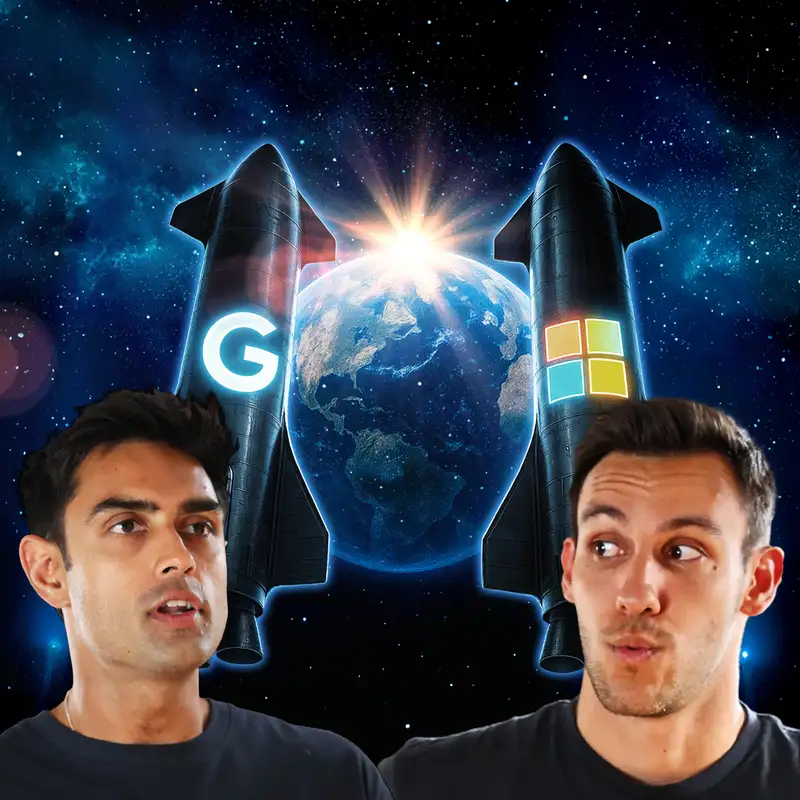
AI In Space: Google and SpaceX's Wild Plan To Fix Our Energy Crisis
Ejaaz:
Everyone thinks that the most valuable resource in AI is the GPU.
Ejaaz:
It's why NVIDIA is worth $5 trillion, right? But what if I told you you're wrong?
Ejaaz:
What if I told you that the most valuable resource in AI is actually energy?
Ejaaz:
Without energy, you can't power these things. Without energy,
Ejaaz:
the GPU is just a worthless piece of metal junk.
Ejaaz:
And in fact, a lot of AI labs are facing this challenge where they just don't
Ejaaz:
have enough energy to power the tens of billions of dollars of GPUs that they've spent so far.
Ejaaz:
In fact, Satya Nadella of Microsoft recently said that he has hundreds of millions
Ejaaz:
of dollars worth of NVIDIA GPUs in his data centers collecting dust.
Ejaaz:
Now, there are a bunch of efforts focused on solving this energy crisis.
Ejaaz:
You've got nuclear energy, you've got renewable energy, but one particular solution
Ejaaz:
that's taking up a lot of mind space with Elon Musk and Google is literally out of this world.
Ejaaz:
I've got six words for you. AI
Ejaaz:
data centers in outer space. That is a real sentence that I've just said.
Ejaaz:
It's the concept of putting GPUs in outer space to harness the energy of the
Ejaaz:
sun for AI training and for AI inference.
Ejaaz:
And whilst it might sound like a far-fetched idea, it's not when you consider
Ejaaz:
that the resources needed on Earth to power up the data centers,
Ejaaz:
which by the way, are requiring as much energy as a mid to large city in the US.
Ejaaz:
You might need to look at alternative resources for this, the one being the
Ejaaz:
sun. And the economics kind of work out in theory.
Ejaaz:
You have up to three to five times more energy efficiency if you operate GPUs
Ejaaz:
above the Earth's atmosphere than below it.
Ejaaz:
So in this episode, we're going to dig into all things AI space data centers.
Ejaaz:
Is this real? Is this achievable?
Ejaaz:
Or is this kind of like a myth that we're going to laugh about and have pie
Ejaaz:
on our face six months from now?
Ejaaz:
Josh, you and I have a tumultuous relationship around this topic.
Ejaaz:
50% of us were optimistic. 50% of us, you, were pessimistic about this.
Ejaaz:
What's your take on all of this?
Josh:
I was the biggest hater in the world. Space was so stupid. Why are we sending
Josh:
stuff to space when we have it all here on Earth?
Josh:
Well, my mind has changed. I have flipped 180 degrees. I'm pro space.
Josh:
I'm ready to send these things to space tomorrow. I want all the data centers
Josh:
in outer space immediately.
Josh:
And when I was considering why, I did a lot of research, which we're going to
Josh:
get into in this episode.
Josh:
But there's this combination of things where there is a power grid straining on the U.S.
Josh:
Where data centers now are one of the main drivers rising electricity demand.
Josh:
We can't fulfill all the electricity demand.
Josh:
There are limits on land, water, permitting, cooling.
Josh:
And I was thinking, I was like, well, if your house is full of all these gaming
Josh:
PCs and the power keeps going out, well, you start to ask yourself,
Josh:
well, where else can we put them? And you're like, on the roof? No.
Josh:
Well, why don't we just send them off into outer space? And thankfully,
Josh:
because of new technologies like SpaceX Starship, we can do this.
Josh:
So there are some benefits to space that I want to go over very quickly before
Josh:
we get into who's talking about this and who's doing this. One of them being...
Josh:
The most important one, unlimited solar energy. A lot of people don't know this,
Josh:
but 99.98% of the entire solar system is the sun.
Josh:
All of the mass of the solar system, it exists in the sun.
Josh:
And the sun is just this huge fusion reactor. And in fact, if you can get access
Josh:
to the sun from outside of our atmosphere, if you leave Earth's atmosphere and
Josh:
you go into just normal space, it's actually eight times more powerful than on Earth.
Josh:
So if you remove the constraint of Earth's atmosphere, immediately the
Josh:
solar panels get access to eight times more energy than they would
Josh:
have in the case of the around space space is also
Josh:
a vacuum which means you can radiate heat directly into this
Josh:
empty space where there's nothing to worry about there's no
Josh:
land there's security and sovereignty because let me tell you it's a lot harder
Josh:
to hack a data center in outer space than it is to do so here on earth so there's
Josh:
a lot of perks we're going to go through but i want to hand it back to you to
Josh:
talk about who's been pro space yes because there's some notable names that
Josh:
are very interested in the space race here yeah.
Ejaaz:
There's a lot of people um talking about this josh um before
Ejaaz:
we get into that i kind of want to like lay out that this
Ejaaz:
is a very real problem and challenge because i'm sure a
Ejaaz:
lot of people listen to this and thinking well like i haven't heard any news
Ejaaz:
about this let me introduce you to some um there are two data centers that got
Ejaaz:
permitted to build these data centers from 2019 by the way josh they're worth
Ejaaz:
hundreds of millions i think like book value is like 500 million dollars between
Ejaaz:
both of them, they're collecting dust.
Ejaaz:
There's no lights on in the data centers because they just can't get the energy
Ejaaz:
supply to power these, right?
Ejaaz:
And I think there's none other than Satya Nadella of Microsoft,
Ejaaz:
which can explain succinctly what exactly this problem is. I'm gonna play a little clip right here.
Ejaaz:
The biggest issue we are now having is not a compute glut, but it's a power.
Ejaaz:
And it's sort of the ability to get the builds done fast enough close to power.
Ejaaz:
So if you can't do that, you may
Ejaaz:
actually have a bunch of chips sitting in inventory that I can't plug in.
Ejaaz:
In fact, that is my problem today, right? It's not a supply issue of chips.
Ejaaz:
It's actually the fact that I don't have warm shells to plug into.
Ejaaz:
And so how some supply chain constraints emerge, tough to predict,
Ejaaz:
because the demand is just going, you know, is tough to predict.
Ejaaz:
So he's not also the only one that's been talking about this,
Ejaaz:
Josh. We've got the likes of SpaceX employees saying by 2045,
Ejaaz:
We're going to need enough compute to the base power of the entire planet to
Ejaaz:
power all kind of like data center efforts.
Ejaaz:
Elon Musk says that there'll probably be electricity shortages in about two years time.
Ejaaz:
Sam Altman says we need to make a breakthrough, whether it's through fusion or something else.
Ejaaz:
Mark Zuckerberg says, listen, we would build a bigger data center,
Ejaaz:
but we just don't have the energy to supply.
Ejaaz:
So this is obviously something that is captivating some of the brightest entrepreneurial
Ejaaz:
minds in the world right now when it comes to scaling AI.
Ejaaz:
And, you know, we see this at the infrastructure level as well.
Ejaaz:
You just heard Satya talk about something called the PowerShell.
Ejaaz:
What he's referring to here is not even just the energy supply lines that you
Ejaaz:
need to feed electricity into these data centers.
Ejaaz:
There's also like the manual labor, Josh.
Ejaaz:
There is the technicians, the specialists that you need to kind of like boost
Ejaaz:
this entire thing. There's so many missing gaps here that we just don't meet it.
Josh:
It's funny. When I was in school, BOCES and like specialty job training was
Josh:
very popular. And that's kind of where you learn to become an electrician or a plumber.
Josh:
And a lot of these people, they didn't accrue a lot of debt.
Josh:
They left school early and they have like well-paying jobs now.
Josh:
And it turns out in a world of post-AI where we have AGI and the robots haven't quite made it here.
Josh:
The people who we need the most are the electricians, are the plumbers,
Josh:
are the people who can do the cooling, the heating, the electricity wiring.
Josh:
Those are the most valuable jobs in the world. and the people are getting paid
Josh:
a tremendous amount of money. Now,
Josh:
Before we get into this next section, I do want to frame a new question that
Josh:
we're going to answer a little bit later, but it's the actual narrative of space
Josh:
because a lot of people are trying to raise a tremendous amount of money,
Josh:
which requires a tremendous amount of optimism from the investors and the public.
Josh:
And you have to ask the question, is this a real narrative or is this kind of
Josh:
an exponential kind of like moonshot guess, moonshot like kind of play that
Josh:
they're targeting to get people interested to raise more money to build their AI?
Josh:
I don't want to answer that yet. We're going to answer that as we go.
Josh:
But by answering it, we're going to start with the first company who's actively
Josh:
doing this, which is a project called StarCloud.
Josh:
Now, StarCloud is the first prototype, as far as I'm aware, EJS,
Josh:
right, that's doing this. Can you tell me a little bit more about it?
Ejaaz:
For sure, yeah. So StarCloud is kind of what triggered this entire debate online, Josh.
Ejaaz:
Prior to StarCloud announcing their prototype of launching a GPU in outer space,
Ejaaz:
everyone was kind of like oblivious to this entire thing.
Ejaaz:
And then Google and Elon Musk chimed in after it. So these are the pioneers.
Ejaaz:
And they kind of pioneered it with
Ejaaz:
this prototype, which should already be launched in November, actually,
Ejaaz:
which is they launched an NVIDIA H100 GPU, which is technically the most powerful
Ejaaz:
computer that's ever existed in outer space, into outer space using Elon Musk's SpaceX shuttle.
Ejaaz:
And they ran a Google open source model called Gemma. So it's currently live and up there running.
Ejaaz:
And the reason why this is such a big deal is it's mainly a testing phase to
Ejaaz:
see if GPUs can survive in outer space. It's running on its own.
Ejaaz:
It's training on its own. It's being iterated to on its own outside in space
Ejaaz:
whilst communicating to their servers on Earth.
Ejaaz:
And what they're really trying to figure out here is, number one,
Ejaaz:
is it feasible or will this GPU just die from radiation? We're going to get
Ejaaz:
into some of the challenges in a second.
Ejaaz:
And number two, does it make economical sense?
Ejaaz:
Like if we can do this with one GPU, can we scale this to hundreds of thousands
Ejaaz:
of GPUs? So they're the real ones, Josh, that started this trend.
Josh:
The initial thing that I found funny about StarCloud was the 16 square kilometer heat diffuser.
Josh:
Oh, yeah. That was kind of where I got caught up on, where five gigawatts of
Josh:
energy means 16 square kilometers of metal that it took to diffuse this.
Josh:
Because again, in space, there is no atmosphere.
Josh:
There is no place to cool it besides shooting the radiation off into deep space.
Josh:
It's not like you can run like cold air over this because there is no air.
Josh:
So I think as I've kind of learned more about the StarCloud project,
Josh:
I've started to realize like, OK, that's that's that's kind of within reason.
Josh:
And that's an early prototype in how they're going to go about actually dissipating heat.
Josh:
So six square miles of solar panels, they fold it into a rocket.
Josh:
They could send it out on a starship. It's like it's pretty cool.
Josh:
It seems like it makes sense.
Josh:
Ejaz, is there anything that I'm missing here that technically doesn't make
Josh:
a whole lot of sense based on these posts?
Ejaaz:
Yeah i mean you nailed a technical challenge number
Ejaaz:
one which is like these deployable structures are not only so large for the
Ejaaz:
amount of compute that it's supposedly meant to be supporting like these things
Ejaaz:
like you said are 16 square kilometers that is huge to fuel do you know how
Ejaaz:
much power it fuels actually josh it's like what's it one gigawatt or is it
Ejaaz:
less than that like maybe 100 kilowatts well
Josh:
It's showing five gigawatts now for the data center yeah.
Ejaaz:
Yeah, okay, right. Four by four. Yeah. So that's technical challenge number one.
Ejaaz:
And then technical challenge number two down here is the radiation that you
Ejaaz:
mentioned, which is basically, you know, you have all these kind of like nuclear
Ejaaz:
and atoms flying around, which
Ejaaz:
can really mess with the composure and structure of these data centers.
Ejaaz:
Radiation is a very real issue in space. That's why you have all these different
Ejaaz:
space suits and insulation.
Ejaaz:
So if you expose hardware to this and it kind of messes up with any kind of
Ejaaz:
the machinery of it's doing its job, then it becomes more and more implausible.
Ejaaz:
But these are things that they were kind of at like the frontier testing in
Ejaaz:
terms of research. We haven't really found a resolution just yet.
Ejaaz:
There are solutions like kind of like cooling that you mentioned,
Ejaaz:
but otherwise there's no clear cut solution.
Josh:
Yeah. Okay. But there is another company that we're all familiar with that does
Josh:
have a seemingly more clear cut solution and a seemingly more clear roadmap
Josh:
which um i believe the ceo goes by the name of elon musk if i'm not mistaken
Josh:
and yeah elon and spacex have a strategy uh we have a clip here that i think
Josh:
you wanted to share maybe we could start there and we'll get into how exactly
Josh:
this is all going to work in.
Ejaaz:
Order in order to harness a non-trivial amount of the energy of the sun you
Ejaaz:
have to move to solar-powered ai satellites in deep space um
Ejaaz:
Somewhat is a confluence of Tesla expertise and SpaceX expertise and XAI on the AI front.
Josh:
So there's three critical pillars that Elon mentioned in that little summary.
Josh:
There's Tesla, SpaceX, and XAI.
Josh:
SpaceX is the single most important pillar in that because without the ability
Josh:
to get mass to orbit, it is impossible to build these data centers in the first place.
Josh:
And the reason why the window is just barely starting to open is because we're
Josh:
able to get the cost per kilogram down low enough to make it economically viable.
Josh:
Because when we started with the space shuttle, Ejaz, it cost $60,000 per kilogram
Josh:
to get something into orbit.
Josh:
Nothing is going to make that viable if it costs $60,000 per kilogram because
Josh:
these data centers are very, very heavy and so are the solar panels,
Josh:
so are the batteries, so all of that.
Josh:
Falcon Heavy, which is SpaceX's newer rocket, got that cost down to $1,500 per kilogram.
Josh:
So we've already seen like a few orders of magnitude decrease and Starship,
Josh:
which we've covered in previous episodes, that is planning to go to Mars and
Josh:
beyond, it's still not working, but they're planning to get it fully reusable by next year.
Josh:
That brings the cost per kilogram down to $10 per kilogram, which is the window
Josh:
that enables this conversation to happen.
Josh:
Because in the absence of Starship, we cannot send mass to orbit at scale.
Josh:
With Starship working, we can actually talk about sending these data centers into space.
Josh:
And that's a hugely powerful unlock that only exists
Josh:
because of spacex which is why i think it's important to pay attention to elon when
Josh:
he talks about this stuff because he's the one who's enabled this to
Josh:
even be a possible conversation um earth gets
Josh:
only one to two billionth of
Josh:
the sun's energy so if you go a million times earth's
Josh:
capacity you must go into space is kind of thinking where in order to scale
Josh:
ai to the size that we want in order for true agi for for ai that scales infinitely
Josh:
with us we need to go past earth's ability to generate energy and we need to
Josh:
go out into the stars and that's kind of the the thesis with elon and the xai thing.
Ejaaz:
Got it. I mean, I was just looking at this other post, Josh,
Ejaaz:
where, you know, StarCloud is kind of laying out the economics for their kind of projections.
Ejaaz:
And they say something pretty similar, which is like, on Earth,
Ejaaz:
it costs near like $200 million to kind of run a 40 megawatt data center for 10 years.
Ejaaz:
Technically, or theoretically, in orbit, it would be worth $8.2 million,
Ejaaz:
which is 20 times cheaper.
Ejaaz:
So what I'm hearing from you and the Elon case is that, well,
Ejaaz:
number one, he's going to be the toll master.
Ejaaz:
He's going to basically own the highway into space.
Josh:
He's the Jensen Huang of space.
Ejaaz:
He's the Jensen Huang of space. That's perfect. We have to trademark that term.
Ejaaz:
He's the Jensen Huang of space.
Ejaaz:
That's crazy good. So he's going to not only own that toll, but the other thing, Josh,
Ejaaz:
which I know we both love the idea of and which he actually commented on in this tweet,
Ejaaz:
he says, simply scaling up Starlink V3 satellites, which are the main satellites
Ejaaz:
that he deploys from his SpaceX launchers will have high speed laser links, which would work.
Ejaaz:
And what he's referring to here is work in terms of like a interconnected network.
Ejaaz:
So these satellites would beam lasers to each other one terabit per second speeds
Ejaaz:
to be able to train or inference AI models up at that level.
Ejaaz:
So imagine like a satellite network kind of in space orbiting Earth that you
Ejaaz:
can use to beam terabits worth of data at super rapid speeds between each of
Ejaaz:
the satellites, train your AI model, and then beam it back down to Earth.
Ejaaz:
Just sounds so nuts at this point, Josh, that I can't quite wrap my head around.
Ejaaz:
And then the third thing that he's talked about, Josh, I don't know if you saw
Ejaaz:
this, he's talking about quantum computing on the dark craters of the moon.
Ejaaz:
Can you, sorry, can you help me wrap my head around this? What the hell is this? What's this concept?
Josh:
Yeah, I'm pulling a number out of thin air. I believe it's right,
Josh:
though, where the craters, there are craters in the moon.
Josh:
So there is no dark side of the moon, but there are craters that never see the sun.
Josh:
Those craters exist at a perpetual negative 200 degrees Celsius.
Josh:
They are literally frozen solid.
Josh:
There is no heat that gets in or out.
Josh:
And if you can place a gigantic data center in one of those craters at negative
Josh:
200 degrees Celsius or whatever the exact amount is, you have a pretty good cooling system.
Josh:
Like it's not that bad. And each as you'll often see with quantum computers,
Josh:
there's this huge mechanism on top of them. And then there's this tiny little chip at the bottom.
Josh:
The entire mechanism on top of it is just to keep it cool.
Josh:
The actual chip is is the size of a normal chip but because
Josh:
it's so important and so necessary to get
Josh:
quantum computing chips at solid zero so that the qubits don't move around too
Josh:
much that's why they need it so there is a world in which quantum computing
Josh:
makes sense if we can get it into outer space there is some data and energy
Josh:
notes that elon has that i wrote down that i want to share briefly because this
Josh:
is also fascinating and he said,
Josh:
Starship should be able to deliver around 300 gigawatts per year of solar-powered
Josh:
AI satellites to orbit, maybe 500 gigawatts.
Josh:
So if this is true, within a few years of full-rate Starship launches,
Josh:
orbital AI could rival or exceed entire country's electrical consumption.
Josh:
So the scale of this is outrageous. And granted, this is all very optimistic.
Josh:
This is all very forward-looking, very sci-fi-esque.
Josh:
But in the case that is even directionally correct the
Josh:
next 10 to 20 years of these launches the next 10 to
Josh:
20 years of compute can scale in
Josh:
a really exciting way and we were talking to to luke who helps produce the show
Josh:
right before this and he made a great point that said in order to get exponential
Josh:
gains in progress you need exponential gains in technology or something along
Josh:
those lines and it's so true where if we really want to build ai that changes
Josh:
the trajectory of the universe you need to do something novel, something new.
Josh:
And doing this all in space and unlocking this new energy source feels like
Josh:
the natural progression given
Josh:
where we are in terms of technological capability back here on Earth.
Ejaaz:
It's also equally fair to say that Elon sometimes gets ahead of himself.
Ejaaz:
Like he can see the vision, right? But his projections are way too near term
Ejaaz:
to what it actually requires to get to that point.
Ejaaz:
And I wish I could critique him, Josh, except that there's also another person,
Ejaaz:
which is bull posting about AI data centers in space.
Ejaaz:
And it is Sundar from Google, the CEO of Google, who in pretty much every single
Ejaaz:
interview, this clip that I'm showing you on the screen right now is from an
Ejaaz:
interview he did literally yesterday,
Ejaaz:
which has got nothing to do with Google's AI space efforts specifically,
Ejaaz:
but he had to shell Google's project called Project Suncatcher,
Ejaaz:
where they are also aiming to put Google's TPUs, which is their GPU equivalent,
Ejaaz:
into space so that they can harness the power of the sun.
Ejaaz:
There are too many important people talking about these things,
Ejaaz:
Josh, where like my inner, kind of like half my brain is kind of fighting against
Ejaaz:
this, saying this is absolutely ridiculous.
Ejaaz:
But the other half, I think, is overwhelmingly now in favor of this thing might actually work.
Josh:
Yeah, it's their moonshot. It's another Google moonshot.
Josh:
And again, I'm going to tease the question, is this just a narrative thing to
Josh:
get people excited to invest more in their companies?
Josh:
Or is this real technology? Maybe we'll see.
Josh:
He is partnering with Planet, a company named Planet, and their plan is to launch
Josh:
two prototype satellites by
Josh:
early 2027 to test TPUs and optical links to orbit and see how that works.
Josh:
In the previous example with SpaceX, you mentioned that there is these like
Josh:
space lasers that can talk to each other.
Josh:
A cool thing is that you can communicate at the
Josh:
speed of light there is no kind of interference in space
Josh:
so the time that it takes for a photon to get from one laser
Josh:
to or one satellite to the next is the latency between the two which is very
Josh:
very fast so there is a world in which theoretically if you're looking at this
Josh:
from first principles based on there are no laws of physics that are being violated
Josh:
in order to do this so therefore it's a matter of technical capability technical called prowess,
Josh:
and our intellectual ability to actually figure out and solve these problems.
Josh:
It's funny seeing Google and Elon kind of converge on this. I assume,
Josh:
like you mentioned earlier, a lot of other companies are not far behind.
Josh:
They just don't quite have the infrastructure or the ability to tackle a problem
Josh:
like this. But it seems very real.
Josh:
And they're planning to do this as soon as the next 24 months with the new TPEs
Josh:
that we've been talking about so often. Sundar.
Ejaaz:
Said that they're already prototyping a bunch of radiation measures on ground
Ejaaz:
here at earth to make sure that their tpus can survive so the next natural step
Ejaaz:
there is to launch these babies into space probably using elon musk's spacex
Ejaaz:
because he is the thomas he's the jensen and
Josh:
To that point actually the uh the economics and the launch cost they actually
Josh:
we have a quote here that says uh their modeling says if launch costs get under
Josh:
200 per kilogram to orbit by the mid-2030s then space-based compute could be
Josh:
comparable to earth data centers on a per kilowatt per year basis so
Josh:
If we can get 20 times more than what Elon's projecting.
Josh:
So if the cost is pretty high. So if it's 20 times more expensive than what
Josh:
Elon's projecting in a decade from now, then we'll have parity with Earth.
Josh:
So it gives you a testament to like the timelines of this. And maybe this is
Josh:
a good time to go into the pros and cons of what.
Ejaaz:
Is good about this,
Josh:
What is bad about this. And maybe humble people a little bit,
Josh:
Ejaz, if you want to start with the cons as to why this isn't as rosy as we
Josh:
think it might be. like maybe maybe bring us back down to earth in fact.
Ejaaz:
I i that's that's where i did did not expect that part josh um okay right so
Ejaaz:
i'm going to start off with the bear case here which you've mentioned a few
Ejaaz:
times which is this is just a narrative play by some of the biggest companies
Ejaaz:
to boost their valuations and let me explain the problem to you right
Ejaaz:
Up until today, speaking about these data centers in space, the focus has been on GPUs.
Ejaaz:
GPUs is the new gold, right? It's what you need to kind of train your AI.
Ejaaz:
And then we found out that they don't have enough energy to kind of like fuel these things.
Ejaaz:
Now, the reason why this is so important, as this post explains,
Ejaaz:
is a lot of these companies, Sundar's company, Google, Elon Musk's companies,
Ejaaz:
are valued based on the amount of GPUs they've been purchasing.
Ejaaz:
And the Wall Street analysts have basically assumed, okay, the amount of GPUs
Ejaaz:
that this company buys is equal to the economic output. I can do a simple formula,
Ejaaz:
right? If they're buying these GPUs, they're going live.
Ejaaz:
What they haven't factored in is that these GPUs aren't going live.
Ejaaz:
They're just sitting collecting dust.
Ejaaz:
And so that's less ROI per quarter than they initially projected,
Ejaaz:
which means that the valuations of these companies should probably be lowered.
Ejaaz:
So what's the countermeasure to this, Josh?
Ejaaz:
Well, obviously it's infinite energy. obviously it's what was
Ejaaz:
that 99.98% of the solar system is the
Ejaaz:
sun it's all that energy so if you can miraculously wow
Ejaaz:
now figure out a way to harness that energy you can
Ejaaz:
now maintain that valuation dare I say boost the
Ejaaz:
valuations right share prices go up after you you hear Sundar talking about
Ejaaz:
this uh google's on an absolute run so that's my skeptics take I think that
Ejaaz:
they might be kind of like feeling this narrative which they know is a decade
Ejaaz:
out from any kind of real uh prototype being out there that scales um so that's
Ejaaz:
my back is do you agree do you disagree with this yeah
Josh:
I i think setting expectations on timing is probably
Josh:
going to be fairly important because again like satya's saying mid 2030s i mean
Josh:
elon's probably saying tomorrow but the reality is it's probably mid 2030s it's
Josh:
going to take a while to get all this stuff to orbit and do it at scale that's
Josh:
comparable to the united states now when i think about that i think about what
Josh:
does the world of ai look like,
Josh:
In the mid 2030s. Like, what are we? What's it going to look like here?
Josh:
Like, we are moving so fast.
Josh:
And to project 10 years into the future, my God, I don't know what the world looks like.
Ejaaz:
So our energy bill is going to be 5x, Josh.
Josh:
Or maybe we have people like Isaiah Taylor, who was on the show last week,
Josh:
solving nuclear reactors right here on home.
Josh:
And we actually have energy abundance. That's enough for our midterm goals prior
Josh:
to extending out to the long term goals. Maybe this is a fun time to talk briefly
Josh:
about the Kardashev scale, which is a sci-fi thing, and there's three tiers to it.
Josh:
The first one being you can harness the entire energy of your planet,
Josh:
and then it's the energy of your sun, and then the energy of your solar system.
Josh:
We have been able to collect perhaps a very small fraction of Kardashev level
Josh:
one, which is of the planet, the energy that hits our planet.
Josh:
So there's a very long way to go, but I think this is kind of like the grand
Josh:
sci-fi vision that gets people excited, gets people motivated.
Josh:
If I'm going to work at a company like SpaceX, I'm stoked at the idea of building
Josh:
super intelligence in outer space. That's a cool mission to have.
Josh:
And like so many of the other missions, it's not physics constrained.
Josh:
It is possible. You can do this thing if you can figure out how to create the
Josh:
technology to do it. So I love the ambition.
Josh:
Is it a narrative play to get more money?
Josh:
Maybe, probably. But in the case of Google and Tesla and SpaceX,
Josh:
it doesn't seem that way. hey, if this was coming from someone like OpenAI or
Josh:
Perplexity or Anthropic, I would feel a little bit differently about it.
Josh:
But Google's always had a moonshot division since the beginning of time.
Josh:
I mean, that's the reason why AI exists in the current state it does today is
Josh:
because they spend so many resources on research and development.
Josh:
If you remember from our episode yesterday, Ejaz, they developed the first neural network 15 years ago.
Josh:
They did. So it's been under development for a long time. And this very much
Josh:
feels like a similar project where these timelines are going to be 10 to 15
Josh:
years. But the research starts now.
Josh:
And it's very important research because directionally it feels like this is correct.
Josh:
Directionally, we're going to need more energy than we can have on Earth,
Josh:
even if we solve nuclear power, because of the hope that it's going to require
Josh:
so much energy to power superintelligence that will be smarter than the smartest thing on Earth.
Josh:
And it just it's a fun science experiment maybe it's a narrative violation because
Josh:
they're getting a little ahead of the gun but you know it could it could be and i like this future.
Ejaaz:
So do i i think my optimistic take on
Ejaaz:
this is all of these things um nuclear fission nuclear power coming into like
Ejaaz:
a scalable means renewable energy and you know harnessing energy from the sun
Ejaaz:
all comes collectively at a time in the mid 2030s where our energy bills are
Ejaaz:
going through the roof and we cannot afford anything else.
Ejaaz:
We need to rely on another energy source. And I think it's all going to neatly
Ejaaz:
come at the right time, Josh.
Ejaaz:
I don't know what makes me think that this might actually happen,
Ejaaz:
but I think we are well on our way to do that.
Ejaaz:
But to your point, there's a bunch of challenges, right?
Ejaaz:
So we've mentioned kind of like some engineering challenges around protecting
Ejaaz:
against radiation and building and deploying these infrastructures out in space.
Ejaaz:
Right now it's too expensive, right?
Ejaaz:
But the idea is presumably using SpaceX's, I'll call it the tunnel to space
Ejaaz:
or the highway to space, it'll eventually reduce the cost down by,
Ejaaz:
you know, maximum weight. So we're able to kind of achieve this.
Ejaaz:
The other thing is kind of like maintenance, right? So it's like a lot of these
Ejaaz:
things require a lot of attention.
Ejaaz:
Like we mentioned earlier that, you know, supplying energy is just one thing.
Ejaaz:
You need to have technicians and experts on there that can like kind of connect
Ejaaz:
the right plugs between satellites and make sure that they speak to each other
Ejaaz:
or GPUs between each other.
Ejaaz:
Are we going to have astronauts roaming around these data centers on space?
Ejaaz:
That is kind of harder to wrap my head around because it just seems infeasible.
Ejaaz:
We don't do that right now. why would it be in 10 years time?
Ejaaz:
Maybe it will be. I'm being optimistic. I have to maintain optimism here, Josh.
Josh:
And hey, maybe robots. Robots in 10 years, probably gonna be pretty good.
Ejaaz:
Oh, Josh, I need to buy more Tesla. I need to buy more Tesla.
Ejaaz:
You've just, the humanoids.
Ejaaz:
Oh God, we are getting way too bullish on the con section.
Ejaaz:
Okay, hang on, wait, hang on. We got to remain tethered to Earth.
Ejaaz:
Speaking of tethering to Earth, actually, how do we get this data and compute
Ejaaz:
that we generate in space down back to Earth?
Ejaaz:
Presumably the majority of the humans are still going to be on Earth,
Ejaaz:
right, Josh? So a question that's in my mind is like, what is the receiving
Ejaaz:
infrastructure of this look like? And is that economically feasible?
Ejaaz:
Elon seems to claim so in that thread that we showed earlier.
Ejaaz:
And Sundar has said multiple times that, yeah, we can just beam data down.
Ejaaz:
We can just beam some of the learnings, the compute down.
Ejaaz:
I don't know if anyone's actually proven that. And it's because we need to do
Ejaaz:
step one first, which is launch the data center.
Ejaaz:
So there's so much that this relies on that needs to be kind of solved via frontier
Ejaaz:
research that we're kind of
Ejaaz:
hoping for, but we haven't got any definitive proof, if that makes sense.
Ejaaz:
So if you're investing in this stuff, it's definitely a longer horizon type thing.
Josh:
Yeah, conceptually, it all makes sense. We're learning a lot from Starlink,
Josh:
actually, in terms of latency and sending things back to Earth,
Josh:
where if you're sending data that's timely, it's a little difficult because
Josh:
there are tens to hundreds of milliseconds that are added in the latency between the two.
Josh:
But if you're batch training, if you're just training mega amounts of AI and
Josh:
then you're beaming them in batches down to Earth, there's enough bandwidth,
Josh:
if you disregard latency, to send quite a bit of data pretty quickly.
Josh:
So I suspect there's some healthy middle ground there where they'll talk to
Josh:
each other very fast and they'll beam data down kind of slow.
Josh:
And that will be okay um there are pros there's lots of pros we talked about
Josh:
a few energy abundance being one cooling being one where you can just create
Josh:
mega radiators you could send things on the dark side of the moon put them in
Josh:
craters where it's really cold um the environmental thing there's you don't
Josh:
need permits or you don't use water or you don't need energy we're just,
Josh:
unobstructed by ai which is kind of an interesting thing because currently ai
Josh:
is very intrusive um it uses a tremendous amount of data and resources and energy and,
Josh:
human labor, which maybe is a good thing to some extent, but that's another thing.
Josh:
And then we have just like the sovereignty and resilience point where when stuff
Josh:
is in space, it is pretty anti-fragile. No one's really going up there to mess
Josh:
with it. It is very secure.
Josh:
You kind of know what you're getting when it's up there. You set it,
Josh:
you forget it. It's a nice thing. So that's kind of how I think we would weigh the pros and cons.
Ejaaz:
Okay. So if those are the pros and those are the cons, the next natural question for me, Josh,
Ejaaz:
is like, if I was an analyst looking at this over the next say like five to
Ejaaz:
ten years yeah what kind of milestones should i be looking for like do you have
Ejaaz:
any idea of what or like what's like what's sensor i guess is it like an entire
Ejaaz:
data center out there or is it a couple of gpus what is it yeah
Josh:
So because there are a few companies that are actively working on this problem
Josh:
we can just kind of evaluate their progress as i think a way of tracking things
Josh:
so we could set a few milestones starting with the suncatcher prototypes who
Josh:
are planned to go up in 2027.
Josh:
So if you're trying to map out trajectories, we have Project Suncatcher.
Josh:
We could ask the question, did the 2027 Suncatcher prototypes launch on time?
Josh:
Did they actually even make it to outer space? Is Starship working?
Josh:
Are they able to carry the correct payloads? Is the payload even able to get into outer space?
Josh:
Then once it's in outer space, we can ask the question, well,
Josh:
does it actually work? Is it able to shield itself from radiation?
Josh:
Is it able to power itself on? Is it able to cool itself down?
Josh:
Do they show working optical links and TPUs in orbit? Can they actually make that work?
Josh:
So we have the prototypes of Suncatcher. Then we want to look at Starship cadence.
Josh:
Is Starship actually getting the cost to orbit low enough to make this economically
Josh:
viable? That, I think, actually is the single most important thing to look out
Josh:
for, is the Starship program.
Josh:
If you are not watching every Starship launch with us on this show,
Josh:
you are missing out, because we're going to cover every single one.
Josh:
It's the most important thing to the progress of this project.
Josh:
And we are going to closely monitor how the cost per kilogram to orbit is going.
Josh:
As long as that number is going down, as long as Starship's
Josh:
start blowing up less, that's going to be a huge win. And that's going to make it at least plausible.
Josh:
And then the third thing I guess to monitor is the power crisis on Earth.
Josh:
We want to see how much power we're able to generate outside of these moonshot ideas.
Josh:
So are people like Isaiah Taylor of Valor able to create modular nuclear reactors
Josh:
to power gigawatts of these data centers and eventually terawatts?
Josh:
Are we able to use natural gas turbines and other forms of renewable energy
Josh:
to not only power data centers, but our day to day lives?
Josh:
Can we do so without making the electricity bills run too high.
Josh:
So I think the convergence of these three things are things to look out for
Josh:
that we can monitor, that will probably give us a better idea of the roadmap,
Josh:
how we're going in the trajectory.
Josh:
And again, 10 years from now, who knows what the world looks like.
Josh:
But that's what I'm going to be looking out for, at least.
Ejaaz:
Yeah, I think that last point is actually one of the most important things,
Ejaaz:
because maybe this is a hot take.
Ejaaz:
But I think the AI data centers in space hype dies down if things like nuclear
Ejaaz:
and renewables can scale on Earth. because people aren't going to focus on things
Ejaaz:
in outer space if they can just kind of fix the thing on problem on Earth.
Ejaaz:
I think this is more of a philosophical semantic thing due to human nature versus
Ejaaz:
kind of doing something in the sky where they haven't spent that much time out there, right?
Ejaaz:
And then the other thing is like, to your point, we've got to reduce the cost
Ejaaz:
of space travel, which I fully believe Elon's going to do, but he has to prove
Ejaaz:
it before people get really bullish and confident that this can be a thing.
Ejaaz:
But that's it. Those are the pros and cons. And that is the thesis and the pick,
Ejaaz:
the for and against for AI data centers in outer space
Ejaaz:
It's so funny seeing our evolution and reaction to this, Josh,
Ejaaz:
given that six weeks ago, we were absolutely laughing at this when StarCloud
Ejaaz:
announced that they were launching an H100 GPU in space.
Ejaaz:
And now here we are opining about, you know, Elon being the toll master,
Ejaaz:
it being cheap enough to launch data centers in space, and then figuring out
Ejaaz:
how to beam down terabits of data to Earth.
Ejaaz:
Just an insane thing that I can't quite wrap my head around.
Ejaaz:
But it's been a super fun episode.
Ejaaz:
And just like the trajectory of putting data centers in outer orbit,
Ejaaz:
there's something else that is reaching the levels and that is exiting the stratosphere.
Ejaaz:
Josh, it is the limitless follow-up page. It is our social pages. It is our YouTube pages.
Ejaaz:
We have gained, I think, what was it? 3,000 subscribers over the last couple of... More? Tell me.
Josh:
Over 4K. And that's not enough because 80% of those people are still not subscribed
Josh:
who are listening to the episode.
Josh:
So if you're listening on YouTube, please make sure not only click the subscribe
Josh:
button, but there's a little bell next to it, which means you could turn on
Josh:
notifications to get notified whenever a new episode comes out.
Josh:
Happens three times a week. They're all pretty good. They normally range from 25 to 35 minutes.
Josh:
And if you enjoy them with your friends, you should share them along because
Josh:
it really makes a big difference to the growth of this podcast.
Josh:
And we're trying to grow.
Josh:
We're trying to make this the biggest thing ever.
Josh:
We've been stalling out a little on the audio front. So if you do prefer to
Josh:
listen to it as a podcast,
Josh:
perhaps go find it on your favorite podcast player, like apple podcast or pocket
Josh:
cast is my preferred one those are good places to to find out and hang out with
Josh:
us but yeah i think that's mostly it jazz do you have any parting words because
Josh:
i actually i have one parting story so you go first.
Ejaaz:
Okay. One final thing is we also have a newsletter and we have about 70,000
Ejaaz:
of you tuning in every single week.
Ejaaz:
Either Josh and I write an essay or a thesis on what we think the future of AI is going to look like.
Ejaaz:
Our last one is a juicy bull case on Anthropik. You'll go check it out.
Ejaaz:
And we give you the five highlights of the week. So we are anywhere and everywhere
Ejaaz:
that you could possibly ingest information about AI and frontier tech.
Ejaaz:
Follow, subscribe, give us your email list. Josh, what is your parting words?
Josh:
Yeah, there's actually a lot of alpha in there. Google, Ejaz,
Josh:
you wrote the Google Bowl case like four or five weeks ago, and the price has
Josh:
gone off like 20% since then.
Josh:
So if you're not listening to or reading the newsletter, I would advise.
Josh:
I wanted to leave with one little bit of sci-fi because when I do episodes like
Josh:
this, I'm always reminded...
Josh:
Of sci-fi. Like when I look at the future, I'm always reminded of sci-fi books
Josh:
and a lot of them get it wrong.
Josh:
But I think you could almost always find a sci-fi story that will map to the
Josh:
reality that we're having currently. And you kind of see this with Black Mirror.
Josh:
One of them that I would encourage everyone to read, it's called The Last Question by Isaac Asimov.
Josh:
And it's where I see this going as we move AI into space, where he kind of like
Josh:
tracks the progress of humanity over millions of years.
Josh:
And each time there is a smarter and smarter and smarter AI.
Josh:
And it is an all knowing form of intelligence. And every time it gets smarter,
Josh:
because they've been able to capture more and more energy and eventually it leads
Josh:
to the last question which is the last question humanity will
Josh:
ever need to answer um which i will leave that for you guys
Josh:
to explore and to uncover for yourself but it
Josh:
is like it's so exciting that we get to live
Josh:
in this world that feels like a sci-fi novel where
Josh:
we're actually talking about sending ai into outer
Josh:
space building artificial general intelligence doing so using space
Josh:
rockets and satellites it's like it's really cool and it's
Josh:
not here today but there is a very clear trajectory to getting there in the
Josh:
future so i think that's mostly what we are excited
Josh:
about covering and i think the people who have been here with us
Josh:
long enough understand that and they're excited to be on the journey with us so for
Josh:
all of you who have made it this far through our fairly long episode today thank
Josh:
you i hope you enjoyed the space race um our agi in space episode i hope you
Josh:
left informed or excited optimistic or just downright frustrated that we are
Josh:
missing the mark so much and ai in space is stupid but whichever one it is let
Josh:
us know in the comments down below and we will see you guys in the next one thank you so much for.