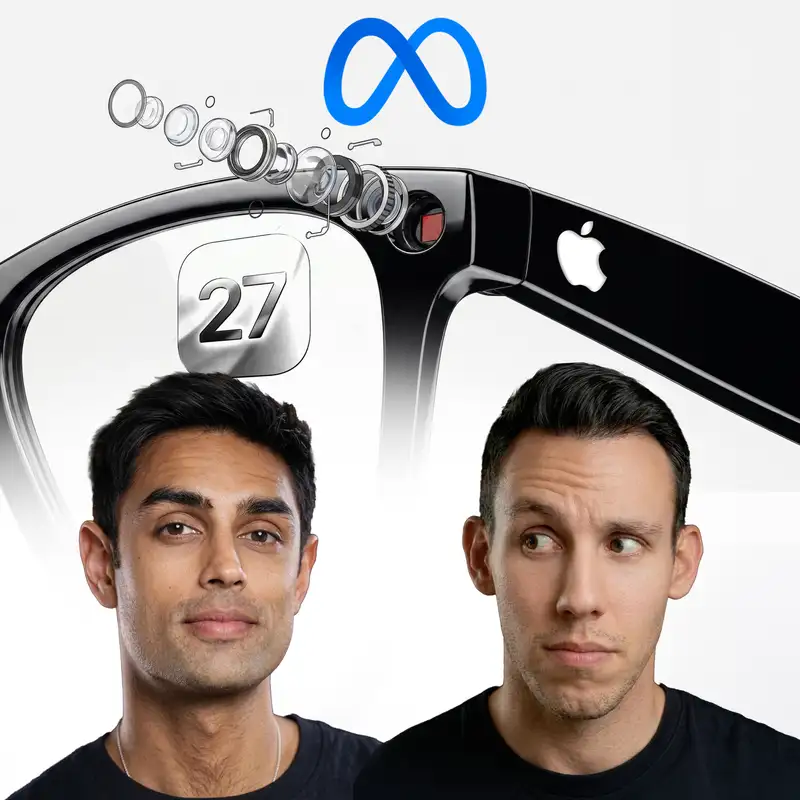
Behind Apple's AI Smart Glasses: Their Last Chance (and Greatest Hope)
Josh:
Apple's brand new AI glasses just had a huge leak.
Josh:
Now, a decade ago, Apple formed a team to build AR glasses. They've been doing this for a long time.
Josh:
They plan to ship three different headworn devices by 2022. Now,
Josh:
as a lot of us know, only one of these has been shipped.
Josh:
It's the Apple Vision Pro, and by all intents and purposes, it flopped.
Josh:
The device is incredible, but people didn't care.
Josh:
Meanwhile, Meta quietly partnered with Ray-Ban and sold over 10 million smart
Josh:
glasses. So Apple is now scrambling to catch up, and they're not alone.
Josh:
We have Google, Snapchat, Samsung, and a slew of Chinese companies that are
Josh:
all converging on the same thesis at the same time.
Josh:
The next great compute platform is going to be on your face.
Josh:
It's glasses. Everyone's building glasses.
Josh:
This is the biggest land grab for hardware since the iPhone,
Josh:
and it all revolves around this new AI platform that everyone's building.
Josh:
So there's a lot to unpack here, starting with Apple and the brand new leak
Josh:
that just came out yesterday on their entirely new strategy when it comes to glasses.
Ejaaz:
Out of all the AI glasses that are coming out, this is the one that I'm most excited about.
Ejaaz:
This leak from this week basically reveals that Apple is building a new pair
Ejaaz:
of AI glasses and they're codenamed,
Ejaaz:
N50. Here are some of the top takeaways for these glasses.
Ejaaz:
They're going to be displayless, which means that in contrary to Meta's Ray-Ban
Ejaaz:
displays, you're not going to be able to see some kind of AR projection on the lens.
Ejaaz:
It's going to be completely displayless, which also means that the glasses are
Ejaaz:
going to be slimmer and sleeker.
Ejaaz:
It's going to come with maybe one to maybe two cameras, which is going to capture
Ejaaz:
your entire surroundings.
Ejaaz:
And the idea here is it's kind of a voice-based device where it links to your iPhone.
Ejaaz:
It captures photos for you. It can capture video as well. And it feeds it into
Ejaaz:
your core device, which is your iPhone.
Ejaaz:
What I'm most excited about, though, is its integration with Siri,
Ejaaz:
which is not something that a lot of Apple users typically say.
Josh:
You're going to have to unpack that.
Ejaaz:
Okay, okay. Like I am one of those people. I have Siri turned off on my phone.
Ejaaz:
It is absolutely terrible. But what I'm most excited about is Siri 2.0,
Ejaaz:
which they're also going to reveal and release around the same time as these
Ejaaz:
glasses at the end of this year, which is an integration with Siri AI.
Ejaaz:
Now, for those of you who haven't been keeping on track, Apple is releasing
Ejaaz:
an AI-powered version of Siri, which is going to plug into Google's new Gemini
Ejaaz:
model, and that's going to make it a hell of a lot smarter.
Ejaaz:
But it's also going to make your phone and devices way more smarter because
Ejaaz:
it plugs into the Apple ecosystem.
Ejaaz:
So you can imagine asking Siri to do something, and it actually does it instead
Ejaaz:
of getting the temperature wrong, Siri.
Ejaaz:
So I'm most excited about that. And this is, of course, part of their three-pronged
Ejaaz:
strategy where Apple is really leaning into AI-powered devices.
Ejaaz:
The rumors are that they have three of them on the line here,
Ejaaz:
these new AI-powered glasses, but also a pair of AirPods, which have cameras
Ejaaz:
that sit in your ears, as well as a new pendant slash puck-like device,
Ejaaz:
which sounds very similar to OpenAI.
Ejaaz:
So I'm excited about Apple's push into this. I think they have the best shot
Ejaaz:
at building the best AI hardware or whatever the form factor eventually looks
Ejaaz:
like. And I think they're going to cook better.
Josh:
Yeah, the three types of devices is really exciting to me because I would love
Josh:
some AirPods with cameras on them, something that gives me a little bit more
Josh:
of the visual AI context.
Josh:
Now, in terms of timelines, we have some interesting information on this.
Josh:
WWDC, which is the developer conference annually that's held by Apple,
Josh:
that's where they originally released Apple Intelligence that flopped.
Josh:
And that's where they're likely to release the new version of Apple Intelligence.
Josh:
That is in the first and second week of June. I believe it starts June 8th,
Josh:
which is when we'll get the keynote.
Josh:
That's when we'll kind of understand what the new series is
Josh:
going to look like what the new ai software stack is
Josh:
going to look like and then in terms of the hardware when we
Josh:
can expect to get these glasses codenamed n50 with
Josh:
a consumer launch sometime next year and the way
Josh:
it's going to act is that there's four flame frames currently in
Josh:
testing these are four different glasses frames a lot of them that
Josh:
we're familiar with like the wayfarer style rectangular the
Josh:
oval kind and what's interesting is i believe
Josh:
they're the first company that isn't partnering with an actual glasses
Josh:
distributor so lixotica is the biggest in the world they
Josh:
basically make everyone's glasses and they just whitelist them to whatever brand
Josh:
they're selling to apple's planning to make their own using acetate
Josh:
which is more durable and luxurious than standard plastic so
Josh:
as always we can expect apple to do it better than
Josh:
everyone else make them much more durable make them look
Josh:
beautiful hopefully and the idea is
Josh:
that you're just going to be able to take some of the sensors from your iphone
Josh:
strap them to your face and go on your way and this is the first iteration of
Josh:
these glasses right it's like we're getting the augmented sensor suite first
Josh:
where you're just strapping cameras and microphones and speakers to your head
Josh:
then eventually later on a
Josh:
few years later we'll get the actual displays where it can augment reality
Josh:
Over your eyes. So I suspect it's going to blow some people's minds when they
Josh:
just suddenly see this new form factor released by Apple, because not a lot
Josh:
of people know this is coming.
Ejaaz:
Yeah, I just want to spend a quick moment on the integrated build that Apple
Ejaaz:
is doing here, because as you mentioned, a lot of the other major companies,
Ejaaz:
including Meta themselves, which is like trillions of dollars,
Ejaaz:
they still rely on external partners.
Ejaaz:
Now, Apple's main advantage, and they've done that with the iPhone and a bunch
Ejaaz:
of other devices that they've built, is they build it in-house.
Ejaaz:
And it is incredibly expensive and very hard to pull off.
Ejaaz:
There's a reason why companies go with third-party vendors because spinning
Ejaaz:
up the supply chain is incredibly hard.
Ejaaz:
But the fact that Apple has been able to pull that off previously and currently is their moat.
Ejaaz:
I saw an article or a headline this morning, Josh.
Ejaaz:
Remember, we covered the MacBook Neo, which is like their cheapest,
Ejaaz:
new, most powerful laptop.
Ejaaz:
They revealed over the weekend that they were running out of a particular component
Ejaaz:
to build that laptop. Come Monday morning, they've secured the capacity and
Ejaaz:
they're spinning out an additional 10 million units.
Ejaaz:
So no one has that weight to swing around, but Apple, they still dominate the
Ejaaz:
majority of TSMC supply when it comes to like AI hardware as well.
Ejaaz:
So although no one talks about Apple being an AI front runner,
Ejaaz:
they very much have the supply chain mode and they're going to play that into
Ejaaz:
these hardware glasses, which I'm really excited to see.
Ejaaz:
The second thing is, I don't want anyone to forget that Apple has the distribution
Ejaaz:
mode right now when it comes to hardware.
Ejaaz:
And that is a very strong levered pull that they can play on any AI software
Ejaaz:
product that they launch.
Ejaaz:
Imagine if tomorrow they turn
Ejaaz:
on Siri AI Assistant 2.0, three billion devices then get access to that.
Ejaaz:
And overnight, they become like the biggest AI company in the world.
Ejaaz:
So I'm pumped about these devices. I hope they actually deliver this time.
Ejaaz:
Siri has been delayed for like well over a year at this point,
Ejaaz:
but I'm going to remain optimistic for this one.
Josh:
Well, this is their last chance. If they can't figure it out this time,
Josh:
then they're in serious trouble.
Josh:
I think to the point of the supply chain and Apple just kind of being the one
Josh:
to move their weight around, we have another example that I don't think a lot
Josh:
of people are aware of, which is the new foldable phone that's on the market for later this year.
Josh:
Now, what we're seeing on screen here is a dummy rendering, or I guess it's
Josh:
a real product, but it's a dummy unboxing of what the iPhone folds will look like.
Josh:
And it is pretty cool. Now, Apple's always late, but when they do it,
Josh:
they do it when the technology is right.
Josh:
And this looks pretty interesting and exciting chances are
Josh:
we're going to get this announced in september with the new iphone 18 pro
Josh:
i believe that's what's coming this year and it's it's just
Josh:
a nod to a new frontier of hardware that's coming that um
Josh:
even though a lot of people have released i mean really good
Josh:
intelligence really good foldable devices apple is the
Josh:
one who is going to be the kind of late entrant but the
Josh:
one who has all of the leverage in the world to make it great they make displays
Josh:
now that have no bend in the middle so you don't see a seam anymore it just
Josh:
it seems like it's finally ready for mass market and they're going to do it
Josh:
um but of course they're not the first ones everyone other than apple has already
Josh:
made a foldable phone yeah
Ejaaz:
Hang on a second like i was going to say like the tech is already here josh
Ejaaz:
like we already have a a frontier phone why would you buy this foldable phone
Ejaaz:
when you have huawei purer x max dude like look at this yeah look familiar.
Josh:
This this thing is kind of badass so huawei chinese company
Josh:
some of the best engineers in the world in terms of manufacturing mobile
Josh:
devices they basically took what i imagine were
Josh:
the apple renderings and said we're just going to front run you and make this ourselves
Josh:
and they pumped out something that looks gorgeous you'll notice
Josh:
that the front facing screen is a little fatter than you're used to a
Josh:
lot of the foldables that exist on the market today have that kind of
Josh:
vertical orientation for the aspect ratio the reason is because if you unfold
Josh:
this chunky thing into two it creates a aspect ratio that's more relatable for
Josh:
video and widescreen applications you'll notice that it kind of looks like an
Josh:
ipad mini and that makes it much more better for video content that's 16 by
Josh:
9 kind of wider i think it's going to have a lot of useful applications
Josh:
I'm going to be a buyer of this one. I'm excited for a folding phone.
Josh:
I think it's cool. I think the technology is exciting.
Josh:
We'll see how it plays out. But Apple getting into foldables, pretty cool.
Ejaaz:
Going back to the glasses, it is tying into a larger trend around people believing
Ejaaz:
that the future form factor for AI and just any frontier technology or consumer
Ejaaz:
technology within hardware is going to sit on your face, whether it's going to be a pair of mystery,
Ejaaz:
earbuds that OpenAI is reportedly working on that have cameras and ingest all
Ejaaz:
the information around the world.
Ejaaz:
Or if it's a pair of glasses that either have a display or don't that sit on
Ejaaz:
your nose and can pick up everything that you see and hear, we're kind of like
Ejaaz:
working towards that kind of thing.
Ejaaz:
We had Apple Vision Pro, which was like this thick, very expensive device that had to sit on your face.
Ejaaz:
They're kind of winding that down and spinning up a smaller,
Ejaaz:
sleeker, thinner version of that, which is going to be glasses.
Ejaaz:
So we're trending in that way. And I believe in the first half of 2025,
Ejaaz:
the market share or the market for AI glasses kind of doubled.
Ejaaz:
And we're seeing similar accelerations at the start of this year as well.
Ejaaz:
Now, of course, we can't mention AI Glasses without mentioning Meta and that
Ejaaz:
sounds like a positive reinforcement. It isn't necessarily that,
Ejaaz:
but Meta has, for better or worse, taken the lead in AI Glasses for now.
Ejaaz:
Their Ray-Ban displays have been pumping out millions of units.
Ejaaz:
I think they're on track to deliver about 30 to 40 million units by the end
Ejaaz:
of the year, which I have no idea how they're doing that because their launch
Ejaaz:
demos, I think two out of three failed.
Ejaaz:
Apple is going head to head with Meta and they think that they can win primarily
Ejaaz:
because they're building everything in-house.
Ejaaz:
They have the supply chain to be able to pull off a sneaker design and they
Ejaaz:
have the ecosystem to support it.
Josh:
Yeah, this is going to sound ridiculous, but I really, I believe that the Apple
Josh:
Vision Pro is like the most impressive consumer hardware device ever made in
Josh:
terms of technology that's baked into a single product.
Josh:
It's just expensive and there's no developer support and there's not many good
Josh:
use cases, but the technology is incredible.
Josh:
So it's really just a ticking time bomb until they're able to compress that
Josh:
into something that's wearable on your face that doesn't weigh 10 pounds,
Josh:
that doesn't give you marks on your face, the whole thing. And it's
Josh:
Kind of weird that right now Meta is the leader. I mean, like you mentioned,
Josh:
the glasses market is up or wearables, at least, is up 110% year over year.
Josh:
AI power glasses specifically are up a two and a half times multiple and Meta is the leader.
Josh:
So what we're seeing on screen now is the Ray-Ban displays that,
Josh:
like you remember, leave a lot to be desired.
Josh:
They're this like kind of augmented interface that sits on top of the glasses
Josh:
that sits on the real world.
Josh:
It doesn't have tracking. It's static imagery.
Josh:
It's not great. think one of the more interesting things that meta has been
Josh:
doing is the peripherals to this device like they're the neural band which was
Josh:
that uh the emg wristband that reads your electromagnetic signals
Josh:
From your muscle pulses as you move your hand around so they're working on this
Josh:
unique way of interfacing with these glasses i think is
Josh:
interesting but still it's it's so early and they're
Josh:
so bad that the fact that this is the market leader it
Josh:
really is reflective of the fact that the form factor isn't there
Josh:
yet but it's coming soon and powering these devices with the next generations
Josh:
of ai that we're going to have is going to be that next iphone level hardware
Josh:
it's this is certainly what the next form factor is going to look like along
Josh:
with many others but this is one of the more important ones that I certainly
Josh:
think we're going to see.
Ejaaz:
I'm hoping it doesn't all look like this demo that I'm showing on screen here,
Ejaaz:
where you have the CEO of trillions of dollars worth of a company,
Ejaaz:
you know, messing up on stage where like he tries to call his friend and it fails.
Ejaaz:
And this was like one of like three demos where it just didn't work.
Ejaaz:
The point that is being made here is you could have all the money in the world,
Ejaaz:
but it's still hard to pull off a really good piece of hardware and then scale it, right?
Ejaaz:
We've seen this play so many times where I think Snap, I forgot what the original
Ejaaz:
Snap capture device that they had, where we were talking about this before we
Ejaaz:
started recording, Josh, where you could get this from a vending machine.
Ejaaz:
The Spectacles, right? They were incredibly hard to scale and get into everyone's
Ejaaz:
hand. And so it just hyped up and then just crashed because no one could get
Ejaaz:
their hands on these things.
Ejaaz:
And the similar thing is being seen with Meta AI, where everyone wants to use
Ejaaz:
this thing, but they're still struggling to scale to even 30 million units.
Ejaaz:
But the demand is still there. And that's great.
Ejaaz:
And like you mentioned, they're working on a suite of different devices.
Ejaaz:
And that is not just working on spectacles. They're working on these different types of wristbands.
Ejaaz:
But they are behind when compared to hardware giants such as Apple,
Ejaaz:
who have spent a lot of time thinking about the design UX of these different
Ejaaz:
things and have the hardware pipeline to back it up.
Ejaaz:
So listen, I'm going to remain optimistic somewhat on Meta being able to pull this off.
Ejaaz:
We've said this on previous episodes and I'll say it again, hardware alone doesn't win.
Ejaaz:
You need the software mode and Meta is a social media platform.
Ejaaz:
I don't know of anyone that uses apps outside of Facebook, Instagram,
Ejaaz:
and WhatsApp, which are huge apps in itself, but doesn't have an operating system
Ejaaz:
or operating suite behind them.
Ejaaz:
And I think Meta is going to fail when it comes to that personally.
Josh:
And what's interesting is Meta is not the only social media network that
Josh:
is pivoting to glasses i mean snap you mentioned the
Josh:
spectacles but they're actually working on a iterative version
Josh:
on top of the old spectacles which are this this
Josh:
mammoth of a pair of glasses that it's funny
Josh:
you asked me if this was real and i said i don't think so and
Josh:
then there's a picture of evan spiegel actually wearing these this is
Josh:
what they actually look like and this is the current state of hardware so
Josh:
it's interesting seeing incumbents like snap or meta
Josh:
focus on this clearly they think that owning the
Josh:
hardware stack is going to be important but again they're
Josh:
at odds with what their company is actually good at when you think about
Josh:
a company like apple and listen i respect meta and snap
Josh:
for doing this in public for actually sharing their prototypes because that's
Josh:
very much what it feels like they are uh even the the meta glasses
Josh:
they don't feel like they're really refined products versus apple
Josh:
who's just kind of doing it all behind the scenes but it's not
Josh:
good and you could kind of see the current state of the hardware based on these
Josh:
photos of evan spiegel the ceo using them they're just big they're clunky they
Josh:
don't work well the technology is not quite there and i guess the question i
Josh:
have for maybe you or anyone who's listening is How long does it take for the
Josh:
technology to get good enough and who's actually going to be capable of doing it?
Josh:
Like when Apple releases these classes next year, are they going to be something
Josh:
worthy of people wanting to actually go out of their way and purchase them and
Josh:
put them on their face when all the sensors are currently in the phone sitting in your pocket?
Ejaaz:
I personally think that there are two players in this game that can win it.
Ejaaz:
Apple is the obvious one that you just mentioned.
Ejaaz:
The other one is probably some formation of Google and their Android investment, at least.
Ejaaz:
We have an example here where we're looking at an Android XR display, glasses from Google.
Ejaaz:
Now, Google glasses was famously very, very early, but definitely too early.
Ejaaz:
It was this ugly contraption.
Ejaaz:
Everyone kind of like tried it out. It failed in the consumer world.
Ejaaz:
It kind of got adoption in the enterprise world and then slowly petered out
Ejaaz:
and died. That was back in 2013.
Ejaaz:
But now, Demis Sissibis referenced, I think, in Davos recently,
Ejaaz:
that they're working on Google Glass or Google Lens 2.0.
Ejaaz:
So we're going to get another form factor.
Ejaaz:
Now, this example that you're seeing on your screen is not exactly that.
Ejaaz:
This is in partnership with Warby Parker, Samsung, and Android.
Ejaaz:
So you've got a bunch of different partners kind of feeding into this to build
Ejaaz:
a hardware and software component.
Ejaaz:
And I have to say, it looks sleeker and slimmer and, dare I say,
Ejaaz:
sexier than any of the other glasses that I've seen. certainly better than the Meta Ray-Bans.
Ejaaz:
Now, I don't know how well it is or how good it is functionally.
Ejaaz:
And I am still marred by the experience or the review and feedback that happened from Google Glass 1.0.
Ejaaz:
I'm convinced now is not a coincidence that we have like, what,
Ejaaz:
six companies, six big companies working on this particular form factor.
Ejaaz:
It also tells me that that's a signal that the hardware components are now good
Ejaaz:
enough to fit into a slimmer device.
Ejaaz:
My hot take on this is you need some form of display on the lenses, Josh.
Ejaaz:
And I don't know whether you disagree with me here, but you,
Ejaaz:
like, if you're feeding all this data into your eyes, you kind of want to be able to do things.
Ejaaz:
And in order to do things, you can't just, like, speak to Siri.
Ejaaz:
You want to be able to see your screen.
Ejaaz:
I don't want to be pulling out my phone every now and then, like,
Ejaaz:
staring at a screen. You might as well put the screen on the lens.
Ejaaz:
Now, I don't know if that hardware component is good enough yet.
Ejaaz:
It still leads to chunkier glasses like we saw with Snap.
Ejaaz:
So that's, like, that's where I'm at odds right now.
Josh:
It will need a screen, but I really like the suite of devices angle because it allows you to
Josh:
like kind of choose your own adventure when the core of
Josh:
it really is that ai now google's glasses these look the best by
Josh:
far um these are these are certainly the best performing
Josh:
glasses they're not publicly available yet but i i believe that
Josh:
the suite of devices that apple is going with like
Josh:
the airpods the perhaps pendant and
Josh:
the glasses is the right one because you you are going to
Josh:
want that interface right like you're going to want some sort of visual component
Josh:
to engage with the outputs of this ai but we have
Josh:
to ask the question is like why is everybody building this why why is they're
Josh:
the sudden race for glasses and it seems like everyone just wants to own the
Josh:
platform in which the ai is interfacing with the end user where there is a clear
Josh:
world in which there's going to be this resistance away from being hooked on
Josh:
your cell phone maybe 12 hours a day like a lot of people are
Josh:
And owning the stack in which you can, I mean, get the answers from the AI that
Josh:
you want and ask questions and have it understand things about you.
Josh:
And it's not only unbelievably valuable as a customer who you can monetize,
Josh:
but also just in understanding the preference stack.
Josh:
And when you think about Meta and Snap and what they're selling,
Josh:
a lot of it, I mean, we talked about Meta last week in the episode on the new model.
Josh:
A lot of it is just understanding the preferences of its users.
Josh:
And if it has something strapped to your face 24 seven, that is collecting information
Josh:
about you, they can just sell much more interesting and novel things.
Josh:
That's kind of why I imagine a lot of these companies are really shifting focus to it.
Josh:
And we have the same thing that's happening with OpenAI too,
Josh:
where they're working on this suite of mystery devices as well.
Ejaaz:
Yeah. I mean, we've seen several leaked clips, but I don't know if it's real.
Ejaaz:
Josh had an experience over the weekend where he thought he spotted a bunch
Ejaaz:
of people wearing the OpenAI buds.
Ejaaz:
But I mean, you got to retell the story, but...
Josh:
I was walked... All right. So I'm walking down the street and there's
Josh:
this group of people who are speaking what i believe is
Josh:
chinese they didn't speak a lick of english and i'm just kind of like passing
Josh:
by them because the street was kind of crowded and this woman and her friend
Josh:
had the cuffs like the ear cuffs that we saw from the open ai teaser and i was
Josh:
like no way and i should have stopped to ask them i was a little intimidated
Josh:
by the fact that they did not sound like they spoke
Josh:
english but it was interesting and it put me down a rabbit hole that led me
Josh:
to find the xiaomi sorry, the Huawei free clips, which are these earbuds that
Josh:
look exactly like the leaked earbuds from the
Josh:
uh scans guard super bowl there
Ejaaz:
He is alexander scars guard for those of you who don't know scars.
Josh:
Yeah i always get these names wrong but some
Josh:
it's funny because we still don't really know the origin or what open ai is
Josh:
working on it could be a troll campaign it could be a real leak we don't know
Josh:
we do know that they're working with johnny ai that we do know that they're
Josh:
working on these hardware products that are going to be offered soon and i just
Josh:
cannot wait until we get those answers.
Josh:
Because in terms of software, OpenAI has the best software AI suite by far.
Josh:
And when it comes to building an AI-first operating system, they have the advantage.
Josh:
I hope they can deliver those hardware. And we'll just have to wait and see on that one.
Ejaaz:
Yeah. So in terms of how all of this plays out, Josh, here's my take. And I want to hear yours.
Ejaaz:
I think we're getting close to these hardware AI glasses becoming a reality,
Ejaaz:
being sleek and slim, not being embarrassed enough to put one of these things
Ejaaz:
on your face, basically.
Ejaaz:
I think that we're probably going to see the first versions of these or the
Ejaaz:
sexy versions of these. I'm excluding meta from this debate.
Ejaaz:
By the end of the year, or maybe early 2027, I think the best leaders are going
Ejaaz:
to come from Apple to start off with.
Ejaaz:
But I think a similar number of different startups are going to compete with Apple.
Ejaaz:
I know there's a bunch of other startups such as Sesame that is working on this
Ejaaz:
and I think physical intelligence as well.
Ejaaz:
So the point is glasses are going to become a popular form factor.
Ejaaz:
And the second thing is, this race in particular is important because Apple
Ejaaz:
showed you that hardware distribution is the actual moat when it comes to any
Ejaaz:
kind of software technology revolution, which might be a hot take,
Ejaaz:
but you need some kind of hardware bridge or component.
Ejaaz:
A lot of the AI nerds think that it's purely going to be humanoid robots.
Ejaaz:
Apple's betting and Meta's betting that it's going to be a suite of devices.
Ejaaz:
So I think those two things are going to play out. And I think we're going to
Ejaaz:
get it by the end of the year.
Ejaaz:
I'm hoping so. So Google Glass 2.0, some form of Xiaomi or Huawei's copycat
Ejaaz:
from Apple's product, and then Apple's product itself.
Josh:
And there's also this one last underrated venue here, which is the prescription glasses marketplace.
Josh:
I had no idea that prescription eyewear is a quarter trillion dollar industry annually.
Josh:
Wow. Like $250 billion of the eyewear market is prescription.
Josh:
And that's only 70% of the total eyewear market. So the eyewear market in general is huge.
Josh:
The amount that is prescription is gigantic. dick and i
Josh:
really believe that even if you
Josh:
don't deliver on a fully augmented reality experience just
Josh:
creating a beautiful set of glasses with a novel feature
Josh:
set that actually works is probably pretty powerful and powerful enough to get
Josh:
a lot of people to start buying these things we've seen that with meta um i
Josh:
think we're going to continue to see that with a lot of other companies so that
Josh:
is an interesting thing but then there is the like the new platform wars right
Josh:
it's like if meta has their glasses am i going to want to buy them because
Josh:
Now I'm constrained to Instagram and WhatsApp and Facebook, and I just don't want to use their stuff.
Josh:
So it's like we have the platform we're sitting in one side.
Josh:
We have the hardware distribution where almost everyone depends on these Qualcomm chips.
Josh:
Apple's really the only one that builds their own internal chips.
Josh:
And Google perhaps might be doing the same too. But there's a lot of these different factors.
Josh:
Everyone's kind of competing from their own unique advantage angle.
Josh:
And the question is who's going to win and who's going to deliver the best product
Josh:
to market first that we're actually going to buy. I remember,
Josh:
Ijaz, you were kind of excited about the metaglasses.
Josh:
That excitement faded away quickly. There is no real good hardware that people are excited to buy.
Josh:
And whoever is able to deliver that is going to unlock a huge market opportunity
Josh:
for this new AI-first operating system hardware integration.
Josh:
And I'm really excited to see how it plays out.
Ejaaz:
Yeah, OpenAI team, the hardware team specifically, Johnny Ive,
Ejaaz:
if you happen to be watching this video randomly.
Josh:
Give me that device.
Ejaaz:
Give me that device. I'm rooting for you, all right? I want to try these glasses
Ejaaz:
out or earbuds or whatever the hell you're building. Let us play with them.
Ejaaz:
I can't wait to test out some of these new hardware products.
Ejaaz:
But until then, we are going to be sitting here and reporting on it, Josh.
Ejaaz:
We're going to be speculating about it and I can't wait to get these things on our faces soon.
Ejaaz:
But I believe that is the end of the episode and that is basically the state
Ejaaz:
of play on all things AI hardware or glasses to be specific.
Ejaaz:
I'm excited about Apple's upcoming release. I think Meta is doing a good job
Ejaaz:
for now and I think there's going to be a bunch of startups that eventually
Ejaaz:
catch up. Josh, do you have any parting thoughts?
Josh:
That's it other than the fact that i'm just excited for someone to deliver
Josh:
something great i just want a product that i can use i'm kind
Josh:
of sick of my old stuff i want something new but it needs to
Josh:
be good and so far there is nothing good so hopefully if it's
Josh:
not this year it's certainly going to be next year where we get
Josh:
the first good products you could put on your face and enjoy them
Josh:
i would love to know which products you are most excited about of
Josh:
all the companies we discussed today whose glasses product
Josh:
are you going to buy or whose peripheral product are you going to buy
Josh:
are you going to get an apple pendant are you going to get the airpods
Josh:
with the cameras um i'm just kind of curious how
Josh:
everyone's orienting themselves around this new paradigm shift that would
Josh:
be fun the second ask is just to share this with your friends as always to rate
Josh:
the show five stars if you're listening on a podcast player
Josh:
wherever you get your podcasts if you like video we publish video on youtube
Josh:
and spotify you can really find us anywhere don't forget to share with your
Josh:
friends we have a newsletter you could subscribe to and yeah just like thanks
Josh:
for being here on the mission we have been doing so well numbers are going up
Josh:
and to the right we're just having record week after record week and it's all
Josh:
thanks to the support from you people listening.
Josh:
So thank you for tuning in like every single day. We publish these four times a week.
Josh:
Just appreciate it. And we have another really packed week planned.
Josh:
So I'm excited to keep chugging along, getting this content out the door and
Josh:
yeah, doing it together.
Ejaaz:
See you guys tomorrow.
Josh:
See ya. Yeah, see you guys tomorrow.
Creators and Guests